The phone chimed just as Liza was standing ankle-deep in the Prut River, trying not to cry out from the cold. Even at the end of August, mountain water was so icy that your toes went numb within a minute. She climbed onto a warm rock, wiped her hands on her shorts, and looked at the screen.
“Come back from your vacation. Mom is sick.”
Maksym. No hello, no question mark, not even a “How are you doing?”
Liza read the message twice. Then once more, more slowly, as though the words might somehow rearrange themselves into something different the third time.
They didn’t.
She had been working toward this trip for six months. When her company promised an annual bonus in March, Liza told herself honestly for the first time in a long while: that money would not go toward renovating the kitchen, buying a new washing machine, or getting her mother-in-law an anniversary present.
It would go toward her.
Five days in Yaremche, staying at a guesthouse with a wooden balcony overlooking the mountains.
The bonus came in July. That same evening, Liza booked the room and bought tickets for the overnight train from Vinnytsia to Ivano-Frankivsk and back, with specific dates.
Maksym found out a week before she left. Liza explained that she needed a break and wanted to spend some time alone.
There was no argument.
Maksym simply sat silently over his plate for a long time before saying:
“Five days is too long. You could have just gone for the weekend.”
“I could have,” Liza agreed. “But I don’t want to.”
They never discussed it again.
She packed her suitcase herself, without his usual list of “things you absolutely need to take,” and for the first time in five years of marriage, she packed not the things that “everyone might need,” but only things for herself: a thick knitted sweater, hiking boots, a swimsuit in case the guesthouse really did have a hot tub, and a book she had already started three times.
The first day passed so quietly it almost felt strange.
The owner of the guesthouse, Mrs. Stefaniya, a thin woman with the voice of a schoolteacher, set a bowl of banosh with bryndza cheese and cracklings in front of Liza that morning and said:
“Eat, dear. You don’t go into the mountains on an empty stomach.”
Liza ate everything.
Then she walked to Probiy Waterfall, stood on the bridge surrounded by fine spray from the water, and bought knitted socks at the market even though she already had three pairs at home.
That evening, she sat on the balcony wrapped in a blanket and finished her book.
She called her friend Khrystyna simply to tell her how the day had gone.
“You sound different,” Khrystyna said. “Your voice is so calm. I haven’t heard you like this in a long time.”
“Must be the mountain air,” Liza laughed.
And on the second day, that message arrived.
She sat on a rock by the river and thought about Valentyna Kostyantynivna.
At sixty-eight, her mother-in-law sang in the folk choir at the local library, went Nordic walking along the Southern Bug embankment twice a week, and invited so many people to every birthday celebration that she had to borrow chairs from the neighbors.
Just a week ago, she had called Liza to ask how much sugar she should put into gooseberry jam, and her voice had sounded as cheerful as a young girl’s.
She had never complained about her blood pressure or her heart.
Quite the opposite. She liked to boast that during her most recent checkup, the cardiologist had told her, “I wish my test results looked like yours.”
Five years ago, Liza would already have been standing on a train platform.
Back then, any message saying “Mom is sick” worked like a switch. She would drop everything and rush over, only to discover that her mother-in-law was simply feeling lonely or Maksym found it inconvenient to deal with things himself.
Liza had never checked.
She believed him and ran.
This time, she placed the phone face down, looked at the water, and nodded to herself.
Not to Maksym.
To herself.
First, find out what was really happening.
Then decide what to do.
That evening, she called Khrystyna.
“Listen, you live near Valentyna Kostyantynivna. Could you stop by somehow? Maksym says she’s sick. Before I drop everything and change my ticket, I want to understand how serious it really is.”
“Of course,” Khrystyna replied immediately. “I’ll go tomorrow morning. I’ll think of some excuse.”
Khrystyna called back the next day, shortly after lunch.
“I was there an hour ago. I brought her a jar of honey and said my father had sent it because he had a lot this year. Liza, that place was buzzing. Nina Hryhorivna and Raisa from the choir were in the kitchen. The table was piled high with peppers and tomatoes, and they were making jars of lecho. Valentyna Kostyantynivna was wearing an apron and telling everyone how much garlic to add. They even made me stay for tea. I didn’t see any sick people there. Unless you count the peppers.”
Liza listened and felt everything inside her fall into place.
It wasn’t relief.
It was clarity—steady and solid, like the answer to a question she had been afraid to ask for years.
“Thank you,” she said. “You really helped me.”
“So what are you going to do now?”
“Nothing. I’m going to keep enjoying my vacation.”
That evening, a second message arrived.
“Are you even reading what I’m writing? Mom is worse. I don’t understand how you can be wandering around the mountains at a time like this.”
Liza didn’t respond to that one either.
She had enough words. Too many, in fact.
But every one of them would require an explanation, and she no longer wanted to explain herself.
During five years of marriage, she had understood one thing: every justification she gave Maksym only convinced him that she worked like an elevator button.
Press it—and she moved.
She put the phone into her backpack and went to dinner alone.
At the mountain restaurant, she chose a table by the window where couples usually sat. The waiter, a young man wearing an embroidered shirt, briefly glanced at the empty chair across from her but asked nothing.
He simply brought her mushroom soup and steaming hot mamalyga.
On the fourth day, Liza kept her phone turned off until evening.
Deliberately.
She climbed Mount Makovytsia, spending three hours walking upward over roots and stones. At the summit, she sat on the grass for a long time, watching clouds drift below her.
She didn’t want someone else’s voice once again dictating where she should go and when she should return.
She finally turned the phone on after she was back in her room, had taken off her boots, and put the kettle on.
A third message was waiting.
“If you don’t come back tomorrow, you’ll regret it. I’ll tell everyone how you abandoned your sick mother-in-law for the sake of your mountains. We’ll see what the people at your work and your mother have to say about you.”
Liza read the last sentence several times.
Not because she was frightened.
For the first time, she was seeing in writing what she had heard between the lines for years.
This had never really been about his mother.
It was about who got to make the decisions in their family.
She couldn’t sleep that night.
She sat on the balcony wearing her sweater because mountain nights were already turning cold like autumn, listening to the river and catching herself wondering:
What if she was exaggerating?
What if Khrystyna had missed something?
What if Valentyna Kostyantynivna really was lying sick at home and Maksym had been right?
Old habits were stubborn.
Five years didn’t disappear after four days of vacation.
Liza pushed the thought away not with determination, but with facts.
She wrote to Khrystyna:
“He’s threatening to tell everyone that I abandoned my sick mother-in-law. She’s healthy—you saw her yourself. If anything happens, you’re my witness.”
The reply came a minute later.
“Of course. I’m here. By the way, she just walked past my window with her Nordic walking poles. Looking very energetic.”
Liza took screenshots of all three messages, with the dates and times visible, and emailed them to herself.
Just in case.
Her return ticket had been sitting in the app since July.
She had bought it in advance not because she had anticipated any of this, but because she always planned trips from the first day to the last.
Now that date was no longer merely a number on a reservation.
It had become her answer.
Liza didn’t write a single word to Maksym.
Not that evening.
Not the next day.
Not even on the day she left.
When she was checking out, Mrs. Stefaniya wrapped a piece of homemade bryndza cheese in paper for her and said:
“Come again, dear. The mountains suit you.”
Liza promised that she would.
The overnight train arrived in Vinnytsia at seven in the morning.
Exactly when it was supposed to.
According to the ticket, not according to someone else’s demand.
Maksym opened the apartment door before she could even take out her keys.
He must have heard the taxi stop outside the building.
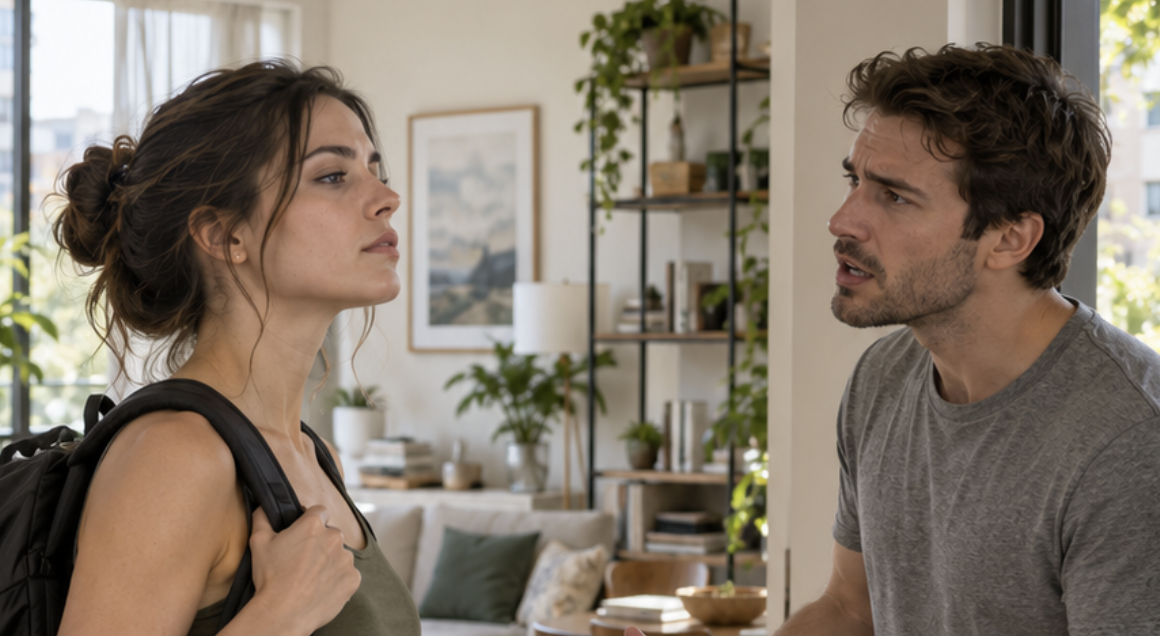
“Finally,” he said instead of hello. “You’re tanned. Well rested. While Mom was barely holding on here.”
Liza placed her suitcase beside the door.
She didn’t take off her jacket.
“Your mother was rehearsing with the choir on the day you sent me the first message,” she said calmly. “The next day she was making lecho with Nina Hryhorivna and Raisa. Khrystyna was sitting in her kitchen drinking tea. And that evening, she saw your mother walking along the embankment with her Nordic walking poles.”
Maksym stopped in the middle of the sentence he had already started.
“You… checked?”
“From now on, I’m always going to check,” Liza replied. “Five years ago, I would have been packing after your first message. This time, I decided to find out the truth first.”
“Well, maybe Mom really did feel unwell that evening,” he said, trying to change his tone. “I suppose I might have exaggerated things a little.”
“You sent three messages, Maksym. The first was a request. The second was an accusation. The third was a threat to tell everyone that I had abandoned my sick mother-in-law.”
She took out her phone and turned the screen toward him.
“Here they are. Dates and times included. Khrystyna is prepared to confirm that she saw your mother healthy and enjoying good company.”
He remained silent longer than she had expected.
Then he sat down on the small bench in the hallway, directly on top of her scarf.
Apparently, he couldn’t stand and search for excuses at the same time.
“So what happens now?” he asked more quietly.
“Now I’m going to tell you something I should have said five years ago. If you ever try to bring me home again by lying about someone’s health, I won’t just stay silent. I’ll show these messages to your mother. Personally. And I’ll explain exactly how you used her name.”
“Liza, that’s going too far.”
“No. Going too far is inventing an illness for your own mother so your wife will cut short her only vacation in five years.”
She took hold of the suitcase handle.
“If you don’t like me traveling alone, tell me directly. Next time. I’ll listen. I respect you enough to listen to honest words. But I’m not going to listen to lies anymore.”
She walked past him into the room.
Behind her, there was silence.
For the first time during the entire conversation, Maksym had nothing to say.
That evening, Liza unpacked her suitcase.
She put the bryndza from Mrs. Stefaniya into the refrigerator.
The sweater that smelled of smoke from the mountain restaurant went over the back of a chair so it could air out.
She placed her hiking boots, still covered in dried Carpathian mud, on the balcony and decided not to clean them yet.
Let them remind her that there would be another trip.
Not because someone would allow her to go.
Because she would decide to.
Late that evening, the phone rang.
Valentyna Kostyantynivna.
“Liza, sweetheart, are you home already? You and Maksym should come over on Sunday. I’ll open a jar of lecho. It turned out better than ever this year. And you can tell me about the Carpathians. I haven’t been there in forty years.”
Liza smiled.
“We’ll come, Mom. And I’ll definitely tell you all about it.”