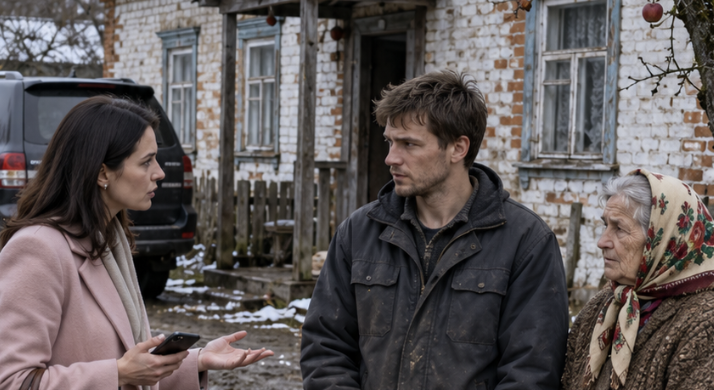
Margarita Opanasivna stepped out onto the porch to fasten the shutter—and froze with the hook still in her hand.
Across the road, where all that remained of Orysia’s house was a blackened shell and a heap of broken bricks, three people were standing. A woman, a teenage boy, and a little girl. Beside them, on the wet grass, lay two bags and a plaid holdall tied with rope.
It was November. Half past five, yet already as dark as midnight. It had been raining for three days straight, and by now it no longer seemed to fall at all. It simply hung in the air—fine, cold, creeping beneath your collar and refusing to leave until night.
Margarita Opanasivna took a flashlight from the windowsill and crossed the yard.
“Who are you looking for?” she called from the gate.
The woman turned sharply, instinctively shielding the little girl with her body.
“Excuse me. We… we came to this house. My grandmother lived here. Orysia Prokopivna.”
“Orysia?” Margarita Opanasivna came closer, pointing the flashlight downward so it wouldn’t shine into their eyes. “And who are you to her?”
“Her granddaughter. Marina. I used to spend every summer here when I was little. You had a goat back then—a reddish one with a broken horn.”
Margarita Opanasivna was silent for a moment.
“Maya,” she finally said. “Thirty years ago.”
Marina looked back at the blackened walls again, as though still hoping she had mistaken the street.
“What happened to the house?”
“It burned down. The winter before last. No one had changed the wiring in forty years. By the time the fire brigade arrived from the district center, there was nothing left to save.”
Marina said nothing. She merely adjusted the strap of the bag on her shoulder even though it had not slipped.
“Mom,” the boy said, “maybe we should go to the highway?”
“What highway, child?” Margarita Opanasivna turned the flashlight toward him. He looked fifteen or sixteen. His jacket was too thin and his sneakers were soaked through. “There’s only one bus from here, at six in the morning. The highway is three kilometers across the fields. You could twist your ankle there even in daylight, and right now there’s water up to your knees.”
The little girl sneezed.
Twice in a row.
“All right,” Margarita Opanasivna said in the same voice she had used for forty years when announcing a test to her third-graders. “Pick up your things and come to my house. You’ll spend one night there, and tomorrow morning we’ll decide what to do.”
“But we don’t even know you,” Marina said quietly.
“But I knew your grandmother. Come on before the child gets completely soaked.”
The kitchen smelled of reheated borscht. Margarita Opanasivna had cooked it on Sunday and stretched it until Thursday—because when you lived alone, it was almost impossible to make a smaller pot no matter how hard you tried.
Katrusia fell asleep at the table before finishing her meal. Marina carried her to the bench, covered her with her own jacket, and then sat stiffly on the edge of a stool as though she were at a job interview.
“They shut down our workshop back in the summer,” she said quietly. “I worked there for ten years. I found another job, but the pay was so low that after rent I had barely enough left for bread and transportation. Then the landlady said she was selling the apartment. She gave us two weeks.”
“And the children’s father?” Margarita Opanasivna asked without lifting her eyes from her cup.
“There is no father. Hasn’t been for a long time.”
She offered no further explanation, and Margarita Opanasivna did not ask.
“I thought Grandma’s house was still standing,” Marina rubbed her face with both hands. “I thought we’d make it through the winter here. There’s a garden, Zhenya could chop wood. I didn’t know that she…”
She never finished the sentence.
Meanwhile, Zhenya stood up, collected the plates from the table, and carried them to the sink. Nobody had asked him. He washed them, wiped them, arranged them in the drying rack, and only then sat down again.
Margarita Opanasivna watched his back and, for some reason, found herself thinking that no one had washed dishes for her in her own home for nearly ten years.
In the morning, the rain turned into wet snow.
Marina had been awake since six. She washed the floor in the entryway, packed the bags, and stood in the middle of the kitchen waiting for the owner of the house to wake up.
“Where are you going in weather like this?” Margarita Opanasivna said from the doorway. “Sit down. Your tea’s getting cold.”
One night turned into a week.
A week turned into December.
Marina found work as a cleaner at a school in the neighboring village, and in January she moved to a bakery in the district center. She woke at half past four because the minibus left at five forty, and returned in the evening with warm bread tucked beneath her coat—not stolen, she bought it; it simply remained warm until the end of the day.
During the winter, Zhenya repaired the gate that had not closed properly for five years, cleaned the chimney, replaced the tap at the outdoor washstand, and learned how to heat the stove without filling the house with smoke. He took the school bus to the district center and, after classes, carried water, chopped firewood, and cleared snow from the porch all the way to the gate and farther down to the road.
Katrusia started first grade in the same school where her mother washed the floors. She named a hen with an injured wing Pushynka and constantly brought it pieces of bread, which gave the other hens serious reasons to resent Pushynka.
And the house became noisy.
Margarita Opanasivna realized it sometime in the middle of January: one morning, she had forgotten to turn on the radio.
She simply forgot.
Because even without the radio, someone in the house was always talking.
Marina offered to pay for staying there three times.
The first time, Margarita Opanasivna said, “Don’t make me laugh.”
The second time, “What am I, a hotel?”
The third time she became genuinely angry, and Marina stopped offering.
Instead, she began buying things.
Glasses—because Margarita Opanasivna’s old pair had broken across the bridge and had been held together with adhesive tape for almost two years.
Heart medication from the pharmacy in the district center—the very medicine Margarita Opanasivna kept telling herself she would buy “next month.”
Then a secondhand washing machine they found in an advertisement—because watching a woman nearly eighty years old wash clothes by hand in a basin was simply unbearable.
And in spring, Zhenya and their neighbor Uncle Vasyl replaced the damaged roofing slate.
It had been leaking above the entryway for two years, and a bucket always stood beneath the spot.
“I had been saving money for the roof repair since my husband was alive,” Margarita Opanasivna said, looking upward.
“Let it stay saved,” Zhenya called down from the roof. “Uncle Vasyl gave us the slate. He had some left over after building his garage.”
Behind the glass doors of the cabinet stood two photographs.
In one was Olesia.
Her daughter.
Dark bobbed hair, a gray blazer, large earrings, and a smile showing all thirty-two teeth. The photograph had been taken in Kyiv about eight years earlier, and Margarita Opanasivna wiped its glass every morning along with everything else in the cabinet.
The other picture showed a girl of about ten in a school uniform.
Her granddaughter, Sofiyka.
Except Sofiyka was sixteen now, and her grandmother had no idea what she looked like anymore.
Olesia had not visited for four years.
Once every few months, money appeared on Margarita Opanasivna’s bank card—two or three thousand at a time, without a single message.
She never withdrew it.
It simply stayed there, like things kept in a drawer because you felt sorry to throw them away but had nowhere to put them.
Olesia had stopped calling six months ago.
A wall calendar hung beside the stove, and every passing day had been carefully crossed out with a diagonal line.
The habit had begun during the second year of silence and somehow never disappeared.
“Grandma, who’s that?” Katrusia asked one day, pointing at the photograph behind the cabinet glass.
“My daughter. Olesia.”
“Why doesn’t she come?”
“She’s busy,” Margarita Opanasivna replied. “Everyone in Kyiv is busy.”
Nina Tymofiivna stopped her near the well at the beginning of April.
“Margarita, have you at least hidden your documents?”
“What documents, Nina?”
“The papers for the house!” The neighbor set down her bucket and glanced around even though there was not another soul in the street. “People like that move in, twist an old woman around their little finger, take her to a notary, slip a deed of gift under her nose—and that’s it. You’re out. It happened in Kobylianka, I’m telling you.”
“Our notary works in the district center, on the second floor above the pharmacy,” Margarita Opanasivna replied calmly. “If you want, we can go together and I’ll show you how it works. We can arrange yours while we’re there.”
Nina Tymofiivna picked up her bucket and walked away, offended, her rubber galoshes slapping loudly against the road.
Five days later, an SUV pulled into the yard.
It was Saturday.
Marina was hanging laundry with clothespins held between her teeth.
Zhenya was sitting on the roof of the summer kitchen, nailing down the final sheet of slate.
Katrusia was near the flower bed, digging with a little garden shovel and planting marigolds she had grown herself on the windowsill.
Olesia stepped out of the car without saying hello.
“What is this?” she demanded, sweeping her gaze across the yard. “Who are these people?”
“Good afternoon,” Marina replied, removing the clothespins from her mouth.
“I wasn’t asking you. Mom! MOM!”
Margarita Opanasivna came onto the porch, wiping her hands on her apron.
“Why are you shouting? People will hear you.”
“Let them hear!” Olesia slammed the car door. “Nina Tymofiivna called me yesterday! She said you let complete strangers move into the house! I didn’t sleep all night. I flew here from Kyiv…”
“You drove for four hours,” her mother said. “People fly on airplanes.”
“Mom, do you even understand that these people could be scammers? They’ll manipulate you, get the house transferred to them, and you’ll end up on the street! I know a lawyer. I’m calling him right now…”
“Call him.”
Olesia stopped abruptly.
“What?”
“I said call him. Let your lawyer come. While he’s here, he can inspect the roof too. It had been leaking above the entryway for two years until Zhenya replaced the slate. I’m sure your lawyer knows all about roofing as well.”
Olesia turned toward Marina.
“How much are you paying her? Or is she paying you?”
“Nothing,” Marina answered. “I offered. She refused. If necessary, I can write you a statement saying we make no claim on the house.”
“Oh, of course. She’ll write a statement.”
“There will be no statements in my house,” Margarita Opanasivna said.
Katrusia appeared from behind her.
Her knees were dirty and she still held the little shovel in her hand. She grabbed the hem of Margarita Opanasivna’s skirt and stared up at the unfamiliar woman.
Olesia fell silent.
Only her eyes moved restlessly.
“And there’s a child too,” she said more quietly.
“Sit down,” Margarita Opanasivna said. “Sit on the bench. Your hands are shaking.”
Olesia remained standing.
“Then stand there and listen. When was the last time you came here?”
“Mom, I…”
“I’ll tell you when. Four years ago, in May. You brought a cake, stayed for two hours, and left because someone called you from work. I gave the cake to Nina afterward because I couldn’t have finished it by myself even in a week.”
“I work!” Olesia raised her voice. “I’m not sitting around doing nothing, Mom. I have two jobs!”
“I know. Everyone works. And everyone carries a phone in their pocket.”
The yard became completely silent.
Zhenya froze on the roof, still holding the hammer in the air.
“Six months, Olesia. Six months you haven’t called me. I stopped counting…” She paused. “No. That’s a lie. I never stopped.”
“Mom…”
“In February, I slipped near the well. I fell and couldn’t get up. I lay there on the ice counting how long it might be before someone found me. Nina goes to buy bread on Tuesdays, so I thought she might notice on Tuesday.”
Margarita Opanasivna looked directly at her daughter.
“It was Thursday.”
Olesia said nothing.
“Zhenya ran outside wearing only a T-shirt, without even putting on a coat, and carried me into the house in his arms. Our paramedic, Valentyna Illivna, came and said it was lucky I hadn’t been alone. Marina spent three nights sitting beside me on a stool. She brought medicine from the district center with her own money, and I spent a week arguing with her about it afterward.”
“Why didn’t you call me?!” Olesia shouted.
“Who was I supposed to call? The ringing tone?”
Marina quietly moved toward the summer kitchen, taking Katrusia by the hand.
Olesia did not even notice.
“You’re not a stranger to me,” Margarita Opanasivna continued more calmly. “You’re my daughter, and I love you, though by now you probably don’t believe that anymore. But I haven’t had a daughter for four years.”
She looked toward Marina and the children.
“People were here instead. Strangers. They carried water for me, baked bread, pulled the blanket over me at night, and bought me glasses because I had been holding mine together with adhesive tape.”
She took one step closer.
“If my own daughter doesn’t need me, then at least let strangers help me. At my age, I no longer get to choose whose hands bring me a glass of water.”
“But I sent you money!” Olesia almost groaned. “Every two months!”
“You did. Every bit of it is still on the card, down to the last kopeck. If you want, take it back and buy yourself some peace of mind.”
Margarita Opanasivna’s voice softened.
“I didn’t need money, Olesia. I needed someone to ask whether I had eaten lunch.”
Olesia silently walked into the house.
Perhaps she did not want to cry in front of strangers.
Perhaps she simply needed somewhere to go.
She stopped in the middle of the kitchen and saw the wall beside the stove.
Katrusia’s drawings were hanging there.
Chickens.
Tyshko the cat with ridiculously oversized whiskers.
A house with yellow smoke coming from its chimney.
And at the edge, on a separate sheet of paper, there was a woman.
Dark bobbed hair.
Gray blazer.
Large earrings.
The picture had been drawn carefully, the pencils pressed so hard they had almost torn through the paper.
At the bottom, in crooked block letters, were the words:
“GRANDMA’S OLESIA.”
“Who is this?” Olesia asked, even though she already understood.
Katrusia peered around the doorframe.
“That’s you,” she said quietly. “Grandma showed me your picture. She said you would come for the holidays. So I drew you early so it would already be hanging here when you came.”
Olesia stood with her back to the door for a very long time.
Then she sat down on the bench and began to cry.
Not gracefully.
Like a child, covering her mouth with one hand so the little girl would not hear.
Margarita Opanasivna walked over and rested her palm on her daughter’s head, exactly as she used to do when Olesia was in third grade, came home with a failing grade in mathematics, and was afraid to enter the house.
“Well,” she said. “That’s better.”
Without saying a word, Marina put the kettle on.
Olesia stayed the night.
They made up the bed for her in the front room, on the high bed with its uneven feather mattress, and she barely slept until after midnight because silence in the village was different from silence in the city.
In the city, silence was empty.
Here, it was full.
A dog barked somewhere in the distance.
A floorboard creaked in the entryway.
The wind moved across the slate roof that had been laid by a boy who was not family.
In the morning, Olesia got up at six because everyone in the village got up at six, and she had no idea what to do with herself.
Zhenya silently handed her a bucket.
“Feed the chickens. If you want.”
She went out to feed them in her city boots.
Pushynka was the first to come running toward her, as though greeting an old friend.
Olesia left after lunch.
At the gate, she stopped and searched through her handbag for a long time, though she never seemed to find whatever she was looking for.
“I’ll come for the May holidays,” she said. “With Sofiyka.”
“Come,” her mother replied. “Just not for two hours.”
“Not for two.”
She took the drawing with her.
She placed it on the dashboard beneath the windshield so she could see it for the entire drive.
Katrusia ran after the car all the way to the turn, waving both hands.
Olesia watched her in the rearview mirror and waved back until she turned onto the highway.
And that evening, for the first time in four years, Margarita Opanasivna did not cross out the day on the wall calendar.
She simply forgot.
And that was the best thing that had happened to her during that entire long winter.