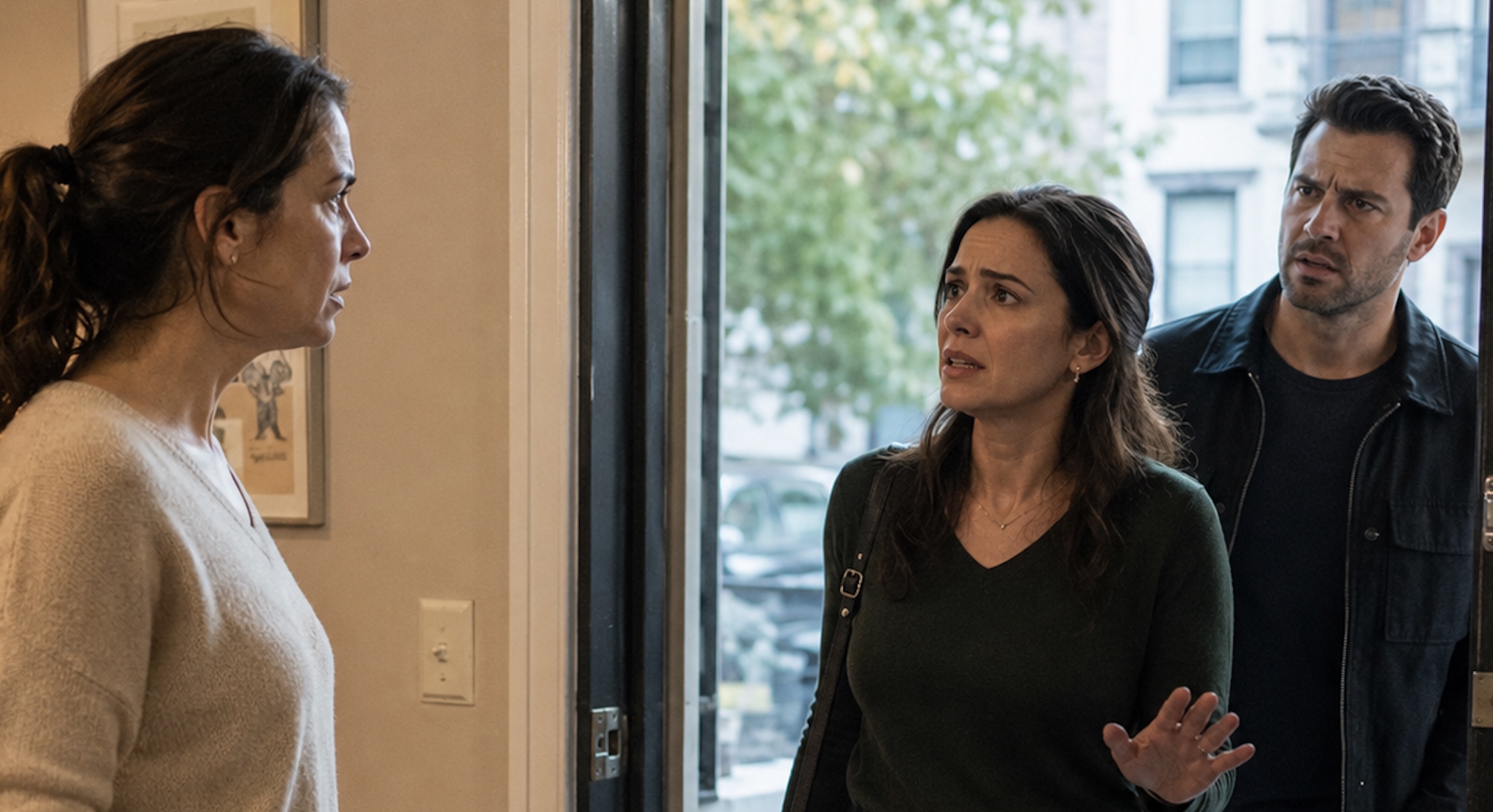
“Are you seriously dragging your mother into my home? Have you completely lost your mind, or are you pretending?” Ksenia snapped.
She had come home half an hour earlier than usual and stopped dead in the hallway.
By the door stood two checkered bags, an old plastic basin tied with rope, a bag of slippers, and a microwave box with the edge of a robe sticking out of it. On her entryway cabinet lay someone else’s hairbrush. Beside it were a bottle of eye drops, glasses in a worn case, and a set of keys with a faded sunflower keychain.
Ksenia did not even take off her shoes at first. She simply stood there, holding a grocery bag, staring at the belongings as if they themselves owed her an explanation for how they had ended up in her apartment.
From the room came the voice of Galina Petrovna, her mother-in-law.
“Oleg, where should I put my towels? In this cabinet? You don’t have much space here, of course. I’ll rearrange things later in a way that’s more convenient.”
Ksenia’s cheek twitched.
“More convenient.”
She had not asked. She had not checked. She had already decided.
At that same moment, Oleg came out of the kitchen. On his face was the strained smile of a man who already knew he had done something wrong, but was still hoping he could slip between the questions.
“Ksyusha, you’re home already? I thought you’d be later.”
“I can see you’ve been thinking about a lot of things without me,” she replied evenly.
Oleg quickly glanced at the bags, then toward the room where the rustling of plastic could be heard.
“Please don’t start right at the door. It’s temporary. Really. We’ll sort everything out.”
Ksenia slowly placed the grocery bag on the shelf by the mirror. She did not throw it. She did not slam it down. She set it there carefully. Too carefully. That carefulness made Oleg tense even more.
“What exactly will be sorted out?”
“Well… Mom has a situation.”
“What situation?”
Oleg scratched the back of his head and looked away toward the kitchen.
“With her apartment.”
“What about her apartment?”
“It needs repairs. And the downstairs neighbor has been complaining. A pipe was leaking. So until everything is fixed, Mom will stay with us.”
Ksenia looked at him so intently that Oleg stopped pretending to be calm. He shoved his hands into the pockets of his house pants and began speaking faster.
“I didn’t want to stress you out ahead of time. You already come home tired. I thought I’d bring her today, and we’d talk calmly in the evening.”
“Talk?” Ksenia gave a short laugh. “You’ve already brought her here with all her bags, she’s already unpacking in my room, and we’re supposed to talk about it tonight?”
“Our room,” Oleg corrected her.
Ksenia turned her head toward him.
“My apartment, Oleg. Don’t confuse things.”
He winced.
“There you go again.”
“And what should I do? Go along with you deciding, behind my back, to move your mother in?”
Galina Petrovna appeared from the room. She was short, sturdy, with neatly styled hair and a face carefully arranged into offended dignity. In her hands, she held a stack of her cardigans.
“Hello, Ksenia. I thought you might at least say hello before shouting at your husband.”
Ksenia slowly turned to her.
“Hello, Galina Petrovna. And I thought someone might at least ask me before moving other people’s belongings into my apartment.”
Her mother-in-law straightened.
“Other people’s? Am I a stranger now?”
“In this apartment, yes. You don’t live here.”
“Oleg, did you hear that?” Galina Petrovna turned to her son. “I’m a stranger to her.”
Oleg exhaled heavily.
“Mom, wait. Ksyusha just got home.”
“I didn’t just get home from a trip, Oleg. I got home from work. I came home. To my home, where your mother’s bags appeared without my consent.”
Galina Petrovna pressed the cardigans to her chest.
“So I was supposed to sleep on the street?”
Ksenia frowned and tilted her head slightly, studying her mother-in-law.
“Why on the street? You have your own apartment.”
“It’s impossible to stay there right now.”
“Why?”
“Because of the pipe.”
“What pipe?”
Galina Petrovna hesitated for a second before answering. That was enough for Ksenia to notice that the story was not as simple as they were trying to make it sound.
“In the bathroom,” Galina Petrovna said. “It’s damp. Wet. I can’t be around that.”
“Did you call emergency maintenance?”
“Oleg handled it.”
Ksenia shifted her gaze to her husband.
“Did you?”
Oleg faltered.
“I called a handyman I know. He said he’d need to take a look.”
“When is he coming?”
“Well… tomorrow or the day after.”
“So there’s no emergency?”
“Ksyusha, why are you picking at words?”
“Because according to your words, a person has an emergency and nowhere to live. But in reality, some handyman might look at a pipe sometime.”
Galina Petrovna sharply placed the cardigans on the edge of the dresser in the room and returned to the hallway.
“Well done, Ksenia. Very graceful. I raised my son my whole life, and now I have to justify every drop of water in my bathroom to his wife.”
“Not every drop. I’m asking why you moved into my apartment without being invited.”
“Oleg invited me.”
“Oleg is not the owner of this apartment.”
The hallway went silent.
Oleg suddenly lifted his eyes.
“Ksenia, enough.”
“No. Now we’re finally going to begin.”
The apartment had come to Ksenia from her father. Not easily, and not right away. After his death, she spent six months going through inheritance procedures, collecting documents, visiting the notary, closing old utility debts, sorting through his belongings, and trying to get used to the fact that his jacket would no longer hang in the hallway.
By the time she married Oleg, the apartment was already legally hers. He had known that from the very first day. Back then, he had even said it did not matter where they lived, as long as they were together.
For the first year, that was exactly how it was. He moved carefully through the apartment, where everything reminded Ksenia of her father. He did not try to take charge, did not bring in unnecessary things, and asked whether he could put his tools in the storage closet. Ksenia appreciated that sensitivity.
But then it began to disappear.
First, Oleg started saying, “At our place.” Then, “We should replace the front door.” Then, “It’s inconvenient for Mom to come all the way here; it’s too far.” Then Galina Petrovna received a spare set of keys “just in case,” when Ksenia was home sick with a fever and Oleg was at work.
Ksenia did not argue then. Her mother-in-law brought medicine, stayed for an hour, and left. Nobody offered to return the keys, and Ksenia did not bring it up at the time. What seemed like a small mistake only appeared small at first glance.
A month later, Galina Petrovna was already dropping by without calling because she had “been passing by.” Two months after that, she opened the door with her own key while Ksenia was taking a shower. Then she began leaving containers of food in the refrigerator that no one had asked for. Then, one day, she said:
“Nice apartment. A little empty, though. It needs a woman’s touch.”
Ksenia looked at her then and replied calmly:
“My touch is already here. No one else’s is needed.”
Galina Petrovna was offended for a week. Oleg asked Ksenia not to pick on his mother.
Ksenia did not pick on anyone. She worked as an administrator at a private dental clinic, came home in the evenings, kept the apartment in order, paid the bills from her own card, bought groceries, monitored repairs, and arranged for technicians whenever something broke. Oleg contributed to daily life too, but the apartment, decisions about it, and its boundaries were her responsibility.
And now those boundaries had simply been carried in along with someone else’s bags.
“I’m asking one last time,” Ksenia said. “Who decided that Galina Petrovna would live here?”
Oleg frowned.
“I decided. Because she’s my mother.”
“And who am I in this apartment?”
“Your wife.”
“A wife you can simply present with a decision after the fact?”
“Ksyusha, I’m not your enemy. Mom will stay for a little while. What’s going to happen?”
“How long is a little while?”
Oleg held his breath.
“Until things are settled at her place.”
“How long?”
“Maybe a month.”
“Maybe?”
“Two. I don’t know.”
Ksenia looked at her mother-in-law.
“And do you know?”
Galina Petrovna was the first to look away.
“I wasn’t counting the days.”
“But you packed thoroughly.”
“I’m too old to be running back and forth.”
Ksenia nodded.
“So we’re not talking about a couple of nights.”
Oleg rubbed his face in irritation.
“For God’s sake, yes! Not a couple of nights! Mom has a hard time living alone. She’s uncomfortable in her apartment. The building is old, the neighbors are noisy, the elevator keeps breaking. Am I her son or not? I’m supposed to help.”
“Then help. Rent her a place nearby. Fix the pipe. Hire a repairman. Take time off and stay with her for a week. There are plenty of options. But you chose one: move her in here, because that’s easiest for you.”
Galina Petrovna flushed. Red spots appeared on her cheekbones.
“Ah, so that’s what this is. I’m in the way. I’m unwanted.”
“You are not unwanted in your son’s life. But you are unwanted in my apartment if you were not invited.”
“Oleg!” her voice cracked. “Are you going to stand there and say nothing?”
Oleg looked at Ksenia now without a smile.
“What do you want me to say? That I should throw my mother out?”
“I want you to tell me why you thought you could make decisions about my home.”
“Because I live here!”
“You live here. But you do not own it.”
“So all this time I’ve just been a tenant here?”
“No. You were a husband. The difference is that a husband talks things through instead of secretly moving people in.”
Oleg opened his mouth, but no answer came at first. His shoulders dropped, yet his gaze hardened.
“Secretly? I told you.”
“After you did it.”
“Because I knew you’d start this.”
“So you knew in advance that I would be against it.”
Suddenly Galina Petrovna spoke up.
“A normal woman would have shown understanding. Her husband’s mother is alone, her son helped her, and the wife accepted it. That’s all. But you’ve turned it into an interrogation, as if I’m some criminal.”
Ksenia slowly took off her coat, hung it on the hook, removed her shoes, and walked into the kitchen. Oleg and Galina Petrovna remained in the hallway. A few seconds later, Ksenia returned with her phone in her hand.
“What are you doing?” Oleg asked warily.
“Calling a locksmith.”
“Why?”
“To have the cylinder in the front door lock replaced today.”
“Are you out of your mind?”
“No. I’ve finally remembered that people who enter my apartment without my permission should not have keys to it.”
Galina Petrovna clutched her bag.
“This is humiliation.”
“Humiliation is trying to push a grown woman with pity while she stands among someone else’s bags in her own home.”
Oleg stepped toward Ksenia.
“Don’t you dare.”
She lifted her eyes to him.
“Don’t you dare give me orders in my apartment.”
The phone was already ringing in her hand. Ksenia turned half a step away and said calmly into it:
“Good evening. I need the cylinder in my front door lock replaced today. Yes, I have the apartment documents. I’ll give you the address now.”
Oleg let out a sharp breath, as if it was not her words that had struck him, but the fact itself.
“Ksenia, hang up.”
She did not.
Galina Petrovna stared at her son, expecting him to snatch the phone away, shout, do anything at all. But Oleg only stood there, his knuckles white.
Ksenia made the appointment, gave the address and time, then put the phone in her pocket.
“The locksmith will be here in an hour.”
“Are you really going to put on this circus?” Oleg asked.
“No. I’m going to take back control of my apartment.”
“Mom isn’t going anywhere tonight.”
“Yes, she is.”
“Where?”
“Back where she came from.”
“There’s a pipe!”
“Then you can go with her and call emergency maintenance. Or a repairman. Or whoever you want. That is a problem with her apartment, not mine.”
Galina Petrovna suddenly straightened and said coldly:
“Fine. Since you’re acting this way, I’ll speak plainly. Oleg has wanted us to live together for a long time. He’s tired of you deciding everything by yourself. He is the man of the house, and you keep him here like a guest.”
Ksenia turned to her husband.
“For a long time?”
Oleg did not answer.
“So this isn’t about a pipe.”
He clenched his jaw.
“Mom is getting older. She needs help.”
“She is not helpless. Today she arrived with her belongings and has already started managing the cabinets.”
“Ksyusha, why do you have to be so harsh?”
“And how should I gently say that you tried to deceive me?”
Her mother-in-law smirked.
“Deceive you? Oleg is your husband. He has the right to bring his mother.”
“No, he does not. A third person living in an apartment, even temporarily, requires the owner’s consent. I am the owner.”
“There it is,” Galina Petrovna nodded as if she had finally found proof. “The owner. And where is the wife?”
Ksenia took a step closer. Her voice did not rise, but it became so clear that Oleg even stopped blinking.
“The wife was here all these years. The wife bought groceries when your son forgot. The wife sat with him after his knee surgery. The wife received you when you arrived without warning. The wife tolerated your keys, your inspections of the refrigerator, and your comments. Today the owner is standing here because both of you decided not to ask the wife.”
Oleg rubbed the bridge of his nose.
“You’re twisting everything.”
“No. I’m naming things directly.”
From the room came more rustling. Galina Petrovna, as if out of spite, went back and continued unpacking. Ksenia followed her.
It was the smaller second room. Ksenia used it as a home office: a desk by the window, a laptop, clinic documents in folders, a bookshelf, an armchair. Her mother-in-law’s cardigans were already lying on the sofa. On the writing desk were her pills, a bag with a towel, and a phone charger. On the chair lay a long house robe.
Ksenia stopped in the doorway.
“Remove your things from my desk.”
Galina Petrovna turned around.
“I’ll sort it out later.”
“Now.”
“Don’t order me around.”
Ksenia walked to the desk, picked up the towel bag, and carefully placed it into her mother-in-law’s open bag. Then she did the same with the pills, the charger, and the glasses case.
“Don’t touch my things!” Galina Petrovna cried.
“Then don’t put them on mine.”
Oleg entered the room after them.
“Ksenia, stop. You’re behaving terribly.”
She turned to him.
“And behaving well means bringing your mother into your wife’s apartment while your wife isn’t home?”
Oleg found no answer.
Galina Petrovna suddenly sat down on the edge of the sofa and pressed a hand to her chest.
“I feel unwell.”
Ksenia looked at her carefully.
“Should I call an ambulance?”
Her mother-in-law blinked.
“What?”
“An ambulance. Should I call one?”
“No.”
“Then pack your things.”
Oleg said sharply:
“She is not going out at night with bags!”
“It’s seven in the evening.”
“Do you understand how this looks?”
“Yes. It looks like my husband brought his mother into my apartment without discussing it with me, and now that I’ve refused, he cares more about appearances than the actual issue.”
Galina Petrovna stood up.
“Oleg, I told you she would never accept me. She needs her apartment, her silence, and you walking on a leash.”
Ksenia smiled only with her eyes.
“Don’t confuse me with yourself. I don’t put anyone on a leash. I simply don’t allow people to carry suitcases into my life without knocking.”
Oleg suddenly exploded.
“Why do you keep repeating it? My apartment, my apartment! I did repairs here!”
Ksenia slowly turned toward him.
“What repairs?”
“I put up the shelf in the bathroom. I changed the faucet.”
“We bought the faucet together. You put up the shelf after three weeks of reminders. That does not give you the right to move people in.”
“I paid utilities!”
“Sometimes. And that was your contribution to daily life, not the purchase of a share.”
“So you kept count?”
Ksenia looked directly into his eyes.
“I’ve always kept count of my money. And now I’m very glad that I did.”
At that moment, Oleg understood that the argument was no longer about his mother. It was much deeper. It was about the fact that he had long become used to living in Ksenia’s apartment as if, one day, she would grow tired of reminding him about boundaries. He had grown used to the idea that if he said “ours” long enough, the apartment would become shared, at least in behavior.
But documents did not change because of that.
And neither did Ksenia.
The doorbell rang sharply.
Galina Petrovna flinched. Oleg turned around.
“Who is that?” he asked.
“The locksmith,” Ksenia replied.
“Are you serious?”
She was already heading into the hallway.
Behind the door stood a man of about forty with a tool case.
“Did you call to have a lock changed?”
“Yes. Come in.”
Oleg stepped forward.
“Nothing needs to be changed.”
The locksmith froze at the threshold and looked at Ksenia.
“Can you show the apartment documents?”
“Of course.”
Ksenia took out the ownership extract and her passport. The locksmith checked them and nodded.
“Changing the cylinder?”
“Yes.”
Oleg stood nearby, breathing heavily through his nose.
“Ksenia, you’re crossing a line.”
“No, Oleg. I’m putting it back where it was.”
The locksmith silently began working on the door. Metal clicked softly, the screwdriver slid through the grooves. For some reason, that sound had more impact than any words: everything was happening not in rage, not in hysteria, but calmly, legally, and irreversibly.
Galina Petrovna came out of the room with the face of a deeply insulted person.
“So I’m being thrown out.”
Ksenia looked at her.
“Yes.”
“Your husband’s own mother.”
“A woman who moved into my home without my consent.”
“I’ll remember this.”
“So will I.”
Oleg clenched his fists.
“You have no right to treat my mother this way.”
“I have the right not to let someone into my apartment when they violate my boundaries. And you have the right to go with her.”
He snapped his head up.
“What?”
“Go with your mother. Help her. Solve her problems. You wanted to help, didn’t you? Then help. Just not at my expense and not with my living space.”
Galina Petrovna quickly looked at her son. In her eyes flashed not relief, but fear. It was one thing to move into her daughter-in-law’s apartment, where everything was ready, clean, and orderly, where she could gradually take up space. It was another to take her son back to her old one-room apartment, where every day would require actually dealing with pipes, neighbors, and daily life.
“Oleg has work tomorrow,” she said more quietly.
Ksenia raised her eyebrows.
“And I don’t?”
“You’re a woman. It’s easier for you…”
“Do not continue.”
The locksmith finished the job and handed Ksenia the new keys.
“Check it.”
Ksenia opened and closed the door. The lock worked smoothly. She paid him, took the old cylinder and the old keys.
“The old ones won’t work anymore,” the locksmith said. “Call if you need anything.”
When the door closed behind him, the silence grew heavy.
Ksenia placed the new keys into the pocket of her house cardigan and turned to Oleg.
“Your keys.”
“What?”
“The old ones. Give them to me.”
“Are you kicking me out too?”
“I’m taking back the old keys, which no longer work. I won’t give you a new set until I understand where you’re sleeping tonight and what you intend to do next.”
Oleg turned pale.
“So you’ve decided to test me?”
“You already tested me. I passed.”
Galina Petrovna tried to interfere:
“Oleg, don’t give them to her. This is humiliation.”
Ksenia looked at her.
“Did you enter here today with your own key, or did Oleg open the door?”
Her mother-in-law did not answer.
Ksenia looked at her husband.
“Answer.”
Oleg was silent for a moment.
“Mom opened it herself. I was home.”
“So she had the key with her.”
“Yes.”
“Give it to me.”
Galina Petrovna straightened.
“This is the key to my son’s apartment.”
“No. It is the old key to my apartment. It is already useless, but I’m taking it anyway.”
“I won’t give it to you.”
Ksenia took out her phone.
“Then I’ll call the police and explain that a person is refusing to return the keys to my apartment and is refusing to leave the property after the owner has asked her to.”
Oleg suddenly turned to his mother.
“Mom, give it to her.”
“Olezhik!”
“Give it to her, I said.”
His mother stared at him for several seconds, then pulled the keyring out of her bag pocket. The sunflower keychain swung between her fingers. She removed the key and placed it on the cabinet with force.
Ksenia picked it up and held out her hand to Oleg.
“Now yours.”
Oleg took out his keyring and silently removed the key. He put it beside the other one.
“Will I get a new one?”
“No. Not today.”
“So now I have to ask permission to come home?”
Ksenia looked at the strange bags, at her mother-in-law, at her husband.
“Today, yes. Because you showed me that you can bring a person here without my consent. Trust does not come back in five minutes.”
Galina Petrovna raised her chin.
“Son, pack your things. Don’t humiliate yourself.”
Oleg gave her an irritated look.
“Mom, be quiet.”
His mother froze. She was not used to her son speaking to her in that tone in front of his wife.
Ksenia noticed and said nothing.
Oleg went into the bedroom. He did not close the door. They could hear him opening the wardrobe and taking out a bag. Galina Petrovna tried to follow him, but he stopped her.
“I’ll do it myself.”
“Oleg…”
“By myself, Mom.”
Ksenia stayed in the hallway. On the cabinet lay two old keys. Small metal objects that had suddenly revealed everything: the silent concessions, someone else’s “temporary,” and how easily some people call something help when it is only convenient for them.
Ten minutes later, Oleg came out with a travel bag. He took his jacket, then looked at Ksenia.
“Do you really want me to leave?”
“I want you to understand that you cannot live here as if I don’t exist.”
“I wanted to help my mother.”
“You wanted me to accept your decision after the fact.”
“We could have talked normally.”
Ksenia nodded.
“We could have. Before you brought her here.”
Galina Petrovna was already packing her things in the small room. She did it noisily: yanking zippers, throwing cardigans into the bag, sighing loudly several times on purpose. Ksenia did not react.
At last, her mother-in-law came out with two bags. Oleg took one, and she lifted the other herself.
At the door, Galina Petrovna stopped.
“You’ll regret this, Ksenia. Throwing your husband out because of his mother doesn’t take much intelligence.”
Ksenia answered calmly:
“I’m not throwing him out because of his mother. I’m doing it because he decided not to take me into account.”
Oleg looked at her as though he wanted to say something, but the words got stuck somewhere between offense and understanding. He silently stepped into the stairwell. Galina Petrovna followed him.
Ksenia closed the door. The new lock clicked with confidence.
She did not sit down on the floor. She did not burst into tears. She did not start pacing through the apartment. First, she walked through the rooms and collected everything her mother-in-law had managed to leave behind: a bag of medicine on the windowsill, slippers by the sofa, a hairbrush on the cabinet. She put it all into a separate bag. Then she checked the closets. Then she wiped the desk in the office where someone else’s belongings had been lying and stood for a long time by the window, clutching the cloth in her hand.
Her hands started shaking only after everything was over. Not during the conversation, not with the locksmith there, not when she took back the keys. Only now, when the apartment had become quiet again.
The phone rang twenty minutes later. Oleg.
Ksenia looked at the screen and did not answer.
Then a message came:
“We’re at Mom’s. Are you happy now?”
Ksenia did not reply right away.
“No. I’m not happy. I’m tired of my boundaries being treated like whims.”
A minute later:
“Mom is crying.”
Ksenia looked at the message and gave a short humorless smile.
“You’re there. Comfort her.”
There was no answer for almost an hour.
During that time, Ksenia made herself dinner, placed the cutlery beside the plate, and for the first time that evening realized she was very hungry. She ate slowly, without enjoyment, simply because her body needed food after a hard day.
Then she washed the dishes, put the bag with the old keys in a drawer, and took out the folder with the apartment documents. She checked everything again: the ownership extract, the inheritance certificate, old utility receipts, service contracts. Everything was in place.
The next day, Oleg came alone.
Ksenia saw him through the peephole. He stood there without a bag, wearing the same jacket, unshaven, holding a small package. He did not look combative. He looked exhausted.
She opened the door but left the chain on.
“Can we talk?” he asked.
“Talk.”
Oleg looked at the chain.
“You won’t even let me in?”
“Not yet.”
He lowered his eyes.
“I understand.”
Ksenia said nothing.
“Mom’s apartment really isn’t in great shape. But not the way I told you. The pipe leaked a month ago. It’s already been fixed. It’s just that Mom… she said she was afraid to be alone. That it was hard for her. That the neighbors annoyed her. That she wanted to stay with us and see how it went.”
“See how it went,” Ksenia repeated.
“I thought if you saw her already here, you wouldn’t make her leave.”
“So it was calculated.”
Oleg nodded. It was unpleasant for him, but he nodded.
“Yes.”
Ksenia took her hand off the door.
“Thank you for at least telling the truth now.”
“I behaved like an idiot.”
“Worse. You behaved like a man who decided his wife had no right to refuse.”
He closed his eyes for a second.
“I know.”
“No, you don’t. If you did, you wouldn’t have come here with a package and hope that I’d let you in now.”
Oleg lifted the package.
“Your groceries are here. Yesterday, in all the chaos, I forgot to give them to you. I bought them on the way.”
“Leave them by the door.”
He placed the package on the mat.
“Ksyusha, I don’t want a divorce.”
“I haven’t mentioned divorce yet.”
“But you could.”
“I could.”
He jerked his eyes up. Apparently, he had hoped to hear something else.
Ksenia spoke calmly:
“We don’t have children. The apartment is my inheritance, so it is not subject to division. If we both agree, we can divorce through the registry office. If you start arguing or trying to pressure me into giving you something, we’ll go another route. I’m not threatening you. I’m simply telling you in advance that I will no longer close my eyes when someone tries to control me.”
Oleg swallowed.
“I won’t demand anything.”
“We’ll see.”
“Can I come back?”
“No.”
“For how long?”
“Until I decide whether I even want to continue this marriage.”
“Where am I supposed to stay?”
“With your mother. Yesterday you chose to solve her problem at the expense of my home. Now solve it beside her.”
Oleg nodded. His face looked gray and tired.
“She said you destroyed the family.”
Ksenia tilted her head slightly.
“That’s a convenient version. Repeat it if it makes things easier.”
“I’m not repeating it.”
“Good.”
He stood there a little longer.
“Can I at least take my work things?”
“Send me a list by message. I’ll pack them and hand them to you at the door.”
“You won’t even let me into the apartment now?”
“Right now, no.”
“I’m not a stranger.”
Ksenia looked at him for a long time. Without anger. Even with tired sadness.
“Yesterday, you made me a stranger in my own home. I need time for that to stop standing between us.”
Oleg looked away.
“I’ll send the list.”
“Send it.”
She closed the door.
After that began a strange week.
Oleg wrote brief messages. He asked for shirts, work documents, a charger, winter boots. Ksenia packed the things and handed them to him at the door or left them with the concierge. He did not receive a new key.
Galina Petrovna called twice. Ksenia did not answer. On the third day, her mother-in-law sent a long message calling her cruel and ungrateful and insisting that “normal wives don’t behave this way.” Ksenia read it to the end and deleted it without replying.
On the fourth day, Valentina Sergeevna, the neighbor from the fifth floor, called.
“Ksenia, forgive me, I’m not trying to interfere, but yesterday your mother-in-law was talking outside the entrance with some woman. Loudly. She was saying you threw poor Oleg out onto the street.”
Ksenia closed her eyes and ran her palm across the table, as if wiping away invisible dust.
“Thank you for telling me.”
“Don’t worry. We’re all adults here. The person who complains the loudest isn’t always the one who’s right.”
For the first time in several days, Ksenia smiled.
“I’m not worried. It’s just unpleasant.”
“I understand. But you did the right thing changing the lock. People are like that nowadays. Today it’s ‘I’ll stay for a week,’ and tomorrow they’re dragging in their own wardrobe.”
After the call, Ksenia sat down at her laptop and made a list for herself. Not an emotional one, but a practical one.
First: never give anyone keys again without a clear written necessity.
Second: put all apartment documents in a bank safe deposit box.
Third: speak with a lawyer about what to do if Oleg refuses to move out permanently or starts applying pressure.
Fourth: do not make decisions out of pity.
On the fifth day, Oleg came again. This time he wrote in advance:
“Can we talk at the door? I’m alone.”
Ksenia opened it.
He looked even worse. Shadows lay under his eyes, and his hair had been carelessly combed back. He had nothing in his hands.
“Mom wants to sell her apartment,” he said instead of greeting her.
Ksenia silently waited for him to continue.
“She says if it’s hard for her to live alone, she should sell it and buy something smaller near us. Or more accurately… near you.”
“Near me?”
Oleg nodded.
“I told her that won’t happen.”
Ksenia looked at him carefully.
“You said that yourself?”
“Myself.”
“And what did she say?”
“First she shouted. Then she said I was an ungrateful son. Then she brought up her blood pressure, the neighbor, and every grievance from her whole life. But I told her your apartment is not a backup runway for her plans.”
Ksenia did not smile, but her gaze softened.
“Why did you understand it now?”
Oleg leaned his shoulder against the wall by the door.
“Because I lived with her these past few days. And I realized it’s not about the pipe, or the neighbors, or loneliness. She simply decided that your place was more convenient. She liked the idea that you would keep everything in order and I would be nearby. She was already discussing where to put her bed. In your office.”
Ksenia gave a dry smile.
“A bed?”
“Yes. And she also said your desk could be removed because ‘there’s no need to bring work into the home.’”
Ksenia bit the inside of her cheek to keep from answering sharply.
“I see.”
“I’m ashamed.”
“That’s better than simply being offended.”
Oleg nodded.
“Can I fix anything?”
Ksenia did not answer right away. Behind her was the apartment: quiet, clean, hers. Not a battlefield. Not a dormitory for other people’s decisions. She wanted it to stay that way.
“You can,” she said. “But not with words.”
“What do I need to do?”
“First. You take all your things for now. Not because I’m throwing you out forever, but because I need space without your expectation standing at the door.”
Oleg turned pale, but he did not interrupt.
“Second. You tell your mother yourself that she no longer comes here without my invitation. She does not call me with accusations. She does not discuss me outside the building. And she does not make plans for my office.”
“Fine.”
“Third. If we decide to continue, then we live by rules discussed by both of us. No one gets keys to this apartment without my consent. No one arrives with belongings without my consent. And the word ‘temporary’ will no longer be used as a way to push through a decision I did not make.”
“I agree.”
“Don’t rush. This is not a phrase for reconciliation. These are conditions.”
“I understand.”
Ksenia opened the door wider but remained standing in the threshold.
“You can pack your things now. I’ll stay nearby.”
Oleg came in. Not like an owner. Carefully, almost silently. Ksenia noticed and said nothing.
He packed for about an hour. Shirts, documents, tools, books, a gym bag. He did not take anything unnecessary, did not rummage through drawers, did not try to pressure her with memories. Once, he stopped near a photograph of the two of them standing on the embankment in Kazan and looked at it for a long time.
“Leave it,” Ksenia said.
“I wasn’t going to take it.”
“Good.”
When he finished, two bags and a backpack stood by the door. Ksenia checked whether any of his keys, documents, or medicines had been left behind. Everything was collected.
“I’ll call a taxi,” he said.
“Call one.”
While he waited for the car, quick footsteps sounded in the stairwell. Then the doorbell rang.
Ksenia looked through the peephole and saw Galina Petrovna.
Oleg understood too.
“I’ll open it,” he said.
“No. This is my door.”
Ksenia opened it, leaving the chain on.
Her mother-in-law stood on the landing in a coat and with a bag. Her face was tense, her lips pressed into a thin line. Behind her, the neighbor from the fourth floor hovered, apparently drawn by the noise.
“Ksenia, open properly. We need to talk.”
“Talk like this.”
“I’m here for my son.”
“He’s coming out now.”
Galina Petrovna tried to look inside.
“Oleg! Are you there? What is she doing to you?”
Oleg came to the door.
“Mom, I’m packing my things myself.”
“What things? Are you really going to let her throw you out?”
“Mom, enough.”
“No, not enough!” Galina Petrovna raised her voice. “I came to take you and tell her to her face that she destroyed everything with her apartment papers!”
Ksenia removed the chain and opened the door fully. She did not step aside. She did not invite her in.
“Galina Petrovna, you are standing outside my apartment and shouting in the stairwell. If you continue, I will call the police. Not for show. Because of disorderly behavior and refusal to leave my door.”
Her mother-in-law was confused for a second. She had clearly expected a scandal in the usual form: accusations, shouting, tears. Instead, she received a calm, almost businesslike tone.
“Are you threatening me with the police?”
“I’m warning you.”
Oleg picked up his bags and stepped onto the landing.
“Mom, let’s go.”
“Divorce her! Today!”
“That is not for you to decide.”
Galina Petrovna turned to her son so sharply that her bag hit her leg.
“What?”
“That is not for you to decide,” Oleg repeated. “And not for me alone. This is my marriage with Ksenia.”
“She threw you out!”
“Because I did something stupid.”
“You were saving your mother!”
“I wasn’t saving anyone. I tried to move you somewhere convenient for you without asking the owner of the apartment. That was wrong.”
Galina Petrovna froze. Then she slowly turned to Ksenia.
“Are you satisfied? You turned my son against his mother?”
Ksenia shook her head.
“No. For the first time, he simply told you something you did not want to hear.”
The neighbor from the fourth floor coughed and quickly disappeared behind her door.
Galina Petrovna noticed and lowered her voice.
“Oleg, let’s go. Talking here is useless.”
“We’ll go,” he said. “But at home, we’ll talk too. About your apartment, about repairs, about hiring someone for a couple of hours if you need help, about real solutions. But not about moving in with Ksenia.”
His mother recoiled from him as if he had betrayed her in front of the entire building.
“A hired helper? You want to give me to a stranger?”
“I’m offering options that don’t destroy someone else’s life.”
Ksenia watched him in silence. For the first time in this whole story, he was not saying convenient words. He was saying necessary ones.
The taxi arrived a few minutes later. Oleg took the bags. Before leaving, he turned to Ksenia.
“I’ll write tonight.”
“Good.”
“Thank you for not closing the door right away.”
“Don’t thank me. Just don’t devalue it later.”
He nodded.
Galina Petrovna left without looking back. But near the stairs, she still threw over her shoulder:
“You won’t last long like this anyway.”
Ksenia answered calmly:
“At least now it’s honest.”
The door closed.
The apartment became quiet again. But it was a different kind of quiet now. Not empty. Not frightened. It was the silence after a difficult decision that had put everything back in its place.
Another week passed.
Oleg did not ask for keys. He wrote every evening, but without pressure. He said he had called a repairman to his mother’s apartment, that there really was no leak anymore, but the old bathroom pipes needed replacing. He said he had arranged a consultation with social services about elderly care at home. Galina Petrovna had refused at first, then agreed at least to listen.
Ksenia read and replied briefly. Sometimes dryly. Sometimes more warmly. But she did not invite him home.
She needed to see not a flash of remorse, but consistency.
On the tenth day, Oleg sent a message:
“Mom said she wants to apologize. I didn’t give her your number. I told her that if you want to, you’ll contact her yourself.”
Ksenia looked at the message for a long time.
Then she replied:
“I don’t want to yet.”
Oleg wrote:
“I understand.”
And he did not argue.
That mattered more than any flowers.
Two weeks later, they met not at home, but in a small park near the clinic where Ksenia worked. She suggested it herself. They sat on a bench with distance between them, but it was no longer so sharp and painful.
Oleg spoke a lot and without his usual excuses. He told her that his mother had been complaining about loneliness for a long time, but instead of looking for real solutions, he had chosen the easiest path: shifting everything onto Ksenia. He admitted he had been afraid she would refuse, which was why he had done everything behind her back. He admitted that the word “temporary” had been a cover, because there had been no real deadline.
Ksenia listened and sometimes asked questions.
“And if I had kept quiet that day?” she asked.
Oleg looked at the path in front of him.
“Mom would have stayed. First for a month. Then longer. Then I would have said it was inconvenient to send her back. Then you would have become guilty every time you tried to take your office back.”
“Correct.”
“I didn’t understand that right away. But I understand it now.”
Ksenia nodded.
“I don’t want to be the evil wife in someone else’s family legend.”
“You’re not evil.”
“To your mother, I am.”
“That’s her way of not looking at her own choices.”
For the first time, Ksenia looked at him without the same tension as before.
“You’re saying the right things now. But what matters to me is what happens next.”
“I’m ready.”
“Then next is this. You don’t come back immediately. We meet, we talk, we decide. If you come back, your mother has no key. No surprise visits from her. No discussions about my apartment. And you understand this: if anything like this happens again, I won’t look for a compromise anymore.”
“I understand.”
“And one more thing. Your mother has to collect the last bag of her belongings. It’s standing in my hallway. You will take it yourself. She does not come to my door.”
“I’ll take it.”
At that moment, Ksenia realized she no longer trembled at the thought of the conversation. She had not forgiven everything at once. She had not forgotten. She had not decided to pretend nothing had happened. But inside her, a steady support had appeared: she had managed. She had not given in. She had not pushed herself out of her own home for someone else’s convenience. She had not allowed her apartment to become a place where decisions were made without her.
That evening, Oleg came to collect the bag. Ksenia handed it to him at the door. He did not ask to come in.
“Thank you.”
“You’re welcome.”
“Ksyusha.”
“What?”
“I told Mom that if she comes to you again with accusations, I’ll call her a taxi back myself.”
Ksenia looked at him carefully.
“You said that?”
“Yes.”
“And what did she say?”
“She was offended. But she heard me.”
“We’ll see.”
Oleg nodded.
“We’ll see.”
He left, and Ksenia closed the door and turned the new key in the lock.
The click sounded short and calm.
She went into her office. The desk was in its place. The laptop, folders, lamp, and favorite mug with a handle shaped like a cat’s tail were all there. No one else’s pills. No bags on the chair. No plans for her space made without her involvement.
Ksenia sat down at the desk and opened her planner. On a clean page, she wrote:
“Temporary does not mean without consent.”
Then she thought for a moment and added below:
“A home is not a place where someone can carry in other people’s bags and declare that the decision has already been made.”
A month later, Oleg returned. Not solemnly, not with grand promises about half the apartment, but with one suitcase and a new agreement between them — spoken, not written, but discussed down to the smallest details.
He received one key. No spare copies for relatives.
Galina Petrovna no longer came to the apartment. At first, she demonstratively stayed silent. Then a couple of times, she sent a dry “hello” through her son. Ksenia did not rush toward reconciliation. It was enough for her that her door was no longer being opened with someone else’s keys.
One day, Oleg said:
“Mom asked if she could come over for an hour. To have tea.”
Ksenia lifted her eyes from her book.
“No.”
Oleg nodded.
“That’s what I told her.”
“And?”
“She said you were cruel.”
“And you?”
“I told her that an invitation is not an obligation.”
Ksenia closed the book.
“Good answer.”
Oleg sat down beside her, but not too close, as if he still remembered that trust is rebuilt not through intrusion, but through respect.
“I’m learning.”
“Learn faster,” Ksenia said, and for the first time, a real smile flickered in her voice.
He smiled back.
The story did not end with a fairy-tale embrace where everyone suddenly became kind and understanding. Life rarely works that way. Galina Petrovna continued to see herself as the victim for a long time. Oleg caught himself more than once slipping into the old habit of smoothing over conflict at his wife’s expense. And Ksenia kept checking whether the door was locked whenever she heard footsteps in the stairwell.
But the most important thing had changed.
In that apartment, no one confused kindness with permission to manage someone else’s life anymore. No one called intrusion care. No one brought bags with the expectation that the woman of the house would stay silent for the sake of politeness.
Ksenia did not become louder, harsher, or angrier.
She simply said “no” clearly enough one day that everyone had to hear it.
And that was when it became clear: “temporary” does not justify making decisions without her consent.