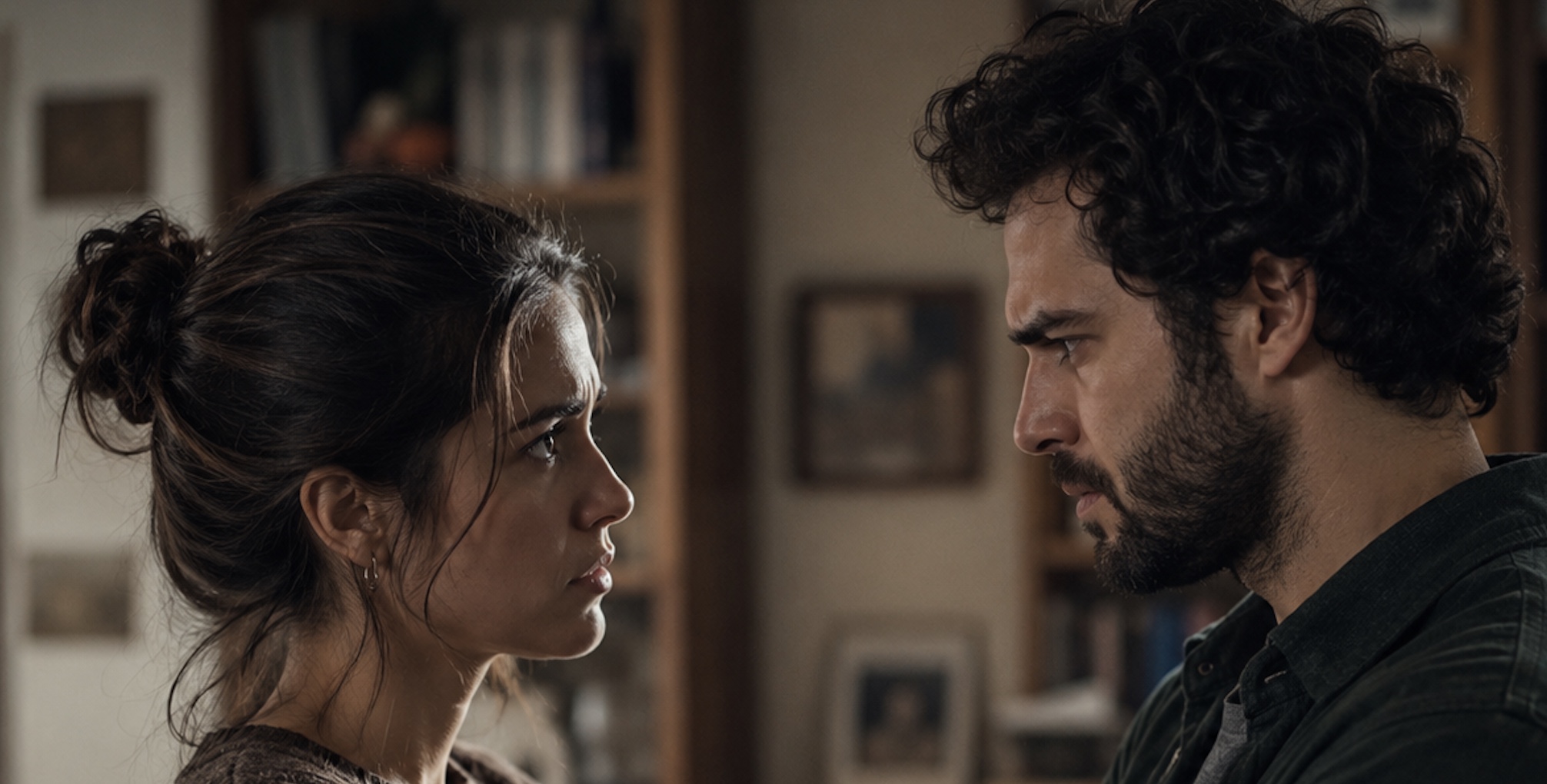
“Do you honestly think you can go out in public wearing this?” Stanislav’s voice was not loud, but it carried that particular vibrating tone that always made Olga’s temples begin to ache. It was the tone people use to scold a guilty cat that has fouled someone’s slippers.
Olga froze with her coffee cup halfway to her mouth and never took a sip. Slowly, she set the ceramic cup down on the table, careful not to let it hit the surface too sharply. One unnecessary sound could become a trigger. Stanislav stood in the middle of the living room, directly beneath the chandelier, using its bright light like an interrogation lamp. In his hands he held a white shirt. He held it with two fingers, keeping it away from himself in disgust, as though it were not a freshly washed and ironed garment, but a filthy rag used to wipe the floor of a public restroom.
“I’m asking you, Olya, is something wrong with your eyes or with your conscience?” He stepped forward, thrusting the cuff toward her face. “Look here. Right here, I said. What is this?”
Olga narrowed her eyes. Before her was perfectly white fabric. Cotton, slightly stiff from starch, smelling of expensive Alpine Fresh fabric softener.
“A shirt, Stas,” she answered evenly, though a dull, heavy exhaustion was already beginning to boil inside her. “White. Clean.”
“Clean?” He gave a short, barking laugh that sounded more like a cough. “You call this clean work? Olya, there’s a crease here. Microscopic, but it’s there. See? The shadow falls right there. The seam on the cuff doesn’t run straight like a string. It goes in a wave. Some pathetic, drunken wave. Were you holding the iron in your hands, or did you stomp on it with your feet?”
He shook the shirt sharply, and the fabric snapped in the air like a sail. Stanislav brought the collar close to his eyes, almost sniffing it. His face twisted into an expression of suffering, as though the physical pain of an imperfect world was too much to bear.
“Soft,” he spat the word out like an insult. “The collar is soft. It’s supposed to stand, Olya. Stand so sharply you could cut yourself on it. It should hold its shape like a frame, like armor. And what is this? A rag. A limp mess. I’ll put this on, and in an hour it’ll droop like a spaniel’s ears. Is that what you want? For people at work to laugh at me? For everyone to see that my wife is a clumsy slob?”
“No one is going to examine your collar under a microscope, Stas,” Olga said, rising from the table and feeling a spring tighten inside her. “It’s an ordinary office shirt. You sit in an office. You’re not attending a reception with the Queen of England.”
“There!” He raised his index finger triumphantly. “That is exactly who you are. ‘Good enough.’ ‘No one will notice.’ That is the mentality of losers, Olya. The mentality of dirt. Tamara Igorevna, my mother, would never have allowed herself such carelessness. Never. Even when my father was working as an ordinary engineer, he left the house looking immaculate. Mother spent forty minutes on a single shirt. Forty! She pressed every seam from the inside, then from the outside through damp gauze. She starched it so well that the shirt could stand on the floor without a hanger.”
Stanislav threw the shirt over the back of the armchair. The white fabric sagged limply, and, to Olga’s horror, a new crease appeared on the sleeve from the impact. Her husband noticed it instantly, and his nostrils flared.
“You think these are little things?” He began pacing around the room, hands clasped behind his back, resembling a prison guard in a cell block. “Everyday life is made of little things, Olya. If you can’t handle a piece of cotton, how can you be trusted with anything serious? This is discipline of the mind. A crooked seam means crooked thoughts. Wrinkled clothes mean a wrinkled life. Mother always said, ‘Show me a man’s collar, and I’ll tell you what kind of wife he has.’ What will my mother say about me if she sees this?”
“Your mother lives in another city, thank God,” Olga snapped, unable to hold back. “And unlike Tamara Igorevna, I have a job. I can’t spend forty minutes on one item. You have fifteen of them.”
Stanislav stopped abruptly and looked at her with a gaze that held nothing human in it — only cold calculation and contempt for something beneath him.
“Oh, now we have a job,” he drawled venomously. “You call shuffling papers around a job, and that excuses your husband looking like a scarecrow? Mother, for your information, worked too. She managed the home, the summer house, and raised my brother and me. And not once, do you hear me, not once did my father put on socks that had not been steamed.”
He came right up to her, invading her personal space, looming over her with his perfectly shaved face that smelled of aftershave.
“That is not an excuse, Olya. It’s laziness. Plain female laziness. You simply don’t care. You don’t care about my status, my comfort. You iron just to get it over with. Swish-swish, and done. But it has to be done with soul. You have to understand the structure of the fabric. You have to feel the iron as an extension of your hand. You’re a woman. This should be in your blood. Instead, you behave like some vocational school girl forced to clean a barracks.”
Olga remained silent, looking away. Arguing was useless. Any word she spoke would be used against her, twisted inside out, and turned into yet another accusation. She looked at the shirt. It seemed to her that the thing was alive, and that it hated her just as much as its owner did.
“Do it again,” Stanislav threw over his shoulder as he headed toward the bedroom. “And in ten minutes, I want it crisp. And God forbid I find even one speck of dust on the lapel. I’ll make you lick it off with your tongue.”
He disappeared behind the door, leaving behind a trail of expensive cologne and the heavy feeling of sticky, hopeless despair. Olga slowly walked to the armchair and picked up the shirt. The fabric was cold. She went into the hallway, where the ironing board stood, and forcefully plugged the iron into the socket. The red indicator light came on like an angry eye. The water inside the appliance hissed as it began to heat. Olga did not yet know that this sound would become the soundtrack to the end of their marriage.
While the iron hissed, spitting streams of steam onto the unfortunate collar, Stanislav moved to the tall dark-wood chest of drawers. This was his personal territory, his altar of order, where every item had to lie according to a strict hierarchy known only to him. Olga heard a drawer slide open — the smooth, oily glide of the soft-close mechanism — then stop abruptly with a dull thud.
Silence followed. Not the calm morning kind, but a dense, cottony silence before a storm, when even the air feels thick and sticky. Olga froze with the iron in her hand, feeling a chill run down her back. She knew that sound. It was the sound of a “crime” being discovered.
“Olya, come here,” her husband called in a frighteningly even voice, almost gentle, though there was a threat inside that gentleness like a razor blade hidden in butter.
She placed the iron on its stand and slowly approached the chest of drawers. Stanislav stood with his hands braced on the sides of the drawer, staring inside as though he had found a dead rat instead of stacks of clean underwear.
“What do you see?” he asked without lifting his head.
“Socks and underwear, Stas. Your things.”
“No.” He straightened sharply, and a fanatical fire flashed in his eyes. “I see chaos. I see entropy. I see complete disrespect for geometry and common sense. How many times, Olya? How many times have I shown you the system?”
He plunged his hand into the drawer and pulled out a pair of black socks. They were folded into a neat, tight ball, with the cuff of one sock wrapped around the other. Everyone did it that way. Her mother had taught her that way. It was convenient.
“What is this tumor?” Stanislav held the socks up to her face, twisting his lips in disgust. “Is this a potato? A ball? Why are you stretching the elastic? Do you understand that when you turn the cuff inside out, you destroy the elastane? You destroy the structure of the item! Socks must lie flat. In a stack. Heel to heel, toe to toe. Like soldiers in a barracks, not like vegetables in a shopping bag!”
He threw the rolled-up socks onto the floor with force. They bounced and rolled toward the baseboard.
“Tamara Igorevna kept my father’s socks in special dividers, arranged by color and texture,” he continued, raising his voice. “She even starched them a little so they held their shape in the drawer. And you? You turn my wardrobe into a garbage heap. A village store! You have a collective farm inside your head, Olya, and you drag that collective farm into my home.”
Olga wanted to say that she was late, that she needed to get ready, that those socks would be on his feet in five minutes anyway, but Stanislav did not let her open her mouth. He reached into the drawer again, this time pulling out a pair of boxers. Dark blue cotton. He unfolded them, shook them out, and held them up to the light.
“And this…” he whispered with a sinister breath. “What is this? Why are they rough?”
“They’re clean, Stas!” Olga burst out, feeling a lump of hurt rise in her throat. “I washed them yesterday.”
“Washing is hygiene, but ironing is aesthetics and disinfection!” he roared, his face blotching red. “You didn’t iron them! You just dried them and tossed them in here like a bone for a dog! Tamara Igorevna always, do you hear me, always steamed them on both sides! This is in contact with the body, with the most intimate area! There must not be a single bacterium, not one stiff crease! How am I supposed to feel like a man if I’m wearing this chewed-up nonsense?”
With one sharp, sweeping motion, he yanked the drawer out of the chest and overturned it.
An avalanche of expensive underwear, socks, and undershirts collapsed onto the laminate floor in a colorful heap. Stanislav stood over the chaos he had created, breathing heavily, as though he had just performed a heroic act.
“Do it again,” he snapped. “All of it.”
“Stas, have you lost your mind?” Olga stared at the mountain of laundry, her hands dropping helplessly. “I have to leave in twenty minutes. I am not going to re-iron all of this and fold it by ruler. You can take the iron yourself if it’s so important to you that your underwear crunches!”
“What did you say?” He stepped toward her, walking straight over his scattered things. “Me? I should do your work? Then what are you here for? Decoration? You live in my apartment, eat my food, spend my money, and you can’t provide basic domestic comfort? You are feeding off me, Olya. You are a mistake, not a wife. Mother would burn with shame if she saw the pigsty her son lives in.”
He bent down, grabbed the first pair of underwear he could reach, and jabbed it toward Olga.
“You will get on your knees right now, collect all of this, and make it decent. And I don’t care about your job. Your main job is me. If you don’t understand that with your head, we’ll teach your hands. You have ten minutes to make this place shine. Or you’ll regret waking up this morning.”
Olga stepped back and hit the ironing board with her back. Behind her, the iron quietly clicked, heating again, as if sensing the approaching explosion. The room smelled of hot metal and hatred — thick, old hatred that had been accumulating for years and now poured out, flooding everything with poison. Stanislav stood and waited, arms crossed over his chest, certain of his absolute power. He did not know that he had just crossed the final line.
Olga stood motionless, staring at the colorful pile of laundry at her feet. Somewhere inside her, in the pit of her stomach, a cold, heavy knot began to grow. It was a strange feeling — not hysteria, not tears, but the icy calm of a person who suddenly realizes there is nothing left to lose. Slowly, she raised her eyes to her husband. Stanislav, still convinced of his victory, nudged the boxers on the floor toward her with the toe of his shoe, as though offering her a handout.
“Well? Why are you frozen?” His voice dripped with contempt. “I don’t see any enthusiasm. Or do you need a special invitation? Maybe I should call Mother and have her give you a master class by video?”
He bent down, snatched the same white shirt from the armchair — the one that had started this morning — crushed it into a tight, hard ball, and threw it straight into his wife’s face. The impact was not so much painful as humiliating. A button scratched her cheek, and the stiff starched collar whipped her neck. The shirt fell at her feet, joining the pile of laundry.
Something clicked inside Olga’s head. Loudly, clearly, like a switch in an electrical panel cutting power to the whole house.
She did not pick up the clothes. She did not even look down. Her hand, now acting separately from her mind, slowly reached behind her and closed around the handle of the iron. Her fingers turned white from the pressure. She felt the heat radiating from the soleplate, felt the water vibrating inside, ready to become scalding steam.
“Have you gone deaf?” Stanislav took a step forward, apparently intending to grab her by the shoulder and shake her. “I said—”
Olga spun around sharply. In her hand was no longer a household appliance. It was a weapon of revenge, heated to two hundred degrees. She thrust the iron out in front of her like a shield and pressed the steam button.
A powerful jet of white, hissing vapor burst from the nozzles with a predatory “pshhh!” Hot air struck toward Stanislav, washing his face in damp heat.
Her husband recoiled so sharply that he nearly lost his balance. His eyes, which only a second earlier had been full of arrogance, widened with animal fear. Before him he no longer saw an obedient wife, but a fury with a piece of burning metal in her hand.
“What… what are you doing?” he squealed, his voice cracking. “Are you insane? Put that thing away!”
Olga took a step toward him. The iron trembled slightly in her hand, not from fear, but from the rage overflowing inside her. She pressed the steam button again. The hiss filled the room, drowning out the street noise beyond the window.
“Stop comparing me to your precious mommy! I am not going to be like her and iron even your underwear and socks! I put up with your comparisons for five years, but today you went too far! Say one more word, and I’ll smash this iron against your stupid head! So pack your things and go live with your mommy!”
She advanced on him, stepping over the scattered clothes, driving him into the corner of the hallway near the full-length mirror. Stanislav held his hands out in front of him, palms forward, trying to protect himself from the invisible but very real threat of being burned. His face had turned gray, and his lips trembled. All his arrogance, all his polish fell away like a husk, revealing the cowardly nature of a small tyrant.
“Olya, calm down, let’s talk…” he muttered, glancing sideways at the hot soleplate of the iron, now dangerously close to his expensive sweater.
“Talk?” she repeated, a wild fire flashing in her eyes. She swung her arm sharply as if she were about to press the iron straight to his forehead.
Stanislav shrank back, covering his head with his hands, and let out a pitiful whining sound.
“Shut up, I said!” she barked directly into his face, savoring his fear. “And pack your things. Go live with your mommy!”
“You wouldn’t dare…” he whispered, but there was no confidence in his voice. He saw that she had crossed a line. He saw that she was ready for anything.
“Try me,” Olga breathed.
She yanked the cord sharply, ripping the plug from the socket.
The red light went out, but the heat remained. She slammed the iron down onto the shoe cabinet with a crash, right beside his car keys. The sound of metal against wood rang out like a gong announcing the end of a round. But the fight was not over yet.
Olga turned and went back into the room, toward the wardrobe. Her movements were fast, jagged, determined. Stanislav, still pinned against the wall, watched in horror as she flung open the doors of his sacred closet.
“What are you doing?” he rasped, afraid to move.
“I’m helping you pack, darling,” she answered with a frightening, crooked smile, tearing his perfect suits from their hangers in armfuls, not caring whether they wrinkled. “You wanted order, didn’t you? I’m about to give you more order than you’ve ever seen in your life.”
She threw the first load of clothes onto the hallway floor at his feet. An expensive jacket landed in the dirty area by the doormat. Stanislav flinched as if he himself had been struck, but he remained silent, staring at the heavy iron nearby. Fear of being burned proved stronger than his love for his belongings. Olga had already gone back for another load, and in her actions there was the destructive force of a storm that could not be stopped with pleading.
“Don’t you dare! Not the coat! That’s Italian cashmere!” Stanislav shrieked when Olga, like an excavator, scooped his favorite outerwear from the hallway shelf. His voice rose into a falsetto, full of genuine horror, the horror of a man watching his temple burn.
Olga did not even look at him. She was in a kind of trance, a state of absolute, crystal-clear fury where there was no room for doubt. With a jerk, she threw open the heavy front door, letting the smells of the stairwell into the sterile apartment: rancid tobacco, old paint, and someone else’s fried fish.
“Fly!” she exhaled, and the beige coat — the object of his pride and endless brushing with a horsehair brush — arced through the air.
It landed directly on the dirty concrete floor of the stairwell, one sleeve falling into a puddle of spilled sweet lemonade. The woolly fabric, which Stanislav forbade anyone to touch without gloves, immediately soaked up the grime.
“You killed it!” her husband screamed, forgetting the iron, forgetting the threats, forgetting everything except his dying coat. He rushed into the stairwell and dropped to his knees, trying to save it, to wipe away the stain that was spreading across the expensive fabric before his eyes.
That was a mistake. A fatal tactical mistake.
Olga, seeing the passage clear, returned to the room. She moved quickly, almost predatorily. Grabbing the same basket with the overturned drawer of laundry he had ordered her to sort, she ran back to the doorway.
“Catch, Cinderella!” she shouted, and with one swing, dumped the entire contents straight onto her crouching husband’s head.
A rain of “improperly folded” socks, “insufficiently crisp” underwear, and “wrinkled” T-shirts fell over Stanislav. Black and blue bundles of fabric bounced down the stairs, rolling toward the garbage chute. One sock caught on his ear like some surreal earring.
“Olya, stop it! People will see!” He jumped up, looking around and trying to gather his scattered treasures. His face blotched red, and his hands shook. “You’re humiliating me! What will the neighbors say?”
“I don’t care what the neighbors say, Stas!” she stood in the doorway, hands on hips, towering over him like a goddess of revenge. “Let them see! Let them see what a treasure I lived with! Let your mommy come and see her son crawling around the stairwell, collecting his precious underwear!”
“Don’t you dare mention my mother with your filthy mouth!” he roared, clutching an armful of underwear mixed with dirt to his chest. “You’re not worthy to stand in her shadow! You hysterical lunatic! You psychopath! I’ll have you locked in an asylum!”
“You couldn’t even manage that,” Olga cut him off.
She bent down, grabbed his polished shoes that stood neatly in a row on the mat, and hurled them at him. One shoe struck the iron railing with a hollow clang; the other hit Stanislav in the thigh.
“Ow!” He jumped back, nearly tangling himself in his own pants.
“Take everything!” she shouted, her voice echoing up and down the floors, bouncing off the concrete walls. “Take it all! Take your iron too. You can sleep hugging it!”
She dashed back inside and grabbed the cooling but still heavy appliance from the cabinet. Seeing the familiar weapon in her hands, Stanislav backed toward the stairs, holding the dirty coat in front of himself like a shield.
“No! Olya, don’t be stupid! It’s a Tefal, it cost money!”
“Then choke on it!”
The iron flew onto the landing with a crash. The plastic cracked against the concrete, the soleplate rang, and the water-tank lid flew off. The appliance slid across the floor and stopped at Stanislav’s feet like a disabled tank.
“You… you ruined everything…” he whispered, staring at the broken body. His voice held more genuine grief than it would have if Olga had cut off her own finger. “How am I supposed to iron now?”
“That’s Tamara Igorevna’s problem now!” Olga snapped. “Go to her! Do you remember the address, or should I set the navigator on your phone? Let her starch, steam, lick, and blow dust off you! I’m done! I resign!”
Stanislav stood in the middle of the stairwell. He wore a house T-shirt and sweatpants with stretched-out knees, the kind he only wore at home so he would not wrinkle his “proper” clothes. Around him reigned chaos. His perfect world, built on straight angles and sharp creases, lay in the dust, spat upon by reality.
“You’ll regret this,” he hissed, trying to preserve the last scraps of dignity while standing in one slipper amid a heap of rags. “You’ll crawl back to me. You’re good for nothing. You’ll drown in dirt without me.”
“I’ll drown in happiness, Stasik. Pure, unironed happiness.”
Olga stepped back into the apartment. She looked at his face, twisted with rage, at his pathetic figure covered in clothing, and felt nothing except enormous, ringing relief. It was as if a concrete slab had been lifted from her shoulders.
She took hold of the door handle.
“Olya! Wait! My keys! I don’t have my keys!” he suddenly realized, stepping toward the door. “How am I supposed to get in? Olya!”
“You’re not,” she answered calmly.
The door slammed shut in his face with a heavy, solid sound. Click. Olga turned the latch. Another turn. Then she took the key and locked the upper lock with all four rotations. The metal scraped firmly and confidently.
From the other side came a fist pounding against the door, then another.
“Open up! Open, you bitch! My suits! My documents!” Stanislav’s voice sounded muffled, as if coming from inside a barrel. “Mother will destroy you! Do you hear me? She’ll grind you into dust!”
Olga pressed her forehead against the cold metal surface of the door. Her heart was pounding somewhere in her throat, her hands trembling slightly, but it was the trembling of liberation. She looked through the peephole. Through the distorted glass, her husband’s figure darted around the landing, kicking the broken iron and gathering dirty shirts.
Slowly, she stepped away from the door and walked into the room where the ironing board still stood. With one sharp motion, she folded it and let it crash to the floor. Then she went to the window and threw it wide open, letting fresh, cold street air into the stuffy apartment that had been soaked in tyranny.
For the first time in five years, she absolutely did not care that the curtains might wrinkle in the wind.