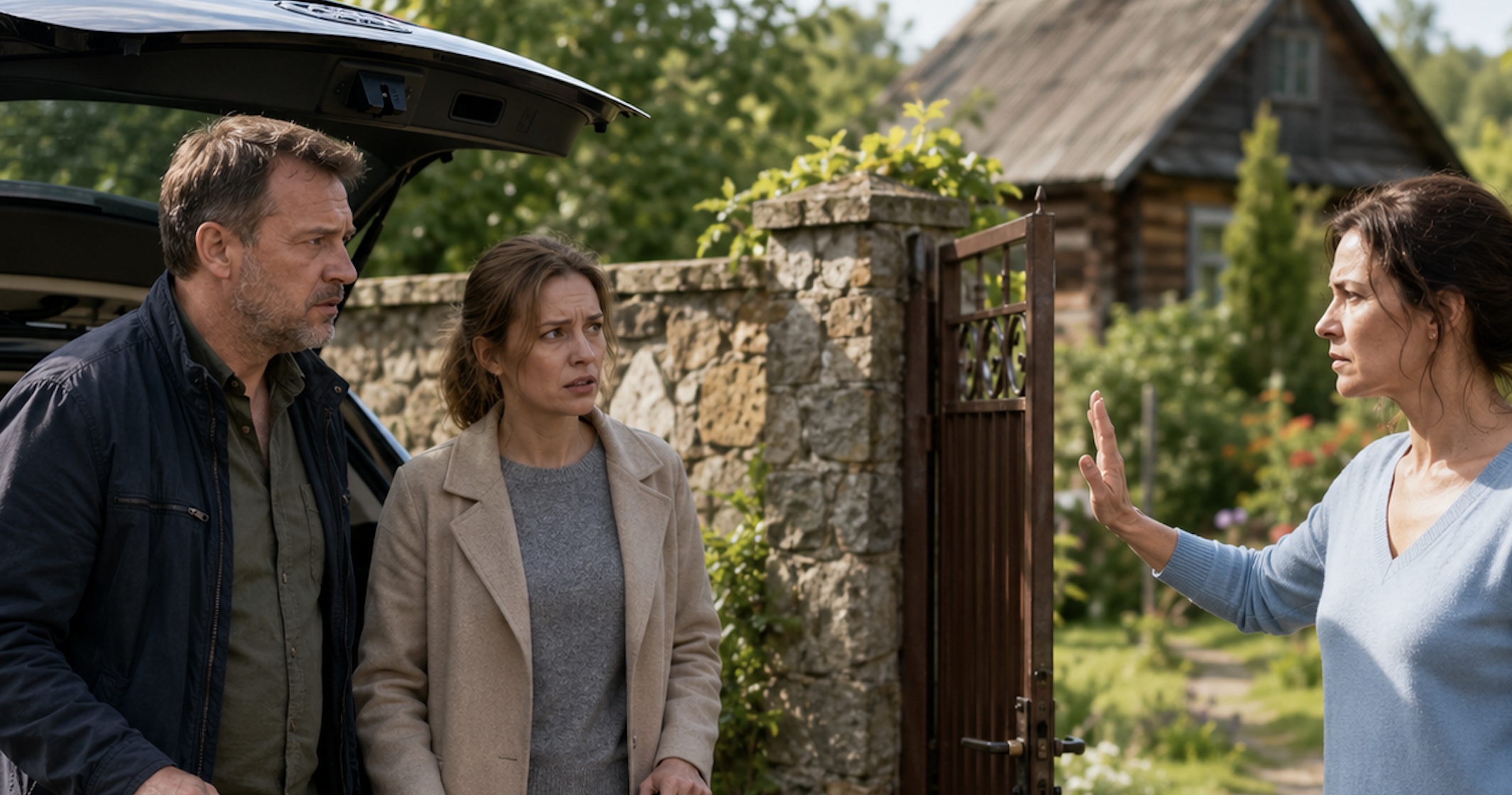
— Came here to relax? Go to a hotel. I’m not your free boarding house.
Vika did not say those words right away.
First, she had driven for a long time along the broken country road, gripping the steering wheel with both hands and trying not to scrape the bottom of the car against the old rain-washed ruts. The car bounced over potholes, while in the trunk the grocery bags, a box of tools, and a new watering can for the greenhouse rolled around with dull thuds.
The dacha had been waiting for her all week.
Vika had planned to arrive on Friday evening, open the windows, walk around the property, check the strawberries, gather the dry branches the wind had blown down, and on Saturday calmly paint the bench by the shed, sort through the seed box, and finally sit on the porch without anyone’s requests, conversations, or that endless, “Vik, come on, what’s the big deal?”
The dacha had belonged to her grandmother. Not to her husband, not to his parents, not to their shared family savings — to Vika herself. Her grandmother had made a will in advance. Six months later, Vika officially inherited the property, received the documents, and registered the house and land in her own name. Back then, her husband Vadim had only nodded and said the place was nice: clean air, the forest nearby, and a river not far away.
For the first two years, he barely went there. He considered the dacha Vika’s little hobby and laughed that instead of having a normal rest, she spent her time fussing over garden beds and an old shed. But everything changed when his relatives once came over for a barbecue.
That time, Vika had invited them herself.
She had felt sorry for her mother-in-law, Zinaida Petrovna, who kept saying she was tired of the city. She invited her sister-in-law Larisa, along with Larisa’s husband and two children. Vadim’s brother Sergey also showed up, even though no one had invited him separately. They spent the day loudly and messily: bags scattered all over the yard, greasy stains on the plastic table, children dumping sand into the old watering tub.
After that day, Vika cleaned until dark. She collected disposable dishes, pulled candy wrappers out of the bushes, scrubbed the bench where someone had spilled sauce. Vadim helped half-heartedly and mostly defended his relatives.
“They came here to relax,” he said then. “Not to do hard labor.”
Vika said nothing, but she made a decision: it would not happen again.
Vadim’s relatives, however, decided otherwise.
First, Larisa started writing to ask whether they could stop by for a couple of hours because the children needed fresh air. Then Zinaida Petrovna hinted that the city was hard on her and she could “stay for a little while” at the dacha. Sergey once asked for the keys so he could “check the roof after the wind,” and later Vika learned from her neighbor Nina Stepanovna that he had sat in the yard with a friend and grilled meat while Vika was at work.
After that, she took the spare keys back from Vadim.
The scandal was loud.
“So you don’t trust me?” he snapped in the kitchen, pushing his plate away. “I’m your husband.”
“I trusted you until your brother held a gathering there behind my back.”
“He only stopped by for two hours.”
“With a stranger. On my property. Without me.”
Vadim slapped his palm against the countertop, but quickly realized that Vika would not back down. She did not shout. She simply opened the drawer, took out the keyring, removed the dacha key, and put it into her bag. She did everything calmly — too calmly. Vadim’s face hardened, as if he had not run into his wife, but into a locked door.
From then on, only she had the key.
At least, that was what Vika thought.
That Friday, she was delayed in the city. First, she had to finish an urgent task at work. Then she stopped by a hardware store for fasteners. After that, she spent too long choosing decent gloves because the old ones had torn. Vadim refused to come with her. He said he was tired and would join her in the morning.
“I’ll manage on my own,” Vika replied.
“Then go,” he said. “Just don’t start another full-scale cleaning session there.”
She looked at him carefully. He was standing by the refrigerator, scrolling through something on his phone, as though waiting for her to leave. It seemed strange to Vika, but she blamed it on fatigue. Over the past few days, Vadim had been restless: sometimes stepping out onto the balcony to talk, sometimes quickly closing his messages whenever she came too close.
She did not interrogate him.
She simply got into the car and drove off.
Near the turn toward the gardening community, Vika noticed something was wrong. Fresh tire tracks from several cars marked the dirt road. Not from one neighbor’s little car, not from the chairman’s old van — from several vehicles. The tracks led toward her street.
Her heart did not sink or stop. Nothing dramatic happened. Her fingers simply tightened around the steering wheel, and her gaze grew harder. Vika slowed down.
When she reached her property, everything became clear even before she turned off the engine.
Two unfamiliar cars were parked by the gate. One was Larisa’s silver car, with a “child on board” sticker on the window. The second was Sergey’s dark car. Behind them, crookedly parked, was another car she did not recognize, dirty along the sides and pulling a trailer. The trailer was empty, but rolled-up mats, a folding grill, and a child’s scooter lay along its side.
The gate was slightly open.
Vika slowly stepped out of the car. She did not slam the door or rush into the yard. She simply took her bag, locked the car, and stood for several seconds by the gate, looking at the scene.
Voices came from behind the fence. Someone laughed. A child’s shriek cut across Larisa’s female voice:
“Matvey, get away from the greenhouse! I told you not to go in there!”
Vika pushed the gate open.
The yard looked as if her property had suddenly been turned into a free vacation base.
On the long folding table lay bags of groceries, bottles of water, packages of meat, bread, containers of salads, and juice boxes. Children’s sweaters, someone’s sneakers, and a bag of towels were thrown across the bench. A grill had already been set up by the shed. A child’s blanket hung on a rope stretched between the apple tree and the grape support. Three travel bags stood by the porch, one open, with T-shirts sticking out of it.
Sergey, wearing a sleeveless shirt and sweatpants, was carrying folding chairs from the car. His wife Inga was rummaging through bags near the table. Larisa, Vika’s sister-in-law, stood with her phone and gave orders to the children. Zinaida Petrovna sat on the porch like the mistress of the house, holding a bag on her lap.
Next to her were house slippers.
Vika’s house slippers.
She looked at them, then slowly shifted her gaze to her mother-in-law.
Zinaida Petrovna noticed her first.
“Oh, Victoria has arrived!” she said in a tone as if Vika had truly been late for a family gathering she herself had organized. “And we thought you wouldn’t be here until tomorrow.”
Larisa turned around and waved.
“Vik, finally! Where were you so long? We were about to start without you.”
The phrase sounded so casual that Vika did not answer immediately. She looked around the yard once more. Inside, everything became quiet, cold, and even. Not from fear. From understanding. They had not asked her. They had not warned her. They had not left her a choice. They had simply erased her from a decision concerning her own home.
“What is going on here?” she asked.
The voices immediately became quieter.
Sergey set the chairs down by the shed and straightened up.
“What do you mean?” he said with fake surprise. “We’re relaxing. The weather is good.”
“On my property?”
Larisa gave a short laugh, but it came out thin and nervous.
“Oh, here we go. Vik, don’t start the moment you walk in. We’re not strangers.”
Vika turned to her.
“I asked what is going on here.”
At that moment, Vadim came out of the house. He was holding two mugs. Not disposable cups. Her mugs from the kitchen cabinet — the white one with a blue stripe and the green one, her grandmother’s, with a small crack near the handle.
Vika looked straight at the green one.
She never let anyone use that mug. She barely used it herself. Her grandmother had drunk from it in the mornings, sitting on the porch when Vika still came here as a schoolgirl. After her grandmother’s death, Vika had kept the mug in the cabinet as a memory. It was not a museum piece, not an expensive thing. It was simply something that belonged only to her.
Vadim caught her gaze and quickly placed the mugs on the edge of the table.
“Hi, Vika,” he said, trying to smile. “Why do you look so serious?”
She looked at him without smiling.
“How did they get here?”
“I wanted to tell you…”
“When?”
He hesitated.
“Well… tonight. I just didn’t have time.”
“They’re already in the yard, Vadim. The cabinets in the house are open. There’s food on the table. Bags are by the porch. You didn’t have time to tell me?”
Zinaida Petrovna sighed loudly.
“Oh, Vika, why are you making such a scene right away? People came from the road. The children are tired. Vadik said it was fine.”
“Vadik is not the owner of this dacha.”
The yard went silent.
Even the children stopped running for a second.
Vadim’s face changed. His smile disappeared; his jaw tightened. He stepped closer to his wife.
“Vika, let’s not do this,” he said quietly. “They’re family. Not for long. Just until Sunday.”
“Today is Friday.”
“Yes. Two days.”
“Without my consent.”
“I’m your husband.”
“So what?”
He blinked. Apparently, he had expected a different answer. Maybe the usual irritation, after which he could say she was exaggerating again. But Vika spoke evenly. She did not throw her bag, did not raise her voice, did not fuss. That made everyone even more uncomfortable.
Larisa put her phone on the table and crossed her arms.
“Vik, honestly, this is ugly of you. We came with children. I promised them the river, barbecue, and an overnight stay. They’ve been waiting all week.”
“You promised them my dacha?”
“Vadim promised.”
“Then let Vadim take you somewhere that belongs to Vadim.”
Sergey snorted.
“Listen, Vika, don’t make a performance out of this. We’re not planning to live here for months. We’ll rest and leave. Your house is empty, the plot is big. What, are you really that stingy?”
Vika looked at him so calmly that Sergey stopped smiling.
“I’m not sorry about the dacha. I’m sorry that grown adults still don’t understand the word permission.”
Inga, Sergey’s wife, stopped rummaging in the bag and wiped her hands with a napkin.
“We brought our own food, actually.”
“Congratulations,” Vika replied. “But the place you took is not yours.”
Zinaida Petrovna rose from the porch. Her face flushed in blotches, but she made her voice sound offended.
“So now I can’t even spend the night in my son’s house?”
“This is not your son’s house.”
“He is your husband.”
“That does not change the documents.”
“Oh, here we go with the documents,” the mother-in-law waved her hand. “It doesn’t take much intelligence to hide behind papers from family.”
Vika slowly turned to Vadim.
“What did you tell them?”
He looked away.
“Nothing special.”
“Vadim.”
“I said they could come. That you wouldn’t mind.”
Larisa immediately jumped in:
“There! That’s what we understood. If we had known there would be an interrogation, we would have rented a cottage somewhere.”
“Excellent idea,” Vika said. “It’s not too late.”
Sergey smirked and reached for a bag of charcoal.
“Come on. Everyone will calm down, we’ll eat, sit together. You’re tired from the road, that’s why you’re getting worked up.”
Without a word, Vika walked past him toward the porch.
Everyone watched as she went into the house. Vadim started after her, but she stopped at the threshold and turned around.
“You stay here.”
“Vika…”
“Here.”
He fell silent.
She went inside.
They had already made themselves at home. In the kitchen, cabinet doors were open. Someone’s bag of spices lay on the counter, next to a pack of napkins. Larisa’s bag was on the sofa in the room, and a child’s backpack lay on the armchair. The door to the small room where Vika kept tools and old things that had belonged to her grandmother stood wide open. A blanket taken from the shelf lay on the floor.
Vika went to the cabinet and saw that the green mug had indeed been taken out. Tea stains remained at the bottom. Not herbal tea — ordinary tea from a teabag, with lemon. A lemon seed clung to the side.
She picked up the mug by the handle with two fingers, held it for a moment, and placed it in the sink. The movement came out too sharp; the ceramic struck the metal loudly. Vika closed her eyes for one breath, then opened them.
No. Not now. Not here, alone in the kitchen.
She went into the hallway and checked the keyring on the hook by the door. The keys hanging there were not hers. They were new. Fresh, shiny, with a red plastic keychain.
Vika took them in her hand and went back outside.
Vadim was standing by the table. Sergey was saying something to him quietly, but when he saw Vika, he stopped.
“Where did these come from?” she asked, lifting the keys.
Vadim turned pale. Not dramatically, but Vika saw him swallow and immediately look away.
“They’re… spares.”
“I asked where they came from.”
“I made a copy.”
“When?”
He said nothing.
“When, Vadim?”
“After that time,” he finally said. “When you took the key back. I needed access. Just in case.”
Vika looked at him for several seconds. Then she shifted her gaze to Sergey. He immediately busied himself with the charcoal, as if the conversation had nothing to do with him. But his face made it clear: he had known everything.
“So you secretly made keys to my dacha and gave your relatives access?”
“I didn’t give them to anyone!” Vadim snapped. “I just came earlier today and opened the place.”
“And who has been coming here without me before this?”
“No one.”
The answer came too quickly.
Nina Stepanovna, the neighbor across the plot, had told Vika back in the spring that she had seen Sergey’s car by the gate. Back then, Vadim had insisted that the neighbor had confused him with someone else. Vika had not argued, but now everything fit together.
“Has Sergey already been here with your key?”
“Why are you starting this in front of everyone?”
“So he has.”
Sergey threw the bag of charcoal onto the ground.
“Fine, I stopped by once. So what? The roof was rattling after the wind. Vadim asked me to take a look.”
“Vadim had no right to ask you to look at my roof without my permission.”
“What difference does it make whose roof it is?” Sergey stepped closer. “It’s a family house.”
“It is not.”
“Are you going to cling to every nail now?”
Vika raised her eyebrows.
“Yes. Every one of them. Because every nail here is either mine or my grandmother’s.”
Zinaida Petrovna gave a mocking smile.
“Your grandmother would probably be surprised that her granddaughter is driving people with children out of the yard.”
Vika turned her head toward her mother-in-law. The woman was sitting on the porch not like a guest, but like a judge who had already decided who was guilty.
“My grandmother locked the gate even on neighbors if they hadn’t warned her in advance. And she never handed out keys to anyone.”
“That’s why she lived alone,” Zinaida Petrovna snapped.
After those words, Larisa quietly gasped, as if she realized her mother had gone too far. Vadim shot Zinaida Petrovna a sharp look, but said nothing.
Vika smiled. Not happily. Only with the corners of her mouth, briefly and almost invisibly.
“Thank you,” she said.
Her mother-in-law frowned.
“For what?”
“For showing me so quickly who I’m talking to.”
Vadim stepped toward his wife.
“Vika, enough. Mom didn’t mean it that way.”
“She meant exactly what she said.”
“Are you really going to ruin everyone’s weekend over one phrase?”
Vika looked at the unfamiliar bags, the children’s blanket, the groceries, the grill, her slippers by the porch, and the shiny keys in her hand.
“No, Vadim. You ruined it yourselves when you decided I didn’t need to be asked.”
Larisa exhaled sharply.
“And what are we supposed to do now? We came with the kids. We have things. It’s already evening.”
“The hotel in the district center is open twenty-four hours. There are also guest houses by the highway.”
“Are you serious?”
“Absolutely.”
“Vik, do you understand how humiliating this is?” Larisa tapped her fingers against her phone. “Are we supposed to pack up in front of the children and leave because you suddenly decided to show your character?”
“Because you arrived without an invitation.”
“But Vadim said…”
“Then direct all questions to Vadim.”
The children started running again. Larisa’s younger son ran up to the greenhouse and pulled at the door. Vika turned sharply.
“Step away from the greenhouse.”
The boy froze and looked at his mother.
“Matvey, come here,” Larisa said irritably. “Before Aunt Vika arrests the greenhouse too.”
Vika ignored the jab. She walked to the table, took her phone from her bag, and opened the map. She found the nearest hotel, turned the screen toward everyone, and placed the phone on the table.
“Here’s the address. Twenty minutes away.”
Sergey laughed.
“Go to hell with your address. We’re already here. I didn’t drive here with a trailer just to run around looking for hotels.”
Vika slowly turned to him.
“Repeat that.”
Inga grabbed her husband’s arm.
“Seryozha, don’t.”
“Don’t what?” He pulled his arm free. “She’s decided to play queen here. We’re people too, you know. No worse than her.”
“No one said you were worse,” Vika replied. “But this is not your property.”
“We know it’s not ours!” Sergey barked. “But you live with our brother. You could at least show some respect for his family.”
“Respect does not begin by breaking boundaries.”
“Nobody broke anything!”
“A key was made without permission. For me, that is already enough.”
Vadim stepped between them.
“That’s it. Enough. Vika, you’re going too far. Yes, I made a copy. Yes, I should have told you. I was wrong. But throwing people out now is too much.”
“People?” Vika nodded toward the yard. “Your mother, sister, brother, their families, and another unknown car with a trailer are here. Who is in the third car?”
Larisa looked uncertainly at Sergey.
Sergey frowned.
“My friends are coming later. Well, they already brought some things and went back for the rest.”
Vika slowly lowered the hand holding the keys.
“More people were supposed to come?”
Vadim looked guiltily toward the fence.
“Sergey said his friend and his wife would stay for one night…”
“One night?” Vika interrupted. “In my house?”
“They would have used a tent…”
“The tents would also be on my property.”
Now everyone was silent.
Vika felt blood rise to her face. Not from embarrassment, not from fear. From such calm, precise fury that every word inside her arranged itself on its own. She no longer searched for soft wording.
“Here is what will happen. You will pack your things, collect the food, take the children, get into your cars, and leave.”
Zinaida Petrovna jumped up from the porch.
“How dare you?”
“I dare to manage my own property.”
“Vadim!” his mother turned to her son. “Do you hear how she’s talking?”
Vadim rubbed his face with his hand.
“Mom, don’t start.”
“No, you don’t start! Your wife is kicking your mother out of the yard!”
“I’m removing uninvited guests,” Vika said.
Larisa grabbed one of the bags, not to pack it, but to move it closer to the porch.
“I’m not going anywhere. The children are tired. If you want a scandal, have one by yourself.”
Vika looked at her.
“Larisa, move the bag away from the door.”
“No.”
“I won’t ask a second time.”
“And what will you do? Call the police on your own relatives?”
“Yes.”
The word landed heavily and unexpectedly in the yard.
Inga immediately began putting the bags back into a large tote.
“Sergey, I don’t want to get involved in this. Let’s go.”
“Sit down,” he snapped at her. “We’re not going anywhere.”
Inga straightened up. Her face took on the expression of a person tired of staying silent.
“I said let’s go. I don’t need other people’s problems. Our children are with my parents; we could have stayed peacefully at home. You’re the one who decided everything was allowed here.”
Sergey flashed his eyes at her but said nothing.
Vika dialed Nina Stepanovna’s number.
The neighbor answered almost immediately.
“Vikus, have you arrived? I saw the cars. Are you having a party?”
“Nina Stepanovna, good evening. Could you please come to the fence? There are people on my property without my consent, and I’m about to call the police. I need a witness that they are here.”
After that phrase, movement in the yard became more noticeable. Larisa sharply turned to Vadim.
“Say something to her!”
Vadim took Vika by the elbow.
“Let’s go talk inside.”
She looked at his hand. He let go at once.
“Talk here.”
“Not in front of everyone.”
“You put me in front of a fact in front of everyone. So talk in front of everyone.”
Vadim lowered his voice, but anger still cut through.
“You are destroying my relationship with my family.”
“They started destroying it when they decided they could come here without my permission.”
“I thought you’d grumble and calm down.”
“That’s exactly the problem, Vadim. You decided in advance that my ‘no’ could simply be waited out.”
He wanted to answer, but from the neighboring plot came Nina Stepanovna’s voice:
“Victoria! I’m by the fence.”
Vika went to the gate and opened it wider. Nina Stepanovna stood on the path in a light jacket, holding her phone. She was the kind of neighbor who saw everything, but only interfered when asked. Now she looked carefully around the yard and immediately understood that there would be no party here.
“Nina Stepanovna, please confirm if needed: I did not invite these people.”
“I will confirm it,” the neighbor said calmly. “I saw them arrive today around five. You were not with them.”
Sergey snorted.
“She even brought the neighbors into it. What a disgrace.”
“The disgrace is having keys to someone else’s house,” Nina Stepanovna replied. “Witnesses are perfectly normal.”
Zinaida Petrovna hunched her shoulders, adjusted her sweater, and suddenly spoke more softly:
“Vika, why are you doing this? We really only wanted to rest. I had been asking Vadik for a long time to take me out into nature. The city is hard, noisy. And here there’s fresh air. I thought you would be glad.”
Vika looked at her. This time without anger. Just attentively.
“If you had called and asked, I would have told you when I could receive guests. Maybe for one day. Maybe with conditions. But you didn’t want to ask. You wanted to arrive in a way that left me unable to change anything.”
Her mother-in-law looked away.
Larisa angrily zipped up a bag.
“Mom, enough. She’s not going to back down anyway.”
“That’s right,” Vika said. “I won’t.”
Vadim suddenly straightened.
“And I’m staying.”
Vika turned to him.
“No.”
“I’m your husband. I can stay.”
“At my dacha, only with my consent.”
“You’re throwing me out?”
“If you continue defending people who came here without permission, then yes.”
For several seconds, he stared at her as if seeing her for the first time. Vika knew that look. It was the way people looked at an object that had suddenly turned out not to belong to them. At a chair they could not take. At a door they could not open. At a woman who would no longer explain the same thing ten times.
“Are you seriously ready to create such a rupture over a dacha?” he asked.
“Not over a dacha. Over respect.”
Larisa slammed the trunk shut so hard the children flinched.
“Let’s pack already!” she snapped. “What a wonderful rest. Thank you, everyone.”
Sergey still stood by the grill.
“I’m not taking the grill back. I already poured out the charcoal.”
“You’ll take it,” Inga said. “And the chairs. And the mats. Everything you brought.”
“Why are you giving orders?”
“Because thanks to your ideas, we look like thieves in front of a woman whose property this is.”
“She’s not a stranger,” he muttered.
Inga looked at Vika, then at her husband.
“She is to us. We came to her without an invitation.”
That phrase unexpectedly changed the air in the yard. Larisa froze with a bag in her hands. Zinaida Petrovna sat back down on the porch, no longer like the mistress of the house, but like a person who did not know what to do with her hands.
Vadim approached Vika again.
“Give me the keys.”
“Which keys?”
“The ones you found.”
Vika tightened her hand around the keyring.
“No.”
“They’re mine.”
“They’re copies of my lock, made without my consent. They stay with me.”
“Vika, don’t shame me.”
“You managed that yourself.”
He sharply drew in a breath but stayed silent. Apparently, he understood that every next word would be worse than the last.
While the relatives packed, Vika stood by the gate and made sure all the чужие things were carried out of the house. Larisa went back and forth, gathering children’s sweaters, backpacks, and bags. Sergey grumbled while folding chairs. Inga silently helped him, but did not defend him. Zinaida Petrovna tried several times to begin a conversation, but Vika answered briefly:
“Is that your bag? Take it.”
“Put my slippers back on the shelf.”
“Fold the blanket and leave it in the house.”
“Take all the food.”
Once, Larisa tried to leave a bag of meat by the shed.
“We could come back for it tomorrow.”
“No,” Vika said. “You take it now.”
“Why are you acting like a supervisor?”
“Like the owner.”
The children had gone quiet. The older boy had already understood that the adults were truly fighting. He stood by the car, twisting the scooter in his hands. The younger one sniffled, but Larisa was so nervous she did not notice at once.
Vika noticed.
She walked to the trunk, took a bottle of water from her own bag, and handed it to the boy.
“Drink. The drive won’t be long.”
Larisa froze.
“We don’t need anything from you.”
“It’s for the child, not for you.”
The boy took the bottle with both hands and quietly said:
“Thank you.”
Larisa turned away. Something like shame flashed across her face, but she quickly hid it behind irritation.
When almost everything had been packed, another car appeared at the gate. The same one they had probably saved space for. A sturdy man got out with a bag of charcoal, followed by a woman in a bright tracksuit.
“Sergey!” the man shouted. “We got everything! The tent too!”
Sergey waved his arm sharply.
“Turn around! Nothing’s happening!”
The man stopped in the middle of the road.
“What do you mean?”
Vika stepped outside the gate.
“The property is closed to outsiders. Turn around.”
The woman in the tracksuit looked her over.
“And who are you?”
“The owner.”
The man looked at Sergey.
“You said everything was fine.”
“I thought it was,” Sergey muttered through his teeth.
Vika said nothing more. She simply stood by the gate, and the strangers quickly realized there was no point arguing. The car backed up, turned around unevenly, raising dust, and drove away.
Vadim watched the road with the expression of a man who was not seeing someone else’s acquaintance leave, but his own confidence that he controlled the situation.
When the last bag was in the trunk, Zinaida Petrovna came up to Vika.
“You will regret this,” she said quietly. “A man won’t tolerate this for long.”
Vika looked at her without smiling.
“Neither will a woman.”
Her mother-in-law opened her mouth, but found no answer. She turned and went to Larisa’s car.
Sergey got behind the wheel of his car, Inga beside him. Larisa seated the children and spent a long time fastening the younger boy’s seatbelt, though it would not cooperate. Zinaida Petrovna climbed into the front seat and demonstratively turned toward the window.
Only Vadim remained.
He stood in the yard without moving.
“Are you going with them?” Vika asked.
“I thought we would talk.”
“Talk.”
“Not like this.”
“There won’t be another format today.”
He looked at Nina Stepanovna behind the fence, at the cars, at the gate, then at Vika.
“I made a mistake. Yes. But you didn’t have to take it this far.”
“You took it this far. You secretly made keys. You secretly brought people here. You allowed them into the house. You let them use my things. You invited even more strangers. And now you want me to handle the consequences gracefully.”
“I wanted everyone to feel good.”
“No. You wanted everyone to feel comfortable. Except me.”
He lowered his head. For a second, Vika even thought he might say something honest for the first time — not an excuse, not a request, not the usual “don’t start,” but a real admission.
But Vadim said something else:
“You’ve become hard.”
Vika gave a short nod.
“Finally.”
He looked at her with resentment.
“So I should leave too?”
“Yes.”
“And not come home?”
“You can come home when you’re ready to talk not like a person whose toy was taken away. But today, leave.”
“This is my family too.”
“Then take care of your family. Find them a hotel.”
He stood for a few more seconds, then pulled his car keys from his pocket and walked toward Larisa’s silver car. She opened the back door so he could sit next to the children. Zinaida Petrovna said something sharp to her son, but Vika was no longer listening.
The cars drove out one after another.
First Sergey and Inga. Then Larisa with the children, the mother-in-law, and Vadim. The trailer rattled over a pothole. Dust rose over the road and slowly drifted along the fence.
When the sound of engines faded, Nina Stepanovna came closer to the gate.
“That was a hard evening for you.”
For the first time in all that time, Vika allowed herself to exhale deeply. Her shoulders lowered, but her face remained composed.
“But a clear one.”
“Change the lock,” the neighbor said. “Tonight, if you have a spare.”
“I do. In the trunk.”
“Want me to call someone to help?”
“No. I’ll manage.”
Nina Stepanovna nodded.
“If anything happens, knock. I’m home.”
“Thank you.”
Vika closed the gate. This time, until it clicked.
Then she went into the house, swept out чужие crumbs, removed the charcoal bag, washed the green mug, and placed it on the top shelf. Not in plain sight. Farther away from чужие hands.
After that, she took the new lock and tools from the trunk and sat down on the porch. She worked slowly, carefully, without haste. The old lock did not give in right away, but Vika did not get angry. She unscrewed the fasteners, removed the body, and placed the old screws beside her. The new lock fit more tightly than the old one. The door closed with a different sound — low, solid, certain.
She checked the key twice.
Then she went to the gate and took the red keychain with the secret duplicates off the inner hook. She put the keyring into her pocket. No one would need those keys anymore.
Her phone vibrated almost immediately.
Vadim.
She looked at the screen but did not answer.
A minute later, a message arrived:
“Are you satisfied? Mom is crying. Larisa is furious. Sergey said he will never set foot there again.”
Vika read it and typed:
“Excellent. That means everyone understood.”
The reply came quickly:
“You went too far.”
Vika looked at the new lock, at the closed gate, at the yard that had become her yard again. At the apple tree under which no stranger’s bags were lying anymore. At the greenhouse no one was trying to enter. At the porch where no people sat after deciding that the owner did not need to be considered.
She wrote:
“No. I simply stopped in time what you had already started treating as normal.”
Vadim did not reply again.
Vika put the phone away and went to the table. A mark from someone’s container remained on it, along with a sticky juice stain. She brought a cloth, wiped the surface, then put her groceries into the refrigerator. She did everything calmly, but not automatically. Each movement seemed to return the space to her: the shelf, the porch, the table, the path to the greenhouse, the gate.
When the yard finally grew quiet, Vika stopped in the middle of the property.
An hour ago, people had been talking here, laughing, giving orders, discussing weekend plans as if the owner did not exist. An hour ago, they had tried to convince her that someone else’s shamelessness was simply family relations, that her property should be available to everyone who managed to call themselves close, that “not for long” cancelled permission, keys, and respect.
Now everything was different.
Vika picked up a forgotten child’s sock from the ground, tossed it into a bag by the gate, and smirked. Tomorrow, if Larisa remembered, she could take it. Over the fence. No one would enter the house.
She walked around the yard once more, checked the shed, the greenhouse, the door, and the gate. The sky was darkening. Somewhere beyond the forest, a bird cried. Inside the house, it smelled of a freshly washed mug, wood, and evening coolness.
Only then did Vika mentally return to the exact moment when she had entered the yard and seen the unfamiliar cars, the half-open gate, the food on the table, and her husband’s relatives settled in as if everything had already been agreed.
Someone had waved to her as though she were late.
Vadim had come out to meet her, tried to smile, and started talking about “family” and “not for long.”
The guests had continued discussing their weekend plans as if the owner were not there.
And Vika had stopped in the middle of the yard, looked directly at all of them, and refused to let her husband finish:
“Came here to relax? Go to a hotel. I’m not your free boarding house.”
And in that very moment, it became clear: “coming as guests” does not mean “without permission and on any terms you like.”