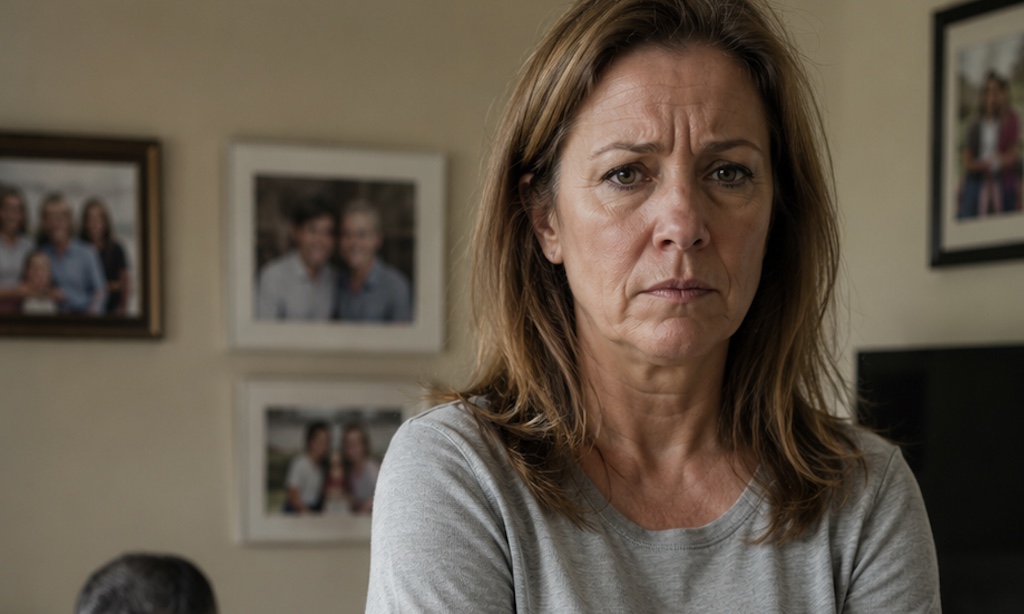
“Transfer the apartment to my name.”
Gennady said it without even looking away from the television. As casually as if he had asked me to pass the salt.
I was standing in the kitchen doorway, holding my mother’s folder of documents. My mother had died two months earlier. She was seventy-eight. Her heart stopped at night — quietly, in her sleep. I had only just received the inheritance certificate. A two-room apartment in Saratov, on Rakhova Street. My mother had saved for it for twenty years, denying herself vacations, wearing the same coat for five seasons in a row. And now it was mine. By law, by her will, and by every sense of justice.
“I don’t understand,” I said.
“What’s there not to understand?” he replied. “Transfer it to me. I’m the man. I decide what belongs to whom in this family.”
We had been married for eighteen years. For eighteen years I had heard who made the decisions. Who earned the money. Who was the head of the house. Gennady worked as a construction foreman. I worked as an accountant at a property management company. My salary was thirty-eight thousand rubles. Every month, I handed over every kopeck to him. Then he gave me fifteen thousand back for groceries — and acted as if that was generosity.
“Gena, this is my mother’s apartment. My inheritance. It is not shared marital property.”
“Everything is shared,” he said, changing the channel. “You’re my wife. That means the apartment is mine too.”
I twisted my wedding ring around my finger. It had become loose — over the past year I had lost seven kilos. My mother’s illness, the funeral, the paperwork.
“No,” I said. “I’m not transferring it.”
Gennady looked at me as if I had said something obscene. Then he smirked and turned back to the television.
“Think about it some more. You’ll come to your senses.”
I took the folder and went into the kitchen. My hands weren’t shaking. But my fingers were cold, as if I had been standing outside in the frost. I sat down at the table and opened the folder. Between the ownership certificate and the cadastral documents lay my mother’s note. Yellowed paper, written by hand:
“Nelly, this is for you. Only for you. Protect it.”
My mother’s handwriting — round, neat, teacherly. She had taught mathematics at school her entire life.
I closed the folder and put it in my bag.
That evening, Boris called. Our son. Twenty-eight years old. He lived separately, worked in Moscow, and called every other day.
“Mom, how are you?”
“I’m fine, Borya.”
“Is Dad trying something with Grandma’s apartment?”
“Why would you ask that?”
“He called me. Asked who Grandma’s lawyer was. And whether the will could be challenged.”
I hung up the phone.
Inside, everything went empty. Not painful. Not frightening. Just empty.
Three days later, I came home from work and opened the closet where the folder had been.
The folder was gone.
I searched the entire apartment. Shelves, overhead cabinets, drawers in the hallway. For an hour and a half. The folder was nowhere.
Gennady came home at eight. I stood in the hallway and waited for him.
“Where are the documents for my mother’s apartment?”
“What documents?”
“Gena. The folder. The green one. From the closet. Where is it?”
He took off his shoes. Hung up his jacket. Only then did he look at me.
“I have it. In a safe place.”
“Give it back.”
“No. I told you to think. You didn’t. So now I’ll do the thinking.”
Eighteen years. Two hundred and sixteen months. Every month — my salary down to the last kopeck. Thirty-eight thousand multiplied by two hundred and sixteen. I am an accountant. I count quickly. Eight million two hundred and eight thousand rubles. That was how much I had brought into this family. Just in salary. Not counting the cooking, the laundry, the cleaning, taking Boris to doctors, doing homework with him, standing in lines for certificates and documents.
And now he had taken my mother’s papers and hidden them.
I called my friend Svetlana.
“Sveta, I need a lawyer. A good one. Family law.”
“What happened?”
“I’ll tell you later. I need a lawyer.”
The next day, I went to the government services office and ordered duplicates of every document. The ownership certificate, the registry extract, a copy of the will. Four thousand rubles and two days of waiting.
When everything was ready, I took the documents to Svetlana and left them with her.
Gennady didn’t know. He thought that without the papers, I was powerless.
That evening, he came into the kitchen while I was chopping onions for soup.
“Well?” he asked. “Have you made up your mind?”
“Yes,” I said. “I restored the documents. Got duplicates. You can keep the stolen papers — they’re worth nothing now.”
His face turned dark red. I watched the muscles in his heavy jaw twitch. He wanted to say something, but no words came.
“You… you went behind my back…”
“You went behind mine first, Gena. I only responded.”
He stormed out of the kitchen and slammed the door. The glass rattled in the frame.
I stood there with the knife in my hand, staring at the chopped onion. My eyes burned. But not because of the onion.
After about five minutes, I wiped my hands on a towel and sat down. I switched on the kettle. The water began to roar. Strange — in the silence after he left, that sound felt deafening.
I drank tea and understood one thing clearly.
This was not the end.
This was the beginning.
Boris called that evening.
“Mom, Dad says you’re making scandals.”
“I restored the documents he stole.”
Boris was silent for a moment.
“Mom, maybe you two should see a family psychologist?”
“Borya, I need a lawyer, not a psychologist. But thank you.”
A week later, Gennady brought his relatives home. Without warning.
I opened the door, and there stood his sister Valeria, his brother-in-law Oleg, and Gennady’s mother, Zoya Pavlovna, eighty-one years old.
“Nelly, we came to talk,” Valeria announced from the doorway.
Five people in a two-room apartment. I didn’t even offer tea. I didn’t have time — they seated themselves. Valeria on the sofa, Oleg in the armchair, Zoya Pavlovna on the chair Gennady had deliberately brought from the kitchen.
“Nelly dear,” Zoya Pavlovna began, “Gena told us you don’t want to put your mother’s apartment in his name.”
“I don’t. It’s my inheritance.”
“But he’s your husband!” Valeria folded her arms across her chest. “A woman shouldn’t own real estate. Property is a man’s business. A woman’s business is the home, the family.”
I looked at her.
Valeria had spent her entire life sitting on Oleg’s neck. She had never worked a day in her life. Four children and not a single day of employment.
“Interesting opinion,” I said. “Mine is different. For eighteen years I gave my husband my salary. Every ruble. Thirty-eight thousand a month. That’s over eight million across all those years. And he gave me fifteen thousand back. For food. For five people, when Boris still lived with us. Three thousand rubles a day for groceries, household supplies, cleaning products.”
The room went quiet.
“In eighteen years, I never once bought myself a dress without asking his permission. Not once. Winter boots — I had to ask. A jacket — I had to ask. And he decided whether I needed a new jacket or whether the old one would do.”
“Well, that’s your family matter…” Oleg began.
“Family matter?” I turned to him. “Then my mother’s apartment is also my family matter. Not yours.”
Zoya Pavlovna shook her head.
“My Gennady always provided for the family!”
“Your Gennady, Zoya Pavlovna, transferred three hundred thousand rubles to Valeria’s card last year. From our family budget. I found out by accident — a text message came to his phone while he was in the shower. Three hundred thousand. That’s eight months of my salary.”
Valeria went red. Oleg stared at the floor. Gennady jumped up.
“You were going through my phone?!”
“I wasn’t going through anything. The screen lit up by itself. A notification came in. You didn’t set a password, Gena. Because it never occurred to you that I might see something.”
“It was a debt! Valeria had borrowed money for renovations!”
“I also invested money into my mother’s apartment, Gena. Eight hundred thousand rubles. From the money my mother gave me for my birthdays while she was alive. Four years, two hundred thousand each year. I saved it. Put it aside. I didn’t tell you a word, because you would have taken it. And I put that money into that apartment — my mother’s apartment. And now you want me to transfer it to you.”
Silence.
Zoya Pavlovna looked at her son. Valeria looked away. Oleg studied the pattern on the carpet.
“Leave,” I said. “All of you. This conversation is over.”
Gennady took a step toward me.
“You’re throwing out my mother?”
“I am asking everyone to leave. Including you.”
He clenched his teeth. That same heavy jaw that had once seemed masculine to me. Now it just seemed heavy.
They left. Zoya Pavlovna was the last, groaning and shuffling in her slippers.
I locked the door with both locks.
The apartment smelled of Valeria’s perfume — sickly sweet floral perfume. I opened the window. Cold air rushed in, and I felt better. Not good. Not happy. But better.
For the first time in three weeks, I felt like I could breathe deeply.
I called Svetlana.
“Sveta, give me that lawyer’s number. I’m going tomorrow.”
But the silence didn’t last long.
The next day, Gennady filed for divorce. And at the same time, he filed a claim for division of property — demanding that my mother’s apartment be included in the marital assets.
The lawyer’s name was Irina Sergeyevna.
She was a dry, composed woman in her sixties, with glasses on a chain. She spread my documents across her desk and read for twenty minutes. Silently.
“The apartment was inherited,” she finally said. “It is your personal property. It is not divided in a divorce. By law.”
“I know.”
“Does he not know?”
“He believes a woman shouldn’t own real estate.”
Irina Sergeyevna removed her glasses.
“I like those types the most.”
She explained the situation to me. The shared property included the apartment where we lived. It had been bought during the marriage. The car — a three-year-old Škoda, registered in Gennady’s name. The dacha in Petrovsk — registered in his name. The garage — in his name. Everything was in his name. In eighteen years, I had never registered anything to myself. He had not allowed it.
“And that,” Irina Sergeyevna said, “will actually help us. Did you work all eighteen years?”
“Without a break.”
“Where did your salary go?”
“To his card. By transfer. Every month.”
“Do you have proof?”
“Bank statements. Eighteen years of transfers.”
“Excellent. And what did he do with the money?”
“He spent it. Saved it. Transferred it to his sister.”
“Do you have proof of the transfers to his sister?”
I hesitated.
“One text message. Three hundred thousand.”
“We need to request a full statement of his accounts through the court. If he withdrew family money, the court will take that into account.”
Boris called that same evening.
“Mom, Dad hired a lawyer. Some guy named Rustam. He says he’ll definitely win Grandma’s apartment.”
“He won’t.”
“Mom, I… I don’t want to choose sides.”
“Borya, I’m not asking you to. But remember one thing. That apartment came from your grandmother. She saved for it for twenty years. She worked until she was seventy-four to pay it off. And she left it to me. Not to Gennady. To me.”
Boris was silent.
“I understand,” I added. “You’re not choosing. That’s okay.”
There were three months before the court hearing.
Irina Sergeyevna requested the bank statements.
And then we found out the truth.
Over the past four years, Gennady had transferred one million two hundred thousand rubles to his sister Valeria.
Not three hundred thousand, as I had thought.
One million two hundred thousand.
From the family budget.
Without my knowledge.
Four transfers.
March 2022 — three hundred thousand.
September 2023 — two hundred and fifty thousand.
June 2024 — three hundred and fifty thousand.
December 2024 — three hundred thousand.
Total: one million two hundred thousand.
When I saw those numbers, I sat in Irina Sergeyevna’s office and couldn’t say a word.
One million two hundred thousand.
My salary for two and a half years.
And I had known nothing about it.
“This is our trump card,” Irina Sergeyevna said. “Withdrawal of shared marital funds without the spouse’s consent. The court is required to consider it during the division of property.”
I twisted my wedding ring.
It hung loose on my finger like something that belonged to someone else.
The hearing was scheduled for March fourteenth. Courtroom number three. The judge was Elena Konstantinovna, a woman about my age, with tired eyes.
Gennady came in a suit. I had seen him in a suit only twice in my life — at our wedding and at my mother’s funeral. His lawyer, Rustam, was a confident young man of about thirty. A folder of papers, a tie, cufflinks.
Irina Sergeyevna arrived in the same gray blazer I had seen at our first meeting. Glasses on a chain. Not a single unnecessary movement.
Rustam spoke first.
Gennady demanded that the apartment we lived in be split equally. The car — to him. The dacha — to him. The garage — to him. And the apartment of his late mother-in-law — my mother — should be included in the marital property because, as he claimed, “during the marriage, the spouse carried out renovations using family funds, which increased the value of the property.”
Irina Sergeyevna stood.
“Your Honor, the property on Rakhova Street was inherited by the defendant. It is her personal property and is not subject to division. As for the renovations, they were paid for with the defendant’s personal funds. Monetary gifts from her mother. Four transfers of two hundred thousand each, on her birthday, over four years. Here are the bank statements.”
Rustam objected.
“Money received during marriage is joint property.”
“Money received as a gift is the personal property of the recipient,” Irina Sergeyevna replied. “Article 36 of the Family Code. Property received by gift. Here are the gift agreements, prepared by the defendant’s mother and notarized.”
My mother.
My dear mother, who continued protecting me even after death.
She had formalized every gift as a legal donation. Notarized.
At the time, I hadn’t understood why.
Now I did.
Gennady sat pale. Rustam flipped through the papers.
Then Irina Sergeyevna presented the main evidence.
Gennady’s bank statements. Four transfers to his sister, totaling one million two hundred thousand rubles.
“Your Honor, during the marriage, the claimant transferred shared marital funds in the amount of one million two hundred thousand rubles to a third party without his spouse’s consent. This constitutes dissipation of joint property. I ask the court to take it into account during division.”
Gennady jumped to his feet.
“It was a debt! My sister borrowed money!”
“Do you have receipts?” the judge asked.
“No, but…”
“A loan agreement?”
“No, we’re family, what agreement…”
“Any correspondence confirming that this was a loan?”
Rustam whispered something to Gennady.
Gennady sat down.
No.
There was nothing.
No receipts, no agreements, no messages.
One million two hundred thousand rubles had simply disappeared.
And Gennady could not prove that the money was supposed to come back.
I sat there and looked at the back of his head. At the collar of his suit, which was a little too tight for him. At his ears, red around the edges.
Eighteen years.
I had given him everything. Every salary. Every ruble.
And he had transferred one million two hundred thousand to his sister and had not even thought to tell me.
The judge left to deliberate.
We waited in the hallway. Gennady on one bench. Me on another. He didn’t look in my direction. Rustam said something quietly to him, but Gennady wasn’t listening. He stared at the floor and clenched his fists.
Forty minutes later, we were called back inside.
The court’s decision:
The apartment on Rakhova Street was the personal property of Nelly Viktorovna and was not subject to division.
The marital apartment: sixty percent to Nelly, forty percent to Gennady.
The car: to Gennady, with compensation for the difference in value.
The dacha: to Nelly, taking into account the dissipation of shared funds.
The garage: to Gennady.
In the end, Gennady received a three-year-old car and a garage.
I received the major share of the marital apartment, the dacha, and my mother’s apartment.
Gennady turned to me. His face was gray.
“Are you satisfied?”
“I received what I was entitled to,” I said.
“You stripped me bare. Robbed me. Left me with nothing but my underwear!”
“Gena, you stripped me bare for eighteen years. Every month. Down to the last kopeck. And when my mother left me the only thing she had, you wanted to take that too. So no, I didn’t strip you bare. You undressed yourself.”
He left. Slammed the door. Rustam hurried after him.
Irina Sergeyevna gathered the documents into her folder.
“Congratulations,” she said.
I stood in the courthouse hallway and looked out the window.
In the parking lot, Gennady was getting into his Škoda.
The only thing he had left.
Well, that and the garage.
My fingers found the ring.
I took it off.
A thin gold band, eighteen years old.
I put it in my pocket.
My hands were warm.
For the first time in many months.
Boris called an hour later.
“Mom, Dad says you robbed him.”
“Borya. The court decided. Not me.”
“He’s crying, Mom.”
I felt sick. Not sorry for him — sick. As if I had swallowed something bitter and it had lodged in my throat.
“Borya, over four years he transferred one million two hundred thousand rubles to Aunt Lera from our family budget. Secretly. While I was saving money on stockings.”
Boris was silent for a long time.
“I didn’t know.”
“Now you do.”
That evening, I returned to our apartment — now mine.
I called a locksmith.
Changed the locks.
Two locks, four keys.
One set for me, one for Boris.
Gennady could collect his belongings in the presence of a court officer. That was what Irina Sergeyevna had told me.
I sat down on the sofa. The same sofa where Gennady had been watching television when he ordered me to transfer my mother’s apartment to him.
The remote lay on the armrest.
I picked it up and switched to the Culture channel.
For eighteen years, I had not chosen what to watch.
Two months have passed.
Gennady lives with Valeria now. In the very apartment where he had sent our money.
People say he tells neighbors and friends that his wife “robbed him,” “deceived him,” and “set him up in court.” That a woman and her lawyer conspired against him.
Valeria sent me a voice message:
“You do realize you destroyed the family, don’t you? All because of an apartment!”
I didn’t answer.
Boris visits me every two weeks. He still communicates with his father, but less often than before. He says it is hard to listen to his dad insult his mother.
Zoya Pavlovna passed on through Valeria that her “heart hurts because of me.”
And I sit in my mother’s apartment on Rakhova Street.
The renovations I paid for with my mother’s gifts. The wallpaper my mother and I chose together. Her kitchen curtains — with little sunflowers.
In the desk drawer lies that same note:
“Nelly, this is for you. Only for you. Protect it.”
I am protecting it, Mom.
My wedding ring lies in a box. Sometimes I look at it. Not out of habit — but to remember how loosely it used to hang on my finger.
Like something foreign.
My friends say I did the right thing. My neighbor, Tamara Ivanovna, said, “Nelly, surely you could have settled it without going to court. He is Boris’s father, after all. You were harsh.”
And Svetlana replied to her, “She tried to settle things for eighteen years. Enough.”
Gennady filed an appeal. His lawyer Rustam is challenging the decision. I’m not afraid. Irina Sergeyevna said he has no chance.
But he is still trying.
Because he still believes that a woman should not own real estate.
But I do.
I own the apartment. I own the dacha. I own what the court awarded me.
Did I go too far? Should I have negotiated, divided everything quietly, and felt sorry for the father of my child?
Or did he earn all of it himself — the court, the changed locks, and the garage instead of a home?