Sonya walked ahead, hopping over cracks in the pavement and counting her steps out loud. Lena held onto the hood of her daughter’s jacket so the little girl wouldn’t dart too close to the road. The May sun was already warm like summer, and the whole courtyard rang with children’s voices.
“Mom, Mom,” Sonya stopped and tilted her head up, “Dad said we’re going to Grandma Valya’s country house. There’ll be barbecue and a swing!”
Lena crouched down in front of her daughter. The smile on her face froze — thin and strained, like a clothesline pulled too tight in the wind.
“When did Daddy say that?”
“Yesterday! When you were washing your hair. He was talking to Grandma on the phone. Then he told me, ‘Pack your little backpack, bunny, we’re going away for the holidays.’”
Lena stood up and glanced at her phone screen. Not one message from Anton. No warning, no question, not even a hint. He had simply decided — and that was it.
She came home with a stone lodged somewhere between her ribs. Sonya ran off to her room to draw, while Lena sat down at the kitchen table and waited for her husband. She believed the conversation could be calm. She always believed that.
Anton came home at half past eight — cheerful, carrying a grocery bag. He put kefir and a loaf of bread on the table, kissed Lena on the temple, and reached into the fridge.
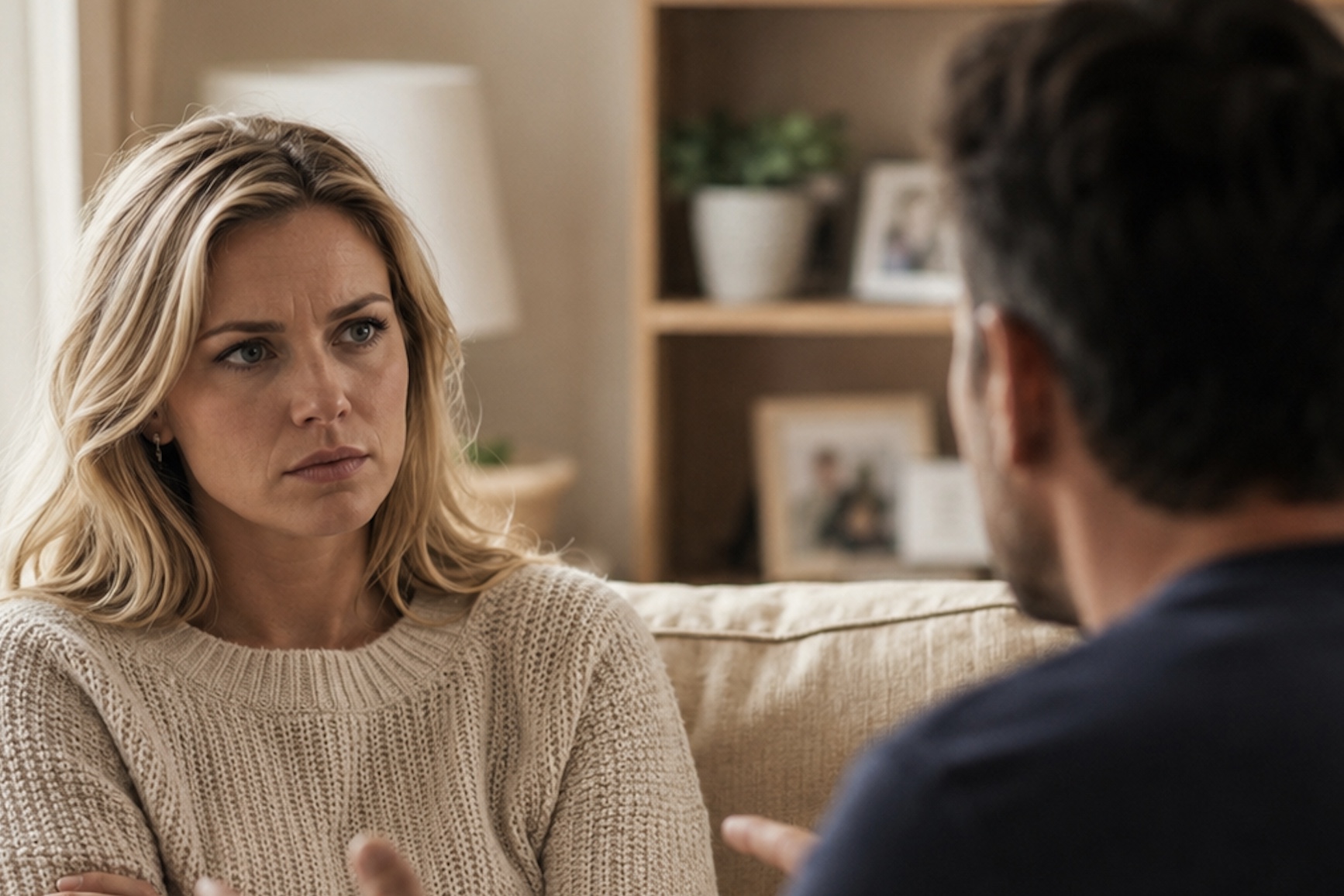
“Anton,” Lena began softly, almost tenderly, “Sonya told me something during our walk.”
“What exactly?”
“That we’re going to your mother’s country house for the holidays. Is that true?”
Anton closed the fridge and turned around. His face was perfectly calm — the expression of a man who genuinely did not understand what the problem was.
“Well, yes. Mom is expecting us. She already marinated the meat. The fence is leaning; I need to fix it. I promised.”
“You promised. But you didn’t promise to ask me?”
“Lena, what’s there to ask? It’s the holidays, fresh air, the country house. It’ll be good for Sonya.”
Lena clasped her fingers in her lap. Her voice remained even, though inside something bitter and familiar had already begun to boil.
“I don’t want to go, Anton. It’s hard for me there. The toilet is outside, the water comes from a well, the mosquitoes come in clouds. Every time I come back from that place, I feel completely drained.”
“It’s a normal country house.”
“For you, it’s normal. You grew up there. I didn’t. And I’m asking you: let’s discuss this together, like two adults.”
Anton sighed and sat opposite her. His expression was patronizing, the way people look at a child throwing a tantrum over porridge.
“Fine, let’s discuss it. Mom is waiting. I promised. Sonya wants to go. What else is there to discuss?”
“The fact that I’m part of this family too. And my wishes matter too.”
“Lena, come on. You can tolerate it for one day.”
“One day?”
“Well…” He hesitated. “Ten. Mom asked if you and Sonya could stay longer. It’s hard for her alone, she needs help. I’ll drive you there and come back. I have things to do.”
Lena leaned back in her chair. Ten days. Not one. Ten. And he said it as casually as if they were discussing what kind of bread to buy — white or rye.
“So you’re going to take me and our daughter to the country house, leave us there for ten days, and drive away?”
“I’m not ‘leaving’ you. I’m leaving you with my mother. Those are different things.”
“To you, maybe. To me, they’re the same.”
He stood up, poured himself a glass of kefir, and took a sip without looking at her.
“It’s already decided, Lena. Mom has prepared everything. Don’t make a mountain out of a molehill.”
Lena wanted to answer, but the sound of small feet came from the hallway. Sonya burst into the kitchen with a pink backpack stuffed to the limit: pencils, a book, a plush rabbit, and rubber boots — one of them sticking out through the zipper.
“Mom, I’m packed! Dad said Grandma will give me a dollhouse!”
Lena looked at her daughter, then at her husband. Anton spread his hands as if to say, See? The child is happy.
“All right,” Lena said quietly. “One day.”
Anton said nothing. She understood then that he was no longer listening.
The country house stood at the edge of a field, near an overgrown pond from which a buzzing cloud of midges rose every evening. The house was old and wooden, with a sagging porch and shutters once painted blue, now the color of forgotten promises. Every time Lena saw it, she was stunned all over again: the family had money, but it never occurred to anyone to spend any of it repairing this place.
Valentina Ivanovna met them on the porch — straight-backed, dry, with pressed lips and sharp eyes. She hugged Sonya, nodded to her daughter-in-law, and immediately led her granddaughter inside to show her the seedling beds.
Lena carried in the bags and paused in the hallway. The walls were covered with photographs of Anton: Anton in a sandbox, Anton at school assembly, Anton at graduation, serious in a white shirt. Not a single wedding photograph. Not one picture of Sonya. As though her son’s life had ended the moment he got married.
“Valentina Ivanovna,” Lena entered the kitchen, where her mother-in-law was already rattling the kettle, “I wanted to talk. Anton said we’re staying for ten days. But I only agreed to one.”
“One day?” Her mother-in-law did not even turn around. “What’s the point of coming for one day? Just wasting gas driving there and back.”
“It’s difficult for me to stay here for long. I hope you understand.”
“Oh, I understand. I understand that everything is difficult for you unless you’re lying on a sofa with your phone. Anton made the right decision. You’ll stay and help. The fence won’t paint itself.”
Lena clenched her teeth and said nothing. Patience. Patience. She repeated the word inwardly like a spell.
Anton left half an hour later. He hugged Sonya, patted Lena on the shoulder, and got into the car.
“I’ll call tonight,” he called through the window.
The car disappeared around the bend, and Lena was left standing in the road with the feeling of someone abandoned at an unfamiliar station.
Less than an hour later, Sonya ran back from the field, tugging at her leg and whimpering.
“Mom! Mom, something is biting me! Here, look!”
Lena dropped to her knees and examined her daughter’s shin. A tiny black dot was embedded in the skin.
A tick.
Her heart plunged.
“Valentina Ivanovna!” Lena shouted toward the house. “Sonya has a tick!”
Her mother-in-law came out, bent down, and clicked her tongue.
“Oh, please. Put some oil on it and it’ll come out by itself. That’s how we always did it before, and we were fine.”
“No. You can’t use oil. We need to go to the hospital and have it tested.”
“What hospital? Have you lost your mind? A hospital because of a tick? City people have gone completely mad.”
“Valentina Ivanovna,” Lena stood up and looked her mother-in-law straight in the eyes, “this is my child. And I am taking her to a doctor. Now.”
“You’re the one who failed to watch her! Where were you looking when she was running through the grass?”
“I was looking where you sent her — ‘go run in the meadow, sweetheart, stretch your little legs.’ Those were your words, not mine.”
Her mother-in-law pressed her lips together until they became a thin white line. Lena was already ordering a taxi on her phone.
In the car, Sonya pressed herself against her mother and quietly sobbed. Lena stroked her hair and dialed Anton. One ring. Two. Three. Five.
“Yes,” her husband answered, his voice irritated and rushed.
“Anton, Sonya has a tick. We’re going to the hospital.”
“A tick? Lena, just pull it out and that’s it. Why are you panicking?”
“I’m not panicking. I’m taking her to a doctor. How can you react like this? She’s your daughter.”
“Fine, fine. You’ll handle it. I’m busy right now.”
He hung up.
He did not ask where she had been bitten. He did not ask whether Sonya was crying. He did not say, “I’m coming.”
He simply hung up.
At the hospital, the tick was removed properly and sent for analysis. Lena filled out paperwork, bought her daughter ice cream from the vending machine, and returned to the country house late in the evening. Sonya fell asleep in the taxi, hugging her rabbit. Lena carried her to bed and sat beside her. She did not sleep until morning. She listened to every breath. Counted the seconds between them.
Anton did not call back.
The morning began with thunder. The sky collapsed over the earth in a heavy gray sheet, and the wind tore at the shutters so violently the whole house groaned. Valentina Ivanovna immediately remembered the laundry on the line and the things left outside.
“Lena, go collect everything from the yard. Quickly, before it gets soaked!”
Lena stepped outside under the first drops. She pulled sheets from the lines, gathered tools into a basin, picked up rags blown around by the wind. Sonya remained inside with her grandmother.
The lightning struck without warning — white, deafening, right into the ridge of the roof. Lena saw smoke pour out from under the tiles, and a second later orange flashed in the kitchen window.
Fire.
The old house, without a lightning rod, caught like a matchbox.
Lena dropped the basin and ran toward the house. At the doorway she collided with Valentina Ivanovna, who rushed outside clutching a handbag and a phone to her chest. Her eyes were wild, her legs unsteady.
“Where is Sonya?!” Lena grabbed her mother-in-law by the shoulders.
“There… in the room…”
Lena shoved her aside and plunged inside. The corridor was already filling with smoke. She found Sonya in the back room. The little girl stood beside the bed, holding her grandmother’s ginger cat against her chest. She was not crying — only staring with enormous eyes.
“Mommy’s here. Come on. Quickly. Don’t be afraid.”
Lena scooped up her daughter with one arm. The cat sank its claws into her jacket, and Lena got them both out through the back door. Outside, neighbors were already rushing around — someone dragging a hose, someone calling the fire department, someone throwing water from buckets. The kitchen was badly burned, but the walls held.
Sonya finally began to cry — softly, without screaming, her face buried in her mother’s shoulder. Lena sat on the ground, holding her daughter, feeling her own heart pound so loudly it seemed to shake her whole body. The cat lay nearby, licking its singed tail.
Valentina Ivanovna stood by the gate, talking on the phone. Lena heard every word.
“Antosha, there was a fire. Lightning struck. The kitchen burned. Yes, I’m fine. I managed to get out. No, the main thing is that I’m safe. As for your wife… what use was she? She was standing outside while the house burned.”
Lena slowly turned her head.
Her mother-in-law did not see her face. She stood with her back turned, nodding into the phone. Not one word that Lena had carried Sonya out. Not one word about the granddaughter at all.
“Valentina Ivanovna,” Lena stood up and walked over. “Give me the phone.”
“Wait, I’m talking to my son.”
“Give. Me. The phone. Now.”
There was something in Lena’s voice that made her mother-in-law silently hand it over.
“Anton,” Lena said evenly, but loudly. “Your daughter nearly burned alive. I carried her out of a burning house. Your mother saved her handbag. Do you want to ask how Sonya is? Or are you not interested?”
“Lena, don’t shout. Mom says everything is fine.”
“Fine?! The house is burning, a six-year-old child is alone in a smoke-filled room — and that is fine?”
“Well, Mom was there…”
“Your mother was outside with her bag! The one who was with your daughter was me. As always — me.”
“Lena, stop yelling. I’ll come tomorrow and we’ll sort it out.”
“No, Anton. You will come today. Or don’t come at all.”
She handed the phone back to her mother-in-law and went to Sonya. Her hands were not shaking. Her mind was clear, as if she had been doused with cold water. Something had changed — not outside, but within her very foundation.
Anton arrived that evening.
Calm.
In the trunk were cans of paint, solvent, and an air freshener for the smell of smoke. He walked around the house, clicked his tongue, touched the burned wall, and returned to his mother.
“Well, it’s not that bad. We’ll repaint it, patch it up. By the end of the holidays, it’ll be good as new.”
“Anton,” Lena stood on the porch with Sonya in her arms, “take us home.”
“Lena, where are we going now? It’s already evening. Tomorrow morning.”
“Now.”
“Mom will be upset. She’s been through enough already.”
“She’s been through enough?” Lena stepped down from the porch. “She’s been through enough? And I haven’t? Yesterday I didn’t sleep half the night because of the tick, today I carried our child out of smoke, and your mother tells you over the phone that I’m useless. And you believe her. You always believe her.”
“Well, she’s my mother. She got carried away.”
“And who am I? What am I in this house, Anton? What am I in this family?”
He was silent. He looked past her, at the blackened corner of the kitchen, as though the crack in the wall mattered more than the crack in their life.
Valentina Ivanovna came out onto the porch with a rag in her hands.
“Antosha, tell her not to make a scene. Let’s paint the walls together instead. Everyone’s already here.”
“Valentina Ivanovna,” Lena turned to her mother-in-law, and her voice rang with restrained anger, “in six years of our marriage, you have never hung a single photograph of your granddaughter on these walls. Not one. But Anton as a little boy in a sandbox hangs in every room. When the house caught fire, you chose your handbag over a child. You blamed me for the tick Sonya picked up while running through your meadow. And now you want me to paint your walls. No. I will not paint your walls. I will repaint my life — without you.”
Her mother-in-law opened her mouth, but Lena had already turned away.
“Anton, I’m filing for divorce.”
Silence lasted three seconds. Then Anton laughed — short and nervous, like a man refusing to believe what he had just heard.
“Lena, are you serious? Because of the country house? Because of a tick?”
“Because in your family I have always been extra. A servant. A function. Someone who is supposed to endure, agree, and keep quiet. I kept quiet for six years. Enough.”
“Come on. You’ll cool down and realize you’re saying nonsense.”
“No, Anton. I won’t cool down. And I’m not saying nonsense. I’m saying the truth — for the first time in six years.”
She went into the house and packed her things and Sonya’s into the same bag they had arrived with. On the dresser beside the bed lay an old photograph: the three of them in a park. Sonya reaching her arms toward her father, while Anton stood with a phone pressed to his ear. Lena remembered that day. Back then she had joked, “You talk to your mother more than you talk to me.” Everyone had laughed.
Now she took the photo and slipped it into her pocket — not as a memory, but as evidence. Physical evidence of six years of invisibility.
“Mom, where are we going?” Sonya clung to her hand.
“Home, bunny. We’re going home.”
“And Daddy?”
“Daddy will stay here. He needs to paint the walls.”
The taxi arrived twenty minutes later. Lena got into the back seat, settled her daughter beside her, and fastened the seat belt. Anton came out to the gate and stood there with his hands in his pockets. His face was confused — not guilty, not frightened, simply confused.
He did not understand.
“Lena, at least tell me — what did I do wrong?”
She looked at him through the glass. For a long time. Carefully. The way one looks at a person one is truly seeing for the first time in many years.
“You didn’t do anything. That’s the problem.”
The car pulled away. Anton remained standing by the fence. Valentina Ivanovna called him in for dinner. He returned to the house and sat down at the table.
A week passed. Anton did not call for three days, certain his wife would “get over it.” On the fourth day, he finally dialed her number. Lena answered calmly and briefly: the papers had been filed, and there was nothing to discuss.
“Lena, this isn’t serious. We had a fight. It happens.”
“It doesn’t happen with us, Anton. Because for a fight, there need to be two people. And you have always been on one person’s side — and it was never mine.”
“You’re being unfair.”
“Maybe. But I’m free.”
Two days later, he came to her without warning, carrying a bouquet and a box of chocolates, as if flowers could patch six years of emptiness. Lena opened the door, looked at the bouquet, and shook her head.
“Why are you here?”
“I want to talk. Normally. Calmly. Without shouting.”
“I never shouted, Anton. Not once in my life did I shout at you. You simply never heard a quiet voice.”
“All right, all right. I understand. Let’s try again.”
“Again from where? From the moment you decided for me that I would spend ten days at the country house? Or from the moment you hung up while I was taking our daughter to the hospital with a tick? Or from the moment your mother saved her handbag instead of her granddaughter?”
“My mother is an older woman. She panicked.”
“She panicked with a handbag in her arms and a phone in her pocket. Very selective panic, don’t you think?”
Anton placed the flowers on the hallway floor and took a step forward.
“Lena, I won’t let you take my daughter.”
Lena did not step back. She stood straight, close to him, and looked directly into his eyes — without fear, without pleading, without the softness that had once been her signature.
“You won’t let me?” She gave a small laugh, and there was so much restrained strength in it that Anton instinctively stepped back. “You didn’t pull her out of a burning house. You didn’t sit with her in the hospital. You didn’t wake up every two hours when she had nightmares after the fire. You don’t know what shoe size she wears now. You don’t know the name of her best friend. You don’t know that she’s afraid of thunderstorms. And you’re telling me you won’t let me take her?”
“I’m her father!”
“You’re her father by blood. In real life, you are a man with a phone to his ear, standing beside her while being a thousand kilometers away.”
Anton fell silent. He stood in the hallway of an apartment that was already no longer his, and for the first time in many years, he had no words. His wife’s words landed precisely — not because she wanted to wound him, but because she was telling the truth.
He left.
The bouquet remained lying on the floor. Lena closed the door, went over to Sonya, who was drawing at the table, and hugged her.
“Mom, did Daddy leave?”
“He left.”
“Will he come back?”
“I don’t know, bunny. But you and I are always together. That I know for sure.”
A month later, the tick test results came back clean — no infection. Lena exhaled so deeply it felt as though she had breathed out the entire past year.
Another month after that, Valentina Ivanovna called. Not Lena — Anton. But Lena heard the details through mutual acquaintances. Her mother-in-law had wanted to transfer the country house to her son — her only, beloved son, whose photographs decorated every wall. She went to the notary, only to discover that after the fire, the house had been declared unsafe, the land beneath it was in a flood-risk zone, and the value of the plot had fallen to almost nothing.
Her entire “empire” — a scorched log house and a crooked fence — was worth nothing.
But that was not the most important part.
Left alone, without Lena, without the familiar order of his life, without dinners on the table and clean shirts in the closet, Anton suddenly discovered that life consisted of more than phone calls to his mother.
The apartment where he had lived was registered in Lena’s name — her parents had helped her buy it before the wedding. The car was also Lena’s, a gift from her father. Anton had grown used to thinking of it all as shared.
It turned out it was not.
He moved in with his mother at the burned country house. There was nowhere else for him to go. His mother met him on the same sagging porch and said a phrase Lena would have remembered forever, had she heard it:
“So why didn’t you keep your wife? I didn’t raise you alone just so you could come back!”
Anton sat in the kitchen — blackened, smelling of smoke and paint — and stared at the wall where his childhood photograph hung. A boy in a sandbox. Happy. Completely unaware of what awaited him.
Lena did not return.
Sonya learned to fall asleep without thunder outside the window.
The photograph from the park — the one where Anton stood with the phone — remained in the pocket of Lena’s jacket. Sometimes she took it out and looked at it.
Not with sadness.
With clarity.
Like a person who had finally stopped being one of her own among strangers — and had become one of her own among her own.