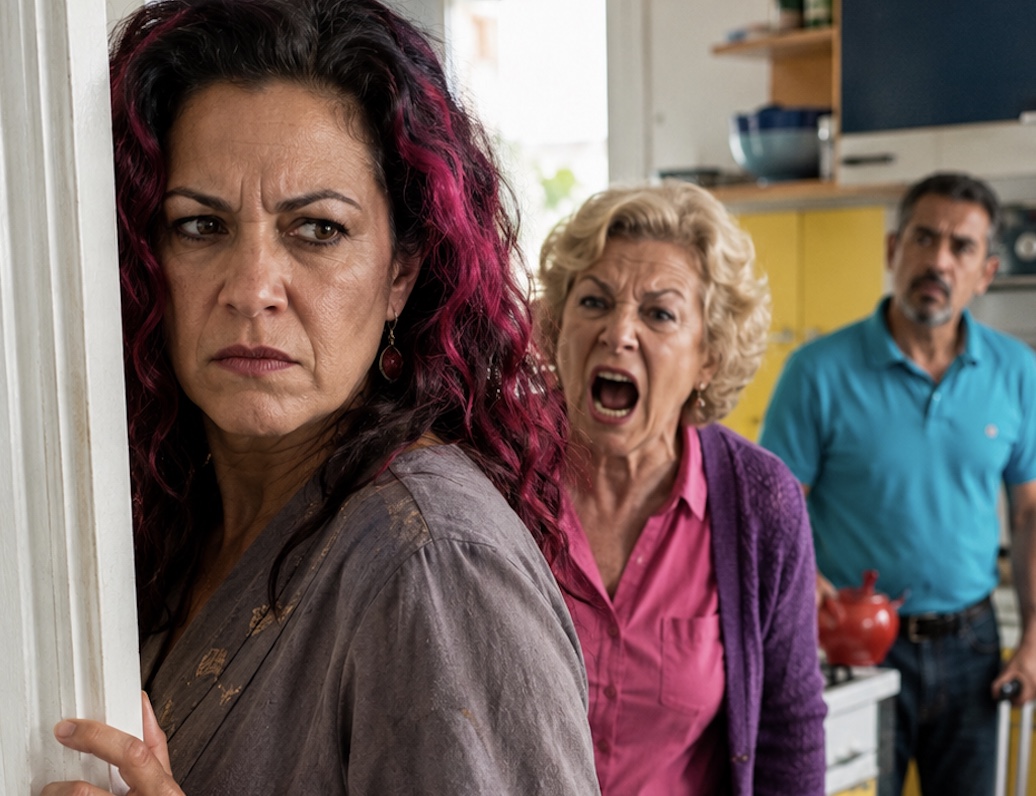
“What are you wearing again? That same gray-brown disaster? Third year in a row, Olya. Third. Do you ever look in the mirror, or have you completely decided to bury yourself alive?” Antonina Pavlovna said with disgust, pinching the edge of my house dress between two fingers as if it were not fabric, but a greasy napkin from some cheap train-station shawarma stand.
I stood by the table with the kettle in my hand, watching steam rise above the bowls of soup. The kitchen smelled of cutlets, dill, and cherry compote. Saturday. Balashikha. My grandmother’s two-room apartment. And everything was as usual: my mother-in-law enthroned by the window, my husband wearing the face of a man interrupted from something important, though all he was doing was chewing.
“Antonina Pavlovna,” I said quietly, “take your hands off my dress.”
“Did you hear that, Igorek? Now she’s snapping back. And I only want what’s best for her. Look at her. No face, no hair, no eyes. At forty, a person should look like a woman, not a cashier after a night shift.”
“I am after a night shift,” I replied. “I got home yesterday at half past midnight. And at seven in the morning, I got up to cook soup for your son.”
Igor lazily lifted his eyes from his plate.
“Don’t start, all right? We just sat down to have a normal lunch.”
“Normal?” I repeated, surprised by how calm my own voice sounded. “This is what you call normal? Your mother is picking at my clothes, and you’re telling me not to start?”
“Oh, Lord, why do you always get so worked up?” my mother-in-law drawled. “It’s impossible to talk to you. Every little comment becomes a tragedy. That’s why you’ve let yourself go. No children, no proper home, no feminine appearance. Everything about you is somehow… unfinished.”
Something old stirred in my chest. Familiar to the point of nausea. Not even hurt anymore. Exhaustion. The kind where you do not want to argue or shout. You only want people to disappear, along with their voices.
“Igor,” I said, keeping my eyes on him, “tell your mother one simple thing. Tell her who pays the utilities for this apartment.”
He grimaced.
“Are we going through this again?”
“No. Not going in circles. Sticking to facts. Tell her who pays the utilities, the internet, the groceries, and your stomach pills because you spent another week eating smoked meat and drinking beer.”
“Olya, are you doing this on purpose? Putting on a show in front of my mother?”
“Oh, so now you’re uncomfortable in front of your mother? And I’ve been comfortable for fifteen years? When she comes here every Saturday for an inspection? Runs her finger over the shelves, counts the spoons, looks into the pots, and then tells me my face is wrong, my voice is wrong, and my life is wrong?”
Antonina Pavlovna leaned back in her chair and snorted.
“I come because my son should have a family, not a dormitory. Everything here is always done carelessly. Sticky floors, old curtains, and you look like you just came from a clinic. You used to at least put on mascara. And now? You sat yourself on my son’s neck and think that just because the apartment belonged to your grandmother, you can do whatever you want.”
“My son,” I repeated. “Fine. Then here is another fact. Has your son paid for a week’s groceries by himself even once in the last six months?”
Igor put down his spoon.
“What exactly are you trying to achieve? Do you want me to report to you in front of my mother?”
“No. I want you to tell the truth for once in your life.”
“The truth,” my mother-in-law cut in, “is that you have become boring, heavy, and constantly dissatisfied. A man comes home, and his wife has the face of an accountant during a tax audit. Who could stand that? A woman should bring joy.”
And then Igor wiped his mouth with a napkin, looked at me coldly, and smirked in a particularly nasty way.
“Mom is right. Have you seen yourself in the mirror? You’ve become empty. No warmth, no lightness. You’re like a stranger now. Even talking to you feels like reading a financial report.”
I slowly set the kettle down on the table.
“Empty?”
“Yes,” he said, growing more confident with his mother beside him. “Empty. You used to be livelier. Now there’s nothing feminine left in you. You come home and immediately start talking about money, bills, work. A man wants a normal wife, not some constantly exhausted auntie.”
“A normal wife?” I even smiled. “You mean a woman who works two jobs, carries the household, tolerates your mother, and then still has to flutter around the apartment in a lace apron every evening?”
“Don’t exaggerate.”
“I’m not exaggerating. For fifteen years, the two of you have been telling me I’m not woman enough. You just conveniently forget whose territory you’re delivering your lectures on.”
Antonina Pavlovna set her cup down sharply on the saucer.
“Do not speak like that in my presence. I am older than you.”
“And what does that give you? The right to be rude?”
“My age gives me the right to see that you ruined my son’s life. Normal people already have grandchildren going to school, and your house is silent. He walks around gloomy, there is no comfort at home, and his wife is like a gray mouse. Of course a man starts to grow cold.”
I looked at her first, then at him. And suddenly I understood with absolute clarity: they were sitting in my kitchen, eating my soup, in the apartment I had inherited from my grandmother, and together they were calmly explaining to me that I was the one who did not belong here.
“I see,” I said. “Then listen to me now.”
“Oh, here we go,” my mother-in-law rolled her eyes.
“No, Antonina Pavlovna. This started fifteen years ago. Now it ends.”
I turned around, opened the lower drawer, and pulled out a heavy cast-iron frying pan. My hand did not tremble. It was still warm, smelling faintly of onion and grease. Igor frowned.
“What are you doing?”
“Watch carefully,” I said very calmly.
I walked over to the table, stood across from him, and with all my strength slammed the pan down onto the oak tabletop beside his plate. The crash was so loud the glasses rattled in the cabinet. His bowl of soup shattered, broth splashed across Igor’s shirt, and the spoon bounced onto the floor. Antonina Pavlovna let out a thin, birdlike shriek, while Igor jerked backward with his chair, lost his balance, and fell to the floor.
“Have you lost your mind?!” my mother-in-law screamed, pressing her hands to her chest.
Igor was already crawling under the table, covering his head with his hands.
I looked down at him and, for the first time in many years, felt neither love nor pity. Nothing. Only clarity.
“No, Igor. You have just shown me exactly who you are. A man who teaches his wife about ‘femininity’ while sitting under the table covered in compote. Very convincing.”
“Olya, stop,” he croaked. “You’re going too far. We were just talking.”
“You were talking. I was silent for fifteen years. Now it is my turn. Listen carefully, both of you. You have exactly forty minutes to collect your things and leave my apartment.”
“You have no right!” Antonina Pavlovna cried. “He is your husband!”
“For now. Formally. But the apartment is my premarital property. Do you want me to read the registration extract number out loud? Or should I call the district officer right now and explain that two citizens are refusing to leave the owner’s home?”
Igor crawled out from under the table, pale and stained with soup.
“Why are you so worked up? Mom said too much. So did I. But that’s not a reason to turn this into a circus.”
“A circus? Igor, you are the circus. I drag grocery bags home from Pyaterochka, finish spreadsheets at night for my second job, stand at the stove in the morning, and meanwhile you tell me I lack lightness. Well, lightness is coming now. Without you.”
“Don’t get heated,” he said, already backing toward the hallway. “Let’s talk calmly. Mom will leave now, and we’ll talk tonight…”
“No. You will leave now. And so will your mother. Together. It’s actually symbolic: at last, you’ll go where you truly feel comfortable — under your mother’s skirt.”
Antonina Pavlovna hissed:
“You ungrateful snake. My son pulled you out of the dirt.”
“Which dirt exactly? My own apartment? My job? Paying for your medicine when he forgot? Should I remind you who called the home IV nurse for you last November? Or was that your son too?”
She faltered, but almost immediately switched back to screeching.
“You hear that, Igor? She counts every kopeck. Not a wife, but an accounting department.”
“Of course I count,” I said. “Someone has to live in reality. Igor, your time has started. Thirty-nine minutes.”
He looked at his mother, then at me, then at the broken plate, and suddenly spoke in a completely different tone — sticky, pleading.
“Olya, stop. I understand, you’re tired. I’ll buy you flowers tomorrow. We’ll go somewhere. We won’t invite Mom. Why get so upset over nonsense?”
“The nonsense is not what you said. The nonsense is the marriage in your head. A marriage where the wife must silently carry everything, and the husband has the right to humiliate her if she has no strength left to put on mascara for soup. Pack your things.”
“You’ll regret this.”
“I already don’t.”
They packed for forty minutes. My mother-in-law deliberately slammed cabinet doors and hissed that I would “curse this day.” Igor carried bags, pretending all of it was temporary. In the hallway, he stopped one more time.
“I’m asking you one last time. Are you really throwing us out?”
“You? No. I’m simply closing the door.”
“What about family?”
“Family is when people do not finish you off inside your own home. That’s enough, Igor. Keys on the console.”
“I’m registered here…”
“Your temporary registration becomes your personal problem tomorrow. Keys.”
He placed the keyring down as if surrendering a weapon. I waited until the elevator swallowed both of them, and only then leaned the back of my head against the door. The apartment was so quiet I could hear the faucet dripping in the bathroom. That silence made my knees buckle.
Twenty minutes later, I was already speaking to a locksmith.
“Urgent lock change?” he asked, setting his toolbox by the entrance.
“Urgent. Today. Now.”
“Threw out your husband?”
“Almost guessed.”
“Then change two locks. People are talented in these situations. First come the tears, then the crowbar.”
“Change two.”
While he drilled into the door, my phone kept ringing. “Igor.” “Igor.” “Igor.” I answered on the fourth call.
“Well?” I said.
“Why did you put on such a shameful scene?” he hissed, as if his mother were sitting right beside him. “Mom is taking blood pressure pills. She’s shaking.”
“What should I do? Send a blood pressure monitor by courier?”
“Olya, don’t be rude. Do you even understand what you’ve done?”
“Yes. For the first time in fifteen years, I did the right thing.”
“You’re destroying a family over words.”
“No. You destroyed the family. Today. When you looked me in the face and repeated after your mother: ‘empty.’”
He fell silent for a second, then spoke with his usual offended tone.
“You always complicate everything. It’s impossible to talk to you like a normal person.”
“Have you ever tried? Like a normal person? Not staying silent while I’m insulted. Not hiding behind your mother. Not living as if I were your maid with the function of a salary card.”
“Oh, here we go again. Money.”
“Because money is reality. And in reality, you are a grown man of forty-two who still cannot tell his mother, ‘Mom, enough.’”
“Go to hell,” he said quietly and hung up.
The next day, I sat in a lawyer’s small office above a pharmacy. It smelled of coffee, paper, and cheap air freshener.
“The apartment was transferred to you before the marriage?” the woman in glasses asked, flipping through the documents.
“From my grandmother. As a gift.”
“Then he has nothing to divide there. We’ll look at movable property, but overall your position is strong. Is there anything else that worries you?”
I placed a folder on the table — one I had found the previous evening in the bottom drawer of the dresser, where Igor usually kept old appliance manuals and useless receipts.
“Please look at this.”
“Hmm… Copies of your passport, insurance number, apartment extract… And what is this? A preliminary application for a loan secured by real estate?”
“I didn’t understand at first either. Then I found correspondence in his email. He and his mother were discussing how to ‘pressure’ me into signing consent. Supposedly for car repairs and a ‘small business.’”
The lawyer looked up at me.
“You threw them out just in time.”
“So they really could have…”
“If you had signed, yes. Then debts, missed payments, and goodbye. Who initiated it?”
“Both of them. His mother wrote: ‘Olga is soft. We’ll press on infertility and age, she’ll agree.’ Word for word.”
The lawyer carefully closed the folder.
“I understand that this hurts, but from a legal perspective, it is useful. We will have solid material in case your husband decides to make claims.”
“He will,” I said. “He only likes being brave when I keep quiet.”
The divorce moved quickly. First Igor sent me a seven-minute voice message calling me hysterical. Then another, where he was already crying and saying he “didn’t mean it like that.” On the third day, my mother-in-law called.
“You think you won?” she hissed. “You’ll come crawling back.”
“I won’t.”
“Who needs you at your age? You threw out your husband, you have no children, your face is tired. Sit alone in your apartment and enjoy it.”
“You know, Antonina Pavlovna, the nicest thing about being alone is that it doesn’t scream at you during lunch.”
“I will curse you.”
“Get in line. You’ve been threatening me with that since 2011.”
She slammed down the phone.
A week later, Igor came himself. He stood outside the entrance with a bag from Krasnoe & Beloe, shifting from foot to foot like a schoolboy kicked out of class.
“Let’s talk,” he said when I came home from work. “No shouting.”
“You have five minutes. Outside.”
“I didn’t want to take a loan against the apartment. Mom pushed it.”
“And whose documents were they?”
“Well, mine, but I just… I was under pressure.”
“From what? Laziness?”
His cheek twitched.
“I have debts.”
“What debts?”
“Just ordinary ones. One credit card, then another, then betting.”
I was silent for several seconds. Cars hissed over the wet asphalt. Near the entrance, a delivery courier was calling someone and saying, “I’m at the door, come out.”
“Betting?” I repeated. “So you were not just living off me. You were also gambling money away?”
“It wasn’t like that. At first it was a little. Then I wanted to win it back. Then…”
“How much?”
“Four hundred seventy thousand.”
“You wanted to mortgage my apartment to cover your gambling debts?”
“I thought I’d pay everything back later.”
“With what? More betting?”
He fell silent and lowered his eyes.
“I’m guilty. But you pushed me too.”
I actually laughed.
“Of course. A man gambled away almost half a million, wanted to crawl into my apartment, and somehow the wife in the old dress is still to blame. Logical. Very manly.”
“Don’t mock me.”
“What should I do? Feel sorry for you? For fifteen years, you pretended the problem was me. That I wasn’t beautiful enough, light enough, warm enough. And it turns out you were simply weak and greedy.”
“I got lost.”
“No, Igor. You got used to me untangling everything.”
He left. But three days later, he called me at night. I had already been asleep. An unknown number appeared on the screen.
“Olya… don’t hang up,” he said in a drunken, damp voice. “I need to say something.”
“It’s one in the morning.”
“I don’t care. I left my mother today. She’s screaming that I ruined everything. I’m sitting in the car. I’ll say it and that’s all.”
“Say it.”
He was silent for a long time. I could only hear a car door slam somewhere and the wind howling.
“Do you remember the clinic in Sokolniki?” he finally asked. “Nine years ago. When we got tested.”
I sat up in bed. I remembered it too well. White walls. Plastic chairs. Tests. Humiliating questions. Then months of silence and his mother’s hints that “some women’s bodies shut themselves off from motherhood.”
“I remember,” I said.
“Everything was fine with you.”
I squeezed the phone so hard my fingers hurt.
“What?”
“Everything was fine with you, Olya. The problem was me. I… couldn’t. Practically zero. The doctor told me directly. And Mom told me to keep quiet.”
Inside me, something slowly turned over. It did not explode. It did not crack. It simply turned over — heavy and many years old.
“Repeat that,” I said.
“It was me. Not you. Mom said if anyone found out, I’d be finished. She said it was better if people thought it was you. That you were career-obsessed, nervous, cold, that your ‘body rejected it.’ It was easier for her that way. And for me too. I stayed silent.”
I closed my eyes. I remembered all her looks. All the stupid advice about herbs, “female energy,” working less and smiling more. All my trips to doctors. All the quiet tears in the bathroom while Igor sat in the next room pretending not to hear.
“So all these years,” I said slowly, “you knew. And you stayed silent. You allowed your mother to use it against me like a knife. And today at the table, when you talked about my ‘emptiness,’ you also knew you were lying.”
“I know. I’m a bastard. I’m weak. I understand everything.”
“No,” I said, and my voice suddenly became completely even. “You don’t understand. Right now you think this confession is an act of courage. But it is just another attempt to ease your own soul at my expense. You have not returned the truth to me. You stole nine years from me. Nine years of shame, guilt, and feeling that something was wrong with me.”
He began to cry. Truly cry. Ugly, choking sobs.
“Forgive me. I was afraid.”
“Of course you were afraid. That’s what you’ve been doing your whole life.”
“I thought if I told you, you would leave.”
“And it was more convenient to keep me guilty?”
He said nothing.
“Listen to me carefully, Igor,” I said. “After tonight, I do not even have hatred left for you. You are too small for such a luxury. There is only one fact: you and your mother spent years building my guilt so that you could live more comfortably. Now live in it yourselves. You will not call me again. Ever.”
“Olya…”
“Ever.”
I hung up and sat in the dark for a long time. Outside, a sparse rain hissed against the window. The refrigerator hummed in the kitchen. Someone in the apartment next door coughed softly. An ordinary night. An ordinary building. An ordinary life. Only in that life, one old sticky thought had suddenly disappeared: that something was wrong with me.
In the morning, I pulled a box down from the storage shelf. It was full of medical papers, old prescriptions, and meaningless printouts from women’s forums where I had once underlined phrases about “psychosomatics.” I placed the box on the floor and said out loud to myself:
“Enough.”
Then I called Lena from work.
“Are you free after your shift today?”
“Depends why. If we’re crying, I’m not free. If we’re drinking coffee and swearing, I am.”
“We’re going to the mall.”
“Oh, now that sounds human. What are we buying?”
“A dress.”
“What kind?”
I looked at the box by the door, then at my reflection in the dark window, and suddenly smiled.
“Not a gray-brown disaster. Something bright. So bright that my former mother-in-law feels sick from a distance.”
Lena burst out laughing.
“Now I recognize you. What about heels?”
“No fanaticism. I’m not trying to prove anything to anyone. I just want to feel good.”
“That, Olya, is the most expensive kind of beauty. Late, but you got there.”
That evening, I stood in a fitting room in front of the mirror, wearing a dark blue dress with a simple, clean silhouette. Not a girl. Not a victim. Not a “convenient wife.” Just a woman with a straight back, clear eyes, and a strange new feeling inside — as if an old, heavy cabinet that had blocked the light for years had finally been carried out of the house.
My phone pinged. A message from the lawyer:
“The court date has been set quickly. No risks regarding the apartment. And one more thing — you did well by not staying silent.”
I typed back:
“Thank you.”
Then I put the phone away, adjusted the collar, and quietly said to my reflection:
“So there was never any emptiness.”
And in the mirror, for the first time in many years, no one argued with me.