Anastasia bought her apartment when she was thirty-two.
It was only a one-bedroom place, but it was hers. It stood on the edge of the city, in a newly built block where the smell of fresh paint and construction dust still lingered in the hallways. She had saved for five years, denying herself almost everything. A seaside vacation was replaced by walks in the park. New clothes were bought only when the old ones were completely worn out. A café visit happened once a month at most.
Her friends were amazed by her persistence. Her mother kept saying she was too obsessed with the idea. But Anastasia kept moving toward her goal.
Every month, she put aside a third of her salary. She followed discounts in stores, repaired old things instead of buying new ones, and counted every unnecessary expense. Those were five long years of patience and waiting. When the day finally came to sign the bank papers, her hand trembled with excitement.
Her own apartment.
It almost did not feel real.
But now it was her personal space. No one could say, “Move your things off my sofa,” or “Turn off the light, electricity is expensive.” Her own apartment meant freedom. It meant being able to live the way she wanted, not the way someone else found convenient.
She furnished it slowly, choosing every item with care. A light-colored sofa for the living room. A comfortable armchair by the window, where she could read in the evenings with a cup of tea. A small desk. Bookshelves along the wall.
Everything was simple, without luxury, but warm and cozy.
And most importantly, it was hers.
She met Egor almost a year earlier at a corporate party hosted by her friend Svetlana. Sveta worked at a large IT company and had organized a celebration after her team successfully finished a difficult project. Egor was one of the lead developers on that team.
At first, Anastasia found him interesting. He talked a lot about the IT world, new technologies, conferences in other cities, and work projects. He spoke beautifully, with the confidence of a man who seemed to know exactly what he wanted. He had a pleasant voice, intelligent eyes, and a light sense of humor. He knew how to listen, asked questions, and seemed genuinely interested.
They met several times a week. Sometimes they went to the cinema to watch a new film. Sometimes they walked along the river on weekends. Sometimes they sat in a quiet café not far from the city center.
Egor was attentive. He brought flowers for no reason, opened doors for her, asked about her work, and remembered little details from her stories.
Everything seemed proper. Everything seemed right.
They had not made anything official. There had been no talk of marriage, no serious discussion about living together. Anastasia was in no hurry. She wanted to look closer, to understand whether he was truly the right person.
She had seen too many examples around her: people marrying three months after meeting, swept away by emotion, and then spending years divorcing through court, dividing property and tearing each other apart.
Egor still lived with his parents in a two-room apartment on the other side of the city, in an old panel building from the seventies. He was twenty-eight, but he was not in a hurry to move out.
“Why rent if I can live at home?” he once explained when Anastasia asked him about it over coffee. “Rent is expensive. It’s just money thrown away. At least thirty thousand a month. Better to save for my own place. Once I have enough for a mortgage down payment, I’ll move out.”
Anastasia nodded and did not interfere. Everyone lived the way they thought was right. She was comfortable in her apartment, and where Egor lived was his own business. She was not the type to climb into someone else’s life with advice and lectures.
Still, from time to time, he complained about his parents.
Sometimes he complained that his mother checked his things, rearranged his closet without asking, and washed his clothes even when they were clean. Other times he complained that his father criticized every decision he made — his job, his spending, even his clothes and haircut.
“I’m already an adult, but they still control me,” Egor would say, tapping his fingers nervously on the table. “Yesterday my mother made a scene because I came home late. At eleven in the evening! Can you imagine? I’m twenty-eight, and she still demands to know where I was, who I was with, and why I stayed out.”
“Then why don’t you move out? Rent at least a room,” Anastasia asked, watching him.
“Where would I go? Renting is expensive, I told you. And why overpay if I can tolerate it for a while? I still haven’t saved enough to buy anything. I’ve only been working for four years. I can’t handle a mortgage on my salary,” he answered, quickly changing the subject.
Anastasia treated it calmly and did not offer him to move in with her.
She believed such decisions had to be made thoughtfully, together, after a serious conversation. You could not simply let someone into your personal space. That was a huge responsibility.
Besides, they had been dating for less than a year. It was too early to talk about living together. They still needed to know each other better, to understand whether their personalities, habits, and views on life were compatible. They needed to know whether they were ready to share everyday life, make joint decisions, and compromise.
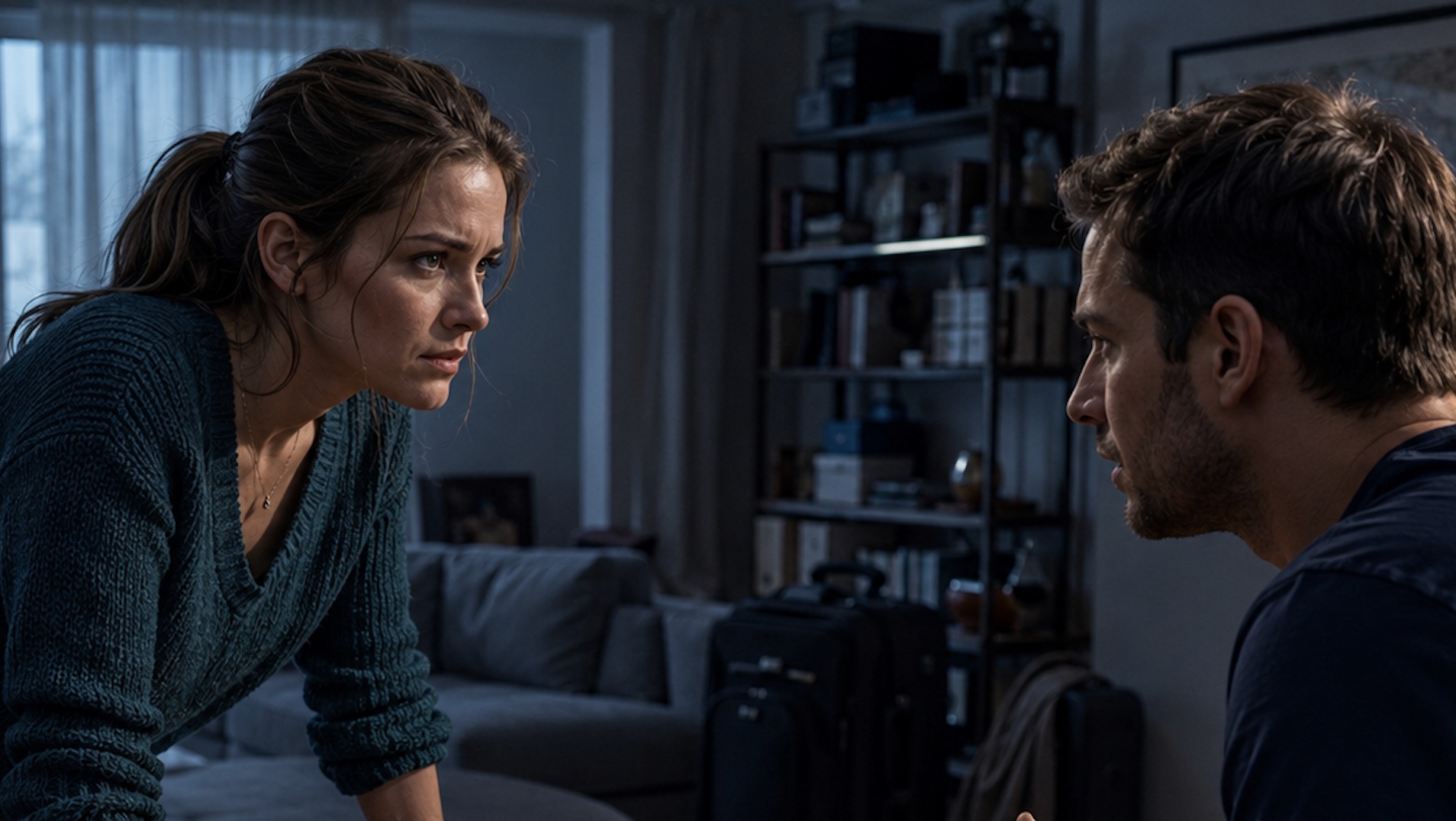
One Friday evening, Egor came to see her after work. It was around eight o’clock.
Anastasia opened the door and froze.
He was standing on the threshold with two enormous sports bags, both stuffed to the limit. It was obvious he had crammed in everything he possibly could.
“Hi,” he said with a wide smile, squeezing into the hallway and dragging the luggage behind him. The bags were clearly heavy; the handles dug into his palms.
“Hi,” Anastasia said, stepping aside to let him in. “What is this?”
“My things,” Egor replied, dropping the bags onto the floor with a dull thud and straightening up while rubbing his shoulders. He looked pleased, as if everything had already been decided and agreed upon. “I’m moving in with you. Temporarily, of course. Until I find a rental place. Or maybe we’ll decide to stay together if everything works out.”
Anastasia stood there, blinking, trying to process what she had just heard.
Moving in.
Temporarily.
Without warning.
Without discussion.
He had simply arrived with his belongings and announced it, as if it were the most natural thing in the world.
“Wait,” she said, raising her hand. “Moving in? When did we discuss this?”
“Well, I told you I was tired of living with my parents,” Egor said, walking into the kitchen. He opened the refrigerator, took out a bottle of water, and drank a large gulp. “I decided it was time to stand on my own feet. I’ll stay with you while I look for a rental. Or maybe we’ll decide to live together after all, if we like it. We’ll see how it goes.”
Anastasia followed him into the kitchen.
Her head was spinning. She tried to remember even one conversation where they had discussed living together.
No. There had been none.
Egor had complained about his parents. He had said he wanted to move out. But he had never said a word about moving into her apartment. Not even a hint.
“Egor, stop. Let’s start from the beginning. When exactly did you and I discuss you moving in with me? Remind me, please,” she said, trying to keep her voice calm, though irritation was already rising inside her.
“I told you last week that I wanted to move out of my parents’ place. I’m sick of it, you know? Every day it’s the same thing — where were you, who were you with, why are you late, why did you spend money. It’s unbearable, like living in prison,” he waved his hand, as if it were obvious. “You knew about it. I told you.”
“You told me you wanted to move out. But you did not discuss with me that you intended to live here. In my apartment,” Anastasia said, crossing her arms.
“Where else am I supposed to go, Nastya?” Egor shrugged, as if the answer was obvious. “You have an apartment. There’s plenty of space. You’re probably lonely here by yourself anyway. I won’t stay long, honestly. Two or three weeks, maybe a month at most. I’ll find something affordable and move out. It’s not forever.”
“Egor, this is my apartment. I bought it myself. I saved for five years. I denied myself everything. And the decision about who lives here is also mine,” she said slowly, pronouncing every word clearly.
“Well, I thought it went without saying,” he replied, placing the bottle on the table. “We’ve been dating almost a year. It’s normal for a boyfriend to stay with his girlfriend if he has nowhere else to go. Everyone does that. It’s just the natural next step.”
“It is normal if the girlfriend agrees. Nobody asked me,” Anastasia said, feeling the tension grow with every second.
“Come on,” Egor smiled in a conciliatory way. “Don’t make a big deal out of nothing. I’m not asking you to register me here permanently. I’ll just stay for a while until I sort out the housing issue. It’s convenient for both of us. We’ll spend more time together and get to know each other better.”
Anastasia took a deep breath.
She could feel anger boiling inside her, but she tried to hold herself together. She could not explode. She had to speak calmly, without emotion.
“And when were you planning to ask me? Or were you just going to move in and present it as a fact?”
“Nastya, you’re exaggerating the problem,” Egor said, waving his hand. “Look, my parents gave permission for us to live at your place. I talked to them yesterday evening, we discussed everything,” he added with complete seriousness, as if that were a strong argument that should settle the matter.
Silence fell over the room.
Heavy. Thick. Tense.
Anastasia slowly straightened, as if checking whether she had heard correctly.
Permission.
His parents.
Had given permission.
To live in her apartment.
An apartment they had never seen. An apartment they had not paid a single coin toward. An apartment they had apparently only learned about yesterday.
“Repeat that, please,” she said, tilting her head slightly and looking at him carefully. “Who gave permission?”
“My parents. I asked them for advice yesterday, and they said it was normal. Mom even said that if we’re serious, then it’s a logical step. Dad was fine with it too. He said young people need to get used to each other and see whether they suit each other,” Egor said casually, as if there was nothing strange about it.
Anastasia closed her eyes and counted to ten.
Then she opened them and asked calmly:
“Egor, since when did your parents start making decisions about my apartment?”
“They’re not making decisions,” he frowned, as if she were saying something foolish. “I just asked for their opinion. That’s normal — asking your parents before making an important decision. They’re experienced. They’ve seen a lot. They can give good advice.”
“Asking your parents for advice is normal. But this is my apartment. I bought it. I pay for it every month. And I decide who lives here. Not your parents, who have never even seen this place and have absolutely nothing to do with it.”
“Fine, I didn’t think it through, I’m sorry,” Egor said, raising his hands in surrender. “But what actually changes? You have space, and I have nowhere to live. Let’s just try it. If it doesn’t work, we’ll separate. No obligations. We’ll just see what it’s like to live together.”
Anastasia shook her head.
He still did not understand the real problem.
“Egor, it’s not about space. It’s about the fact that you made a decision without me. You discussed it with your parents, packed your things, and came here. You didn’t even ask my opinion. Doesn’t that seem strange to you? Doesn’t it feel wrong?”
“Nastya, it’s logical,” he tried to explain, spreading his hands. “You have a big apartment — a whole one-bedroom. I don’t want to rent, and I’m tired of living with my parents. So the most reasonable option is for me to stay with you. Everything fits perfectly. I don’t understand what the problem is.”
“The logical thing would have been to ask the owner of the apartment first, not consult third parties,” she said evenly, without raising her voice. “That is called respect.”
“What do you mean, third parties? They’re my parents! The closest people to me! They only want what’s best for me!” Egor was beginning to get irritated, and hurt notes entered his voice. “Besides, we’ve been together almost a year. Isn’t that a sign that the relationship is serious? Don’t I have the right to hope for support?”
“The seriousness of a relationship is shown by how a person makes decisions. Together with their partner, or behind their partner’s back,” Anastasia said, walking over to the window and looking outside, trying to calm herself.
Streetlights glowed below. People were hurrying home after work. Someone was walking a dog in the courtyard.
An ordinary Friday evening.
And inside her apartment stood a man with two bags, sincerely unable to understand what was wrong.
“Nastya, please don’t make me angry,” Egor said, stepping closer and trying to take her hand. “I thought you’d be happy. This is a step forward. We’ll spend more time together and get to know each other better. Isn’t that what all couples want?”
“A step forward is taken by two people. When both want it. When both agree. You just showed up with bags without even warning me,” she said, pulling her hand away.
“Fine, I’m sorry. I really didn’t think,” Egor sighed. “Let’s fix it now. I’m officially asking: Nastya, may I stay with you? Please.”
Anastasia looked at him for a long moment.
Egor stood there looking guilty, but in his eyes there was certainty.
She would agree. Where else would she go? They were dating, she had an apartment, it all made sense. It was just a formality.
“No,” she said calmly.
“What do you mean, no?” Egor looked stunned, as if he had heard something impossible.
“No, you may not. At least not now.”
“Why? I apologized!” he said, unable to believe it.
“Because you’re not ready. You brought your parents’ permission into my apartment instead of talking to me. And you don’t see the problem with that. But it is a problem, Egor. A very big one.”
“Nastya, are you serious? Over some formality? Over words?” he threw up his hands. “I apologized! I admitted my mistake! What else do you want?”
“This is not a formality. It is a question of respect and maturity. If a twenty-eight-year-old man asks his parents for permission to move in with his girlfriend, then he has not yet learned to make independent decisions. And I am not ready to live with someone who consults his mother about every part of his private life.”
“I didn’t ask for permission! I just asked for advice! Those are different things!” Egor raised his voice, his face reddening with anger.
“There is no difference here. You discussed my apartment and my personal space with your parents. Without me. You decided where you were going to live with your mother,” Anastasia said, walking into the hallway and picking up his bags. “Take your things.”
“Are you joking? Nastya, where am I supposed to go now? It’s late! It’s eight in the evening!” panic appeared in his voice.
“To your parents. The ones who gave permission,” she said, opening the door wide.
Egor stood in the hallway, red with anger and humiliation.
“You’re really kicking me out? Because I asked my parents for advice? Because of an ordinary conversation?”
“I’m suggesting you think. About how relationships are built. About what it means to make decisions together. About the fact that you cannot enter someone else’s life and someone else’s space without being invited. When you understand that, then we can talk.”
“This is ridiculous! You’re making a scandal out of nothing! I wanted the best! For both of us!” he grabbed one bag, yanking at the zipper.
“This is not nothing. This is the foundation,” Anastasia said, handing him the second bag. “When you learn to take responsibility for your own decisions, when you stop asking your parents for permission about your personal life, then we can talk. Until then, live where you were allowed to live.”
Egor snatched the bag from her, turned around, and left, slamming the door so hard the glass rattled.
Anastasia leaned against the doorframe and closed her eyes.
Everything inside her was trembling — from anger, disappointment, and hurt.
But along with it came relief.
She had seen something she might otherwise have missed. A man who lived according to his parents’ instructions would never become an equal partner. He would always be a son first.
Egor called two hours later.
Anastasia did not answer.
Then he called three more times. She rejected every call.
At midnight, a long message arrived:
“Nastya, you’re exaggerating. I just wanted what was best for both of us. My parents have nothing to do with it. It was just a normal conversation. You’re making a mountain out of a molehill. We’re adults. Let’s solve this calmly, without unnecessary emotions.”
Anastasia did not reply.
She went to bed, but she could not fall asleep for a long time. She kept replaying the whole evening in her mind.
Maybe she had gone too far? Maybe she should have given him a chance? Maybe he simply had not thought it through and truly had not meant any harm? Maybe it had been a one-time mistake?
No.
She had done the right thing.
A person who, at twenty-eight, could not make a simple decision without parental approval was not ready for a serious relationship. He would ask his mother’s advice on everything — where to live, how to spend money, how to raise children, where to go on vacation.
She had seen men like that before. Outwardly adults, working, earning money, but in reality remaining mama’s boys their entire lives.
The next day, her friend Sveta called — the same friend whose corporate party had introduced her to Egor.
“Nastya, Egor is saying at work that you two had a fight. What happened?”
Anastasia sighed and told her the whole story.
Sveta listened silently, then burst out laughing.
“Parental permission? Seriously? God, what a child. Is he twenty-eight or eight?”
“That’s exactly what I thought.”
“You know, I worked with him on the same team for a year. He’s a good programmer, a competent specialist. But he’s always quoting his mother. ‘Mom said that’s wrong.’ ‘Mom thinks we should do it differently.’ At first I thought he was joking. Then I realized he wasn’t.”
“Why didn’t you tell me earlier?”
“I thought maybe he was different in his personal life. People behave differently at work and at home. I thought it was just his way of speaking.”
“Apparently not. Apparently that’s who he is.”
“Nastya, you did the right thing. Men like that don’t change. He will always have two opinions — his own and his mother’s. And his mother’s will matter more. Always.”
Anastasia ended the call and felt even more relieved.
It was good she had seen it now, not after a year of living together. Not after five years of marriage. Not after children, when every decision about their upbringing would have to pass through grandmother’s advice.
In the morning, another message came from Egor:
“Nastya, let’s meet and talk properly. I understand I was wrong. Forgive me. I’m ready to fix everything. Give me a chance.”
She wrote back briefly:
“Egor, I need time to think. Please don’t call me for now.”
Time revealed a great deal.
A week later, Egor tried to come again — this time with apologies and a huge bouquet of red roses.
Anastasia met him at the door and did not invite him inside.
“Nastya, forgive me. I really didn’t think. I was a complete idiot. Let’s start over and forget this stupid incident,” he said, holding out the bouquet, hope shining in his eyes.
“Egor, do you understand what the problem was?”
“Yes, I understand. I should have talked to you first, not my parents. It was wrong of me.”
“And?”
“And what else?”
“What comes after that? Do you understand why it matters?”
He fell silent, searching for words, shifting from one foot to the other.
“Because it’s your apartment? And you have the right to decide who lives in it?”
“Not only that. Because relationships are built on respect. You cannot make decisions that affect both of us without asking my opinion. That is a basic rule. The foundation of any relationship.”
“I understand, honestly. It won’t happen again. I promise. I give you my word.”
Anastasia shook her head, looking at him closely.
“Egor, the issue is not whether it will happen again. The issue is that at twenty-eight, you still live by your parents’ advice. And until you understand that yourself, nothing will change. You will keep asking them for permission for every step of your life.”
“Nastya, can’t you see? I came here, I’m apologizing. I admit I made a mistake. I bought flowers. What else do you want?”
“I need a partner. An adult, independent person who can make decisions and take responsibility for them. Not a boy who consults his mother and father about every question in his personal life.”
“Not every question! It was one time! You’re nitpicking! You’re looking for an excuse on purpose!” Egor’s voice grew louder.
“Egor, in the year we’ve been together, you’ve told me a hundred times what your parents advise, what they think, what they believe is right. You live by their opinion, not your own. Even your job choice came after a long consultation with your father. Even your car purchase needed their approval.”
He stood silently, gripping the bouquet so tightly that the stems cracked under his fingers.
Then he turned and left, throwing the flowers onto the stairwell floor.
Several months passed.
Anastasia ran into Egor by chance at the shopping center near her home. He was with a girl — young, about twenty-three, wearing a bright dress and laughing. They were holding hands, choosing something in an electronics store and arguing about specifications.
Egor noticed Anastasia and gave her a strained, awkward nod.
She nodded back and walked past without stopping.
At home, while brewing her favorite green tea, she thought about that story.
Back then, on that Friday evening, when he had arrived with bags and parental permission, she had made the right choice. Letting him into her apartment would have meant letting into her life a man who did not know how to make decisions on his own.
Her apartment was her fortress.
A space where she set the rules.
And no one had the right to enter it without her consent.
Not even with permission from someone else’s parents.
Especially not with permission from someone else’s parents.
Anastasia smiled as she looked out the window. Beyond the glass, the lights of the evening city were glowing. Somewhere out there, people were building relationships, arguing, making peace, learning to live together. They were making mistakes and trying to correct them.
One day, she would also meet the person with whom she would want to share her space.
Someone who would ask for her opinion, not his parents’ permission.
Someone who understood that serious decisions are made by two people together, not through a family council.
But for now, her one-bedroom apartment belonged only to her.
And that was wonderful.