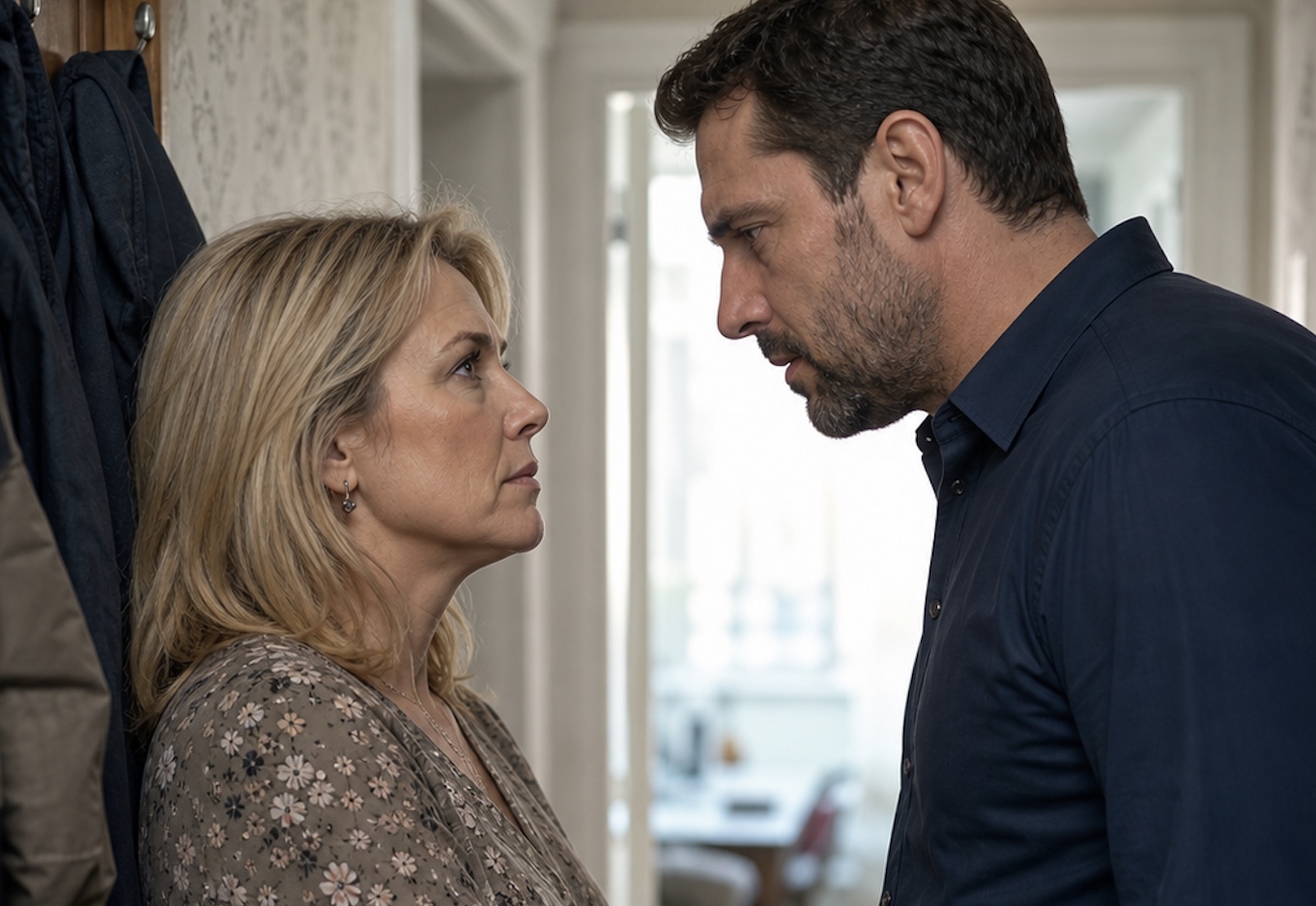
“Do you even understand what you just said?”
Marina didn’t raise her voice. On the contrary, she spoke almost in a whisper. That made the sentence hit even harder. Alexey froze in the hallway with his jacket in his hands, looking as if he had been caught stealing and people were still deciding whether to forgive him or call the police.
“I only asked…” he began, then immediately stumbled over his own words. “What if… what if Mom is right?”
Marina slowly closed her laptop. She didn’t slam it. She didn’t throw it shut. She lowered the lid carefully, the way people close a coffin when everything is already understood.
The kitchen was bright, clean, and far too calm for what was beginning to unfold. The new tiles shone under the light, and the kettle hummed softly, as if pretending none of this had anything to do with it.
“Say it again,” she said. “Slowly. So I can be sure I understood.”
Alexey swallowed.
“Well… maybe it really would make sense to put part of it in my name. Just formally. So Mom can calm down.”
Marina leaned back in her chair. Inside, she felt empty and cold, like an elevator stuck between floors.
“So,” she said, choosing every word carefully, “you came home and decided that the most reasonable thing to do was ask me to give you a piece of my apartment. Because your mother feels awkward in front of the neighbors?”
“That’s not what I mean!” he flared up. “You’re twisting everything!”
“No, Lyosha. I’m simplifying it. Removing the decoration.”
She stood up and walked to the window. In the yard below, someone was walking a dog. Teenagers were shouting near the entrance. Life was going on as usual. Only inside her, something had cracked — quietly, but permanently.
“Do you know how many years I’ve been paying for this place?” she asked without turning around. “How many extra jobs I took? How many vacations I gave up? Do you know any of that?”
“I’m not denying it…” he muttered. “But I live here too. I’m your husband.”
Marina turned sharply.
“A husband is not a registration address. And not a stamp in a passport. A husband is someone who stands beside you — not between you and his mother like a translator from the language of hysteria.”
The doorbell rang.
Long, persistent, without pauses — the way people ring when they are absolutely sure they must be let in.
Alexey flinched.
“It’s her,” he said grimly. “I told you she might stop by.”
“You said ‘maybe,’” Marina cut him off. “With you, it’s always ‘maybe.’ With her, it’s always ‘I’m already here.’”
Tatyana Petrovna entered as if she were walking into her own home. She took off her shoes without looking, placed her bag on the table, and glanced around with a judging eye, as though searching for something to criticize. Finding nothing only seemed to irritate her more.
“Well, hello,” she said with mournful dignity. “Sitting around?”
“Standing,” Marina replied. “For now.”
“I won’t take long. We need to talk.”
“Again?” Alexey couldn’t help himself.
“Not again. Finally, like adults,” his mother snapped. “I kept silent. I endured. But how long can we pretend everything is normal?”
Marina felt the familiar tension settle into her shoulders, like the start of a long uphill climb.
“Speak,” she said. “But let’s do it without theatrics.”
“The theatrics started without me,” Tatyana Petrovna narrowed her eyes. “He got married — and that was it. My son practically disappeared. No place of his own, no say in anything. He lives like a tenant.”
“Mom…” Alexey began, but she waved him off.
“I’m not talking to you. I’m talking to her.”
Marina crossed her arms.
“Then be precise. What exactly are you unhappy with?”
“Everything!” her mother-in-law burst out. “You decided everything for him. The apartment is yours, the money is yours, the rules are yours. And what is he? An accessory?”
“He is a grown man,” Marina answered calmly. “He can speak for himself. If he wants to.”
Alexey said nothing. He stared at the floor.
“There!” Tatyana Petrovna declared triumphantly. “See? Even now. He’s silent. Because he knows words mean nothing here.”
Marina gave a faint smile.
“Words always mean something. Some people just don’t have the courage to say them.”
“Oh, you certainly do,” her mother-in-law said with venom. “You’re so brave. But courage isn’t everything. There is also respect. Respect for family. For a mother.”
“Respect is not demanding someone else’s property and calling it care,” Marina replied. “And it’s not deciding how other people should live.”
Tatyana Petrovna leaned forward.
“I want my son to have something of his own. I want him not to feel like a stranger.”
“He doesn’t feel like a stranger because of the apartment,” Marina said quietly. “He feels that way because you still keep him on a short leash.”
Alexey lifted his head.
“Marina…”
“No, Lyosha. Let her hear it.”
A heavy silence filled the kitchen. The kettle clicked off by itself.
“Fine, then,” Tatyana Petrovna said, grabbing her bag. “I understand everything now. You’ve decided you’re smarter than everyone else. But remember this: it won’t end that easily.”
“I never expected it to be easy,” Marina answered.
Her mother-in-law left, slamming the door behind her.
Alexey sat down and buried his face in his hands.
“Why did you have to say it like that?” he whispered. “She’s my mother.”
Marina looked at him for a long time.
“And I am your wife. If you don’t make a choice now, someone else will make it for you later.”
He stayed silent.
After his mother left, the apartment didn’t feel quieter. It felt muffled — the way it does after a loud bang, when your ears are still blocked and every sound reaches you through cotton.
Alexey remained sitting on the stool, hunched over, as if he had suddenly shrunk. Marina moved around the kitchen slowly, mechanically. She cleared the cups, wiped the table, straightened a chair. Everything was ordinary. Only inside, everything had gone wrong.
“Do you really think that?” Alexey finally asked without lifting his head. “That I’m… on a leash?”
Marina stopped near the window. Outside, a billboard blinked, showing a happy family smiling with impossible sincerity.
“I think you choose not to think far too often,” she said. “It’s easier that way. Silence is your substitute for having a position.”
“And you always have a position, right?” he gave a crooked smile. “You always know what’s right.”
She turned around.
“No. But at least I can recognize when something hurts me. And I don’t pretend that’s how it should be.”
He stood, walked around the kitchen, then stopped in front of her.
“You have no idea how this looks from the outside.”
“From whose outside?”
“From normal people’s outside. My mother worries. Neighbors ask questions. And I… I live in my wife’s apartment. You don’t even understand how that feels.”
Marina felt irritation rise inside her — not like a flash, but like a dense wave.
“What exactly feels heavy?” she asked. “Other people’s gossip? Or the fact that you still haven’t decided who you are and what you want?”
“I want a normal family!” he snapped. “Without constant conflict!”
“Then stop bringing conflict into this home,” Marina replied calmly. “I don’t fight with your mother for fun. I defend myself.”
He turned away.
“She thinks you suppress me.”
Marina laughed shortly, without joy.
“Of course she does. It’s convenient. If a woman is independent, she must be suppressing someone. And if a man can’t make up his mind, then obviously he was suppressed. Excellent logic.”
That evening, they barely spoke. Alexey went to bed early. Marina stayed in the kitchen for a long time, staring into the darkness outside the window. Her thoughts circled the same question again and again: when exactly had everything begun to fall apart?
Not yesterday. Not today.
She had simply pretended not to see it before.
The next day, she received a call from an unknown number.
“Marina Sergeevna?” The voice was formal, with poorly hidden satisfaction. “This is the New Format real estate agency. We are calling regarding a request from your mother-in-law.”
Marina exhaled slowly.
“And what exactly does she need?”
“A consultation regarding shared residence and a possible redistribution of rights.”
“Tell her,” Marina said evenly, “that the only thing she can redistribute is her own illusions.”
She ended the call and, for the first time in a long while, felt not anger but exhaustion. The kind that comes when you finally understand: this cannot continue.
That evening, Alexey came home later than usual. He sat down, ate in silence, and avoided looking at her.
“Did your mother call you?” Marina asked.
He nodded.
“She was crying.”
“And?”
“She said you want to leave me with nothing.”
Marina put down her fork.
“And what did you say?”
He hesitated.
“I said we would figure it out.”
“Lyosha,” she looked him straight in the eyes, “we’ll figure it out means nothing again. You are either with me, or you are an observer.”
“You’re giving me ultimatums.”
“No. I’m naming reality.”
He stood up abruptly.
“You want me to break with my mother?”
“I want you to stop letting her make decisions for us. Those are different things.”
He was silent for a long time. Then he said quietly:
“I’ll stay with her for a few days.”
Marina was not surprised. She simply nodded.
“Fine. Stay there. Think.”
He packed quickly, as if he had already made the decision beforehand. In the hallway, he paused.
“Are you angry?”
“No,” she answered honestly. “I’m watching.”
The door closed.
This time, without a slam.
The days without Alexey turned out to be strangely peaceful. No one left shoes scattered around. No one sighed in the evenings. No one looked at her with silent accusation.
Marina worked, met with friends, even laughed. But inside, she kept holding a pause, as if waiting for the rest of an unfinished sentence.
The continuation came soon enough.
On Saturday, Valentina Ivanovna stopped by.
“Just for a minute,” she said, sitting down without being invited. “I heard you and Lyosha separated.”
“Temporarily,” Marina replied.
“Well, well. Tatyana Petrovna says you threw him out.”
Marina looked at the neighbor wearily.
“And why are you telling me this?”
“Oh, I mean well. People are talking…”
“People always talk,” Marina interrupted. “But I’m the one who has to live my life.”
That evening, Alexey called.
“I want to talk.”
“Come over,” she said. “But without witnesses.”
He arrived late. He looked tired, thinner, but there was something new in his face — as if he had seen himself from the outside for the first time.
“You know,” he said without taking off his jacket, “everything is the same at her place. The same conversations. The same accusations. And suddenly I understood: if I give in now, it will never stop.”
Marina said nothing.
“I don’t want to live like that,” he continued. “But I don’t want to lose you either.”
“Then you’ll have to lose something,” she said quietly. “The illusion that you can please everyone.”
He sat across from her.
“I choose you.”
Marina looked at him closely. Not with relief — with caution.
“Words aren’t tested by words, Lyosha. They are tested by time and actions.”
He nodded.
“I know.”
Outside the window, the billboard blinked again. The happy family smiled just as before. But for the first time, Marina thought that happiness was not a smile. Happiness was when you no longer lied to yourself or to others.
Alexey did not come back right away. Not the next day, and not even a week later. He disappeared from her life quietly, without dramatic gestures. He sent short, routine messages, like reports: “Everything is fine.” “Busy.” “We’ll talk.”
Marina read them and did not answer.
Not out of revenge, but from sober understanding: if she started dragging the conversation forward again, everything would slide back into the same familiar swamp.
For the first time in a long while, she lived without constantly looking over her shoulder. She came home late, didn’t cook dinner if she didn’t feel like it, played music loudly, opened the windows even on chilly evenings.
And she caught herself thinking something strange: she felt calm.
Not joyful. Not happy.
Calm.
And, as it turned out, that was a luxury.
The calm ended on Thursday.
Someone from Alexey’s workplace called her.
“Marina Sergeevna?” The woman’s voice was careful, like the voice of someone expecting an unpleasant answer in advance. “Are you Alexey Igorevich’s wife?”
“Formally, yes.”
“He took unpaid leave. He said it was due to family circumstances. I just wanted to check… is everything all right?”
Marina thanked her, hung up, and sat still for a long time.
Family circumstances.
An interesting phrase. Especially considering he had told her nothing.
That evening, he appeared on his own. He stood at the door with the same expression he had worn on the first day they met — confused and somehow too honest.
“May I come in?”
“This is still your home,” she replied. “For now.”
He entered, sat down, and looked around, as if afraid something had changed. But everything was in its place. Somehow, that made it even harder for him.
“I went to a lawyer,” he said without preamble.
Marina raised an eyebrow.
“Which lawyer exactly?”
“Mom… Mom arranged it.” He faltered. “At first, I didn’t want to go. Then I thought, fine. I’ll listen.”
“And?”
He exhaled.
“They told me I have no rights to the apartment. None at all. And that all the talk is meaningless.”
Marina nodded.
“I told you that a year ago.”
“Yes,” he agreed. “But back then, I wasn’t listening.”
He paused, then added:
“And then Mom…” He stopped. “She said if I ‘missed my chance,’ I’d have only myself to blame. That you’re using me. That you have someone else.”
Marina slowly placed her cup on the table.
“Now that part — explain.”
“She said you’re too confident. That a normal woman doesn’t behave like that. And that maybe you’re preparing the ground to be alone, but with the apartment.”
Marina smirked.
“What a carefully built theory. And you believed it?”
He looked at her.
“I doubted.”
“That’s enough,” she said calmly. “Doubt is already a crack.”
He lowered his head.
“I took leave because I realized that if I don’t sort this out now, it’ll only get worse. I’m tired of being in the middle.”
“Between whom and whom?” Marina asked.
“Between the past and the present,” he answered with unexpected precision.
She stood and came closer.
“Lyosha, let’s avoid beautiful phrases. Say it directly: are you ready to live your own life? Not your mother’s expectations, not the neighbors’ gossip, not the comfortable image of a ‘good son’?”
He was silent for a long time.
Then he said:
“I talked to her. Truly talked.”
“And?”
“She said that if I choose you, I will no longer exist for her.”
Marina looked at him carefully. There was no pity in her gaze, no anger — only clarity.
“And you were afraid?”
“Yes,” he answered honestly. “Very. But then I realized I’ve been living someone else’s life for a long time. I just used to call it care.”
He raised his eyes.
“I told her I’m staying with you. And that I will no longer discuss our apartment, our money, or our decisions.”
“How did she react?”
“She said you turned me against her. That I’m ungrateful. That I’ll regret it.”
Marina nodded.
“The classic set.”
He took her hand carefully, as if asking permission.
“I don’t know what will happen next. But I know what I don’t want.”
She gently pulled her hand away.
“And I know what I do want,” she said quietly. “I want a partner. Not a boy I have to protect, and not a man other people make decisions for.”
He straightened.
“Give me a chance to prove it. Not with words.”
She looked at him for a long time. Then she nodded.
“All right. But understand this: I won’t test it a second time.”
He stayed.
Not immediately. Not that same evening.
He rented a room, started going to work again, and began dealing with his own problems himself. His mother did not call. But the neighbors called. Acquaintances called. Distant relatives called. Rumors spread quickly.
Marina listened and did not justify herself.
That was a new feeling — not defending herself.
A month later, Alexey came with a box.
“These are documents,” he said. “I arranged a marriage contract. On my own initiative. So there will never be these conversations again.”
Marina took the papers and leafed through them.
“Are you sure?”
“Yes.”
She looked at him and, for the first time in a long while, smiled sincerely.
“Then come home.”
That evening, they sat in the kitchen, drinking tea in silence.
Without tension. Without unspoken words.
“You know,” he suddenly said, “I used to think family meant everyone owed each other something.”
Marina shook her head.
“Family is when no one lies to anyone. Even with the best intentions.”
He nodded.
Outside, the city hummed.
Life went on — without promises, but also without lies.
And that turned out to be enough.