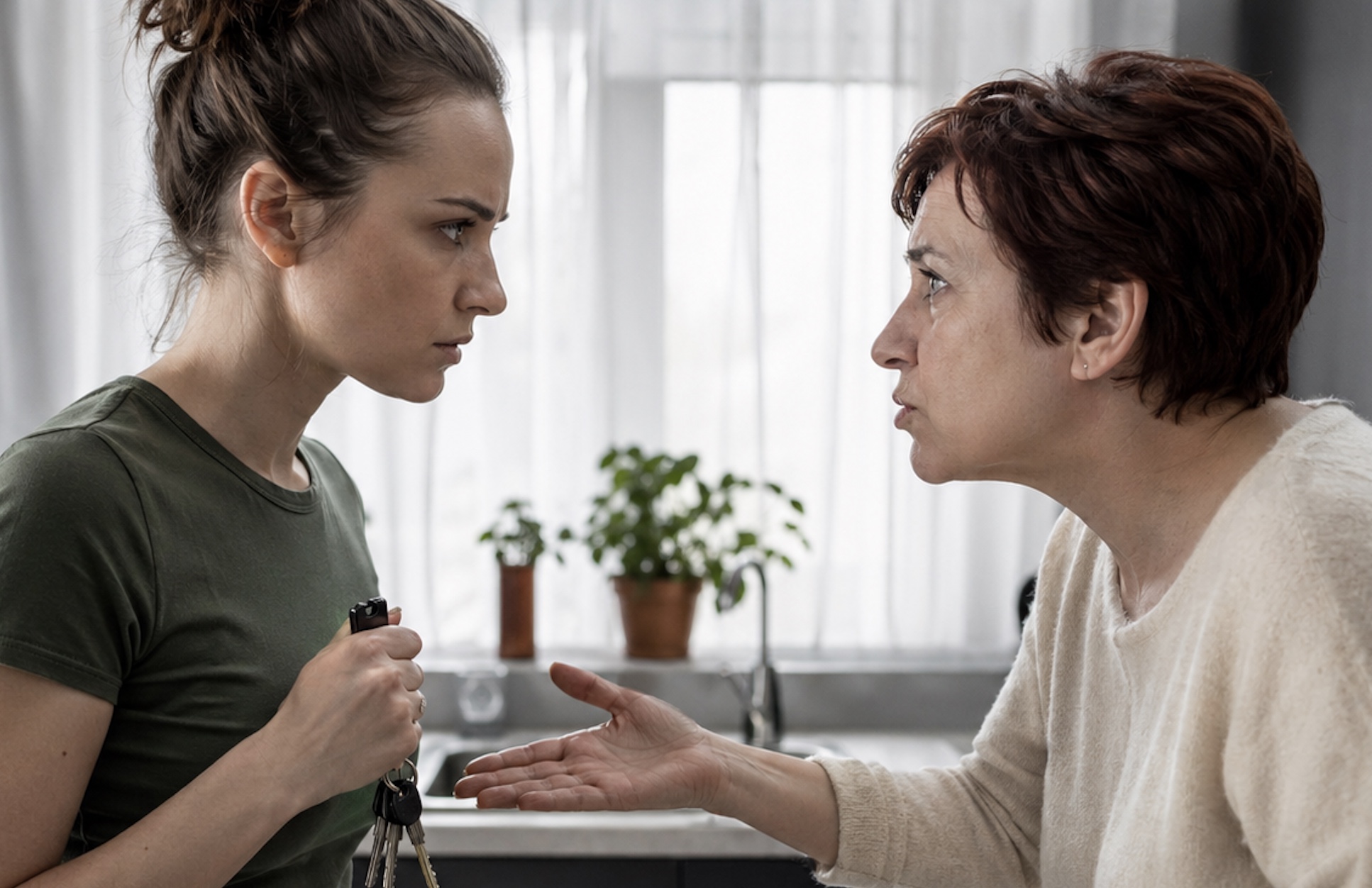
“Leave the keys to the dacha. We’re all going there for the May holidays,” her mother-in-law demanded.
Oksana stopped in the kitchen doorway, still wearing her light jacket. The apartment keys were still lying in her palm, the strap of her bag pressed into her shoulder, and behind her, in the hallway, the front door clicked softly shut.
Valentina Pavlovna, her husband’s mother, was sitting in the kitchen.
Not like a guest.
Not with a cup of tea.
Not with her usual heavy sighs about blood pressure and the long trip across town.
She had settled herself at the table as if she had not come to visit her daughter-in-law, but to preside over a meeting where a decision had already been made and only needed to be signed.
Next to her sat Roman.
Oksana’s husband.
He was staring at his phone, though the screen had long gone dark. He was simply holding it in his hand, as if that black piece of glass could somehow save him from taking part in the conversation.
“Good evening,” Oksana said, looking from one to the other. “I see everything has already been discussed without me.”
Valentina Pavlovna did not look embarrassed in the slightest. She adjusted the notebook on the table, two pages of it covered in her large handwriting.
“What is there to drag out?” she said. “The May holidays are almost here. People need to know where they’re going, what to pack, how long to plan for. Everyone has families, children, belongings. It’s easy for you to just get up and go whenever you feel like it. We have an entire family to organize.”
Oksana slowly took off her jacket and hung it in the hallway. Then she returned to the kitchen.
The air was thick with the smell of fried onions from the dinner Roman had apparently reheated before she came home. On the table lay a packet of cookies, Valentina Pavlovna’s phone, the notebook, and a pen. Everything looked as though her mother-in-law had not come to ask for anything, but to run a field headquarters.
“What family?” Oksana asked.
“Ours,” Valentina Pavlovna answered quickly. “Me, Vitya, Lida with the children, Igor and his wife, Aunt Zoya if her legs allow it, and maybe Slavka will stop by for a day. And, of course, you and Roman.”
Roman coughed, but still did not raise his eyes.
Oksana looked at her husband.
He had the face of a man who had already decided that it was more convenient to wait it out.
In their marriage, this habit had not appeared immediately. In the early years, Roman had been attentive, easygoing, able to defuse any quarrel with a joke. But beside his mother, he seemed to shrink. His shoulders narrowed, his voice became quieter, and decisions were made somewhere around him, without him.
“How interesting,” Oksana said. “Was anyone planning to ask me?”
Valentina Pavlovna frowned, tilted her head to one side, and studied her daughter-in-law for several seconds, as if Oksana had said something indecent.
“What is there to ask? The dacha is standing empty. The weather will be good. The children need fresh air. You have land, a house, a bathhouse. We can’t all sit in an apartment.”
The dacha was not standing empty.
The dacha was breathing its difficult spring breath: after winter, the roof over the veranda needed to be checked, the gutters cleaned, the water turned back on, the electrical panel inspected, the pipes examined in case the frost had damaged them.
Every spring, Oksana went there alone first. Later, when everything was ready, she could invite someone close.
Invite.
Not because she was greedy or antisocial, but because it was her place.
The house had come to her from her grandfather, Nikolai Yegorovich. After his death, Oksana had accepted the inheritance after the required six months, completed the paperwork, paid the fees, repaired the porch, replaced the old wiring, and ordered a new pump.
Legally, Roman had nothing to do with that house.
And if she was honest, emotionally he had very little to do with it either.
In the first years, he had gone there with her two or three times a season, helped mow the grass, and grilled meat over the barbecue. Then he had more and more reasons to stay home. He was tired. He had things to do. His mother had asked him to stop by.
Oksana had not been offended.
She even liked being at the dacha alone. There, she did not have to adjust herself to anyone else’s mood.
But Valentina Pavlovna saw it differently.
From the moment she learned that her daughter-in-law had a house outside the city, she began pronouncing the word “dacha” in a special tone. As if it were not Oksana’s house, but a family resource belonging to Roman’s relatives, accidentally registered under the wrong person’s name.
“So let me make sure I understand,” Oksana said. “You decided to go to my dacha without my invitation?”
“Oh, here we go,” Valentina Pavlovna said, leaning back in her chair. “Mine, yours… Roman is your husband. That means we are not strangers.”
“I didn’t ask whether you were strangers or not. I asked who invited you.”
Roman finally lifted his head.
“Oksan, don’t start. Mom just suggested it. Everyone wants to relax. What’s so terrible about that?”
Oksana turned to him.
She did not raise her voice, but her fingers tightened around the strap of her bag so hard that her knuckles turned white.
“Roman, this is not a suggestion. A suggestion sounds different. First, people ask whether it is convenient for me. Then they discuss whom I am willing to host. They do not draw up a guest list and demand the keys.”
Valentina Pavlovna snapped her notebook shut.
“What kind of person are you? People are asking you normally, like family, and you immediately put up a wall. There are children involved! Do you understand that? Lida needs to get the boys out of the city. Igor’s wife hasn’t been in nature for ages. Aunt Zoya dreams of seeing the lilacs.”
“There’s no guarantee the lilacs will bloom by the May holidays,” Oksana noted.
“Don’t pick at my words.”
“I’m not picking at your words. I’m trying to understand why the sleeping arrangements in my house have already been planned.”
Her mother-in-law leaned forward.
On her face appeared that familiar certainty Oksana had seen many times before: when Valentina Pavlovna decided what would happen at Roman’s birthday, when she bought them towels in a “practical color” without asking, when she once brought an old chest of drawers into their apartment and declared it a sin to throw away such a sturdy thing.
“Because I know how to organize people,” she said sharply. “If everything is left to chance, there will be chaos. I’ve already worked it out. Viktor Petrovich and I will take the small room. Lida and the children will take the big one. Igor and his wife can sleep on the veranda. Aunt Zoya can go in the walk-through room. You and Roma can manage in the car or in the living room. You’re young. You won’t fall apart.”
Oksana blinked slowly.
For a moment, she thought she must have misheard.
“So you have already assigned rooms at my dacha, and you left the car for me and my husband?”
Roman grimaced.
“Mom, well, that’s a bit…”
“What?” Valentina Pavlovna turned to him. “Where else should they sleep? The house isn’t made of rubber. It’s easier for the two of them.”
Oksana gave a small laugh.
Not a cheerful one.
Not an angry one.
A short, almost soundless laugh.
It came out by itself.
From the absurdity of what was happening.
From the fact that two grown adults were sitting in her kitchen discussing where she would sleep near her own house so that her husband’s relatives could have more space.
“And have you already divided up the groceries too?” she asked.
“Of course,” her mother-in-law said, brightening, apparently deciding that the conversation had entered a practical stage. “You’ll take grains, vegetables, disposable dishes, charcoal, and water. Roman will buy meat. Lida will bring sweets for the children. Igor will handle drinks. I’ll make appetizers.”
Oksana put her bag on a chair.
The kitchen became quiet.
Even the refrigerator, which usually hummed softly, seemed to fall silent at the worst possible moment.
“Valentina Pavlovna,” Oksana said, “are you seriously telling me that I must provide the house, buy half the food, free up the rooms, and hand over the keys as well?”
“Don’t twist things. We need the keys so we can arrive earlier. You’ll be working before the holidays and won’t be able to meet everyone. We’ll open up, air the place out, get everything ready. You can come later.”
Oksana looked at Roman.
“You knew?”
He shifted his eyes toward the window. Outside, the yard was growing dark; somewhere near the entrance, a car door slammed. On an ordinary evening, Oksana might not have noticed the sound. Now it struck the silence so sharply that Roman’s shoulders twitched.
“Mom called,” he said. “Well… we discussed it. I thought you wouldn’t mind.”
“You thought?”
“Oksan, you barely ever stay overnight there. And the house is good. Why shouldn’t people rest?”
For several seconds she said nothing, simply looking at her husband.
There was no explosive flash inside her.
There was something else.
An unpleasant clarity, like a bright light suddenly switched on in a dark room.
Everything became visible at once: his silence, his mother’s notebook, the guest list, and her own naïve hope that Roman would, just once, tell his mother no.
“Because it is my house,” Oksana said. “And because I decide who goes there.”
Valentina Pavlovna shot up from her chair.
“So that’s how it is. Roman means nothing to you. His relatives mean nothing. But your dacha is sacred.”
“Don’t distort what I said.”
“I’m not distorting anything. I can see it. You’ve always kept things to yourself. Everything is separate with you. Money separate, plans separate, dacha separate. Your husband is like a tenant in your life.”
Roman gave his mother a pained look, but again said nothing.
Oksana ran her hand along the edge of the table, gathering herself before answering. She wanted to say many things: that Roman had never asked how much the roof repair cost; that Valentina Pavlovna had not come to help when the hose near the well burst after winter; that her grandfather’s house was not a free recreation center for loud people who had no respect for it.
But she understood that long justifications would only give her mother-in-law more hooks.
“I will not give you the keys,” Oksana said. “For the May holidays, I am going to the dacha myself. Alone.”
Roman straightened.
“What do you mean, alone?”
“I mean exactly that. I need to open the season, check the house, and put the plot in order. I did not plan on guests.”
“And us?” Valentina Pavlovna jabbed a finger at the table. “We already told people!”
“You shouldn’t have.”
Those two words hung between them heavier than any shout.
Her mother-in-law looked at her daughter-in-law as if she were seeing, for the first time, not a quiet, convenient woman who used to give in for the sake of peace, but a homeowner with a straight back and a closed door behind her.
“Roman, do you hear this?” Valentina Pavlovna turned to her son. “Your wife is refusing your mother. Right in front of you.”
Roman stood up.
He placed his phone on the table face down, as though he had finally decided to enter the conversation. For one brief second, Oksana allowed herself to think he might choose honesty now.
Not her.
At least common sense.
“Oksan,” he began cautiously, “maybe we really shouldn’t be so harsh? Let them go. Just for a couple of days. What will happen?”
Oksana nodded slowly, as if tasting those words.
“What will happen is that my house will stop being mine. Today they go without asking for the May holidays. Tomorrow someone asks for the keys for a weekend. Then Lida decides to leave the children’s things there. Then your mother says it would be more convenient for her to come there in the summer. And if I object, I will be the bad one again.”
“You’re exaggerating.”
“No. I simply heard the part you didn’t say out loud.”
Valentina Pavlovna laughed dryly, without joy.
“How clever you’ve become. You used to seem normal.”
“I used to keep quiet more often.”
“And you were right to. A woman should be softer in a family.”
“Softness ends where people start demanding my keys.”
Her mother-in-law grabbed her notebook from the table and shoved it into her bag.
But she was not about to leave.
She was the kind of person who did not retreat from an argument right away. First she pressured. Then she took offense. Then she found someone to blame. Then she pressed again, this time through other people.
“You’ll regret this,” she said. “You’ll push away your relatives, and then you’ll be left alone with your dacha.”
Oksana looked at her carefully.
There was not only irritation in her mother-in-law’s face. Something else flickered there too — fear of losing the authority she was used to.
Valentina Pavlovna was accustomed to her son adjusting himself, to Lida complaining and receiving help, to Igor arriving with requests, and to all of them calling it closeness. Oksana had long tried not to break that pattern. She had attended family dinners, bought gifts, hosted guests, tolerated comments.
But the dacha was the final line.
“Better alone with my dacha,” Oksana said, “than surrounded by people who consider my property communal.”
Roman exhaled in irritation.
“Why do you have to say it like that? Mom isn’t a stranger.”
“Then let her behave like a close person. Close people ask. Close people protect what matters. Close people do not arrive with a notebook to assign rooms in someone else’s house.”
Valentina Pavlovna flushed.
Not from embarrassment.
From anger.
She opened her mouth, but at that moment her phone rang. Lida’s name lit up on the screen.
Her mother-in-law looked at the call, then at Oksana, and suddenly put it on speaker.
“Yes, Lidochka.”
“Mom, well? What’s going on there?” came a woman’s voice from the phone. “Is Oksana giving you the keys? I already told the kids we’re going. They’re looking for their rubber boots.”
Oksana raised her eyebrows.
Roman closed his eyes and rubbed a hand over his face.
Valentina Pavlovna did not turn off the speaker. On the contrary, she looked at her daughter-in-law challengingly.
“There, Lida is asking. What should I tell her?”
Oksana stepped closer to the table.
“Tell her the truth. That you asked no one and promised the children someone else’s dacha in advance.”
There was a pause on the phone.
“Is that Oksana?” Lida asked cautiously.
“Yes,” Oksana replied. “Lida, I am not hosting guests for the May holidays. I did not invite you.”
“Oh, come on, why are you being like that?” Lida’s voice became thinner. “We’ll be careful. The children have wanted to go out of town for so long. Mom said there’s plenty of space.”
“There is exactly as much space as I am willing to provide. For these holidays, that means none.”
“Well, wow,” Lida drawled. “Rom, are you even there? Say something to your wife.”
Roman opened his eyes sharply, but did not speak.
Oksana watched her husband.
There it was — another convenient place where he could have stood beside her. At least tell his sister that the matter was closed.
But he stayed silent.
And because of that silence, nothing inside Oksana tore outward.
On the contrary, everything became very calm.
Dangerously calm.
“Roman is here,” she said. “But the dacha is not his. So I will speak on this matter.”
Valentina Pavlovna ended the call.
“You made us look ridiculous.”
“No. I stopped your improvisation before you arrived at locked gates.”
Her mother-in-law snatched up her bag.
“Come on, Roma.”
Oksana looked at her husband.
“He lives here. Or are you taking him too, according to your list?”
Roman stood up sharply.
“That’s enough, Oksana.”
“I agree. Enough.”
For several seconds they stood opposite each other.
Valentina Pavlovna stood to the side, bag in hand, waiting for her son to finally put his wife in her place. Roman understood that too. His face hardened, but his eyes remained uneasy.
He did not want a quarrel.
He wanted Oksana to give in, as she had before, and for everyone to pretend nothing terrible had happened.
“You could meet us halfway,” he said. “Just once.”
Oksana laughed softly.
“Just once? Roman, your mother stayed with us after the hospital for a week instead of two days. Just once. Lida brought the children over, and then I spent the whole evening scrubbing the kitchen and collecting toys from under the sofa. Just once. Your father asked me to take his documents somewhere because you were too busy, and I drove across the whole city. Just once. All of you love these ‘just once’ moments, but somehow they keep adding up into my life.”
Roman looked away.
Valentina Pavlovna cut in sharply.
“So that’s it. You’ve been keeping count.”
“Yes. I have. Because if I don’t count my time, my money, and my strength, you count them as free.”
Her mother-in-law stepped toward the exit.
“Roman, I said let’s go. Let her sit with her principles.”
Roman did not move.
“Mom, I’ll call you later.”
Valentina Pavlovna stopped.
For the first time, confusion appeared on her face.
Her son had not immediately followed her.
It was a small gesture, almost invisible. But to her, it sounded louder than Oksana’s refusal.
“Of course,” she said. “Now you’ll start crawling in front of her. Fine. Just don’t come complaining later.”
She went into the hallway, loudly zipped her bag, and put on her shoes.
Oksana followed and opened the door.
“Goodbye, Valentina Pavlovna.”
Her mother-in-law paused on the threshold.
“I’ll ask Roman for the keys anyway. He is my son.”
“Roman does not have the keys to the dacha,” Oksana replied calmly.
Her mother-in-law blinked.
“What do you mean, he doesn’t?”
“Exactly that. After last summer, I took back his set. He lost the gate key fob and didn’t even notice. I didn’t make him a new one.”
Roman came out into the hallway.
“Are you serious?”
“Yes. You said yourself back then that you didn’t need the dacha and weren’t planning to go there.”
Valentina Pavlovna glanced at her son.
Her confidence finally cracked.
Until that moment, she had apparently been certain that if her daughter-in-law refused, her son would still find a way to open the house.
But there was no way.
“So you planned everything in advance,” she hissed.
“No. I simply keep track of my keys.”
Her mother-in-law left.
Oksana closed the door and turned the lock.
Then she removed the keyring from the door and put the keys into the pocket of the house vest hanging nearby.
Not on the stand.
Not on an open shelf.
Somewhere no one could take them “by accident.”
Roman stood in the middle of the hallway.
“You humiliated my mother.”
Oksana looked at him.
After Valentina Pavlovna’s departure, the apartment did not feel lighter. The tension remained. Only now it belonged to the two of them.
“No, Roman. I did not let her humiliate me.”
“You could have been gentler.”
“You could have told her earlier that the dacha is mine and that I decide this matter. Then it would have been gentler.”
He went to the kitchen and poured himself water.
The glass trembled in his hand, and water spilled over his fingers. Oksana noticed, but said nothing.
She did not want to feel sorry for him in that moment.
He had used her ability to understand everyone for too long.
“I’m between you two like between two fires,” Roman said.
“No. You stand aside and wait to see who gets tired first.”
He set the glass down hard on the table.
“You’re being unfair.”
“Maybe. But I’m tired of being convenient.”
That sentence seemed to close the conversation.
Roman sat down, clasped his hands, and stared at the table for a while.
Oksana went to the bedroom, changed clothes, and washed her face. In the mirror above the sink, she saw her own reflection: tired, composed, with red marks on the bridge of her nose from her glasses.
There was no heroic firmness.
Just a woman after a workday who had come home and discovered that her property had already been mentally divided among others.
That night, they barely spoke.
Roman lay with his back to her, but he did not sleep for a long time. Oksana heard his breathing change, heard him carefully pick up his phone and then put it back down. Several times, the screen lit up in the darkness.
Surely his mother was writing.
Maybe Lida.
Maybe their entire family chat was already discussing her greed, pride, and cruelty.
Oksana did not check.
She lay on her half of the bed and thought about her grandfather.
Nikolai Yegorovich had built the dacha over almost ten years. Not all at once. First he put up a small house with a stove. Then he added the veranda. Then he built a shed for tools. Then he planted apple trees.
As a child, Oksana had spent her summers there.
Her grandfather taught her how to hold a hammer, how to tell good boards from damp ones, how to shut off the water before leaving, and how never to leave a house to people who did not understand how much labor was hidden in every plank.
“A house loves its owner,” he used to say. “Not a noisy crowd. Not guests in dirty boots. The one who remembers where the floorboard creaks.”
After his death, the dacha had seemed too quiet to Oksana at first.
She would come, open the door, walk through the rooms, and every time expect her grandfather to appear from the shed with a bucket of nails.
Then she got used to it.
The silence stopped being emptiness and became support.
And now someone was trying to turn that support into a place for other people’s holidays.
In the morning, Roman left earlier than usual.
On the table, he left a note: “We’ll talk tonight.”
Oksana read it, folded it in half, and put it in a drawer.
She did not throw it away.
She felt oddly sorry for that little piece of paper. There was more willingness to talk in it than there had been in Roman himself the previous evening.
During the day, Valentina Pavlovna did not call.
Lida did.
Oksana did not answer.
Then a message came: “You could have said it like a human being, not in front of Mom.”
Oksana looked at the screen and wrote back: “Like a human being means asking the owner first.”
She sent it and did not open the chat again.
That evening, Roman came home looking like a man who had been worked over on the phone all day.
He was gloomy, spoke briefly, and reheated his dinner himself.
Oksana was working on her laptop in the room and waiting for him to begin.
He began closer to ten.
“Mom said you did it on purpose in front of Lida.”
Oksana closed the laptop.
“Your mother turned on the speaker herself.”
“She didn’t expect you to answer like that.”
“And I didn’t expect children to be promised my dacha behind my back. Yesterday was educational for everyone.”
Roman sat opposite her.
“Listen, I understand they went too far. But you’re acting as if you’re cutting everything down with an axe.”
“I’m not cutting. I’m drawing a boundary.”
“Boundary, boundary… Everywhere now it’s boundaries. How are people supposed to live?”
“More peacefully than without them.”
He was silent for a moment.
Then he said what he had apparently spent the entire day preparing to say.
“Maybe we should still go together? Not the whole crowd. Just Mom and Dad, Lida with the kids. For two days.”
Oksana looked at him.
He was already bargaining.
Reducing the number of people, the length of the stay, the scale.
But he was not changing the main point: his relatives still had to get access to her dacha, because otherwise Valentina Pavlovna would not calm down.
“No.”
Roman clenched his jaw.
“Just no?”
“Just no.”
“You’re not even thinking about it?”
“I thought about it yesterday. And last night. And today. The answer is the same.”
“Because of a principle?”
“Because of self-respect.”
He stood up and walked around the room.
Not aimlessly, not nervously pacing, but like a person who needed movement in order not to say too much.
“Do you understand that after this, relations with my family will be ruined?”
“Roman, they were not ruined after my refusal. They were ruined every time you allowed them to decide things for us.”
“For us? It’s your dacha. You just said so yourself.”
“Exactly. When they need something, it suddenly becomes ‘ours.’ When there is work and expense involved, it is mine.”
He stopped by the window.
In the glass, the room was reflected: the lamp, the edge of the wardrobe, Oksana in the armchair, Roman with his shoulders lowered.
“I don’t know how to talk to my mother,” he said quietly.
This sentence sounded different.
Without irritation.
Without defense.
For the first time in all of this, there was something real in it.
Oksana looked at her husband more closely.
“And do you know how to talk to me?”
He did not answer right away.
“It’s easier with you.”
“Because I gave in for a long time.”
Roman sat back down.
His face looked tired.
“She’s been like that all her life. If you refuse her, she spends the next week calling everyone, complaining, measuring her blood pressure, involving my father, involving Lida. Since childhood, I got used to the idea that it was easier to agree.”
“I did not grow up in your house, Roman. I am not obligated to continue that order.”
“I understand.”
“No. Not yet. You want me to become a shield between you and her dissatisfaction. You want her to be angry at me while you remain a good son.”
Those words hit precisely.
Roman did not even try to argue.
He looked away and ran his fingers over the table, as if erasing an invisible line.
“Maybe that’s true,” he admitted. “I didn’t mean to.”
“But you did it.”
He nodded.
In that brief silence between them, something resembling honesty appeared for the first time in a long while.
Unpleasant.
Uncomfortable.
But alive.
Oksana did not rush to comfort him.
She did not say everything was fine.
She did not make his confession easier.
Let him sit with it himself.
“I am going to the dacha alone for the May holidays,” she said. “If you want to preserve any normal relationship between us, do not try to pressure me through your mother, your sister, or pity.”
“I understand.”
“And one more thing. If any of your relatives come there without an invitation, I won’t speak to them through the gate. I’ll call the police. The house is registered in my name. The documents are in order.”
Roman lifted his head.
“They won’t go.”
“I hope so.”
But Oksana was wrong to hope that this was the end of it.
Two days before the holidays, her dacha neighbor Tamara Sergeyevna called. She was the kind of neighbor who knew everything not because she was nosy, but because she cared. She kept an eye on Oksana’s plot in winter and let her know if snow piled up by the gate or if branches fell after a storm.
“Oksanochka, you didn’t give anyone the keys, did you?” she asked, skipping the usual pleasantries.
Oksana straightened immediately.
“No. Why?”
“A woman came here. With a man. They walked around your gate. Looked at how to open it. Then they talked to the neighbors, asking who could help take the lock off because the owner was supposedly delayed.”
Oksana closed her eyes for a second.
Not from fear.
From exhaustion before the obvious.
“Valentina Pavlovna?”
“I don’t know her name. A fuller woman, in a light jacket. The man was quiet. She said they were relatives.”
Her father-in-law.
Viktor Petrovich.
So Roman had been wrong.
Or had not known.
Or had not wanted to know.
“Are they there now?”
“They left. I told them no one would remove locks without you. And that around here we don’t break into other people’s plots. She wasn’t happy.”
Oksana thanked her neighbor and immediately called Roman.
“Your mother was at my dacha today.”
There was silence on the other end.
“What?”
“She and your father were walking around the gate and asking who could help remove the lock.”
“That can’t be.”
“It can. Tamara Sergeyevna saw them.”
Roman cursed under his breath.
“I’ll call her now.”
“Call her. And tell her that if she appears there again without me, I will file a report for attempted unlawful entry. I don’t care how that sounds at the family council.”
“Oksan…”
“No. I warned you.”
She ended the call.
That evening Roman came home late.
His face was gray with exhaustion.
He did not pretend nothing had happened.
For the first time, he came up to Oksana himself and said:
“I’m sorry.”
She was standing in the kitchen, sorting groceries for the trip. On the table were vegetables, grains, bread, a pack of coffee, insect repellent, and batteries for a flashlight.
“For what exactly?” she asked.
Roman lowered his eyes.
“For not stopping this right away. For thinking you were exaggerating. For letting Mom go this far.”
Oksana picked up the pack of batteries and placed it in her travel bag.
“I accept your apology. But it does not erase the consequences.”
“What consequences?”
“I’m going to the dacha tomorrow. I’ll change the lock on the gate myself, and the one on the house too. The old keys will no longer work for anyone. And I’ll install a camera at the entrance.”
“You won’t give me a key either?”
She looked at him.
The question mattered.
Not because of the metal or the lock.
Because of trust.
“Not for now.”
Roman nodded slowly.
It was obvious the answer hurt him.
But he did not argue.
“I earned that,” he said.
Oksana did not respond.
She did not know whether he had earned it or not.
Trust rarely collapses because of one action. More often, it is worn away by small concessions, by someone else’s silence, by phrases like “don’t start” and “is it so hard for you?” And then, one day, a woman hears someone demand her keys — and realizes that inside, everything has already been decided.
The next morning, Oksana left early.
The city had not fully awakened yet. In the courtyard, the air smelled of damp asphalt and last year’s leaves, which the caretaker was raking near the curb. Oksana loaded her bag, tools, a new padlock, and a box with the camera into the car.
Roman came out to see her off.
“Maybe I should still come? Help you,” he offered.
Oksana closed the trunk.
“No. I need to be there alone.”
He nodded.
“I told Mom. Firmly.”
“And?”
“She shouted. Then cried. Then said I had betrayed my parents.”
“And what did you say?”
Roman looked somewhere toward the children’s playground.
“That betrayal is trying to break into someone else’s gate after the owner has said no.”
For the first time in several days, Oksana held his gaze a little longer.
“That was well said.”
He smiled bitterly.
“Too late, unfortunately.”
She got into the car.
Before she closed the door, Roman bent down.
“Oksan, I really don’t want to lose you over a dacha.”
“This is not about the dacha, Roman.”
“I know.”
“When that knowledge becomes stronger than your fear of your mother, then we’ll truly talk.”
She drove away, leaving him in the courtyard.
The road out of the city was almost empty.
Along the sides stood gray strips of old grass. Water glittered in the low spots. At gas stations, people were already crowding with bags, barbecues, children, and dogs. Everyone was hurrying toward their holiday.
Oksana was driving to her house not to rest, but to return its silence to it.
The dacha greeted her with the smell of damp earth, pine needles, and cold wood.
The gate was locked.
Fresh scratches were visible on the lock.
Not deep, but noticeable.
Oksana crouched and ran her finger over the metal.
Her face became still.
So they had not merely walked around.
They had tried.
She took out her phone and photographed the lock, the gate, and the marks near the fence. Then she called Tamara Sergeyevna and asked her, if necessary, to confirm that Valentina Pavlovna had come.
“I’ll confirm it, of course,” the neighbor said. “Just don’t worry. You’re doing the right thing by not letting them in. Let people in today, and tomorrow they’ll be calling the shed theirs.”
Oksana changed the lock on the gate, then the lock on the front door.
She worked calmly, without rushing.
The metal chilled her fingers. The screwdriver slipped a couple of times, but she stubbornly put it back in place.
When the new lock clicked for the first time, Oksana unexpectedly smiled.
Not broadly.
Just the corners of her lips moved slightly from the feeling that a small but important part of order had been restored.
The house was cool inside.
She opened the windows, checked the electrical panel, and walked through the rooms.
Everything was in its place: her grandfather’s old stool by the wall, a stack of magazines in the little cabinet, a blanket on the armchair, the box of tools under the table.
No prepared sleeping places for someone else’s relatives.
No guest list.
Only a house waiting for its owner.
Oksana put the kettle on, but did not drink tea right away.
She sat on the step by the entrance and listened to birds calling beyond the fence, to a trimmer starting somewhere in the distance, to the neighbor’s dog lazily barking at a passing car.
By lunchtime, Valentina Pavlovna called.
Oksana looked at the screen for a long time.
Then she answered.
“I’m listening.”
“Are you pleased with yourself?” her mother-in-law’s voice was hoarse and angry. “You turned my son against his own mother?”
“No. I protected my house.”
“House, house, house… You trampled over people because of some boards and dirt.”
“I did not touch anyone. I did not let them enter a place where they were not invited.”
“We wanted to rest!”
“You can rest however you like at your own expense and in your own place.”
For several seconds, Valentina Pavlovna breathed into the phone.
“You think that because the documents are in your name, you can do whatever you want?”
Oksana looked at the new lock.
“Yes. When it comes to access to my dacha, the documents matter.”
“And Roman? He is your husband. Does his opinion mean nothing to you?”
“It means something when he speaks for himself. Not when he repeats your wishes.”
“You will lose him.”
Oksana brushed a dry crumb of bark from the step with her palm.
“Maybe. But I have already started getting myself back.”
Her mother-in-law fell silent.
Apparently, she had not expected that answer.
She had wanted excuses, tears, shouting, pleas to understand.
But Oksana spoke evenly, and because of that, every word sounded final.
“You’re cruel,” Valentina Pavlovna said.
“No. I’m simply no longer convenient.”
Oksana ended the call.
That evening, Roman arrived.
Without warning.
But not with his mother, not with his sister, and not with a trunk full of other people’s bags.
Alone.
He stopped at the gate and did not honk.
He called.
“I’m at the gate. May I come in?”
Oksana walked down the path.
Roman was standing behind the gate with a small bag. He did not look like a man who had come to rest. He looked more like someone who had spent the whole drive rehearsing a conversation and had now forgotten half the words.
“Why did you come?” Oksana asked.
“To talk. If you don’t mind.”
“Through the gate?”
He looked at the new lock and nodded.
“If that makes you feel safer.”
For some reason, that sentence touched her more deeply than all his previous excuses.
There was no resentment in it.
Only acknowledgment of her right to decide.
Oksana opened the gate.
“Come in.”
Roman entered and looked around.
Nothing remarkable was happening on the plot: fresh damp soil, barrels by the shed, apple trees with swollen buds, the house with its windows open.
But for him, it seemed, everything looked different now.
Not a free place for relatives.
Not a convenient holiday option.
Someone else’s territory, where he had been allowed in by trust.
“It’s beautiful here,” he said.
“You haven’t noticed that for a long time.”
“Yes.”
They sat on the bench near the house.
Roman placed the bag beside him.
“I brought some groceries. A little. Not to buy forgiveness. I just thought you might need them.”
Oksana looked inside: bread, cheese, apples, a bottle of water, a pack of napkins.
“Thank you.”
He was silent for a long time.
Then he said:
“Mom and Lida aren’t speaking to me now. Father said I’m weak.”
Oksana turned to him.
“And did you come here so I would feel sorry for you?”
“No. I came to say that for the first time, I didn’t run to fix their mood.”
She looked at him closely.
Roman was tired.
It was visible in his face, in his shoulders, in the way he held his hands.
But inside that tiredness, something new had appeared.
Not doom.
Adulthood.
Weak, uncertain, but real.
“And how does it feel?” she asked.
“Unfamiliar. Nasty. Like I’m a bad son.”
“In your opinion, is a good son obligated to give away someone else’s keys?”
“No.”
“Then get used to it.”
He nodded.
The sun was sinking behind the trees, and the shadows of the apple trees stretched across the ground in long stripes. Somewhere nearby, children laughed, a gate slammed, and the smell of smoke from a barbecue drifted through the air.
The world around them was preparing for the holidays, but Oksana and Roman had neither lightness nor a ready reconciliation.
Only a conversation that should have happened long ago.
“I don’t know what will happen to us next,” Oksana said.
Roman looked at her.
“Neither do I.”
“I don’t want to live in a marriage where my refusal is treated as the problem and someone else’s pressure is treated as normal.”
“I understand.”
“Understanding is not enough.”
“I know. I’ll have to prove it with actions, not words.”
Oksana looked at the house.
In the window, the evening sky was reflected.
Her grandfather used to say that in spring, a house listens to who has come to it.
Today, it seemed to her, the house was listening too.
“I’m not giving you the keys yet,” she said.
Roman gave a small smile, without his former resentment.
“I already understood that.”
“And no one except me will be here for the May holidays.”
“What about me?”
Oksana turned to him.
The question was simple, but the answer did not fit into a single word.
She could say, “Stay,” and smooth everything over too quickly.
She could say, “Leave,” and close the door on a man who, for the first time, had tried to enter not by force, but by asking.
“Today you can help me shut off the water in the old tap and check the roof over the veranda,” she said. “Then you’ll go home.”
Roman nodded.
“All right.”
He stood, took off his jacket, and followed her to the shed for the ladder.
No objections.
No mention of his mother.
No attempt to bargain again.
They worked almost until dark.
Roman held the ladder while Oksana checked the edge of the roof. Then he tightened the gutter fastening, and she turned on the water and watched to make sure nothing was leaking.
They said little.
But that silence was no longer like the one in the kitchen beside Valentina Pavlovna.
It was not cowardly.
It was not empty.
There was room in it for thought.
When Roman was about to leave, he stopped by the gate.
“Can I call tomorrow?”
“Call.”
“Not to pass on anything from Mom. Not about the dacha. Just you.”
“All right.”
He stepped outside the gate.
Oksana closed the new lock.
The click sounded clear and confident.
Roman heard it and turned around.
“You’re doing the right thing,” he said quietly.
Oksana said nothing.
Roman’s car disappeared around the bend.
The plot became darker and calmer.
Oksana returned to the porch, sat down on the step, and looked at the house.
Ahead were the May holidays, conversations, hurt feelings, and perhaps new attempts at pressure. Valentina Pavlovna was not the kind of person who gave up after one refusal. Roman would not become a different man in one evening either.
But the most important thing had already happened.
When Oksana was told to hand over the keys, she did not justify herself, did not give in, did not hide her irritation behind politeness.
She asked who had invited them to her dacha in the first place.
And with that simple question, she destroyed the entire plan others had built on her silence.
Her mother-in-law’s confidence had not vanished because Oksana shouted louder.
It vanished because, for the first time in a long while, the owner spoke like the owner.
A twig snapped in the darkening garden.
Oksana stood up, checked the gate, then the door of the house.
She put the keys into the inner pocket of her jacket.
People can demand many things.
But from now on, only she would decide.