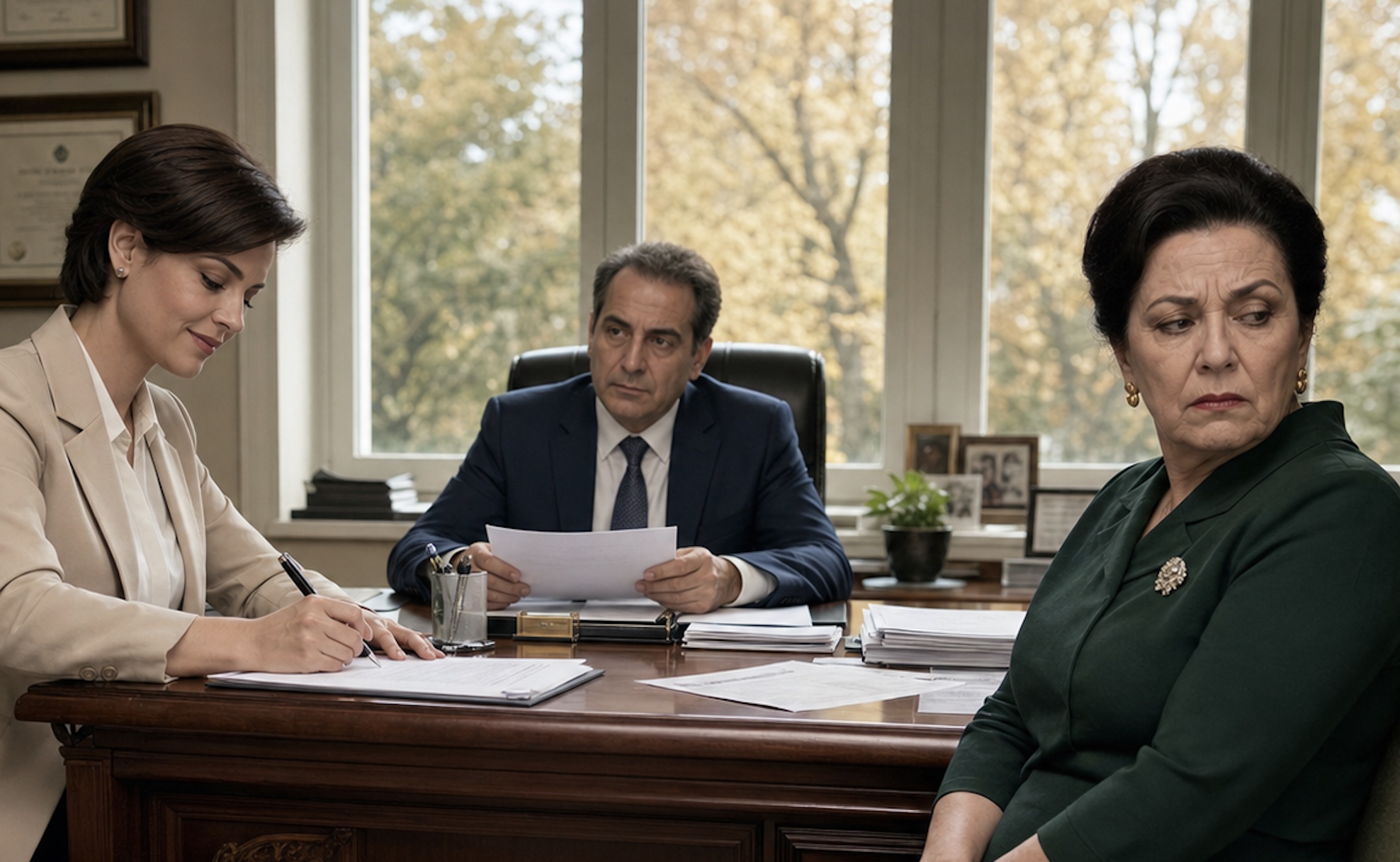
“You are nobody here. You never were, and you never will be.”
“The papers have been signed,” her mother-in-law said, placing a stack of documents on the table. “You can leave.”
Natasha stared at the pages, unable at first to understand what she was reading. The letters blurred before her eyes. Then the meaning reached her slowly, like cold water rising inch by inch until it stole her breath.
A sale agreement.
Their apartment.
Sergey’s signature stood at the bottom — firm, confident, final.
As if he had been preparing for this for a long time.
“What… is this?” Natasha asked, lifting her eyes to her mother-in-law.
Lyudmila Petrovna folded her arms across her chest. She was a short, neat woman with perfectly styled hair and clothes that always matched flawlessly. From the outside, she looked pleasant. Polite. That was exactly what had always made her frightening.
“This is our family’s decision. The apartment has been sold. The buyers will move in three weeks.”
“What decision?” Natasha felt her throat go dry. “This is our apartment. Sergey and I bought it together. I put in everything I had left from my father!”
“The documents are in Sergey’s name,” her mother-in-law replied calmly. “You are nobody there. Legally, you are nothing.”
The silence in the hallway became deafening.
Natasha looked around.
Sergey was standing a little farther away, near the window. He was staring outside with his hands buried in his pockets. He did not turn around.
Seven years.
They had lived together for seven years.
Natasha had met her mother-in-law before the wedding. Sergey had brought her to his mother’s birthday party, visibly nervous, adjusting his collar every few minutes. Lyudmila Petrovna had opened the door, looked Natasha up and down with a quick, practiced gaze — like a jeweler appraising a stone — and then smiled. Wide. Welcoming.
“Natashechka! We have heard so much about you!”
Natasha had exhaled in relief back then. She liked the woman. Energetic, domestic, devoted to her son. The kind of mother-in-law many women only dream of having.
Three months later, Natasha realized her first impression had lied.
Lyudmila Petrovna did not yell. She did not insult openly. She worked differently — subtly, almost invisibly, like a spiderweb you only notice once you are already tangled in it up to your shoulders.
She called Sergey every day, morning and evening. She asked his advice about every little thing, deliberately doing it in Natasha’s presence, making one thing clear: her son belonged to her.
He always had.
Once, during dinner, Natasha asked her husband not to answer the phone.
He looked at her with soft surprise.
“But it’s Mom.”
Three words.
A complete and final argument.
In the second year of their marriage, Lyudmila Petrovna began dropping by without warning. She would simply ring the doorbell and come in carrying bags. She said she had cooked something — “Seryozhenka loves homemade food.” Then she would fill their refrigerator with containers, pushing aside whatever Natasha had prepared.
Once, she rearranged the furniture in the living room because, according to her, “it looks better this way.”
Natasha came home from work and barely recognized her own home.
“Mom was just trying to help,” Sergey said.
Natasha kept silent then.
She often kept silent.
She thought things would settle down. That they would all get used to one another.
They did not.
By the fourth year, there was the kitchen renovation.
They had saved for two years. Natasha had visited store after store, choosing cabinets, comparing tile samples, planning everything carefully. The decision had already been made.
Then suddenly Lyudmila Petrovna suggested “another option.” Someone she knew did renovations, she said — good quality, cheaper price.
Sergey agreed without saying a word to his wife.
“You could have at least asked me,” Natasha said when she found out.
“I thought you wouldn’t care,” he shrugged.
But she did care.
She had always cared.
Only saying it became harder and harder, because every conversation about his mother hit the same soft, soundless wall.
A daughter-in-law was not supposed to have an opinion that differed from “the family’s” opinion.
Natasha’s father had died five years earlier and left her a modest inheritance — two hundred thousand rubles. She had not spent a single kopek. She had saved it carefully, waiting for the right moment.
The moment came when she and Sergey decided to buy an apartment, adding her money to the mortgage.
“We’re buying it together,” Sergey had said then. “It’s ours. Yours and mine.”
She gave him all the money.
Every last ruble.
Her father’s money.
The apartment was registered in Sergey’s name — “it’s easier that way with the mortgage.”
Natasha did not argue.
She trusted him.
For seven years, she trusted him.
And now she stood in the hallway, staring at the sale agreement.
“Where is Seryozha?” she asked quietly.
“Sergey has thought everything through,” her mother-in-law answered. “He made an adult decision. We have been discussing this for a long time. The apartment will be sold. The family needs the money.”
“What family?” Natasha no longer recognized her own voice. It had become hard, unfamiliar. “I am his family. I am his wife.”
Lyudmila Petrovna looked at her for a long time.
There was no anger in her face.
That was worse than anger.
She was calm.
“Natalia, you are a good woman. But you are nobody here. You never were, and you never will be. Sergey is my son. That has always been the most important thing.”
There it was.
At last, said out loud.
Natasha felt something strange, almost physical — as if something inside her had snapped off. It did not hurt. It simply broke away.
And suddenly she felt lighter.
As if a stone she had been carrying for seven years had finally slipped from her shoulders.
She turned to her husband.
“Seryozha.”
He finally looked back.
His face was tired, guilty, and somehow… unfamiliar.
In that moment, Natasha realized she did not know this man.
Maybe she never really had.
“Natasha,” he began. “You understand, don’t you? Mom is right, we need—”
“Stop,” she said.
One word.
Quiet.
But he stopped speaking.
“I need to do something,” she said evenly. “I’ll be back in an hour.”
She left the apartment and went down the stairs slowly, holding the railing.
Outside, it was an ordinary autumn day. Gray sky, yellow leaves underfoot, the damp smell of wet earth.
Natasha took out her phone.
She had found the number a year earlier by accident while sorting through her father’s old papers.
A business card.
Galina Romanovna Istomina. Lawyer. Family Law. Inheritance Disputes.
On the back, in her father’s pencil handwriting, there was a note:
Reliable person.
Her father had always known how to judge people.
The call was answered after the second ring.
“Galina Romanovna?” Natasha said. “My name is Natalia Orlova. I need to meet with you today. It’s urgent.”
The lawyer listened to her forty minutes later in her office — a small room filled with shelves and folders.
Galina Romanovna was a woman of about fifty-five, with attentive eyes and a completely calm face. Natasha spoke while the lawyer made notes in a notebook. She did not interrupt. She did not express pity or judgment.
She simply listened.
When Natasha finished, Galina Romanovna raised her eyes.
“You didn’t take a written receipt?”
“No,” Natasha admitted.
“Do you still have the bank transfer records?”
“Yes. I transferred two hundred thousand to Sergey’s account. The date, the amount — everything is in the statement.”
Galina Romanovna nodded.
“That is something. But by itself, it may not be enough to challenge the sale directly. Legally, the apartment is his, and the transaction was carried out properly. However, we have another route. The money you received from your father was inheritance. It is not marital property. You invested personal funds into the purchase of shared housing. This can be treated as unjust enrichment, or we can demand recognition of your share. There is court practice in cases like this.”
“Will it take long?” Natasha asked.
“Several months. Maybe more. But we can begin with interim measures. We will file a request to prohibit registration actions involving the apartment. While the case is being considered, they will not be able to complete the sale.”
Natasha slowly exhaled.
“So the sale can be stopped?”
“We can try.” Galina Romanovna put down her pen. “But this will require your time, your patience, and your nerves. Are you ready?”
Natasha thought of her mother-in-law.
Of that calm sentence: “You are nobody here.”
Of Sergey standing by the window with his hands in his pockets.
Of her father’s money.
“Yes,” she said. “I’m ready.”
The request for restrictions was filed that same day. Galina Romanovna worked quickly; it was obvious that stories like this were not new to her.
The next morning, Natasha returned to the apartment.
Sergey was home alone. His mother had apparently already left. There was no need to celebrate anymore — the game seemed won.
“You have to leave,” he said when he saw her. “Mom says—”
“Let Mom say it to the judge,” Natasha replied.
She took an envelope from her bag and placed it on the table.
Inside was a copy of the court request for interim measures, stamped as accepted.
Sergey picked up the paper.
He read it for a long time.
His face changed — first confusion, then irritation, then something very close to fear.
“You… filed a lawsuit?”
“I am protecting my legal interests,” Natasha said. “The two hundred thousand rubles were my father’s money. I have a right to part of this apartment. The court will decide.”
“Mom wasn’t expecting this,” he blurted out.
“I know.”
That was exactly what suited her.
The following weeks were difficult.
Lyudmila Petrovna called every day — sometimes Sergey, sometimes Natasha directly. Her voice was no longer as steady as before. There was something new in it: first outrage, then persuasion, then outrage again.
Her mother-in-law was not used to things going against her plan.
“You are destroying the family,” she said one day.
“I am defending what belongs to me,” Natasha answered.
“Sergey will never forgive you for this!”
“That is his choice.”
Natasha hung up and returned to her own business.
Galina Romanovna told her: stick to the facts, stick to the documents. Put emotions aside. The court listens to arguments, not hurt feelings.
Natasha learned.
She had never imagined she would have to understand legal terminology, read court decisions, collect statements and certificates. But the further she went, the clearer it became: this was necessary not only for the court.
It was necessary for her.
So she could feel the ground beneath her feet again.
Sergey tried to talk to her several times.
He would come in the evening, sit across from her, and look at her with that same guilty exhaustion that once would have made Natasha want to comfort him, hug him, say, “It’s all right.”
Now she simply waited for him to speak.
One evening he said:
“I didn’t think it would turn out like this. Mom convinced me it was the right thing to do. She said we would buy something else later. Something better. You understand, don’t you? She does everything for me…”
“Seryozha,” Natasha interrupted. “I understand that you love your mother. That is normal. But for seven years, I was the third wheel in this family. And you knew it. You allowed it. That is the point.”
He said nothing.
“It isn’t about the apartment,” she continued. “It’s about the fact that I was never the main person in your life. Do you understand? Not first. Not equal. Not anything.”
Sergey stared at the table.
This time, not out the window.
And Natasha realized he was hearing her.
Maybe for the first time in seven years.
Two months later, the court ruled that the interim measures would remain in place until the case was heard in full.
The sale was frozen.
When the buyers learned there was a court dispute, they refused to wait and withdrew their offer.
Lyudmila Petrovna called Natasha that same evening.
“Are you satisfied?” Her voice was dry.
“No,” Natasha answered honestly. “I’m not satisfied. I’m tired. But I won’t back down.”
A long pause followed.
“What do you want?” her mother-in-law asked.
For the first time, there was no polite wrapping around the words.
Just the question.
“Justice. My part of the apartment represents my father’s money. I want it recognized officially. Either a share in the property, or compensation. Nothing more.”
Another pause.
“I’ll talk to Sergey.”
This time, the conversation with Sergey was different.
Natasha did not know exactly what his mother had said to him. Apparently, something had shifted in her view of the world when the judge sided with the daughter-in-law.
Through their lawyer, they offered a settlement: Natasha would receive compensation equal to her investment, adjusted for inflation.
Not everything she wanted.
But fair enough.
Galina Romanovna advised her to accept.
A court process could last for months, and the result was never guaranteed. This, at least, was certainty.
Natasha agreed.
On the day the agreement was signed, she came to the notary’s office alone.
Sergey sat on the other side of the table.
Lyudmila Petrovna had come too. She sat upright and did not look at Natasha.
The notary read the documents aloud.
Natasha listened and thought about how much was hidden inside those dry formal sentences: seven years of life, her father’s money, sleepless nights over the last few months.
All of it had now become a line in an official document.
When she signed, her fingers did not tremble.
As she was leaving the office, Sergey caught up with her.
“Natasha.”
He stopped beside her.
“I wanted to… I’m sorry. I behaved badly. Back then, now… all of it.”
She looked at him.
At the man she had once loved.
At the man who had allowed his mother to decide everything for him — and for her too.
“I hear you, Seryozha,” she said. “But forgiveness doesn’t mean what happened was acceptable. And it doesn’t mean I’m coming back. Just… live well. Truly. Not the way your mother wants. The way you want.”
She did not know whether he understood.
But it was no longer her responsibility.
Natasha found a rental apartment within a week.
It was small, bright, on the fourth floor. From the window, she could see a little park with yellow maple trees.
On her first evening there, she sat on the windowsill, holding a cup of tea, looking at the trees.
It was quiet.
Not the heavy silence she had grown used to in their shared apartment — the silence filled with things unsaid and unresolved.
This was different.
This was the kind of silence where a person could simply breathe.
She called her friend.
“How are you?” her friend asked.
“I’m okay,” Natasha answered. “Really okay.”
And it was true.
At the very beginning of all this, one of her colleagues had told her:
“Natasha, there’s such a thing as dignity. No one can take it from you unless you hand it over yourself.”
Back then, Natasha had not fully understood.
Now she did.
Her mother-in-law called a month later.
Natasha saw the name on the screen and stared at it for a few seconds.
Then she answered.
“Hello.”
“Natasha.” Lyudmila Petrovna’s voice sounded tired. Without its usual firmness. “I wanted to say… what I said back then — that you were nobody… It was cruel. I lost my temper.”
Natasha remained silent.
“I’m not asking you to come back. I just…” Her mother-in-law faltered. “You turned out to be stronger than I thought.”
“Lyudmila Petrovna,” Natasha said calmly, “I wish you well. Truly. But I will no longer explain to you who I am. I know that already.”
She ended the call and went back to her tea.
Outside the window, the maple trees swayed.
It was an ordinary autumn day. Gray sky. Yellow leaves.
Natasha’s life was hers now — not decided by anyone else, not divided without her consent.
She took a sip of tea and thought:
This is what a beginning feels like.
Every daughter-in-law who has gone through something similar knows this: the hardest part is not the court case, and it is not the scandal.
The hardest part is deciding that you matter enough to fight for yourself.
Natasha made that decision.
And as someone who has seen hundreds of stories like this, I will tell you one thing:
We all need more decisions like that.