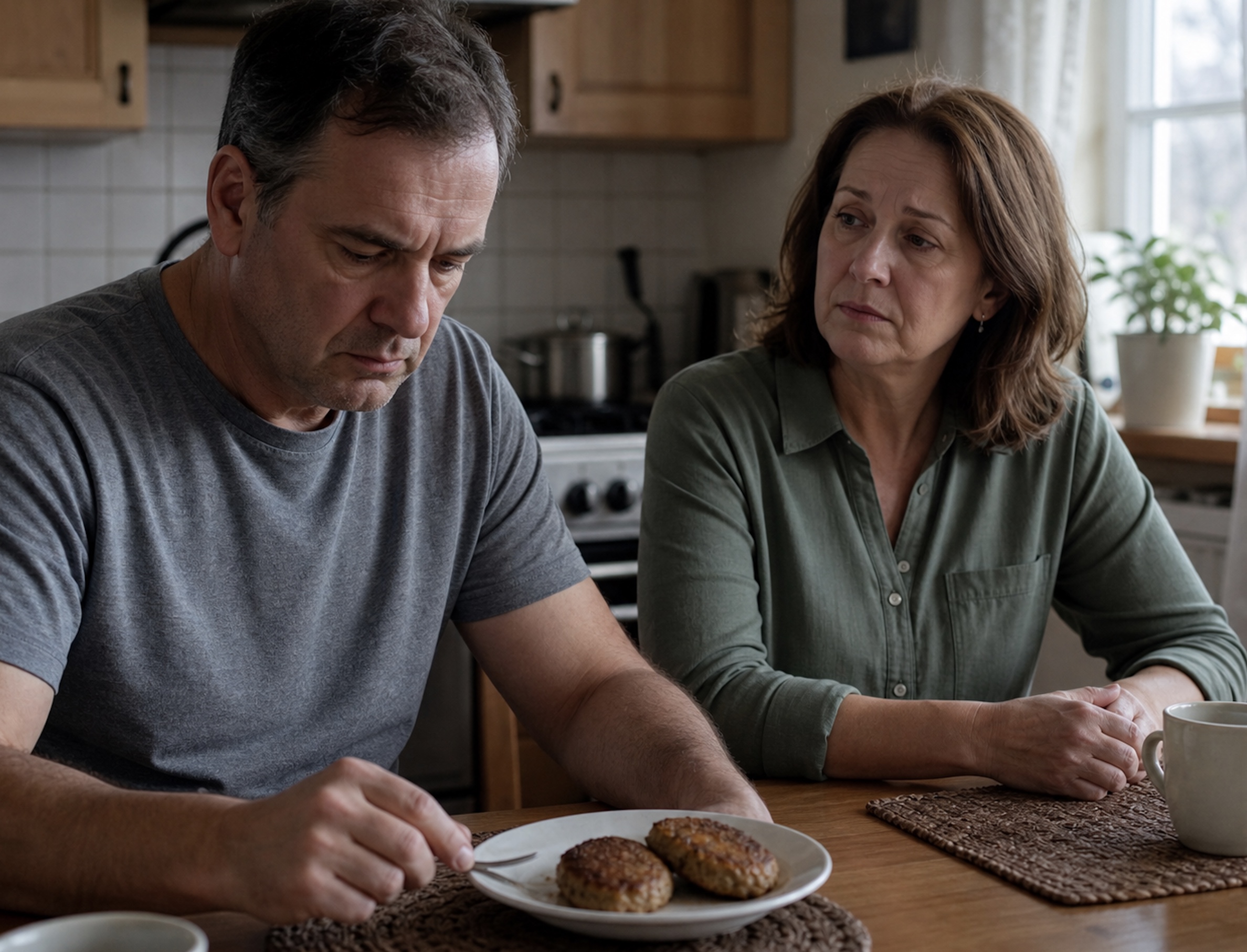
“I can’t live with a pensioner anymore.”
He said it without looking at me, staring down at the plate of cutlets instead. I had just placed the second one in front of him. He always ate two. Every Saturday. For thirty-two years.
“Victor, what are you talking about?”
“Us, Zoya. Or rather, the fact that there is no ‘us’ anymore.”
I sat down across from him. I placed my hands flat on the table, palms down, so they wouldn’t betray me. The accountant in me switched on before the wife did. The accountant always reacts first to the word “no.”
“You’re leaving?”
“I am. I found someone else. She’s twenty-nine. And, you know, she doesn’t walk around the apartment in an old robe with stretched-out pockets.”
To be fair, my robe really was old. Blue, with buttons on the front. I had bought it back when our daughter first started school. It was comfortable. Victor used to call it “my couch robe.” He used to laugh.
He wasn’t laughing now.
“What’s her name?”
“Kristina.”
I nodded, as if that explained anything.
The cutlets were cooling on the table. I looked at them and had the strangest thought: I had spent three hours making them. Ground the meat myself, soaked the bread in milk the way my mother had taught me. Three hours of my Saturday. And now he was going to stand up and leave for Kristina, who probably ordered sushi.
“When?”
“When what?”
“When are you leaving?”
“Today. My bag is already packed.”
That was when something clicked inside me. Not cracked, not broke — clicked. Like a switch being turned off.
His bag was already packed. While I was in the kitchen. While I was cooking borscht for the week ahead like an idiot.
“Then go,” I said.
He looked as if he didn’t believe me. Even raised his eyebrows.
“That’s it? Nothing else?”
“What do you want to hear, Victor? That I washed your shirts for thirty-two years for nothing? I already know that without you telling me.”
He stood up and went into the hallway. I heard him fiddling with the lock on the suitcase — the same one we had taken to Anapa in 2008, the year we received the bonus and bought the apartment. I had also put my mother’s inheritance into that apartment. Two million seven hundred thousand rubles. I remembered every number. I’m an accountant, after all.
And we registered the apartment in his name.
“It’s easier this way, Zoyechka. We’ll transfer it later.”
We never did.
I sat in the kitchen, staring at his two cutlets. Then I stood up, took out a large black garbage bag — one of those 120-liter ones I buy in packs at Pyaterochka — and went into the bedroom.
“What are you doing?” he asked when he saw me with the bag.
“Helping you pack. One suitcase won’t be enough.”
And I started putting things in. Shirts — into the bag. Sweatpants, the ones he wore every Sunday while lying on the sofa — into the bag. Slippers, toothbrush, razor, phone charger. Everything went into the bag. Quickly. Calmly. Like I was doing inventory.
“Zoya, have you lost your mind?”
“No, Vitya. Quite the opposite. I’ve finally found it. For the first time in thirty-two years.”
He grabbed my arm. I looked down at his fingers — short, with yellowish nails — and for some reason, he let go.
“I’ll come back for the rest later.”
“Come back. Just call first. So I can open the door.”
Back then, I still thought I would.
Four days later, he came.
Not alone.
I opened the door and saw her.
Kristina.
She was standing on the landing in a white coat that was too light for the season, holding a purse on a thin gold chain. She looked at me the way people look at old furniture that needs to be carried out.
“Hello,” she said politely, with a slight squint.
“Hello.”
Victor squeezed past me into the hallway as if he were still the master of the place.
“Zoya, we’ll be quick. I’m here for my winter clothes and documents.”
“What documents?”
“Well, mine. Passport, car registration, insurance number. And the apartment papers.”
I stopped in the kitchen doorway.
“The apartment papers?”
“Yes. The apartment is in my name.”
Behind him, Kristina smiled slightly. Just one corner of her mouth lifted. I remembered that smile often afterward.
“Victor,” I said very slowly, “are you seriously standing here asking for the documents to an apartment where I invested my mother’s inheritance?”
“Zoya, what inheritance? That was a hundred years ago.”
“Eighteen,” I corrected him. “Not a hundred. Eighteen years ago. Two million seven hundred thousand rubles in 2008, in case anyone is interested. Back then, that was the full price of a two-room apartment in our district. The whole price. You even laughed and said I saved ‘penny by penny.’”
“Young man,” Kristina suddenly cut in, “we actually don’t have time.”
That “young man” nearly finished me.
He was fifty-six. A belly hanging over his belt, a red face, bags under his eyes — what young man? But to her, he was “young” because he paid. And technically, he was paying with my money, because for the last three years he had stopped bringing half his salary to the card, saying it was “for gas and lunches.”
I felt a sharp pounding in my temples. Not my heart — my temples. Dry and sharp, like someone snapping their fingers inside my skull.
“Victor, please leave. And take your young lady with you. You’ll get the documents through court.”
“What are you talking about?”
“Through court, Vitya. From now on, you get everything from me through court. Shirts, socks, and that half of the apartment you supposedly own. By list, with a stamp and a signature.”
Kristina gave a short laugh.
“You seriously think you’ll win anything? The apartment is registered in his name.”
“Girl,” I turned to her, and something in my voice must have changed because she took half a step back, “go wait in the hallway. I’m speaking to my husband. Formally, he is still mine.”
Victor tugged her by the sleeve. She stepped out onto the landing. He stayed.
“Zoya, don’t do anything stupid. We can settle this normally.”
“We can. But ‘normally’ does not mean ‘give me the apartment and my passport.’ Normally means, ‘Let’s calculate who invested what and divide it fairly.’ Shall we calculate?”
He said nothing.
“You don’t want to calculate. Fine. I’ll calculate on my own. I’m good at that, as you know.”
I closed the door behind him. Turned the lock once. Then again. Then leaned my back against the door.
The apartment was quiet. Only the fridge hummed in the kitchen, as always. And it smelled of borscht — the one I hadn’t finished eating since Saturday.
I slid down the door to the floor and sat there for about five minutes.
I didn’t cry.
I just sat and counted in my head: two million seven hundred thousand, plus the renovation in 2012 — another four hundred thousand, plus the kitchen in 2015 — two hundred ten thousand, plus the balcony in 2019…
The accountant in me was working.
The wife was silent.
Then I got up, took my phone, and called a locksmith. He arrived an hour later and changed the lock cylinder. Two thousand three hundred rubles. I wrote it down in my expense notebook. Habit.
That evening, my daughter called.
“Mom, Dad says you won’t let him in.”
“I won’t.”
“Mom, but he’s…”
“Alyona, I have one request. Don’t get involved. Please. I’ll handle this myself.”
She went quiet. Then she said, “Okay, Mom.”
And that “okay” was the first thing that warmed me all week.
Two weeks later, the court notice arrived.
“Claim for division of jointly acquired property.”
Victor demanded half the apartment, half the dacha — which, by the way, we didn’t even have, he added it for importance — and, for some reason, “compensation for moral damages” because I had changed the locks.
I read it and, honestly, laughed.
For the first time in a month.
Then I went to a lawyer. Not someone I knew — people you know talk too much — but a stranger from an advertisement. A young woman of about forty in a gray blazer. Her name was Irina Sergeyevna.
I laid a folder in front of her.
The folder I had been building for eighteen years.
An accountant’s habit: keep everything.
“Certificate of inheritance from 2007,” I said, placing the papers down one by one. “Bank statement showing two million seven hundred thousand rubles deposited into my account. The apartment purchase agreement — same amount, one month later. Renovation receipts, all of them, from 2012 onward. Receipts for the kitchen. Contract with the workers for the balcony. Utility bills, which, by the way, I paid myself for the last six years from my salary of fifty-eight thousand, while he was ‘investing in relationships.’”
Irina Sergeyevna flipped through the pages in silence. Then she looked up at me.
“Zoya Pavlovna, why did you keep all this?”
“I’m an accountant,” I said. “I keep everything.”
She smiled. A real smile. As if she had finally met someone who had come prepared.
“You have a very strong case. I think we can get you not just half, but the whole apartment.”
I nodded. Then I said,
“Irina Sergeyevna, there’s one more thing. I’m a guarantor on his car loan. Since 2022. A Toyota. He took the loan for three years. There are eleven months left. Can I somehow… get out of it?”
She thought for a moment.
“You can’t withdraw as guarantor unilaterally. But we can write to the bank about a substantial change in circumstances — the divorce. Most likely, the bank will require him to either provide a new guarantor or repay the loan early. And if he can’t do either…”
“They’ll take the car?”
“They’ll take the car.”
I looked out the window. Wet snow was falling, landing on the awning and melting immediately. I thought about Kristina in her white coat. About how much she probably loved riding in that Toyota. About how Victor had driven me in it only twice — once to the clinic and once to the cemetery, to visit my mother’s grave.
“Let’s write it,” I said.
And Irina Sergeyevna wrote it.
That evening, I came home and made tea.
Not for him. Not “for two.”
For myself.
In a small mug with forget-me-nots on it, the one he had always despised. I drank it by the window.
The apartment was quiet. My robe hung on its hook. No one called it “the couch robe.”
I thought: so this is what it feels like. Being alone is not frightening.
What was frightening was cooking two cutlets for thirty-two years and receiving only one cutlet’s worth of attention in return.
Then the phone rang.
Unknown number.
“What have you done, you old hag?!” Kristina screamed into the receiver.
I moved the phone away from my ear. Carefully, the way an accountant moves aside an incorrect report.
“Girl, I have one request,” I said calmly. “Only contact me through my lawyer. I can give you Irina Sergeyevna’s number.”
And I hung up.
The first gun had fired.
The court hearing was in February.
Victor came in his only suit — dark blue, the same one he had worn to Alyona’s wedding four years earlier. It had grown tight on him. The jacket wouldn’t close over his stomach.
Kristina wasn’t there. As I learned later, she was already fighting with him that day.
I came in an ordinary skirt and a white blouse. No robe, obviously. Victor looked at me and seemed confused. Maybe he had expected to see “a pensioner.” Instead, sitting across from him was a woman who had spent thirty-two years keeping accounts for others, and had finally come to settle her own.
Irina Sergeyevna spoke for about twenty minutes. Calmly, document by document.
Certificate — one.
Bank statement — two.
Receipts — one folder, three hundred and eighteen pages.
Payment records — another folder.
I watched Victor. He turned red, then pale. At one point he even reached into his pocket for Validol — and didn’t find any, because I had always been the one who put it there.
The judge listened, then looked at him over her glasses.
“Defendant, do you have anything to object to on the merits?”
“Well… it’s jointly acquired property…”
“With what funds was the apartment purchased?”
“Common funds.”
“The case file contains an inheritance certificate and a bank statement. Two million seven hundred thousand rubles were deposited into the claimant’s account in 2007. The apartment was purchased in 2008 for two million seven hundred thousand rubles. What proof do you have of your contribution?”
He was silent.
“No proof?”
“No.”
We won the case.
Completely.
The apartment was mine. Plus compensation for renovations that I had paid for from my card — another six hundred thousand rubles, which he was ordered to pay me within six months.
Victor left the courtroom first. I stayed behind to sign documents.
When I stepped into the hallway, he was standing by the window, looking out into the courtyard. His shoulders sagged. His suit hung on him like a sack.
“Zoya,” he said without turning around. “You can’t do this.”
“Do what?”
“This. Count everything down to the last ruble. I’m not a stranger to you. We have a daughter together.”
I stepped closer and stood beside him.
And then — I swear, I didn’t expect it from myself — I said what I said.
“Vitya, I wasn’t a stranger to you for thirty-two years. But you made me one in a single Saturday. Do you remember what you said? That you couldn’t live with a pensioner. I am not a pensioner. I’m fifty-four. I still have six years until retirement. But even if I were one — for those words, I won’t forgive you a single ruble. Not one, Vitya. And I won’t forgive your car loan either.”
“What loan?”
“The Toyota. I wrote to the bank about the divorce. They removed me as guarantor. They’ll call you any day now and demand either early repayment or a new guarantor. Do you think Kristina will sign for you?”
He turned around.
His face wasn’t red anymore. It was white.
“You… you did that on purpose?”
“On purpose, Vitya. Very much on purpose.”
I walked past him toward the elevator.
The second gun fired right there, in the courthouse hallway. I heard his phone vibrate in his pocket.
Probably the bank already.
At home, I poured myself tea into my forget-me-not mug. I sat by the window, watched the snow, and thought: maybe this is what people mean when they say justice has been served.
Only my hands were still shaking.
Not from fear.
From thirty-two years of exhaustion that I had finally allowed myself to feel.
Then Alyona called.
“Mom, have you lost your mind? Dad lost the car. He says you set him up with the bank. Is that true?”
“It’s true, daughter.”
“Mom, but he’s my father. He’s crying.”
“Alyona, I love you very much. But we are closing this subject. He will always be your father. But he is no longer my husband. I have my accounts, and he has his.”
She was silent. Then she finally said,
“You’ve become different.”
“I’ve become myself, Alyona. For the first time in thirty-two years.”
And I hung up.
The second gun had fired. And to be honest, I didn’t know then whether I should feel glad or not, because my daughter had been sobbing on the phone.
A year passed.
I learned about Victor in bits and pieces through Alyona. She still called, although by October she stopped saying “Dad” and started saying “he.”
His Toyota was taken back in March. Kristina refused to become his guarantor. She said she had not gotten together with him “just to pay his debts.” They never married, by the way. They lived in her rented one-room apartment on the outskirts of town, and from what I heard, things got worse every month.
In August, she threw him out.
It happened on a Wednesday evening. Alyona called me crying.
“Mom, he called me. He says he has nowhere to live. No apartment, no car. Kristina put his bags outside the door. She told him, ‘I can’t live with a debtor anymore.’”
I was sitting in the kitchen, peeling potatoes. For one portion. I cook only for one now. Fewer potatoes, less food wasted.
“Mom, do you hear me?”
“I hear you.”
“He’s asking to come back. He says just temporarily.”
I looked at the potatoes in the bowl. At the knife. At my hand holding the knife.
My hand was steady.
“Alyona, please tell him one thing. I can’t live with a pensioner anymore.”
“Mom!”
“Those are his words, Alyona. Not mine. His own.”
She went quiet.
For a long time.
Then she said,
“You’ve become cruel.”
“Maybe.”
“You should see him. He’s wearing an old jacket and holding a bag of things. Like a homeless man.”
“I saw him for thirty-two years, Alyona. In every state. In good suits and in sweatpants. Now it is my turn to live, not watch him standing there with a bag.”
She hung up.
And I finished peeling the potatoes. Put them on the stove. Then I turned on the television — loudly, louder than I had in years, because Victor had never liked it loud.
Some series was on.
I wasn’t watching.
I was just listening to the voices filling the apartment.
My apartment.
Completely mine, from baseboard to baseboard.
A couple of hours later, my phone buzzed by itself on the table. Victor’s number. I watched it vibrate and slowly crawl toward the edge.
One call.
A second.
A third.
I didn’t answer.
Not the fourth time. Not the fifth. Not the sixth.
He called six times before midnight.
I counted. Accountant’s habit.
The next day, Alyona sent me a message: “He’s staying with us. Temporarily.”
I replied: “All right, sweetheart. Take care of yourself.”
And that was all.
We don’t talk about it anymore. Alyona is cold with me, but she is still my daughter. She says I “destroyed the family.” I say the family was destroyed by the man who left on a Saturday, leaving two cutlets on the table.
We don’t agree.
I heard he got a job as a night watchman at a construction site. He lives in a temporary cabin. Kristina married someone else — some car dealership director — and posts everything on Instagram.
As for me, I drink tea in the mornings from my forget-me-not mug. I cook for one. I bought myself a new robe — not blue, but green, with large buttons. I chose it myself in the store and tried it on in front of the mirror.
In the mirror, there is a woman of fifty-four.
Gray at the temples.
Glasses.
Not a pensioner.
Just a woman who finally owes nothing to anyone.
So now I’m asking you, ladies.
Alyona barely speaks to me. My neighbor, Aunt Valya, told me in the elevator yesterday, “Zoya, forgive him. He’s a man, these things happen with men.” The accountant at work said, “Zoya Pavlovna, but what about your daughter? She’s being torn in two.” My own sister from Saratov said, “Zoyushka, he has no roof over his head. Take him in at least for the winter.”
But I won’t take him back.
Did I go too far with the bank and the guarantor issue? Or did I do the right thing — after thirty-two years of laundry, two cutlets, and being called “a pensioner”?
What would you have done, ladies?
Would you have let back in the husband you sent away a year ago with a garbage bag?