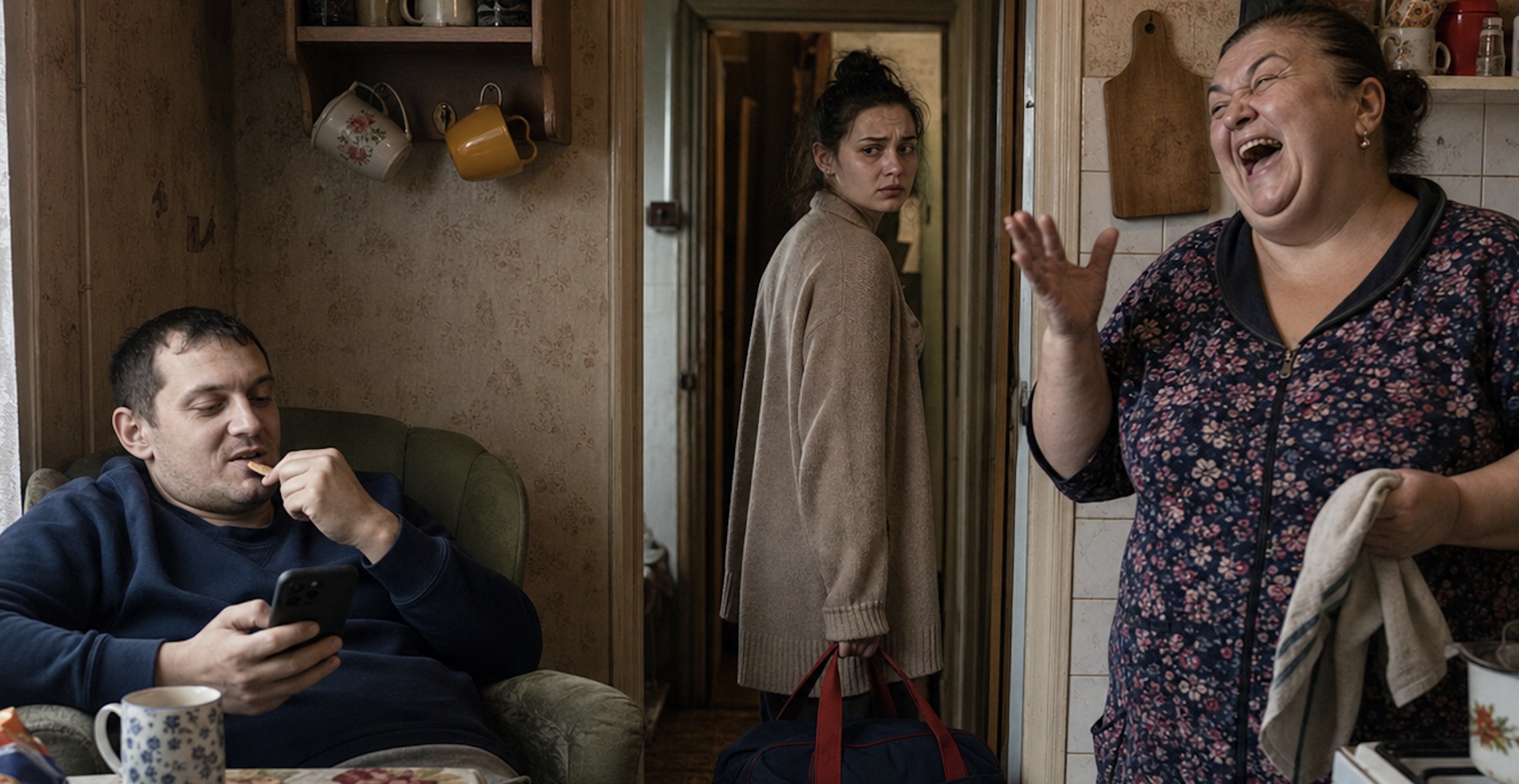
The bunch of keys landed on the small hallway cabinet with a dull metallic clatter. The cramped entryway smelled heavily of cooking fumes, damp wool, and stale cigarette smoke. From the room came the monotonous drone of the television and the steady crunching of snacks.
Ksenia slipped the coat from her shoulders, still damp from the November drizzle. The fur on the collar had clumped together.
“I’m filing for divorce,” she said, stopping in the kitchen doorway.
The springs of the sagging sofa creaked. Maksim did not even turn his head away from the sports channel. He simply tossed another handful of crackers into his mouth, brushing crumbs off onto his sweatpants.
But by the gas stove, Zoya Nikolaevna immediately spun around. She wiped her oil-shiny hands on her faded apron.
“What was that?” her mother-in-law narrowed her small, deep-set eyes. “What divorce? You still have loans to pay off. Go heat up the cabbage soup! Look at this countess, thinking she’s getting divorced! Who needs you anyway? Four years married and you couldn’t even manage to have a child, yet here you are acting like you have rights!”
Maksim took a loud sip from his large mug. He was plainly bored by the whole conversation.
Ksenia leaned her shoulder against the doorframe.
Only two hours earlier, she had been standing behind a heavy velvet curtain in the banquet hall of a restaurant. She worked as a props maker at the local drama theater. That evening, she had received an urgent order to deliver stage props for the corporate party of a large retail company.
After handing the boxes of masks to the administrator, Ksenia had meant to slip out quietly through the side door. But then her eyes caught sight of a familiar jacket in the cloakroom.
And then she saw Maksim himself.
He was sitting at a corner table, half-hidden in the dim light, while Lilia, a dispatcher from his own property management company, sat comfortably on his lap as if she belonged there.
“So your wife is still gluing those little cardboard things?” Lilia drawled in a spoiled voice, twirling a strand of hair around her finger. “She’ll spend her whole life dragging your debts around.”
“Let her drag them,” Maksim smirked, kissing Lilia’s neck. “She’s obedient. She won’t go anywhere.”
And this was the man for whom Ksenia had willingly chained herself to debt for the next ten years.
A year earlier, Maksim’s construction crew had taken on the renovation of a country cottage. On Friday, the workers had decided to celebrate the completion of the rough work right there at the site. They brought alcohol. And they forgot to shut off the main heating valve.
Boiling water poured through the house all night. By morning, the expensive parquet had swollen, the decorative plaster had fallen off, and the Italian furniture on the ground floor was ruined. The client presented a bill with far too many zeros and promised to destroy the foreman financially.
Maksim’s friends disappeared that very day.
And Ksenia went to the banks.
She took out a massive loan in her own name at monstrous interest rates to save her husband from court. And now that same saved husband was calmly chewing crackers while his mother ordered Ksenia back to the stove.
“I’m filing the papers tomorrow,” Ksenia repeated, staring straight at the back of Maksim’s head. “And you can move in with Lilia. I saw you both tonight.”
The crunching stopped.
Maksim slowly lowered his hand. Zoya Nikolaevna gasped in outrage and grabbed the edge of the table, but Ksenia did not stay to listen to excuses or accusations.
She walked into the bedroom, pulled an old sports bag down from the top shelf of the wardrobe, and began methodically folding sweaters, jeans, and clothes into it.
Fifteen minutes later, the front door slammed behind her.
The cold wind slipped under her coat. She had nowhere to go. Her parents lived in another region, and she had long ago lost touch with her friends because she had been working two jobs constantly.
Ksenia walked toward the service entrance of the theater. The night guard, long used to her staying late before premieres, silently nodded and turned the key in the lock.
She spread a piece of thick woolen cloth over the narrow cutting table and placed her rolled-up down jacket under her head. The workshop smelled of wood shavings, acrylic paint, and old fabric.
In the morning, she woke to the sound of footsteps and creaking floorboards.
Standing in the doorway of the workshop was Arkady, a guest playwright from the regional center, whose play they were currently staging. Over the past two months, Ksenia had often discussed costume sketches with him.
When he saw her crumpled bag and tired, wrinkled face, Arkady placed two plastic cups of coffee on the edge of the table.
“Pack your things,” he said evenly.
“I have a shift in forty minutes.”
“I already spoke to the director. You’re being transferred to the regional theater. Their props master has retired, and they have no one to replace him. For now, you’ll live in the theater dormitory. The room is tiny, the bathroom is shared, but it’s better than sleeping on a cutting table.”
There was no point in refusing.
A week later, Ksenia was standing in the spacious, bright workshop of the regional theater. New Year’s performances were approaching. Work saved her from obsessive thoughts about the debt that was taken from her card every month.
One day, an actress from the ensemble came down with a bad cold. The director shoved an embroidered cape into Ksenia’s hands, and she had to go with the troupe to a children’s boarding home on the outskirts of the city.
After performing a short scene, Ksenia handed out sweet gifts. The children pushed, shouted, and reached out their hands.
Only one little boy, about six years old, stood off to the side, pressing his shoulder against the cold painted wall.
“That’s Matvey,” a caregiver who had come up beside her said quietly. “His parents were stripped of their rights a long time ago. His grandmother passed away last autumn. He isn’t used to noise. He keeps waiting by the door, thinking someone will come for him.”
Ksenia walked over to the boy and crouched down in front of him.
“Hello.”
Matvey said nothing.
He did not look at the sweets. Instead, he stretched out his small palm and carefully touched the thick velvet fabric of her theater cape.
At that moment, Ksenia understood with absolute clarity that she would do everything possible so that this child would never be alone again.
That evening, she told Arkady everything. They were sitting in the empty theater buffet.
“For a single woman with huge debts to adopt a child is a dead end,” Arkady said directly, without softening the truth. “The guardianship authorities will reject your application. You need to officially divide your obligations with your ex-husband and get a clean divorce document.”
The meeting with Maksim took place a few days later in a cheap café near the railway station. Her former husband looked worn out, but he carried himself confidently, sprawling on the plastic chair.
“Here’s how it’s going to be,” Maksim said through his teeth, stirring sugar into his cup. “I’ll give you the divorce. And I won’t make any claims over property division. But I have one condition. You take all the debts for my ruined project completely onto yourself. We sign a backdated marriage contract or an agreement at the notary’s office. Otherwise, I’ll dig my heels in, the courts will drag on for a couple of years, and your little boy will be given to someone else.”
Ksenia stared at the greasy spot on the tabletop beside Maksim’s cup.
In her mind, she saw Matvey touching the velvet of her cape.
“Fine,” she said.
They signed all the papers.
When Ksenia stepped out of the notary’s office, she suddenly felt terribly sick. For the past few weeks, she had been nauseous every morning, blaming it on nerves and cheap sausages from the theater buffet. But now the pavement seemed to sway beneath her feet.
She made her way to the nearest private clinic.
The doctor’s office smelled of disinfectant and sterile air. The doctor moved the ultrasound probe over her stomach for a long time, looking at the monitor.
“Well, congratulations,” the doctor said in a routine tone, wiping the gel away with a paper towel. “Eight weeks. Everything is developing normally.”
Ksenia stared up at the white ceiling.
Useless.
That was what her mother-in-law had called her for four straight years.
She remembered that one single evening two months ago. A difficult premiere, nerves in the workshop, Arkady coming in to pick up sketches and staying to pour her a cup of tea. A long conversation that had ended with an absolute loss of control over the situation.
When she returned to the theater, Ksenia went down to the workshop.
Arkady was sitting at her worktable, looking through set design drawings. She silently placed the medical report in front of him.
Arkady read the lines quickly. Then he slowly set the paper aside.
In the workshop, the only sound was the hum of the old ventilation system.
He stood up, walked over to Ksenia, and firmly took her by the shoulders.
“Next month, I’m signing a major contract for the script of a historical series,” he said, his voice steady. “The advance will be enough to pay off your bank debt. And we’ll take Matvey. Together.”
Two years passed.
In Zoya Nikolaevna’s cramped apartment, the old metal kettle whistled unpleasantly.
Maksim lay on the sofa, mindlessly clicking the television remote, while his new wife Lilia irritably scrolled through her phone.
A popular morning program was on TV. The host cheerfully introduced the guests in the studio.
“Today we are joined by the creator of the hit series, screenwriter Arkady Sokolov, and the chief artist of the regional theater, Ksenia Sokolova!”
The camera moved in for a close-up.
Ksenia sat on a light-colored sofa in the studio. She was well-groomed, confident, and dressed in an elegant suit. Arkady sat beside her.
“Arkady, your filming schedule is insane. How do you manage to find time to raise two children?” the host asked.
“I wouldn’t manage anything without Ksenia,” Arkady said, looking at his wife. “Our eldest son, Matvey, started first grade this year, and our daughter recently turned one. They are our most important project.”
A heavy silence settled over Maksim’s apartment.
He sat up on the sofa and muted the television with the remote. Lilia placed her phone on the table.
Zoya Nikolaevna slowly shifted her gaze from the radiant Ksenia on the screen to her new daughter-in-law.
“You’ve been living together for two years,” the mother-in-law said dryly, wiping her hands on her apron. “And there’s no children’s laughter in this house, no care, nothing. All you do is stare at your phone. You should go see a doctor. You really are useless.”
Lilia drew in a breath, ready for a scandal.
Life in that apartment had returned to its familiar circle of mutual reproaches and gray hopelessness.
And far away, in the regional center, Ksenia stepped out of the television studio onto a sunlit street and felt, at last, that she was home.