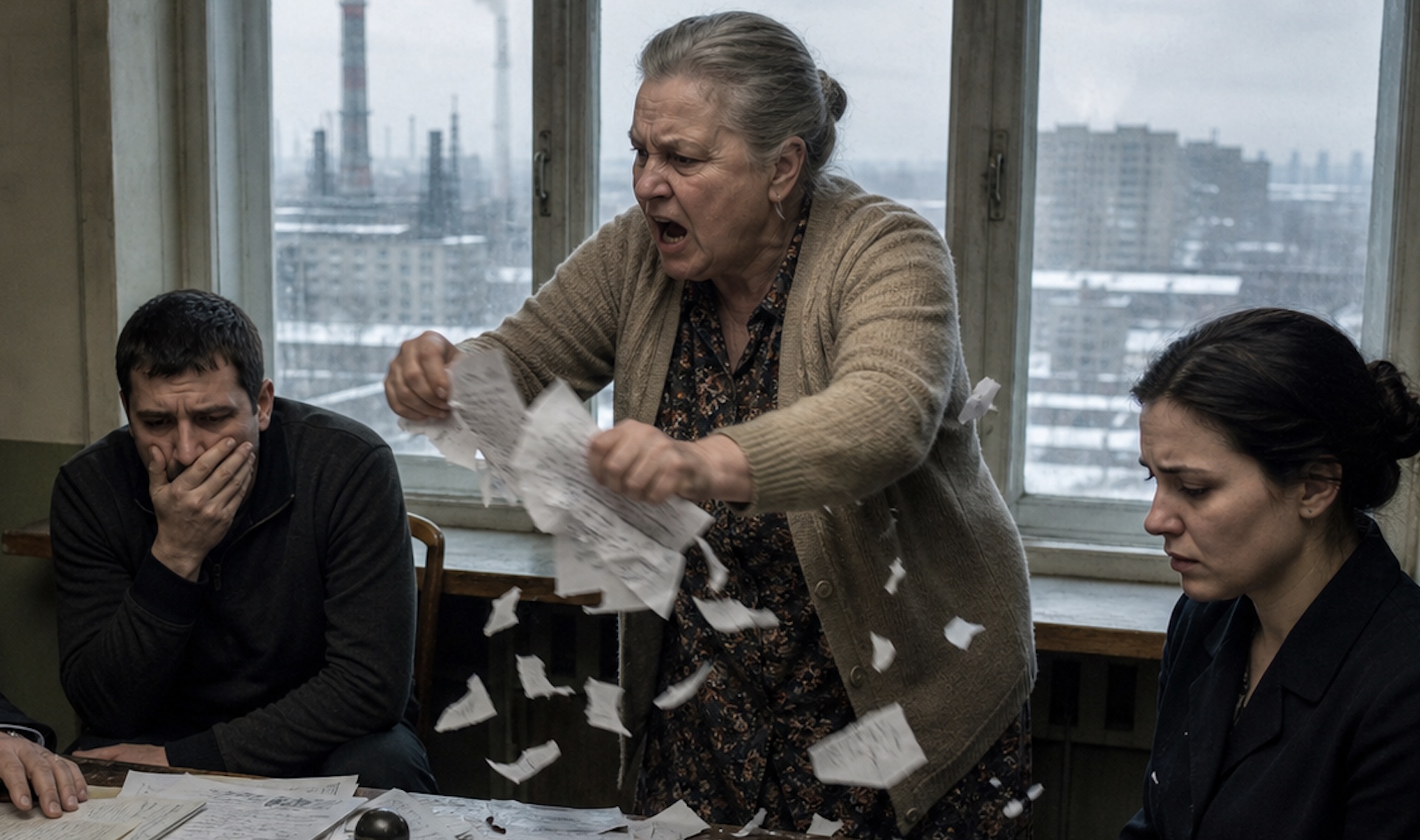
“Picked you up from the garbage, you dowryless little b*tch! Washed you, let you into an apartment, gave you a family name — and now you wave promissory notes in our faces?!” Raisa Stepanovna was not shouting. She was howling, and in the narrow notary’s office in central Bratsk, that sound felt almost physical, like a shockwave.
The white sheet of paper burst into tiny scraps. One sharp corner grazed my cheek, leaving a thin scratch. Another piece got caught in my hair. Raisa Stepanovna stood over me, her breath smelling of garlic croutons and Corvalol. Then she threw the remains of my promissory note straight at my chest. The scraps fluttered down onto the linoleum, mixing with dust and dry soil that had spilled from a cracked pot with a zamioculcas on the windowsill.
“There’s no more little paper of yours, Karina!” my mother-in-law bared her gold bridge in a triumphant grin. “Swallowed that? Now you’re nobody here. Go back where you came from. Back to your dormitory with the cockroaches. And don’t you dare bother my precious Seryozhenka again.”
Sergey, my husband, sat on the chair beside me, staring at his knees. He did not move. His fingers, used to a keyboard rather than hard labor, trembled slightly. He did not say, “Mom, what are you doing?” He did not say, “Arina, forgive me.” He simply waited for it to end. In documentary language, that is called passive complicity.
The notary’s office was stuffy. The window was shut, and beyond the glass Bratsk was suffocating in industrial fog. I looked at my hands and thought that yesterday I had forgotten to buy laundry detergent. A strange thought at the moment your life is collapsing, but my mind had always worked that way — clinging to ordinary details when reality became too sharp.
“Raisa Stepanovna,” I lifted my head. My voice was dry, like tracing paper. “You have just destroyed a document confirming that I transferred two million four hundred thousand rubles to your son to pay off his debts. Do you understand the legal consequences?”
“Consequences?!” she burst into a barking laugh. “The consequence is that you’re about to be kicked out of here! Seryozha, get up! We have nothing more to do here. Let this beggar prove in court that she ever held even one ruble in her hands.”
I looked at the notary. A woman of about fifty in a strict suit was silently observing the scene. She had not made a single move to stop my mother-in-law. She had not even raised an eyebrow when Raisa Stepanovna snatched the note from her desk. She merely looked at the Yantar wall clock.
I looked at the clock too.
It was the second minute of the seven that separated Raisa Stepanovna’s triumph from her total destruction.
The depression I had been treating for the last six months suddenly stepped back. You know how it happens — when body temperature drops to a critical level, and everything becomes painfully clear. I am a process engineer at an aluminum plant. I know how metal melts. And I knew exactly at what temperature human arrogance begins to melt.
To understand how we ended up in that office at 10:42, you need to go back to the numbers. In documentary language, numbers are the only truth.
My salary as a process engineer at the Bratsk Aluminum Plant was 145,000 rubles. Net. Plus quarterly bonuses. Plus northern allowances. I worked twelve-hour shifts. My hands smelled of the workshop, and my hair smelled of smoke that even the most expensive shampoo could not wash out. Sergey worked as a freelance designer. His income was a variable value, tending toward zero in the winter months.
Two years earlier, Sergey had decided to “scale his business.” He took out loans at insane interest rates and invested in some crypto mining farm that burned down a month later. With penalties, the debt reached 2,400,000 rubles. Bailiffs started coming to our door. Then Raisa Stepanovna appeared on the threshold with her lamentations:
“They’ll throw Seryozhenka in jail! They’ll ruin him! Arina, you’re his wife, you have to help!”
I was his wife.
I withdrew the money from the savings account I had been building for eight years. My grandmother’s inheritance and every kopeck from my hazardous-duty shifts. I paid off his debt. Completely.
But I am not a fool.
Before transferring the money, I made Sergey sign a promissory note stating that the money was a targeted loan, subject to repayment in the event of property division or divorce.
Back then, Raisa Stepanovna smiled right into my eyes.
“Of course, sweetheart. Everything fair and honest. We’re family.”
And three days ago, I found out that Raisa Stepanovna had secretly transferred the two-room apartment on Obrucheva Street, where we lived, into her own name. The apartment had been registered to Sergey under a gift agreement, but there was some loophole in the documents that she and another notary — not this one — had “corrected.” Sergey signed a waiver of ownership rights in favor of his mother.
They had decided to dump me.
Like spent slag.
10:44.
In the notary’s office, Raisa Stepanovna began gathering her bag — a heavy imitation-leather thing stuffed with receipts and eternal shopping sacks. She felt like a winner.
“Arina, don’t take it personally,” Sergey suddenly spoke. His voice was hoarse. “Mom is right. We need to live separately for a while. I can’t handle this pressure anymore… you’re always demanding things, always counting…”
“I count my money, Seryozha,” I replied. “And your time.”
I remembered how three days earlier I had sat in this very same office. Without Sergey. Without Raisa Stepanovna.
I had come here with that same promissory note. The notary, the same woman in the strict suit, carefully examined the document.
“You understand that the original may be lost?” she asked me then.
“I suspect it may be destroyed,” I answered. “That is why I want to issue a duplicate and enter it into the Unified Information System of the notariat.”
The procedure took half an hour. The state fee was three thousand rubles.
Those were the best three thousand rubles I had ever spent.
10:46.
Raisa Stepanovna was already standing by the door, her chest thrust forward in victory.
“Arinka, pick up your scraps after yourself. It’s not proper to litter in an official place. Come on, Seryozha.”
Sergey stood up.
He looked at me briefly, the way people look at an accident on the roadside while driving past. There was relief in his eyes. He thought that together with the torn paper, his debt had disappeared too. That he could start life with a clean sheet, one his mother would spread with jam for him.
“One moment,” the notary said.
Her voice sounded like the click of a safety catch.
Raisa Stepanovna turned around. Confusion flashed across her face. In her mind, she was already drinking tea in her kitchen, discussing what new wall unit she would buy for the newly freed room.
“Is something wrong, Vera Viktorovna? We’re finished, aren’t we? No paper, no case.”
The notary slowly, with almost mechanical calm, opened the folder lying in front of her. She did not look at my mother-in-law. She looked at the computer monitor.
“Raisa Stepanovna, you have committed an act that in legal practice may be interpreted as an attempt to conceal or destroy evidence. Video and audio recording is conducted in this office. Under procedure, I am required to record the fact of document damage.”
“What document?!” my mother-in-law threw up her hands. “That was just a piece of paper! Karinka drew it up herself!”
“That was the original promissory note registered in my records three days ago,” the notary turned the monitor toward Raisa Stepanovna. “Three days ago, Karina Sergeevna issued a duplicate of this promissory note. Under the law, the duplicate has the same legal force as the original. Moreover, the fact that you destroyed the original in my presence automatically triggers clause 7.2 of this agreement.”
Sergey went pale.
He knew what was in clause 7.2.
He had signed it without reading, confident that his mother would “sort everything out.”
I looked at him.
My subjective opinion: at that moment, he resembled an aluminum billet that someone had forgotten to machine. Gray, cold, and useless. I remembered how he had sworn he loved me on the shore of the Bratsk Reservoir. In documentary language, that is called misleading a person for financial gain.
“Clause 7.2,” the notary continued, “states that in the event of an attempt by the borrower or his representatives to dispute the loan or destroy the document, the repayment term for the entire sum is reduced to three banking days. With a penalty of one percent for each day of delay from the date the original was signed.”
The office fell silent.
From behind the wall came the sound of a hammer drill. In Bratsk, renovations never stop.
Raisa Stepanovna slowly lowered herself onto a chair. Her jaw twitched.
“Wait… what three days? What penalties? Seryozha, what is she talking about?”
“Mom…” Sergey covered his face with his hands. “Over two years, the penalties have added up to… another apartment.”
Mathematics is a cruel thing.
2,400,000 rubles. One percent per day. Seven hundred and thirty days. Of course, in court I would never be able to recover such an amount because of Article 333 of the Civil Code on disproportionate penalties, but the debt itself, confirmed by a duplicate, made their plan to throw me out impossible.
10:48.
Six minutes had passed.
I opened my bag. I took out a plastic folder — not blue, black, with a broken edge — and placed another document on the desk.
“Raisa Stepanovna,” I said. “This is a notice imposing a restriction on registration actions concerning the apartment on Obrucheva Street. My lawyer filed a motion for interim measures yesterday, based on the duplicate promissory note. You will not be able to sell it. You will not be able to gift it. And in three days, if Sergey does not return my two million four hundred thousand rubles plus lawful interest, we will begin the procedure of recovery against this property.”
My mother-in-law stared at me.
There was no fire left in her eyes.
Only ash.
“But you… you’re his wife…” she whispered.
“I was his wife until 10:42 this morning,” I replied. “Now I am your main creditor.”
The notary took a fresh sheet from the printer.
It was the duplicate.
The very one I had come for.
With a hologram, a seal, and the icy shine of truth.
She placed it in front of me.
“Karina Sergeevna, sign to confirm receipt. Raisa Stepanovna, Sergey Borisovich — you are free to go. I will prepare a report on the disturbance in the office and forward it to the appropriate authorities if Karina Sergeevna decides to pursue action for destruction of documents.”
Sergey stood up first.
He did not look at his mother. He did not look at me. He simply left the office, hunched over like an old man. Raisa Stepanovna backed out after him. She forgot her bag on the floor, returned for it, clumsily stumbled against the leg of a chair, and gasped. Her triumph had turned into a pathetic farce.
I remained sitting in the office for another five minutes.
“Thank you, Vera Viktorovna,” I said.
“It’s my job, Arina,” the notary replied. “You know, I’ve been sitting here for thirty years. And every day I see the same thing. People think that if they burn the paper, they burn the truth too. But truth is like aluminum. To destroy it, you need a temperature too high for your mother-in-law to reach.”
I stepped outside.
Bratsk greeted me with biting snow. I inhaled the air — salty, metallic, familiar. My hands no longer smelled of my mother-in-law’s Corvalol. They smelled of my new life.
I got into my car — an old Niva I had bought myself three years earlier. I started the engine. It rumbled confidently, familiarly. In documentary language, that is called proper technical condition of equipment.
Half an hour later, I was at the plant.
My shift began at noon. I changed into my blue work coat and tied on a headscarf. Then I entered the electrolysis workshop. The huge baths hummed, and heat shimmered above them. Here, everything was honest: current, temperature, chemical reaction. If you violated procedure, the metal would not come out right. If you betrayed a person, life would not come out right either. Everything was logical.
By lunchtime, Sergey called me.
“Arina… let’s talk. Mom is unwell. She’s having a hypertensive crisis. She didn’t mean to… she was just scared for me. Let’s come to some agreement. I’ll sign over a share of the apartment to you, just withdraw the statement.”
I looked at the molten aluminum flowing through the channels. A river of fire that knew no mercy.
“Sergey,” I said. “You should have negotiated three days ago. When you and your mother sat in front of another notary and erased me from your life. Now everything will be done according to the law. Three days. You have seventy-two hours left.”
I hung up.
My lunch was a cheese sandwich and strong tea from a thermos. I ate slowly, tasting every crumb. The depression was gone completely. In its place, something structural had risen — solid, like the frame of an industrial building.
That evening, I returned to the apartment on Obrucheva Street.
The keys worked. They had not had time to change the locks yet. The hallway smelled of someone else’s food and of that same Raisa Stepanovna. I walked into the room. Sergey’s things were scattered everywhere. He had apparently been frantically searching for some documents or money after realizing the situation had spun out of control.
I began packing my belongings.
Calmly. Without hysterics.
I took only what I had bought myself: my laptop, metallurgy books, and my favorite mug with the plant logo. I folded my clothes into two large suitcases. In documentary language, that is called asset evacuation.
On the kitchen table lay that same torn promissory note — or rather, the scraps I had mechanically stuffed into my coat pocket at the notary’s office and later placed there.
I looked at them and smiled.
Raisa Stepanovna thought she had “picked me up from the garbage.” But garbage was what remained of their family after the first real test of truth.
The landline rang.
I picked up.
“You bitch!” It was my sister-in-law, Sergey’s sister. “What are you doing? Mother is in the hospital, my brother is on the verge of a breakdown! Do you want to ruin all of us? We will never give you that apartment!”
“Natalya,” I said, “you should ask your brother where he put the more than two million rubles I paid off for him. And why he decided I was supposed to gift that money to your family. I don’t need the apartment. I need my money. With interest.”
“He doesn’t have that kind of money! Where would he get it?”
“Then there will be a court sale of the property. You’ll sell the apartment, pay the debt, and buy yourselves a room in Energetik with what’s left. People live there too.”
I hung up.
An hour later, I was eating fried potatoes in my new rented one-room apartment in Padun. From the window, I could see the Bratsk Hydroelectric Power Station. A majestic structure. Millions of tons of concrete holding back the pressure of water. I felt like that dam. I had endured for a long time. I had given them a chance. But now the floodgates were open.
The three-day deadline expired on Saturday.
Nobody called me. Nobody brought the money. Sergey sent a text message:
“You’ll regret this.”
In documentary language, this is interpreted as an empty threat with no material basis.
On Monday, my lawyer filed a lawsuit to recover the loan amount and pursue recovery against the pledged property.
The slow, dull machinery of the court began. Judge. Hearings. Appeals.
It took eight months.
For eight months, I lived alone, worked, went to the gym, and learned to breathe again without glancing over my shoulder at someone else’s “what will people say?”
The final court hearing took place in May. Bratsk had already thawed, and streams ran along the streets, smelling of earth and hope.
Raisa Stepanovna did not appear in court. She sent a medical certificate saying she was unwell. Sergey sat on the defendant’s bench, gaunt, wearing an old windbreaker. He no longer looked like a “freelance designer.” He looked like a man who had lost a lottery whose rules he himself had written.
The court ruled: to recover the principal debt of 2,400,000 rubles plus interest for use of the loan at the Central Bank rate. The judge reduced the one-percent-per-day penalty to reasonable limits, just as I had expected, but the final amount still came to around four million.
The apartment on Obrucheva Street was put up for sale.
We left the courthouse.
Sergey stopped on the steps and lit a cigarette.
“Happy now?” he asked, squinting in the bright spring sun. “You destroyed everything. The apartment, the family. Mom is now crammed into Natalya’s one-room place with me. Are you glad?”
I looked at him.
My subjective opinion: he had understood nothing. He still blamed me, not his own cowardice and his mother’s greed.
“Seryozha, I simply took back what was mine. What I earned in the workshop while you were ‘scaling your business.’ And I did not destroy the family. A family is when people stand for each other, not when two people scheme behind one person’s back in a notary’s office.”
I walked to my Niva.
On the back seat lay the same malachite box with my mother’s photo. I had taken it from that apartment after all.
A year passed.
I bought myself a small, cozy apartment in a new building. I have a new schedule, a new position — deputy head of the workshop. My salary is even higher now, and the responsibility is greater, but I like it. I know exactly what every decision costs.
Sometimes I pass by the old building on Obrucheva Street. Other people live there now. Children’s clothes dry on the balcony. Geraniums bloom. Life goes on.
Yesterday, I saw Raisa Stepanovna at the market. She was choosing potatoes, bargaining for every ruble, shaking her shopping bag. She did not notice me. Or pretended not to. I did not care.
Do you know the most ironic thing in this whole story?
I am genuinely grateful to Raisa Stepanovna.
If she had not torn up that promissory note back then, if she had not thrown it in my face, I probably would have kept enduring. I would have kept believing that “family is the most important thing,” even when that family was eating me alive.
She gave me the exact impulse I needed to remember who I was.
I am an engineer. A designer of structures.
And if a structure is rotten, you do not patch it.
You demolish it.
I got into my car and turned on the radio. Some light melody was playing. I drove to work, and in the rearview mirror there was only the clean, high sky of Bratsk.
My duplicate of the truth is always with me now.
And it no longer needs locks.