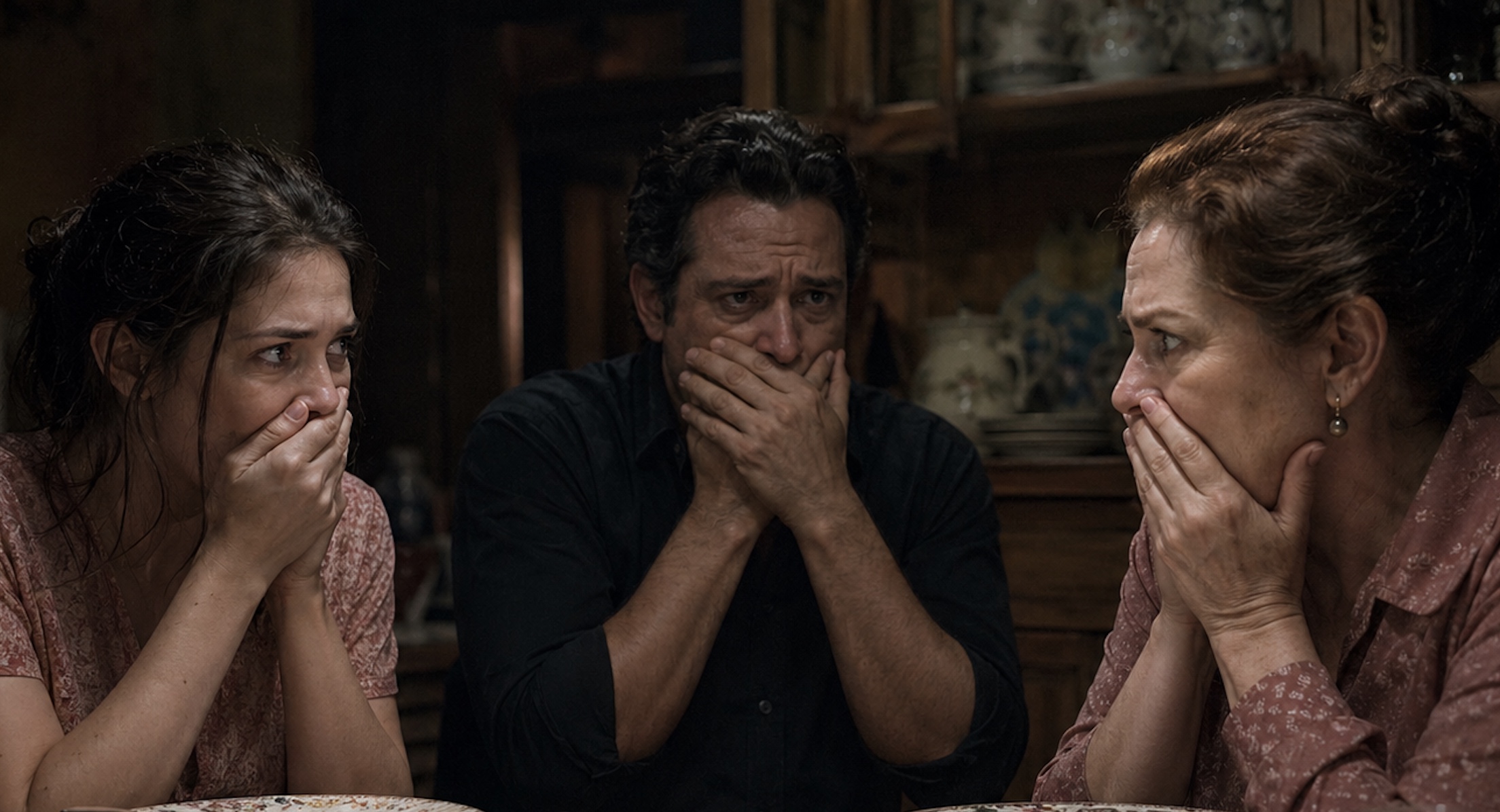
That day was supposed to be different.
Sergey and I had planned a quiet weekend at the country house — grilling shashlik, digging around in the garden beds, and simply lying in the hammock doing absolutely nothing. But those plans fell apart the moment I stepped inside.
As usual, the first thing I did was head to the kitchen to put the kettle on. And then my fingers touched it — cold, but wet on the outside. I hadn’t used it the day before. We had only just arrived.
A strange, unpleasant feeling stirred somewhere under my ribs.
I opened the cabinet where I kept my tea collection. The packet of expensive oolong I had brought back from my last trip was crumpled and half-empty.
“Sergey,” I called to my husband, trying to keep my voice from shaking. “Did you make tea here last time?”
He came into the kitchen, looking around with that familiar awkwardness of a man who rarely spent time in that room.
“What tea? No, of course not. We left right after lunch on Sunday, remember? Why?”
“Because someone boiled our kettle,” I said, holding up the packet, “and someone drank my oolong.”
Sergey sighed and rubbed his hand over his face. I knew that gesture by heart — the gesture of a tired peacemaker.
“Marina, maybe Mom came by? To air the place out, water the flowers. Maybe she made herself a cup of tea. It’s nothing.”
“Nothing?” I couldn’t hold back. “Sergey, this isn’t the first time! Remember the new pack of coffee we hadn’t even opened? Half of it was gone. And my new garden bench? Where did those scratches come from, as if someone had scraped nails across it?”
I left the kitchen and walked into the living room. He followed me. The air inside the house was stale, smelling of dust and someone else’s perfume.
Not mine.
“Mom said it could have been the neighbor’s cat,” Sergey muttered uncertainly.
“What cat?” I nearly shrieked with outrage. “A cat that opens coffee packages and brews itself oolong? That must be one brilliant cat!”
I walked over to the washing machine, which we had bought only a couple of months earlier. It stood there like silent evidence against us.
“And this, in your opinion, was also the cat? We bought it, installed it, used it carefully. Three weeks later, it broke. Under warranty. The repairman came and said, ‘Madam, your pump is clogged. Hair, some kind of fur.’ We have a short-haired hamster, Sergey! Where did the fur come from?”
He said nothing, staring at the floor.
I could see he hated this. He didn’t want to get involved. His mother, Lyudmila Petrovna, lived in the neighboring house, barely a five-minute walk away. And to Sergey, she was sacred. She had been widowed early, raised two sons on her own, and he, the eldest, lived with a permanent sense of guilt toward her.
“Marina, calm down,” he finally said. “Mom isn’t a thief. She’s just… a little intrusive. She gets lonely. She comes by to feel useful. Maybe she really does water the flowers or tidy up a little… and have some tea.”
“A little?” Everything inside me boiled. “Sergey, this is my home. Our home. I’m supposed to feel like the mistress of this house, not a guard at some warehouse that keeps getting robbed! I can’t relax here anymore. I’m constantly checking whether things are where I left them, whether I locked the door properly. What locks? I’m sure your mother has spare keys!”
He came closer and tried to hug me, but I stepped away. His desire to smooth everything over only made me angrier.
“Fine. I’ll talk to her,” he promised, looking at me with pleading eyes. “Carefully. Gently. I’ll ask her to knock before coming in.”
“She doesn’t come in, Sergey,” I exhaled. “She lives here when we’re not around. And it’s not just about tea. It’s about the fact that this place smells like someone else. I don’t feel comfortable here.”
That evening we never grilled the shashlik.
We sat at the table in suffocating silence. I felt like a stranger in my own house, in a fortress whose walls had somehow betrayed me and dissolved. And Sergey saw not a loving wife in front of him, but a quarrelsome woman attacking his poor, lonely mother.
Later, back in the city, I told my friend Olga everything over the phone.
“Well, your mother-in-law is certainly a gift,” she said sympathetically. “You know what a lot of people do now? They install hidden cameras. Not for spying, just for control. Like those smart doorbells and security systems. You install one, and everything becomes clear — who comes, when, and why.”
I laughed, but the laugh came out nervous.
“A camera? Absolutely not. That’s too much. Like I’m in some spy movie.”
“Think about it,” Olga insisted. “Otherwise, you’ll keep snapping at Sergey, and he’ll keep thinking you’re paranoid. You need proof. Solid proof.”
I hung up, but her words stayed in my head like a splinter.
Proof. Solid proof.
All the following week, I moved through life as if in a fog, returning to the same thought again and again. It seemed so radical, so… distrustful. But every time I remembered the wet kettle and the crumpled packet of tea, I felt my certainty grow.
And one evening, sitting in front of my laptop, I found myself scrolling through an online store without hesitation.
My finger stopped over one image.
A small, simple device disguised as a smoke detector.
Perfect, I thought. No one will even notice.
I added it to the cart and clicked “Place order.”
The package arrived sooner than I expected. A small cardboard box, harmless-looking. I hid it at the bottom of my bag as if it were stolen, and on Friday, when Sergey and I set off for the country house, my heart pounded wildly.
The whole drive, I sat silently, looking out at the trees flashing past the window. Sergey turned on the radio, and quiet music filled the car, but it couldn’t drown out the voice of my conscience whispering:
You’re crossing a line. This is wrong.
Then I remembered the wet kettle, the ruined bench, and Sergey’s helpless face.
No. I had to do this. For peace of mind. For proof.
Installing it took only a few minutes on Sunday, right before we were supposed to leave. Sergey was outside loading things into the trunk.
“I’ll be right there,” I called to him, going upstairs. “Just checking we didn’t forget anything.”
I took the small plastic cylinder from my purse. It looked exactly like a real smoke detector. My fingers trembled as I attached it to the ceiling, carefully snapping the base into place. It blended into the white surface perfectly and looked completely natural.
I connected the device, downloaded the app to my phone, and checked the feed. A clear image of the empty room appeared on the screen.
It worked.
Just then, Sergey’s voice came from downstairs.
“Marina, how’s it going? I think everything’s packed!”
“Coming!” I answered, my voice breaking slightly.
I took a deep breath and left the room.
I didn’t tell my husband a word.
My thoughts were tangled. What if I was breaking some law? What if it was discovered? But no — I was protecting my property, my home. I had a right to do that.
On the way back to the city, Sergey seemed to be in a good mood.
“Well, there we go. We had a nice weekend. No fights. Mom even walked by today, waved, and didn’t come in. See? You were worried for nothing.”
I simply nodded, squeezing my phone inside my jacket pocket.
Worried for nothing.
If only he knew.
For the first two days at work, I couldn’t focus. My phone lay on the desk in front of me like a rattlesnake, ready to strike at any moment. Every now and then I picked it up and opened the app. The screen showed an empty, sunlit living room. Silence and peace.
I even began to feel ashamed.
Maybe I really had imagined everything. Maybe my mother-in-law had only stopped by for a minute, and everything else was the product of my sick imagination.
Then, on the third day, Tuesday, around three in the afternoon, I was in a meeting when my phone suddenly vibrated in my bag, short and insistent.
My fingers went cold.
It was an alert from the app.
Motion detected.
I excused myself and left the conference room, slipping into the empty staff kitchen. My hands were shaking so badly that I could barely unlock the screen. I tapped the notification.
The image loaded.
My heart dropped.
Lyudmila Petrovna was standing in my living room. She was saying something, her back half-turned to the camera. In her hand, she held a key.
My key.
Then she stepped aside, and two other people came into view.
I almost dropped the phone.
Behind her entered her younger son, Dima, my brother-in-law. He was carrying several full grocery bags. Next to him trotted his wife, Irina, with a handbag over her shoulder and the same smug expression I had always seen on her face.
I stood leaning against the refrigerator, unable to tear my eyes away from the screen.
So that was who the “thieves” were.
Family.
Lyudmila Petrovna took off her jacket and hung it over the back of my armchair — the one I had brought myself from a trip to the Baltics.
“Well, here we are, home,” her voice came clearly through the microphone. “Put the groceries away, Dimulechka. I’ll put the kettle on.”
She headed toward the kitchen, and a moment later I heard the familiar sound — the hiss and bubbling of water inside my kettle.
I stared at the screen, my mouth dry.
So this was what “airing out the house” meant.
I stood in the silence of the staff kitchen, glued to my phone. The picture was clear, the sound sharp, as if I were standing in the next room.
This was not a brief visit.
This was a full picnic on my bones.
Dima noisily placed the bags on my coffee table and began pulling out bottles, cookies, cheese.
“Ira, make some snacks,” he tossed at his wife, sprawling on the couch and throwing one leg over the armrest. “Mom, where’s that whiskey Sergey was bragging about? He must have stashed something expensive here.”
Lyudmila Petrovna immediately bustled toward the sideboard where we kept alcohol for special occasions, moving like the rightful mistress of the house.
“It’s here, son. I know where he keeps it. Lower shelf, so it isn’t visible. Take it, don’t be shy. We’ll tell your brother we treated guests. He isn’t greedy.”
Something inside me went cold.
They spoke about my husband, my generous, trusting Sergey, with such casual contempt that blood rushed to my head.
Without thinking twice, Dima pulled out the expensive whiskey and, not finding glasses right away, poured the amber liquid into my favorite large coffee mugs.
Meanwhile, Irina was looking around the room with interest. Her gaze slid over the shelves, the framed photographs, then stopped on the bedroom door.
“Lyudmila Petrovna, can I look at what bedding they have? Last time I saw Marina had bought something new, silky-looking. I want to see it up close.”
“Go ahead, dear,” my mother-in-law allowed graciously. “Our daughter-in-law likes to spoil herself. You could use a little of that too.”
Irina disappeared into the bedroom.
I switched to the bedroom view, which the camera also covered. My heart began pounding even harder.
She went to our bed, ran her hand over the silky duvet cover, then her eyes landed on my wardrobe. Without the slightest hesitation, she flung it open.
Heat rushed through me.
She began going through my dresses, sweaters, blouses, taking some off their hangers and holding them against herself in front of the mirror. Then she chose one — an elegant sand-colored dress I had worn only once, to Sergey’s birthday celebration.
Irina took off her own sweater and jeans and put on my dress. It fit her a little tighter, but she spun in front of the mirror, striking languid poses.
“Dima, come here!” she called. “Take pictures of me. Let people see how one should relax in the countryside.”
Dima lazily came in with a mug of whiskey in his hand, pulled out his phone, and started photographing her. They laughed like children misbehaving while the adults were away.
“Does it look good?” Irina flirted.
“Very. It suits you. Maybe you should keep it. Marina probably won’t even remember,” Dima chuckled.
I watched, barely able to breathe.
This was no longer just a violation of boundaries. It was mockery. They felt like owners here, people allowed to do anything.
Returning to the living room, Irina continued her fashion show, now for my mother-in-law. Lyudmila Petrovna nodded approvingly.
“Oh, what a beauty you are! A real model. And on Marina, that dress…” She paused briefly. “It didn’t sit the same way. That cut doesn’t suit her.”
I couldn’t bear it and turned off the sound, sinking onto a chair.
I felt physically sick. From their arrogance. From the sense of utter helplessness. I was sitting in my office, many kilometers away from the country house, while they were there, helping themselves, trying on my life like someone else’s dress.
After a while, I forced myself to turn the sound back on.
They were already sitting at the table, eating the food they had brought, drinking our whiskey. The conversation flowed smoothly — and disgustingly.
“Well, son, do you like it here?” Lyudmila Petrovna asked, looking around the room with a possessive expression.
“It’s fine,” Dima replied with his mouth full. “Sergey has taste. His wife helps, of course, but the foundation is ours. Family. You and I have been here all our lives, Mom. And she came along and immediately started acting like the mistress.”
Lyudmila Petrovna sighed, pouring herself more whiskey.
“What can you do, Dimulechka? A stranger came into our family. Into our ancestral nest. And she thinks she’s in charge here. What does she know about our history? Our traditions? Nothing. She just attached herself to us.”
The word stranger sounded so openly poisonous it was as if she had slapped me across the face.
All my attempts to build a relationship with them, all my compromises, every holiday meal I had cooked for them — all of it crashed against the stone wall of their certainty that they were above me.
Suddenly Irina pushed her plate aside and went back to the wardrobe. But this time her attention fell not on the clothes, but on a large cardboard box on the top shelf.
I froze.
That box held old family photographs, letters, and several albums belonging to my late mother — the dearest things I had, things that had no price.
Irina pulled the box down, set it on the floor, and began rummaging through it without any real interest. She flipped through the albums, tossing photographs back inside. Then she came across one where I was about seven, sitting on my mother’s lap.
Irina looked at it for a couple of seconds, shrugged, and tossed the photo back into the box by the corner like a useless scrap of paper.
At that moment, something inside me snapped.
The tears I had been holding back poured down my face.
This was no longer about things. It was about my memory. My love. My mother, whom she had never even known.
It was a real, cynical desecration.
I wiped my tears and turned the sound back on.
I needed to hear it all.
Every word.
Every laugh.
I watched them, these strangers in my house, and for the first time in a long while, I felt not confusion or rage, but cold, solid determination. They themselves, with their own hands and their own words, were giving me a weapon against them.
And I was determined to use it.
They stayed in the house for about another hour. I did not look away from the screen, turning into a silent, helpless viewer of my own humiliation. They finished eating, drank, Dima stretched out on the couch and turned our television up loud, and Irina still did not take off my dress.
When they finally got ready to leave, Lyudmila Petrovna cast a satisfied glance around the room.
“There, we had a nice time. We’ll come by tomorrow and take out the trash,” she said, as though doing us a favor.
They left behind dirty plates on the table, an empty whiskey bottle, and an invisible but sharp smell of someone else’s presence.
The door slammed shut.
I sat in the staff kitchen in complete silence, with only broken sobs escaping me. My hands were still shaking. I turned the sound back on, but now there was only hollow silence in the house. The camera showed the empty living room, scattered with traces of their feast.
So that was what it meant to “air out the house.”
That was why my tea kept disappearing.
That was where the scratches on the bench and the broken washing machine had come from.
My thoughts rushed and collided.
Rage.
Self-pity.
A dull, aching feeling of betrayal.
But strongest of all was confusion.
What was I supposed to do now? Call Sergey? Scream into the phone, “I told you! I saw everything!”?
I imagined his face.
First disbelief. Then an attempt to justify it.
“Mom probably just wanted to tidy up, and Dima and Irina happened to stop by… Don’t dramatize everything, Marina.”
No.
Words wouldn’t be enough.
He wouldn’t understand. He wouldn’t feel the cold shiver that ran down my spine when Irina tossed my mother’s photograph aside. He hadn’t seen how happily they drank his whiskey while discussing his wife.
I didn’t need words.
I needed a film.
The very recording that was now stored in my phone.
I took a breath, wiped away my tears, and opened the app again. Now my movements were precise and controlled. I found the archive function and began looking through recordings from the previous weeks.
And I found them.
Not such long sessions, but short visits.
Here was Lyudmila Petrovna alone, making tea and curiously studying the contents of my kitchen cabinets. Here she was leading Dima into the house, the two of them talking animatedly, though the sound was too far away to make out their words. And here was Irina, quickly dropping by “for a minute” to leave some box.
I began saving the most striking moments from that day to my phone.
One separate file — Irina trying on my dress.
Another — them drinking the whiskey.
Another — my mother-in-law’s speech about the “stranger” in the family.
And separately, the smallest but most painful file — my mother’s photograph flying back into the box.
Each saved fragment was like a knife driven into my memory, but I forced myself to do it.
I was gathering weapons.
Cold, iron, undeniable weapons.
Later, at home, I tried to act as usual, but everything inside me churned. Sergey told me something about work, and I nodded, hearing only the distant hum of his voice.
All I could see were their smug faces.
“You seem out of sorts,” he noticed during dinner. “Tired?”
“Yes,” I answered honestly. “Very tired.”
He reached across the table and stroked my hand.
“It’s okay. You’ll get some sleep. Next weekend we’ll go back to the country house, get some fresh air.”
I looked at his kind, unsuspecting face and felt a strange wave of pity.
His world, his faith in a “close family,” was on the verge of collapse. And I was the one who would have to bring it down.
Lying in bed, I couldn’t sleep.
I went through every possible option in my head.
Start a scandal.
Show him the recordings immediately.
Post everything in the family chat.
But every option felt too emotional, too careless. They would unite, twist everything, call me crazy, accuse me of fabricating it. My mother-in-law would burst into tears, Dima would start threatening me, and Sergey would end up in the middle again.
No.
They didn’t need a scandal.
They needed a verdict.
And for that, one emotional conversation was not enough.
I needed a complete file.
Several recordings.
An undeniable system of proof showing their repeated, shameless, cynical behavior.
I quietly turned onto my side and stared into the darkness.
Anger gave way to cold, calculating resolve.
They thought they were playing in their own sandbox.
They had no idea I had already started digging a pit for them.
And their next party in my house would be their last.
The following weekend arrived with a heavy, oppressive sense of expectation.
We drove to the country house, and the silence in the car was thick and ringing. I looked out the window, mentally rehearsing my actions. Sergey, sensing my tension, tried several times to start a light conversation, but when I didn’t respond, he fell silent.
When we pulled up to the house, my heart began beating faster.
They were sitting on the veranda, just as I had expected.
All three of them.
Lyudmila Petrovna was knitting, Dima was looking at his phone, and Irina, upon seeing our car, stretched lazily as though waking up from a nap in her own home.
We got out of the car.
The air was fresh and clear, but an invisible wall hung between us.
“Well, finally,” my mother-in-law greeted us, setting aside her knitting. “The kettle is already boiling.”
“Hello, Mother,” I said dryly, avoiding her attempt at an embrace.
We entered the house. I immediately glanced around the living room. Everything was clean and tidy.
But I knew what lay hidden beneath that mask of order.
Over tea, what I mentally called “reconnaissance by combat” began.
I took my cup and sipped.
“How strange,” I said thoughtfully, looking at the wall. “Before we left, I had a full packet of good tea here. And somehow it disappeared. In just one week.”
The atmosphere at the table instantly became electric.
Lyudmila Petrovna froze with her saucer in her hand.
“Maybe you finished it yourself and forgot?” Irina quickly inserted in a sugary voice.
“No,” I replied just as calmly. “I was saving it. Just like the coffee that mysteriously vanished last time. Or the new bench… Where did those scratches come from, as if someone scraped nails across it?”
Dima looked up from his phone and slowly raised his eyes to me. Irritation and challenge showed in them.
“Are you hinting at us?” His voice came out rough and loud.
Sergey immediately stirred.
“Dima, calm down. Marina is just stating facts.”
“What facts?” Lyudmila Petrovna flared up, her eyes instantly filling with wounded tears. “I watch over this house, and now I’m being accused of stealing! I, your own mother, Sergey, trusted you with the keys, and now I’m being humiliated like this!”
She dabbed a nonexistent tear with the corner of a napkin.
“Mom, no one is accusing you,” Sergey fidgeted in his chair, casting a pleading look at me.
“Then who?” Dima continued, heating up. “Your wife is saying outright that we steal and damage things here! Seriously? I have plenty of my own money! You think I need your tea and benches? Ridiculous!”
“Who said anything about stealing?” I turned to him, maintaining icy calm. “I simply listed things that have disappeared or been damaged recently. I’m stating facts. And I’m asking whether any of you saw anything.”
“We didn’t see anything!” Irina snorted. “Maybe you have mice. Or maybe your memory is failing.”
“My memory is perfectly fine,” I replied. “But my sense of safety in my own home has definitely started to suffer.”
My mother-in-law burst into real sobs now, but I saw pure performance in those tears.
“Sergey!” she cried. “Do you see? Do you hear how your wife talks to us? She thinks we’re thieves! Some kind of crooks! We’re family! And she… she’s the stranger here if she treats us like this!”
The word stranger, spoken aloud, landed like a slap.
Sergey went pale. He was trapped between hammer and anvil — his sobbing mother and his cold, unyielding wife. Pressure grew on him from both sides.
“Marina…” His voice trembled. “Maybe that’s enough? Mom is upset. Maybe you should just apologize for the misunderstanding, and we’ll forget it?”
Everyone froze, staring at me.
Dima’s look held malicious triumph. Irina could barely hide a smile. Lyudmila Petrovna watched me from behind her handkerchief with silent accusation.
I slowly placed my cup on the saucer. The clear clink of porcelain sounded through the ringing silence.
I raised my head and looked directly at my husband.
“No, Sergey. I will not apologize. Because there is no misunderstanding here.”
Then I stood up from the table and walked out into the garden, leaving dead silence behind me.
That evening, Sergey and I sat in silence at opposite ends of the couch like two strangers accidentally locked in the same room.
He wouldn’t look at me, burying himself in his phone. I could feel his hurt, his confusion, but inside me everything had hardened into crystal.
Their reaction had only confirmed that I was right.
The next morning, under the pretext of urgent business in the city, I left the country house alone. Sergey only nodded when I said goodbye, his face stone-like.
I drove along the empty Sunday highway, one thought pounding in my head:
What next?
An emotional scandal was not enough.
I needed a plan based not on shouting, but on the law.
On Monday, during lunch break, I met Olga in a quiet café. She was already waiting for me, and from the look on her face I could tell she understood it was serious.
“So, how did your James Bond adventure go?” she asked, but the joke sounded strained.
I didn’t say anything.
I simply took out my phone, opened the saved videos, and handed it to her. I watched as her face slowly changed from curiosity to surprise, then to silent outrage.
She watched Irina posing in my dress, Dima pouring whiskey, my mother-in-law giving her speech about the “stranger.”
“They… they’re just…” Olga searched for words, pushing the phone away as if it were hot. “This is complete lawlessness. Unbelievable nerve.”
“Now do you understand?” I said quietly, taking the phone back. “I showed it to Sergey. He asked me to apologize.”
Olga was silent for a few seconds, digesting what she had heard.
“All right. A scandal is useless. They’ll turn everything upside down. You need a lawyer. A real one. My cousin had a similar situation with neighbors. I’ll give you the contact.”
Two hours later, I was sitting in a strict office across from a woman in her fifties with intelligent, attentive eyes.
Her name was Alla Viktorovna.
For the third time, I replayed my humiliation, but this time it was easier. I spoke like a robot, listing facts.
Alla Viktorovna listened silently, only occasionally making notes in her notebook. When I finished, she set her pen aside.
“Let’s take this step by step,” she began calmly. “First and most important: hidden filming in your own apartment or house, which you legally own or use, is not a violation. You are not violating anyone’s right to privacy, because these people were inside your home without your permission — or, more precisely, they exceeded the permission given to them. You had every right to protect your property this way. These recordings are material evidence.”
Relief spread through my body.
I was not the offender.
I was the victim.
“Second,” she continued. “From what you’ve described, several elements can be identified. First, petty theft — tea, coffee, food. Second, possibly unlawful entry into a dwelling, if it can be proven that your mother-in-law exceeded the authority given to her by the key supposedly used ‘to water the flowers.’ Third, property damage — the scratches on the furniture. For now, these may be administrative offenses, but under certain circumstances they could become criminal matters.”
She looked at me directly.
“What do you want in the end? A criminal record for your relatives? Compensation for the damaged bench?”
“No,” I answered firmly. “I want it to stop. Forever. I want them to be afraid to even come near my house. I want my husband to finally see the truth and stop blaming me. And I want to have every card in my hand if they decide to fight back.”
Alla Viktorovna nodded.
“Reasonable. Then you don’t need to run to the police with these recordings. Not yet. You need to organize the evidence. Make a detailed list of everything stolen or damaged, including the cost. Attach receipts if you have them. Edit a short but clear video, five to seven minutes, with the most revealing moments. And prepare an official statement in free form: a demand for compensation and an obligation not to approach your house. We’ll certify it.”
“And if they refuse to sign?” I asked.
The lawyer smiled slightly.
“Then you calmly inform them that your next step will be going to law enforcement with all the collected materials. And then the conversation will move to a very different scenario. Believe me, after watching those recordings, they’ll lose all desire to argue.”
I left her office feeling completely different.
Fear and uncertainty had been replaced by a clear, precise plan.
I had a weapon.
And now I knew how and when to use it.
That evening, I came home to an empty apartment. Sergey hadn’t returned yet. I sat at the computer, inserted the flash drive with the recordings, and opened the editing program.
Now, looking at those clips, I felt not pain, but cold concentration. I cut, stitched, added subtitles to the most insulting phrases.
I wasn’t just making a video.
I was preparing a verdict.
And it would be delivered at the next family council.
Saturday greeted us with a gray sky and heavy, damp air. It seemed as though nature itself was holding its breath before a storm.
Sergey and I drove to the country house in silence, and that silence was thicker and heavier than ever. He was still sulking, while I gathered strength for the performance ahead — the one in which I would have to play the leading role.
When we arrived, they were already there.
All three of them.
Sitting on the veranda as if we had come to visit them.
Lyudmila Petrovna with cold dignity, Dima with a defiant smirk, Irina with a sugary, contemptuous smile.
We entered the house.
The atmosphere was stretched tight as a string.
“Well, have you made peace?” Dima asked mockingly, sprawled in an armchair.
“I asked everyone to gather because I want to put an end to this misunderstanding once and for all,” I began, keeping my voice even.
I went to the large television in the living room and connected my laptop.
“Oh, are we watching a movie?” Irina snorted. “Should I make popcorn?”
Sergey looked at me with confusion and alarm.
“Marina, what are you doing? Enough of this theater.”
“This is not theater, Sergey,” I said, looking straight into his eyes. “This is our life. And now you’ll see it without curtains or makeup.”
I picked up the remote.
On the big screen appeared a frozen image of the empty living room, filmed from above.
Lyudmila Petrovna frowned.
“What is this? What kind of spy nonsense is this?”
“You didn’t believe my words,” I said, and for the first time my voice carried steel. “You called me hysterical. So let’s look the truth in the face.”
I pressed play.
The screen came to life.
A sunlit room.
The creak of the opening door.
And there they were — Lyudmila Petrovna, Dima with the grocery bags, Irina.
The sound was clean and clear.
“Well, here we are, home,” my mother-in-law’s voice rang out.
For the first few seconds, there was stunned silence in the room. They stared at themselves on the screen, unable to understand what was happening.
Then, when Dima poured whiskey into my coffee mugs and Irina headed toward the bedroom, Lyudmila Petrovna jumped up.
“Turn this off immediately! This is vile! This is illegal!”
“Sit down,” I said coldly, not taking my eyes off the screen. “The most interesting part is just beginning.”
On the screen, Irina was already spinning in my dress in front of the mirror.
“Turn it off!” Dima roared and lunged toward me, reaching for the remote.
But then Sergey stood up.
His face was pale, and in his eyes there was a rage I had never seen before.
“Sit down!” His voice cracked like a whip, stopping Dima halfway. “Don’t move. I want to see everything. To the end.”
He said it with such undeniable authority that Dima, blinking in shock, stepped back and collapsed heavily onto the couch.
And on the screen, the very monologue began.
“She came into our family. Into our ancestral nest. And she thinks she’s in charge here… She’s just a stranger…”
Sergey stood motionless, absorbing every word, every laugh.
He watched them discuss him, his wife, his home. He saw the cynical contempt with which they treated all of it.
When Irina on the screen tossed the photograph aside, he clenched his fists so tightly that his knuckles turned white.
The video came to an end.
I stopped the recording.
A grave silence fell over the room, broken only by Dima’s heavy breathing and Lyudmila Petrovna’s quiet sobs.
Everyone looked at Sergey.
He slowly turned toward his mother. His gaze was empty and cold.
“So that’s what ‘airing out the house’ meant?” he asked quietly. “That’s why our things were disappearing? That’s why Marina was nervous? You… you were just living here. Like cockroaches behind a cabinet.”
“Son, I…” my mother-in-law began, but he cut her off sharply.
“Be quiet!” He pointed at the screen. “This is material evidence. And the next step is calling the police. Marina, dial the number.”
Panic erupted in the room.
“Sergey, darling, you can’t! We’re family!” Lyudmila Petrovna wailed.
“Family?” He laughed bitterly. “Family doesn’t behave like this. You acted like looters. And like the lowest kind of boors.”
I had already taken out my phone — not to call the police, but to pull the prepared documents from my bag.
The compensation agreement.
And the written obligation not to approach the house.
The lawyer had been right.
After watching that film, they had no strength left to argue.
The silence in the living room was deafening. It hung over us like a heavy, dense blanket, pierced only by Lyudmila Petrovna’s muffled sobs and Dima’s rough, hoarse breathing.
They sat there broken, unable to raise their eyes. All their fake grandeur and arrogance had dissolved, leaving only their pathetic essence behind.
I silently placed two sheets of paper on the table in front of them. The text was printed in large, clear font.
“This is an agreement to fully compensate the damage,” I said evenly and quietly, but in that silence every word was heard. “I made a detailed list. The damaged bench, food, alcohol, emotional harm. The amount is stated here. And this is an obligation not to approach our house or land within one hundred meters. Ever.”
Dima raised his eyes to me. In them burned a mixture of hatred and fear.
“And if we don’t sign?”
“Then I immediately call the police,” I replied. “And I hand over all the recordings, including the one where you just moved toward me in a threatening manner. Then this will no longer be limited to an administrative report. Do you need that?”
Sergey, still pale but completely calm, stepped forward.
He was no longer a confused boy trying to please everyone.
He was a man protecting his home.
“Sign,” he said quietly, in a voice that sent chills down my spine. “And leave. While I can still speak to you calmly.”
Lyudmila Petrovna sobbed something about family, about forgiveness.
“Mom,” Sergey looked at her, and in his eyes there was only tired sorrow. “You destroyed everything yourself. You called my wife a stranger in our shared home. You allowed them to behave here like owners. What kind of family is that? Sign and leave.”
The signing took several minutes.
They did it silently, hunched over as if being led to execution. Trembling hands. Illegible signatures.
When the last dot was placed, they stood up without a word and, avoiding our eyes, headed for the door. Dima and Irina almost pushed Lyudmila Petrovna outside.
The door closed behind them with a soft click.
We were alone.
Sergey slowly came toward me. He took my hands in his. His palms were cold.
“Forgive me,” he breathed, his voice trembling. “I was blind and stupid. I didn’t protect you. I didn’t protect our home. I let them think this was normal. I was so afraid of conflict that I almost lost everything we have.”
I looked at him, and the stone wall inside me began to melt.
In his eyes, I saw not pity, not excuses, but pain and firm understanding.
“Our home is protected now,” I said softly. “And not because of a camera. Because of our decision. Because we are on the same side.”
He nodded and hugged me.
We stood in the middle of the living room, where an entire world had collapsed only minutes earlier, and for the first time in many months, this house smelled of peace again.
Our peace.
A week later, I ordered a new video surveillance system.
Not hidden.
A real one.
With cameras on white brackets, wires, and a large sign on the gate:
Video surveillance in operation.
I no longer wanted to hide.
One of the following Saturdays, Sergey and I came back to the country house. The fresh wooden plank on the bench shone in the sunlight with new varnish. I poured myself a cup of expensive oolong from a new packet and went out onto the terrace.
The air was clean and transparent. Birds sang in the garden, and not a single foreign sound disturbed the quiet.
I sat in my chair, drinking my tea and looking at my house.
It was mine again.
Every speck of dust.
Every rustle of leaves in our garden.
Sergey came out to me, carrying two plates with freshly made sandwiches. We ate breakfast, exchanging a few words here and there, and it was our ordinary, unclouded morning.
I no longer checked the locks.
I no longer listened for footsteps behind the door.
I simply lived.
And that was the most precious thing I had won in that war.
Not things.
Not money.
But the right to my peace.
To my home.
And to my life.