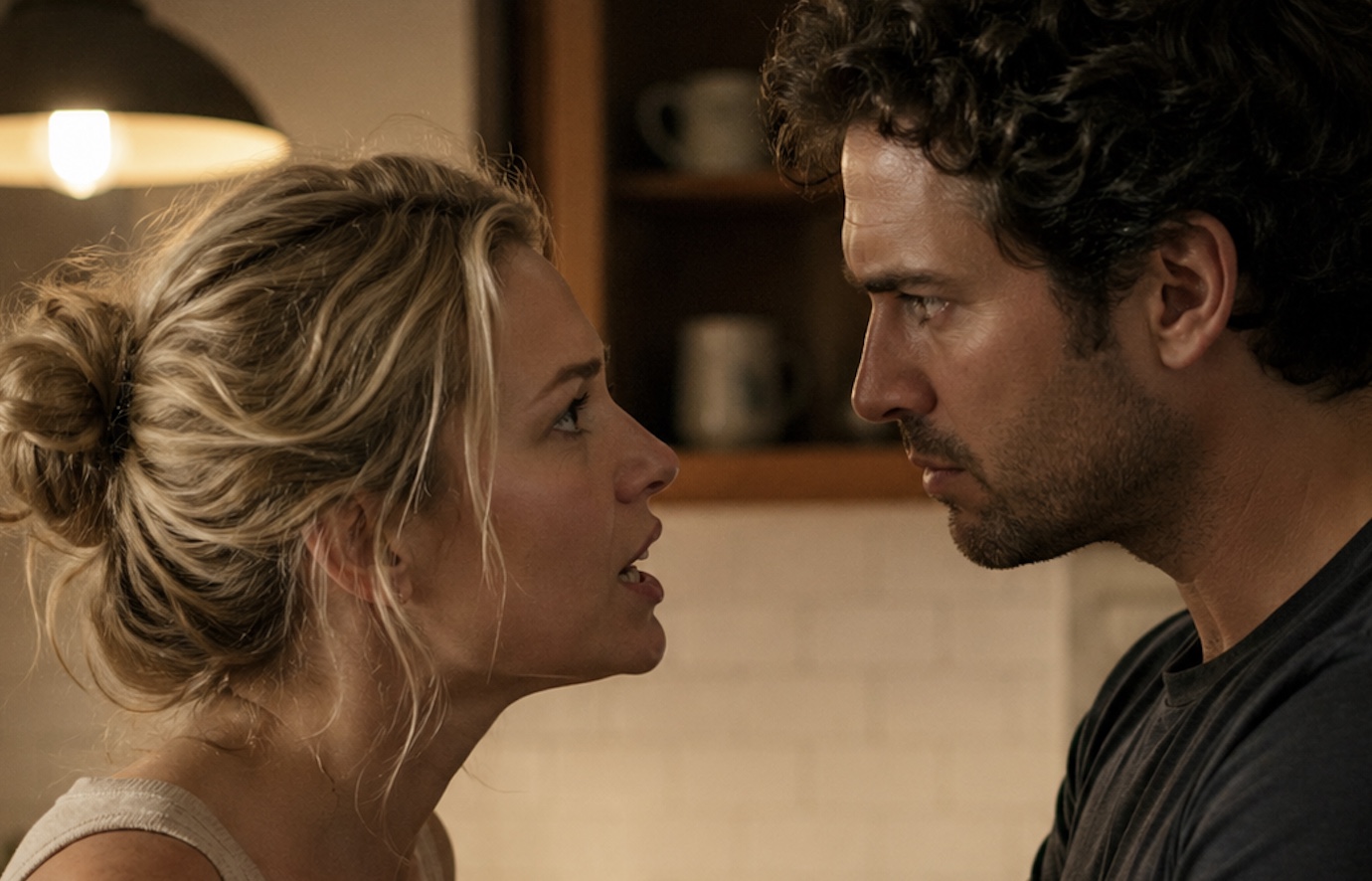
“Eat, Zhenya. The soup will get cold. Though, judging by everything, this whole house is about to go cold.”
Natalya stood by the window with her arms crossed over her chest, staring at the gray nine-story apartment block across the yard. On the kitchen table, right in front of a bowl of borscht, lay a glossy university brochure with a bright photo of smiling students on the cover. Evgeny sat at the table in a worn house T-shirt with a coffee stain on it, carefully pretending the brochure did not exist. He scooped up a spoonful of thick red soup, blew on it, and put it in his mouth, trying not to meet his wife’s eyes.
The kitchen smelled of fried onions and some heavy, sticky hopelessness. It was not the smell of a scandal. It was more like the smell of sour milk — when you already know something has spoiled and you can no longer drink it, but somehow you still feel sorry to throw it away.
“Is it good?” Natalya asked without turning around. Her voice was flat and dry, like fine sandpaper.
“It’s all right,” Evgeny muttered, eating the soup with a piece of black bread. “Could use a little salt.”
“There’s no salt left. Just like there’s no money left for it.”
Evgeny sighed loudly, put down his spoon, and finally looked at the brochure. The glossy paper shone under the light of the cheap chandelier. There, in the picture, happy people in graduation gowns smiled at a future that, for their daughter Lena, had suddenly become just as ghostly as the conscience of the man sitting in front of Natalya.
“Natalya, enough already, will you?” Evgeny winced as if he had a toothache. “You’re being dramatic. Nobody died. Money is a renewable resource. We’ll earn it back.”
Natalya slowly turned around. Her face was pale, but absolutely calm. No red blotches, no trembling lips. Only her eyes had become sharp and cold, like splinters of ice. She walked over to the table, picked up her phone, unlocked the screen, and showed him the banking app.
“Your mother wanted a new gazebo and landscaping at her dacha, and you gave her the money for our daughter’s college? Our daughter is applying in a month — what are we going to pay with? Couldn’t your mother sit on her old bench? You stole your own child’s education for the sake of shrubs and planks! Go to your mother and live in that gazebo, you traitor!”
“What are you saying? I just—”
“Three hundred and fifty thousand rubles. One transaction. Yesterday evening, while I was asleep.”
“It isn’t just a gazebo!” Evgeny flared up, pushing his plate away. Borscht splashed over the edge, leaving a greasy streak on the plastic tablecloth. “Mom explained everything. Her garden looks like it was bombed. The Petrovs next door built themselves a patio, laid stone paths. And what does Mom have? A rotten bench and three gooseberry bushes? She’s ashamed to invite people over. She cried, Natalya. Do you understand? An elderly woman cried because she doesn’t have a proper relaxation area.”
Natalya sat down across from him. She looked at her husband with frightening curiosity, as if she were seeing him for the first time in twenty years of marriage.
“A relaxation area,” she repeated. “Zhenya, Lena has her final exams in three weeks. We saved that money for two years. We gave up vacations. I’m still wearing winter boots I’ve glued back together three times. We agreed that money was untouchable. It was for a paid program if she doesn’t get enough points for a government-funded place. The competition this year is huge.”
“Lena is smart. She’ll get in on her own,” Evgeny waved it off, reaching for the bread again. “And if she doesn’t, she can work for a year, get some life experience. Nothing terrible about that. But Mom has the season now. The workers are available now. They promised her a discount. If she doesn’t start now, that’s it, the summer will be wasted. You know how long she’s dreamed of having an alpine rock garden.”
“An alpine rock garden,” Natalya said the phrase as if tasting rotten fish. “You transferred the cost of your child’s year of education for stones and moss? Zhenya, are you actually serious right now? You stole your own daughter’s education for shrubs and planks.”
“I didn’t steal it, I lent it!” Evgeny slammed his palm on the table. “I’ll pay it back. I’ll get a quarterly bonus, find some side work. Why are you making me out to be a monster? A mother is sacred. She raised me. I can’t watch her sit on an old bench while everyone around her lives in comfort. She needs comfort. She needs a proper fixed barbecue grill, not that rusty tin thing on legs.”
He spoke with such heat, such conviction, that Natalya felt a cold fear rise inside her. He truly did not see the problem. In his world, “shame in front of the Petrovs” outweighed his own child’s future. His mother knew how to pull the strings of guilt so skillfully that a forty-year-old man turned into a five-year-old boy ready to give away his favorite toy just to make Mommy smile.
Natalya picked up the brochure from the table, rolled it into a tube, and tapped it against her palm.
“Your bonus is thirty thousand, Zhenya. The quarter ends in July. The first semester has to be paid by August twentieth. Where are you going to get three hundred thousand in two months? Sell a kidney? Or maybe your mother will grill some kebabs on her new barbecue and pay us back?”
Evgeny looked away. He knew perfectly well his mother would not return the money. Her pension was twelve thousand, and she had “a pile of illnesses” that needed money too. The money that had gone to the dacha had disappeared into the black hole of parental selfishness forever.
“Well, we’ll borrow it,” he muttered uncertainly. “I’ll ask Slavka. We’ll take out a consumer loan…”
“We have a mortgage and a car loan for your Lada, which you’ll be paying for another two years,” Natalya said clearly, almost mechanically. “No bank will give us a loan, Zhenya. Not a kopeck. We are in the red zone for banks.”
She stood up, walked over to the trash bin, and slowly, demonstratively threw the university brochure into it. The glossy paper rustled as it caught on potato peels.
“Why did you do that?” Evgeny asked, frightened.
“What do we need it for now?” Natalya wiped her hands on a towel. “Go to your mother. Right now. And live in that gazebo, you traitor. Because there is nothing left for you to eat here. I will not feed a man who feeds someone else’s complexes instead of his own child.”
“Have you lost your mind?” Evgeny gave a nervous laugh, trying to turn it into a joke. “Divorcing over a dacha? Come on, Natalya, don’t go too far. So we bought some stones… It’ll look nice. We’ll come there with Lena, grill some kebabs…”
Natalya looked at him in such a way that the smile slid off his face like badly glued wallpaper.
“Lena will not go to that dacha, Zhenya. And neither will I. And you’ll eat those kebabs alone. If they don’t stick in your throat.”
She switched off the kitchen light and walked out, leaving her husband sitting in the half-darkness before a bowl of borscht that had gone cold and was now covered with a greasy film.
Five minutes later, Evgeny entered the bedroom, shuffling in his slippers like a guilty schoolboy who had been thrown out of class but still hoped to sneak back to his desk. Only the bedside lamp was on, and in its yellowish light Natalya looked as if she had been carved from stone. She was sitting on the edge of the bed, surrounded by bills and receipts, writing something quickly and angrily in a notebook.
He tried to defuse the situation in his usual way — he turned on the television, hoping the murmuring voice of the presenter would fill the uncomfortable, prickly silence.
“Turn it off,” Natalya said without lifting her head. “Or I’ll throw the remote out the window. Along with you.”
Evgeny obediently pressed the power button. The screen went black, and the silence returned, even denser than before. He sat down on his side of the bed. The springs creaked pitifully.
“Natalya, why are you starting again?” he said in a conciliatory tone that had always worked before. “I told you, we’ll manage. I’ll borrow from Slavka. He sold his car. He has money.”
Natalya finally looked up from her notebook. She looked at him the way a doctor looks at a hopeless patient who still believes in miracle herbs.
“Slavka has three kids and a mortgage on an unfinished apartment, Zhenya. He sold the car to pay off debts, not to sponsor your attacks of filial love. Do you ever switch on your brain before you open your mouth?”
“I’ll take out a loan!” Evgeny began to get irritated. It infuriated him that she was speaking to him like he was an idiot. “From some payday lender if the banks refuse. The interest will be high, but I’ll juggle it.”
“Juggle it with what?” Natalya threw the notebook onto the blanket. “Have you seen this list? Car insurance is due in a month. Utilities have gone up. Lena needs a graduation dress, or should she go in jeans because Daddy paid for Grandma’s gazebo? Do you understand that we’re in the negative, Zhenya? We are not just at zero. We are in a deep, black hole. Your payday lenders will skin us alive, and we’ll end up on the street.”
“You’re exaggerating!” Evgeny jumped up and began pacing the tiny bedroom. “You always do this! The slightest thing, and suddenly it’s a catastrophe. But you don’t care that my mother is struggling there alone. All you care about is counting your money. Selfish. You simply never loved her. That’s all. It drives you crazy that I help her.”
Natalya silently stood, walked to the wardrobe, and took a winter blanket down from the top shelf.
“I don’t love stupidity, Zhenya. Or irresponsibility. Your mother is not disabled. She has a house, a roof over her head, and a pension. And Lena now has no future. Do you understand the difference between ‘I want it pretty’ and ‘I need it for life’?”
She threw the blanket onto the sofa in the corner.
“You’ll sleep here. I can’t sleep next to you. The sight of you makes me sick.”
Evgeny froze in the middle of the room. His wife’s words hit harder than a slap. He had expected shouting, tears, reproaches — but not this cold, physical disgust. His male pride, wounded and shriveled, demanded protection. He reached into the pocket of his sweatpants and pulled out his smartphone.
“You just don’t understand,” he hissed, tapping at the screen. “You judge without seeing. Look! Look what it’s for! This is art, Natalya!”
He shoved the phone under her nose. On the bright screen was a 3D visualization: an elegant wooden gazebo with carved railings, next to it a neat mound of gray stones surrounded by little shrubs. In the center of the gazebo stood a proud wrought-iron barbecue with a roof. The picture was beautiful, glossy, like something from a magazine about millionaires’ lives.
Natalya looked at the screen, and her face turned harder and harder.
“Beautiful, isn’t it?” Evgeny asked hopefully, mistaking her silence for admiration. “The wood is larch. It’ll last a hundred years. The stone is natural, not plastic. Mom has dreamed of a corner like this all her life. Imagine it in the evening with little lights on…”
Natalya slowly lifted her gaze from the screen to her husband’s face. Such icy rage flickered in her eyes that Evgeny involuntarily took a step back.
“I see,” she said quietly. “I see very clearly. That carved post is Lena’s first semester. That pile of stones is her English courses. And that barbecue is her dream of becoming a translator. You burned her future in that grill, Zhenya. You traded your child’s education for the chance to eat roasted meat in a pretty setting.”
“What does Lena have to do with it?” Evgeny shouted, losing control. “She’ll get in! She’ll get in on her own! She isn’t stupid! And my mother won’t live forever! She wants to enjoy life now!”
“Your mother won’t live forever,” Natalya echoed. “And your daughter will? Lena gets one start in life. And you sold that start. You know what’s most frightening? You don’t even understand what you’ve done. You’re standing here, shoving this picture in my face, waiting for me to praise you. ‘Well done, Zhenya, what a good son you are for your mommy.’”
She snatched the phone from his hand. Evgeny jerked forward, but he did not manage to catch her wrist. Natalya threw the phone hard onto the sofa, straight into the pile of blanket.
“Take your larch and go sleep in the kitchen. Or on the doormat. I don’t care. But if you say one more word about ‘beauty’ and ‘comfort,’ I won’t be responsible for myself. Tomorrow I’m filing for child support while still married. And believe me, the court will leave you in nothing but your underwear, with no landscape designs at all.”
“You wouldn’t dare,” Evgeny whispered, feeling the ground disappear beneath his feet. “That’s… that’s betrayal.”
“Betrayal?” Natalya gave a bitter laugh, walked to the door, and flung it wide open. “Betrayal, Zhenya, is when a father chooses between his daughter and his mother’s showing off — and chooses the showing off. Get out.”
Evgeny stood there for a second, gasping like a fish thrown onto shore. He had run out of arguments. Payday loans, Slavka, the old car — all of it crumbled to dust before her iron logic. He grabbed his phone, pressed a pillow Natalya had not given him to his chest, and trudged toward the door, feeling her heavy, hateful stare on his back. In the hallway, he looked back at the bedroom door as it closed behind him. The click of the lock sounded like a shot fired at point-blank range.
On the screen of the phone he was still clutching, the light went out, and the beautiful 3D gazebo dissolved into darkness, leaving him alone with a reality in which he was completely bankrupt — financially and morally.
The kitchen was stuffy and dark. Only the green diode on the microwave blinked, counting down the seconds of their collapsing family life. Evgeny sat at the table, picking at a cold cutlet with a fork straight from the pan. He did not want to take a plate. He did not want to turn on the light. He wanted to hide in that hole like an offended badger and feel sorry for himself. He felt like the victim of a monstrous injustice. After all, he had done a good deed. He had made his old mother happy. And for that, they had dragged him through the mud.
The door creaked. Natalya appeared in the doorway. She had changed into an old T-shirt and pajama pants, but she looked as if she were getting ready for war. She held a glass of water in her hand but made no move to drink. She watched him eat — greedily, hastily, dropping crumbs on the table — and her face froze in an expression of pure, undiluted disgust.
“Come to finish me off?” Evgeny muttered, still chewing. “Go on, then. Why stop now? Tell me what a terrible father I am. Though honestly, Natalya, let’s be real: our Lena isn’t exactly reaching for the stars. If she were smarter, she’d get a free place. And as it is… why pay for something she may not even be capable of?”
Natalya set the glass on the counter. The sound of glass against laminated particleboard was dull, like a hammer striking a coffin lid.
“Are you serious right now, Zhenya?” Her voice was quiet, stripped of every emotion except contempt. “You’re justifying your theft by saying your daughter isn’t talented enough?”
“It wasn’t theft!” Evgeny threw the fork into the pan. Grease splattered onto the tablecloth. “It was a redistribution of the budget! Lena is spoiled. We’ve been wiping her backside since first grade. Tutors, courses, dancing and all that nonsense. And what good did it do? Her scores are borderline. Let her go work, learn what life is. A year at the register in Pyaterochka, and her brain will fall into place. But Mom… Mom gave her life for me. She deserves to sit in a proper gazebo in her old age, not on rotten planks!”
He spoke and felt his confidence grow. Yes, he was right. They were selfish. His wife and daughter. They had attached themselves to him and drained him dry. But his mother — his mother was sacred.
“Sacred, you say?” Natalya seemed to read his thoughts. She stepped closer, and Evgeny caught the scent of her hand cream — a scent he had loved for twenty years, but now it irritated him. “Let’s remember your sacred mother. When Lena was born and I had a fever of forty because of mastitis, did your mother come? No. She said she had high blood pressure and a TV series to watch. When we took out the mortgage and asked her to lend us money for the down payment, she ‘had no money,’ even though a week later she bought herself a new fur coat. Your mother has never, do you hear me, Zhenya, never given us a single kopeck or helped us with a single thing.”
“Don’t you dare count her money!” Evgeny shrieked, feeling his face turn red. “It’s her money! She earned it!”
“And that was Lena’s money!” Natalya struck the table with her palm so hard the saltshaker jumped. “That was her chance not to rot at Pyaterochka, the way you’re predicting for her, but to become someone. But you decided your mother’s comfort was more important. You built her an alpine rock garden on the bones of your own daughter’s future. Do you understand what you’ve done? You didn’t just buy stones. You showed Lena that she is second-class to you. That an old, selfish woman who never lifted a finger for us is dearer to you than your own child.”
Evgeny looked at his wife and did not recognize her. Where was that soft, accommodating Natalya who baked pies and tolerated his socks scattered everywhere? Before him stood a stranger — a hard woman with the eyes of a killer. And the worst part was that he could see she despised him. She was not angry, not offended. She despised him. The way people despise a cockroach crawling across the dinner table.
“You’re just jealous,” he spat out the final, most pathetic argument. “You’ve always been jealous of her. She has taste, she has style, and you… you’re a clucking hen. Just an ordinary house hen.”
Natalya slowly exhaled through her nose. The corner of her mouth twitched into a terrifying half-smile.
“Maybe I am a hen, Zhenya. But I’m the hen who carried this family while you played tanks and drove your mother around garden centers. I’m the hen who saved every bonus while you changed phones. But you, Zhenya, aren’t just lazy. You’re dangerous. You’re like a parasite that eats the organism from the inside while being convinced it is the most important part of it.”
Natalya fell silent, catching her breath. Silence hung in the kitchen, broken only by the hum of the old refrigerator, which seemed to be groaning with shame at what was happening. Evgeny sat there, staring at the cold cutlet. He wanted his wife to disappear, evaporate, turn into smoke. Her words burned because somewhere very deep, beneath layers of self-justification and filial pride, he understood: she was right. But admitting that would mean destroying the whole world in which he was a noble knight saving his elderly mother from the misery of dacha life.
“Are you finished?” he asked dully, not lifting his eyes. “If you are, let me eat. I have work tomorrow. The same job where, according to you, I just sit around doing nothing.”
“Eat,” Natalya stepped back but did not leave. “Choke on your peace of mind. But know one thing: Lena will not go work as a cashier. I’ll sell my car. I’ll take out a loan in my mother’s name if she allows it. I’ll wash stairwells at night if I have to, but my daughter will get an education. Without you.”
Evgeny snorted, breaking off a piece of bread.
“Well, well. What a heroine. Go ahead. Sell the car, ride the bus. Maybe then you’ll understand how money is earned.”
At that moment, a floorboard creaked in the hallway. The sound was quiet, barely audible, but in the tense silence of the apartment it rang out like thunder. Evgeny and Natalya turned their heads toward the doorway at the same time.
Lena was standing there.
She was wearing pajamas with little bears on them, barefoot, her hair messy from sleep. But her face was not sleepy at all. It was gray, as if dusted with ash. In her eyes, usually lively and cheerful, large tears had gathered. They did not roll down her cheeks. They froze in the corners of her eyes, making her gaze glassy and terrifying.
“Dad…” Her voice trembled, breaking into a whisper. “Do you really think I’m stupid?”
Evgeny choked on his bread. He coughed, pounding himself on the chest with his fist, his face turning crimson. Natalya rushed to her daughter and wrapped an arm around her shoulders, trying to cover her, to shield her from her father like from a wild animal.
“Lenochka, go back to your room,” she said quickly. “We’re just arguing. Dad is tired. He didn’t mean it like that…”
“I heard everything, Mom,” Lena gently but firmly moved her mother’s hand away. She looked straight at her father, who had finally swallowed the piece of bread and was now wiping his watering eyes with a napkin. “You said I wasn’t capable. That my place is at a cash register. That Grandma’s gazebo is more important than my institute.”
“Lena, don’t make things up!” Evgeny jumped up, knocking over his chair. The crash made them all flinch. “You twisted everything! I said that if you don’t get a free place, you can work for a year! That’s normal! Everyone does that in Europe! It’s called a gap year! Finding yourself!”
“You gave away my money, Dad,” Lena said quietly. “The money we saved from my birthdays. Grandma and Grandpa on Mom’s side sent some, I worked in the summer handing out flyers… You gave it all to Grandma Nadya for stones?”
Evgeny felt himself being backed into a corner. He became hot. Shame mixed with aggression — the defensive reaction of a weak man.
“It’s the family budget!” he barked, waving his hands. “I am the head of this family! I decide where the money goes! Your grandmother is old. She needs joy! And you’re young. You have your whole life ahead of you. You’ll earn more! Selfish girl! Just like your mother! You only think about yourselves! Clothes and institutes, that’s all you care about! Nobody thinks about the soul! About family!”
Lena looked at him, and something died in her eyes. The childish belief that Dad was the strongest and kindest person in the world died. The hope of protection died. Love died. In its place, a cold, adult emptiness was born.
“I understand, Dad,” she said in a completely calm, unfamiliar voice. “Grandma needs a gazebo. And I need a father. But apparently neither of us will get what we want. Because Grandma will have a gazebo, but she won’t have a granddaughter. And I… I don’t have a father anymore.”
She turned and went back to her room. The door closed quietly, without a slam. That soft click hit Evgeny harder than if she had smashed a plate over his head.
“Are you satisfied?” Natalya whispered.
She stood in the middle of the kitchen, her arms hanging at her sides. There were no tears. No hysterics. Only the icy calm of a surgeon who has realized that a limb cannot be saved — gangrene has set in, and it must be cut off to save the rest of the body.
“You turned her against me!” Evgeny hissed, feeling the fear of loneliness begin to tighten its cold fingers around his throat. “This is your fault! Yours! You raised a monster! Saying things like that to her own father!”
Natalya slowly approached him. There was no pain in her eyes anymore, no offense. There was emptiness. Absolute, cosmic emptiness, where neither love nor pity could survive.
“You’re right, Zhenya,” she said. “I am guilty. Guilty of putting up with your childishness for twenty years. Guilty of letting you treat us as second-class after your mother. Guilty of not leaving sooner. But I’m going to fix that mistake. Right now.”
She turned and quickly left the kitchen. Evgeny heard her go into the storage closet and start rustling around.
“What are you doing?” he shouted after her, but no answer came. “Natalya!”
He remained standing in the middle of the kitchen, surrounded by dirty dishes and the smell of cold borscht, feeling the floor slip away beneath his feet. Deep down, he understood that something irreparable had happened, but his brain, so accustomed to comfortable self-deception, refused to believe it. She’ll blow off steam and calm down, he thought, trying to steady his trembling hands. Tomorrow I’ll buy flowers. I’ll call Mom, let her talk to her…
But then from the hallway came a sound that could not be mistaken for anything else. The sharp, synthetic tearing sound of a roll of thick plastic bags being ripped apart.
Evgeny went cold. He dropped the fork and ran into the hallway, realizing that the end of his comfortable life was not coming tomorrow or in a month. It was happening right now.
Natalya returned to the room not to continue the argument. She moved with frightening mechanical precision, like a robot that had been given a disposal program. In her hands was a roll of thick black garbage bags — the kind that held one hundred and twenty liters and were usually used for construction waste. She sharply shook out the first bag, opening it with a loud, whipping crack that sounded in the quiet apartment like a gunshot.
Evgeny, still standing in the kitchen doorway and digesting her words about being a “house hen,” froze. He had expected shouting, breaking dishes, maybe even a theatrical packing of suitcases — the classic female “I’m going to my mother.” But Natalya was not planning to leave. She opened the wardrobe with his clothes and began methodically raking things off the shelves.
“What are you doing?” Evgeny’s voice trembled. He took a step into the room but stopped when he met her gaze. There was no fury in it. There was emptiness. That was how one looked at a patch of mold on the wall before scraping it off with a putty knife.
“Clearing space,” she replied calmly, throwing a stack of his T-shirts into the black mouth of the bag. Jeans followed.
Evgeny rushed into the bedroom, almost tripping over the threshold, and froze, paralyzed by what he saw. Natalya was moving with terrifying, inhuman speed. She was not folding his things — she was destroying them, throwing them into the black, rustling mouth of the bag. Shirts, jeans, his favorite sweater with reindeer — everything flew into a pile, mixed with socks and chargers. This was not simply packing his belongings. This was cleansing a territory of biological waste.
“What the hell are you doing?” he squealed, lunging toward her and trying to tear the bag away. “Natalya, snap out of it! You’re hysterical! It’s the middle of the night. Where am I supposed to go?”
Natalya yanked the bag sharply toward herself. The plastic creaked pitifully but held. She straightened and looked at her husband with dry, red eyes. There was so much cold in that look that Evgeny involuntarily stepped back.
“Hysterical, you say?” Her voice was even, terrifyingly calm. “Hysterics were when I cried in the bathroom while you were choosing tiles for your mother. Hysterics were when I counted coins until payday. This is sanitary treatment. I am removing the source of infection from our lives.”
She turned to the dresser and swept his documents into the bag: passport, driver’s license, insurance. Everything that made him a citizen, a husband, a person with rights, flew into the trash.
“Give me my passport!” Evgeny tried to catch her hand, but Natalya shoved him away with force.
“Don’t touch me,” she hissed, and steel rang in her voice. “Touch me again, and I’ll call the police. I’ll say you’re drunk and threatening to kill me. And Lena will confirm it. Did you hear her? She’ll confirm it.”
His daughter’s name hit him like a blow to the stomach. He remembered Lena’s glassy stare and her quiet words: “I don’t have a father anymore.” Fear, sticky and cold, crawled down his back.
“Natalya, let’s talk tomorrow,” he whined, changing tactics. Aggression gave way to pathetic pleading. “We got carried away, it happens. I’ll pay everything back! I’ll borrow, I’ll take out a loan, I swear! Why destroy a family over money?”
Natalya tied the first bag shut, pulling the knot so tightly that her knuckles turned white.
“A family?” she gave a bitter laugh, dragging the heavy sack toward the door. “We don’t have a family, Zhenya. A family is when everyone is in the same boat. You punched a hole in the bottom of our boat so you could build a dock for your mother. So go to her.”
“To Mom? At one in the morning?” He blinked in confusion.
“Exactly. She has a little paradise there now, doesn’t she? Larch, natural stones, a barbecue. Go live there. In the fresh air. Surrounded by the beauty you sold your daughter’s future for.”
She dragged the first bag into the hallway. Evgeny shuffled after her, still unable to believe this was real. It seemed like a bad dream, a prank, a lesson. Any moment now she would stop, cry, and they would make peace. Like always.
But Natalya did not stop. She opened the front door and shoved the bag onto the stairwell landing with force. Then she returned for the second one, into which she had already thrown his shoes and jacket.
“The keys,” she demanded, holding out her hand.
“Natalya…”
“The keys!” she barked so loudly that a dog began barking in the neighboring apartment.
With trembling hands, Evgeny took the key ring from his pocket. He placed the metal into her palm, feeling as if he were handing over the last twenty years of his life along with it.
“Leave, Zhenya. And don’t call. Not me. Not Lena. If you have even one drop of conscience left, let your daughter finish school in peace and forget this disgrace.”
The door slammed shut in his face. The click of the lock sounded like a shot in an empty shooting range. Then a second turn. And silence.
Evgeny remained standing on the dirty tile of the stairwell, in slippers, with two black garbage bags at his feet. The light bulb above his head flickered, throwing jerky shadows around him. He stood there for a minute, waiting for the door to open. But behind it, everything was quiet.
Slowly, with difficulty, he bent down and pulled on the sneakers Natalya had mercifully thrown on top of his things in the second bag. He put on his jacket. He picked up his property — his whole life packed into one hundred and twenty liters of plastic — and trudged toward the elevator.
Outside it was damp and windy. The taxi arrived quickly. The driver, a gloomy man with a mustache, gave the passenger with garbage bags a sideways look but said nothing. The whole way, Evgeny stared out the window at the lights of the night city sliding past. His head was empty. No anger, no resentment, only a dull, aching awareness of catastrophe.
His mother did not open the door right away. She rustled around behind it for a long time, asking, “Who is it?” When she saw her son with the bags, she threw up her hands.
“Zhenya! My God, what happened? A fire? War?”
“They kicked me out, Mom,” he rasped, collapsing into the narrow hallway of his parents’ house, which smelled of Corvalol and old age. “Natalya kicked me out. For good.”
“Oh, that witch!” his mother immediately came to life, grabbing one of his bags. “I knew it! I always said she wasn’t good enough for you! It’s all right, son, it’s all right. We’ll manage! At least you’re home now. With your own mother.”
She bustled about, rattling the kettle, saying something about “ungrateful creatures,” but Evgeny was not listening. He went out onto the back porch.
In the darkness of the garden, the outline of that very gazebo could be made out. It was not finished yet — only a frame of expensive larch wood and a pile of those same natural stones dumped nearby. The wind whistled through the empty openings where carved windows would one day be.
Evgeny walked closer. He ran his hand over the rough wood. Cold. Dead.
He sat down on one of the stones — the same “elite serpentinite” that had cost him half of Lena’s courses. The stone chilled his backside through his thin jeans.
There was silence all around. No sound of his daughter’s laughter. No smell of Natalya’s pies. None of the warmth he had grown used to and had taken for granted, like air. There was only the wind, the creaking of an old apple tree, and that stupid unfinished gazebo, which in the night looked like the skeleton of some huge, gluttonous animal.
“Beautiful,” Evgeny whispered, and his voice broke. “Very beautiful.”
He covered his face with his hands and, for the first time that evening, began to cry. Not from resentment. Not from self-pity.
From horror.
He suddenly understood, with crystal clarity, that he was sitting on the ruins of his own life. And he had built those ruins with his own hands, stone by stone, paying for them by betraying the people closest to him.
And no alpine rock garden in the world could ever cover the black hole of loneliness in which he had now been left forever.