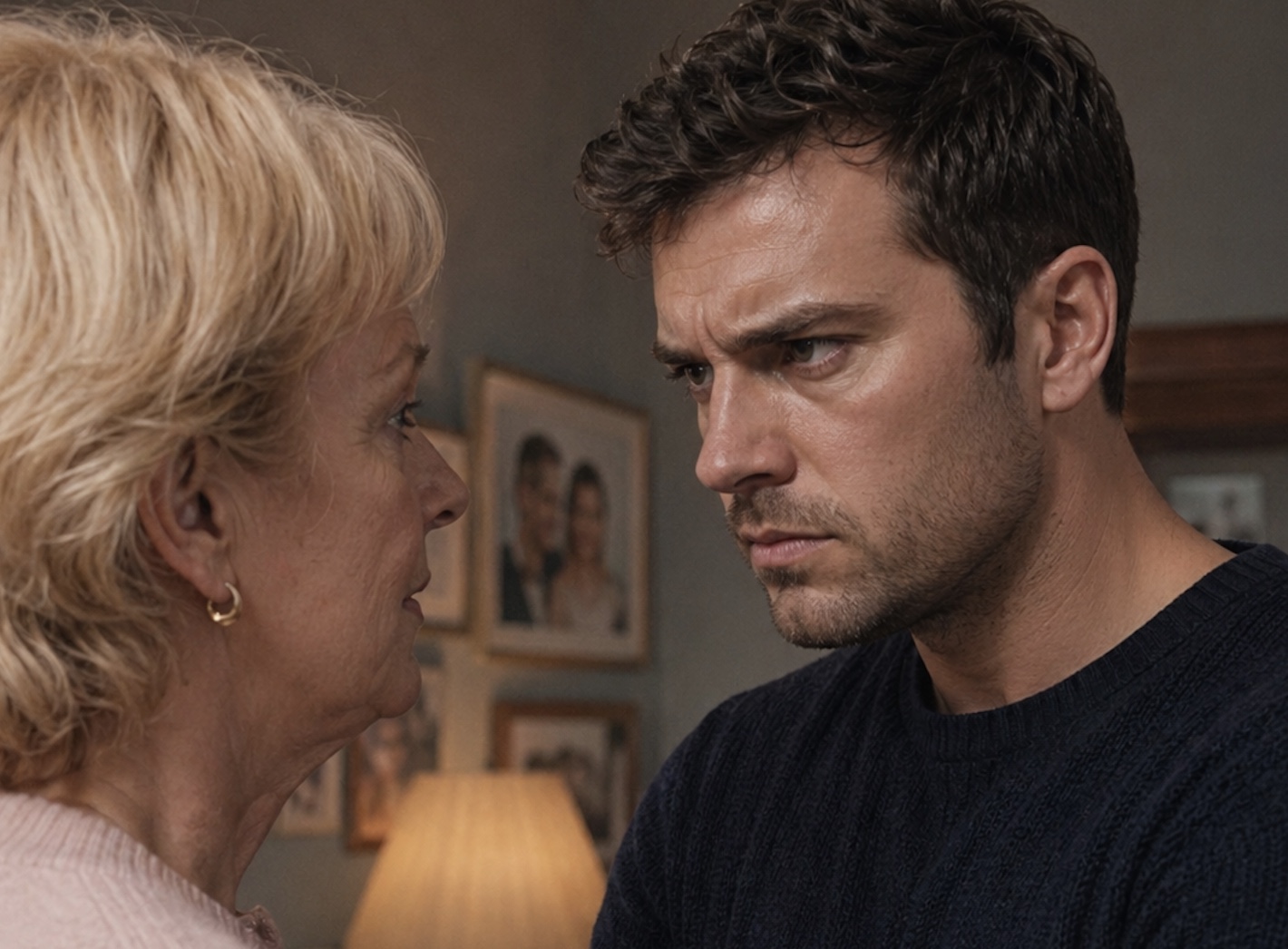
“You do understand this isn’t just some whim, German, don’t you? It’s practically a matter of survival. Mom can’t find peace. Her blood pressure spikes every evening.”
“Vera, Tamara Igorevna’s blood pressure isn’t jumping because of the weather. It’s jumping because she took on obligations she couldn’t handle. Did I warn her? I did.”
“Why do you always start with that same song?” Vera snapped, nervously moving her coffee cup and nearly spilling it across the polished tabletop. “She thought she could manage it. She believed her pension and side jobs would be enough to cover everything. Who could have known prices would rise like that?”
German sighed. He sat across from his wife, his broad hands resting on the table. Strong hands, used to work, the hands of a man who knew the value of every coin. German worked for the municipal gas service. It was not exactly a prestigious job in the glossy world of appearances, but it was responsible and, most importantly, stable. Still, his real financial security had not come from his gas-worker salary.
There was money in their family, and quite a lot of it, but German had never liked showing off. The story of his wealth went back to his student years. When his grandmother died, and then his grandfather soon after, his father inherited a solid village house with a large plot of land. At a family gathering, his father had said, “Georgy — German was often called by his father’s full name at home, since he had been named after him — you’re a smart boy. You need a start. The house is yours.”
German, still a student at the time, thought sensibly. He was not going to become a gardener. He sold the property at the peak of the market, when city people were buying land for country homes in droves, and took a risk. He invested in technology companies that people were only beginning to whisper about on forums. During his university years, his portfolio grew so much that after selling his assets, he bought a spacious three-room apartment in a new building, purchased a reliable Japanese SUV, and still had a solid safety cushion left in bank deposits. He never touched that reserve, choosing to live on his salary.
Vera knew about this, but she did not fully understand the scale of it. She herself had never reached for the stars. She worked privately as a nanny, often taking difficult cases — children with developmental needs, bedridden patients. The work was hard and noble, but emotionally exhausting. Vera was soft, yielding, and that softness eventually played a cruel trick on her.
“Vera, listen to me,” German said calmly, though the first notes of fatigue were already ringing in his voice. “Your mother had a three-room apartment. She did, didn’t she? She sold it. She bought herself a studio, and gave the difference — a huge difference — to Svetka. Your sister lives in a two-room apartment bought with that money and doesn’t care about a thing. So why am I supposed to solve your mother’s problems?”
“Svetlana is alone with a child!” Vera flared up at once. “It’s hard for her! And you and I… we have the means.”
“We have the means because I think with my head, not with emotions. Tamara Igorevna got used to living lavishly when your late father was alive. But your father is gone, and the habits stayed. That crossover she bought on credit… Why does a lonely pensioner need a car like that? To drive to the supermarket once a week?”
“She needs comfort!” Vera almost shouted, but stopped herself as soon as she noticed German’s eyes narrowing. That was not a good sign.
German stood up, walked to the safe hidden behind an inconspicuous panel in the cabinet, and took out a thick stack of cash. He returned to the table and placed the money in front of his wife with a dull thud.
“This is exactly enough to cover her overdue payments and a couple of current ones. But, Vera, listen to me carefully. This is the money we were saving for vacation. We were planning to fly to the islands. You’ve been dreaming about it for six months.”
Vera froze. Her gaze darted from her husband’s face to the money.
“Choose,” German said harshly. “Either we go on vacation like normal people, and I forget this conversation happened. Or you take this money and bring it to your mother, but then forget about the sea this year. And I will not give another kopeck for her credit adventures. That is my final word.”
Vera said nothing. Inside her, resentment fought against the daughterly duty that had been drilled into her through years of manipulation. She remembered her mother’s call the previous evening: tears over the phone, complaints about “collectors who are about to come any minute” — even though it had only been bank employees politely reminding her about the payment — and lamentations that her rich son-in-law was too greedy to spare a coin for family.
“I can’t abandon her,” Vera said quietly, reaching for the stack of money.
German did not move. He only clenched his jaw, watching as his wife hid the money in her purse. Something went out in his eyes. The very tenderness with which he had always treated his wife began to cover itself with a crust of ice.
“Fine,” he said evenly. “That is your choice. But remember this, Vera: I do not work so I can feed your mother’s bank. Do not bring up this subject again.”
Vera rushed out of the kitchen, feeling like a victor who had torn away a piece of prey, but somewhere deep inside, an unpleasant foreboding scratched at her. She had failed to understand the main thing: German was not being greedy. He was setting boundaries. And she had just bulldozed right through them.
The next day, Vera met with her friend. Zhanna, a striking brunette with sharp eyes and an eternal cigarette between her thin fingers, was something like a guru of worldly wisdom to Vera. At that moment, Zhanna was in a permanent war with her ex-husband, trying to sue him for an apartment to which she had no legal claim at all — it had been his premarital property. But small details like that never stopped Zhanna.
“And what, he really said it like that? ‘Either your mother or the sea’?” Zhanna blew a stream of smoke toward the café ceiling. “What a miser. He’s got more money than he knows what to do with, and he’s blackmailing his own wife.”
“Well, he did give the money in the end,” Vera defended him weakly, stirring her already cold latte. “But it left such an unpleasant feeling. He said it was the last time.”
“Oh, come on, ‘the last time,’” her friend snorted. “Men always say that. They scare you. Don’t fall for it. You’re his wife. You’re his support. You create comfort for him. He is obligated to provide not only for you, but to help your family too. We’re not orphans, are we? We have relatives. Your mother raised you, didn’t sleep nights because of you. And what, he can’t spare some cut-up paper?”
“He can’t, Zhanna. He thinks Mom is to blame herself. That she bought the car for nothing.”
“What difference does it make who’s to blame?” Zhanna exclaimed. “The fact remains: money is needed. My ex used to whine too, saying I spent too much. Now I’ll strip him down to his underwear and let him see what it’s like to live without money. You’re too kind, Vera. You need to be tougher. If you give in now, later he’ll make you account for every pad you buy.”
Vera nodded, absorbing her friend’s poison. It seemed to her that Zhanna was right. German really was not poor. So what if the vacation was canceled? He would earn more. Helping her mother was sacred.
That evening, the apartment was quiet. German was absorbed in his tablet, reading stock market news and frowning from time to time. Vera tried not to attract attention, but a few days later the silence was broken by a call from Georgy. It turned out German was being sent on a business trip to the northern part of the region — an inspection of a major gas distribution unit. The job would take two weeks, but such trips were paid with an increased rate.
“When are you leaving?” Vera asked, trying to hide her disappointment.
“In a week. I need to prepare the equipment and coordinate the permits.”
Vera immediately called her mother. As soon as Tamara Igorevna heard the news, she instantly brightened.
“Vera, that’s a sign!” she chirped into the phone. “My anniversary is in exactly two weeks. He won’t be there, so he won’t sit at the table with that sour face of his. But you understand… since he’s going away to earn money, he could contribute. I’m turning fifty-five, Vera! I want a restaurant, I want music. Aunt Lyuda called. She wants to come.”
“Mom, German already said…” Vera began.
“Oh, who cares what he said!” her mother interrupted. “Are you a wife or a servant? Talk to him gently. Tell him it’s a gift. A person only has a jubilee once in a lifetime! I’m not asking for a new car. Just a table, just to welcome the relatives. Don’t disgrace me in front of people.”
Vera hung up. Her fear of her husband’s displeasure battled with her fear of disappointing her mother. Stupidity won.
A week before German’s departure, a true nightmare of planning began. Encouraged by her mother, Vera started making an estimate. At first, it was supposed to be a modest dinner at a café. Then Aunt Lyuda called and joyfully announced she would not be coming alone, but with her granddaughter. Then a niece wrote that she would come with her fiancé. The guest list swelled before Vera’s eyes. Tamara Igorevna became carried away.
“Maybe we should hire a host? Just for an hour! Otherwise it’ll be boring, like a funeral meal.”
The bill kept growing. Vera looked at the numbers and went cold, but she could no longer stop. It seemed to her that if she organized everything now, German would see how happy everyone was, soften, and pay for it all. “He loves me,” she repeated to herself like a mantra.
The day of German’s departure arrived. His travel bag stood in the hallway. He was checking his documents, silent and focused. Vera hovered around him in circles, nervously tugging at the belt of her house robe. She had to make up her mind.
“Ger,” she began when he was already putting on his jacket. “There’s something…”
German raised his eyes to her. There was already expectation of some trap in them.
“Mom’s anniversary. You remember, don’t you?”
“I remember. I congratulated her in advance and gave her a gift — a good set of kitchen appliances, like she wanted last year.”
“No, not that. There’s…” Vera handed him a folded sheet of paper. “Here’s the bill. The restaurant needs to be paid. And a few small things too: food, accommodation for Aunt Lyuda at a hotel…”
German took the sheet. His eyes ran down the lines. “Hall rental.” “Banquet menu.” “Host.” “Luxury hotel for guests.” “Transfer.” The final sum was enough to buy a used foreign car.
He lifted one eyebrow and looked at his wife. There was no anger in his gaze, only boundless astonishment turning into disgust.
“Are you serious?” he asked quietly.
“German, it’s her jubilee! Relatives are coming! We can’t just sit at home on stools. Mom wants a celebration.”
“Vera,” German’s voice became dry and hard, like sandpaper. “Your mother is buried in debt. I covered her overdue payments at the cost of our vacation. And instead of paying down the actual loan, she’s arranging a feast during the plague? A hotel? A host? Have you all lost your minds?”
“Don’t you dare talk about my mother like that!” Vera shrieked. “Are you too stingy to help family? You have money! You’re going on a work trip, you’ll earn more! And you want me to be humiliated in front of my relatives?”
“I am not humiliating anyone. You’re humiliating yourselves with your lack of common sense. Your mother has another daughter. Let Svetlana — the one who got the money from the apartment — pay for this banquet. Why should I pay for a party I won’t even attend?”
“Because you’re a man! You’re a husband!”
German silently crumpled the bill and threw it onto the hallway cabinet.
“I am not an ATM, Vera. And I am not the sponsor of a traveling circus. I will not give you the money. Not a single kopeck. Deal with it yourselves.”
He grabbed his bag and walked out the door without looking back. Vera stood in the hallway, feeling as if her world had collapsed. What was she supposed to do now? The guests were already coming. The restaurant had been booked on good faith.
Two hours later, while German was already on the train, watching gray groves flash by outside the window, his phone beeped. A message from his mother-in-law. He opened it. One word:
“Pig.”
German smirked. Short and clear. Less than a minute later, a message came from Vera. Exactly the same:
“Pig.”
German put the phone aside. In his chest, where until recently there had still been a flicker of hope that his wife would come to her senses, there was now an empty, ringing hollow filled with cold. So many times he had pulled them out, helped them, solved problems, fixed taps in his mother-in-law’s studio, driven her to doctors. But the moment he firmly said “no” to outright insolence, he instantly became an animal.
“Well, a pig it is,” he whispered into the empty compartment. “Then someone will be wallowing in the mud. But it won’t be me.”
The two weeks passed as if in a fog. Work helped distract him. German climbed around pipes, inspected valves, argued with contractors, and drew up reports. In the evenings, he did not call home. Vera remained silent too.
When he returned to the city, he did not call or warn anyone. He opened the door with his key. The apartment smelled of someone else’s perfume — heavy and sweet. His mother-in-law’s shoes stood in the hallway.
Vera and Tamara Igorevna were sitting in the kitchen. When they saw German enter, they fell silent. An opened bottle of wine stood on the table. Both women’s faces were red, their eyes angry.
“So you finally showed up,” his mother-in-law hissed instead of greeting him. She looked worn out, but the battle paint on her face showed she was ready for a fight.
German silently put down his bag, walked into the kitchen, and poured himself a glass of water from the pitcher.
“Did you bring the money?” Tamara Igorevna asked bluntly.
German slowly turned toward her.
“Good evening, Tamara Igorevna. Nice to see you too. What money?”
“For the anniversary!” his mother-in-law barked, slapping her palm against the table. “You abandoned us! I had to take out a microloan! Fast-money lenders, at insane interest! Because the restaurant demanded payment, the guests had arrived, and you, you miser, just ran off!”
“I warned you,” German answered calmly, leaning his lower back against the kitchen counter. “I said it plainly: I would not give the money. You decided to gamble.”
“You owe me two hundred thousand now!” his mother-in-law declared. “With interest and moral damages. Transfer it immediately or give it in cash. Vera said you were paid well for the trip.”
German suddenly laughed.
“You really think I’m going to take out my wallet now and pay for your stupidity? Two hundred thousand?” He shook his head. “Tamara Igorevna, you have completely lost sight of the shore.”
“You bastard!” his mother-in-law shrieked. “I gave my life for you! I gave you my daughter!”
“You didn’t give me your daughter. She married me herself. And as for the money… listen carefully. From this day on, the shop is closed. Completely. Vera,” he shifted his gaze to his wife, who sat with her head lowered but looked at him with angry eyes from under her brows. “If you transfer even one kopeck from the family budget to your mother to cover this idiocy, you can pack your things and move into her studio. I am no longer financing this parasitic existence.”
“How dare you speak to my mother like that?!” Vera roared, jumping up from the chair.
“Exactly the way she deserves. That’s it. The show is over. Tamara Igorevna, leave my apartment.”
His mother-in-law drew air into her chest, preparing to unleash a stream of curses, but German’s gaze was so heavy that she choked on her words.
“Come on, daughter,” she hissed, rising. “There’s nothing to talk about with this freak.”
She grabbed her handbag and swept out of the kitchen with her nose held high. The front door slammed.
German and Vera were left alone. The silence was thick and sticky.
“You humiliated my mother,” Vera said quietly. Her lips trembled.
“Your mother humiliated herself. And you along with her.”
“You forced her into debt! If you had given the money right away, none of this would have happened!”
“Vera, do you have a problem with logic? I said no. That means no. It does not mean: take a loan at monstrous interest in the hope that I’ll change my mind.”
“You’re selfish! A greedy beast!” Vera rushed toward him. Her eyes burned with a mad fire. Wound up by her mother, her friend, and her own sense of injured pride, she no longer controlled herself.
She swung and slapped German hard across the face. The blow was strong and unexpected. German’s head jerked to the side. His cheek began to burn.
He slowly turned his head back. Something inside him snapped completely. The last thread that connected him to this woman broke with a dry crack.
“Do you understand what you just did?” he asked in a voice stripped of all emotion.
“I do!” she shouted. “That’s for my mother! For the fact that we’re in debt now! Pay what you owe, right now!”
German stepped back.
“We are getting divorced, Vera. Tomorrow I am filing the papers. The apartment is mine. I bought it before the marriage. The car is mine. You have one week to move out.”
Vera froze. The words “divorce” and “move out” pierced through the armor of her hysteria. Suddenly, she understood reality. Her sister’s two-room apartment was occupied. Her mother lived in a studio, and with debts on top of that. Vera had nowhere to go. Her nanny’s salary was small; it would not be enough to rent decent housing.
“No…” she whispered. “German, you can’t. We’re family.”
“We were family. Until you decided I was a resource to be milked and insulted.”
“Forgive me!” Vera collapsed to her knees in front of him, grabbing his hands. Tears burst from her eyes. “I’m a fool! Mom wound me up! German, don’t throw me out! I’ll fix everything!”
She sobbed, smearing mascara across her face, trying to kiss his hands. German looked down at her with disgust.
“Get up,” he said. “Don’t disgrace yourself.”
“Pay off the loan, please!” she whined, changing tactics again. “What does it cost you? And we’ll forget everything! I’ll be good!”
“No.”
That short word struck Vera like an electric shock. She jumped to her feet, her face twisting with rage. Fear of loss turned into animal aggression.
“You bastard!” she screamed and hit him in the face again, putting all her hatred and despair into the blow.
German’s head jerked again. This time, a metallic taste of blood appeared in his mouth — her untrimmed nail had split his lip.
German slowly wiped his lips with the back of his hand. He looked at the blood. A cold, terrible fire lit in his eyes. He was no longer going to endure it. The rules about “not hitting women” applied to women. In front of him stood an enemy who had just attacked him twice.
“Did you enjoy that?” he asked in a whisper.
Vera swung a third time, aiming her nails at his eyes, but German caught her arm. The jerk was so forceful that Vera spun around.
He struck. Not with a fist, but with a heavy open palm. Hard. Backhanded. The sound of the slap cracked through the kitchen. Vera flew back against the refrigerator, hit it with her back, and would have slid down if German had not grabbed her by the shoulders.
“You wanted equality?” he growled into her face. “Then have it.”
The second slap, from his left hand, landed on her other cheek. Vera’s head snapped to the side, and blood burst from her nose. She screamed and tried to shield herself with her hands, but German was relentless. He was not beating her. He was punishing her. Soberly, deliberately, and frighteningly.
He shook her like a rag doll. The fabric of her blouse cracked and tore under his fingers.
“You thought I’d tolerate it? You thought I was some fool you could hit, call a pig, and milk for money?” he shouted, and that cry, rising from the depths of his lungs, was more terrifying than any threat.
Vera whimpered, pressed against the refrigerator. All her arrogance, all her insolence evaporated. Before her stood not the kind gas-worker husband, but an enraged man defending his dignity.
German let her go. She dropped to the floor, covering her face with her hands and sobbing.
“Get up!” he roared.
Vera flinched in terror and tried to rise.
“You have ten minutes to pack. You can collect the rest of your things later. Right now — documents and the essentials.”
“Where am I supposed to go? It’s night…” she mumbled through her broken lips.
“To your mother. To the anniversary. Move!”
German went to the bedroom himself. He pulled a large suitcase out of the wardrobe, opened it, and began throwing Vera’s things inside. Clothes, cosmetics, shoes — everything flew into one pile. He moved quickly and roughly. Anger gave him strength and an almost frightening clarity of motion.
Fifteen minutes later, Vera — disheveled, with blood and mascara smeared across her face, wearing a coat thrown on in haste — stood by the door. German pushed the suitcase out onto the stairwell landing.
“Out.”
She tried to say something, but when she met his eyes, she understood: if she opened her mouth, he would hit her again. She stepped out.
The drive to her mother’s place passed in grave-like silence. German sped, not bothering much with the limit, but held the road firmly. Vera sat pressed into the seat, afraid to move.
They pulled up to the apartment block where Tamara Igorevna lived in her cramped studio. German got out, opened the trunk, and threw the suitcase directly onto the asphalt by the entrance. Mud splashed onto the light plastic, but he did not care.
Vera got out of the car, trembling from cold and shock.
“I don’t want to see you again,” German said, getting back behind the wheel. “The divorce papers will come by mail.”
He turned sharply, the tires squealed, and the SUV disappeared around the corner.
Vera was left standing alone at the nighttime entrance with her suitcase. She took out her phone and called her mother.
“Mom, open the door…” she croaked into the phone.
Five minutes later, she was sitting in her mother’s narrow little kitchen. Tamara Igorevna fussed, pressing ice to her daughter’s face and pouring curses onto her son-in-law.
“We’ll sue him! We’ll document the injuries! We’ll put that monster in prison!” her mother shouted.
Vera stared at one point. A thought circled in her head: lawsuits required money. Lawyers required money. And there was no money. There was only a two-hundred-thousand debt at insane interest, ticking upward every day. And her nanny’s salary, which would barely be enough to feed the two of them.
“Mom, shut up,” Vera suddenly said quietly.
Tamara Igorevna stopped short, her mouth open.
“What?”
“I said shut up. This is your fault. You and your greed. You left me without a husband, without a home, without money. Are you happy with your anniversary now? Did you enjoy your Caesar salad?”
Vera stood up, dropped the ice onto the floor, and went into the only room, where she would now have to sleep on the sofa. She lay down facing the wall and closed her eyes.
Ahead of her was a gray, hopeless life in cramped quarters, with debts and a mother who never stopped whining. Svetlana, her sister, after hearing what had happened, said only over the phone, “Well, you two really did it, girls. Figure it out yourselves. I have enough problems of my own,” and hung up. Her friend Zhanna, once she learned that the “gold mine” had dried up, stopped answering her calls altogether.
Vera understood that German would not come back. He was the kind of man who endured for a long time, but when he cut someone off, he did it once and forever.
And the most frightening thing was that she knew he was right.