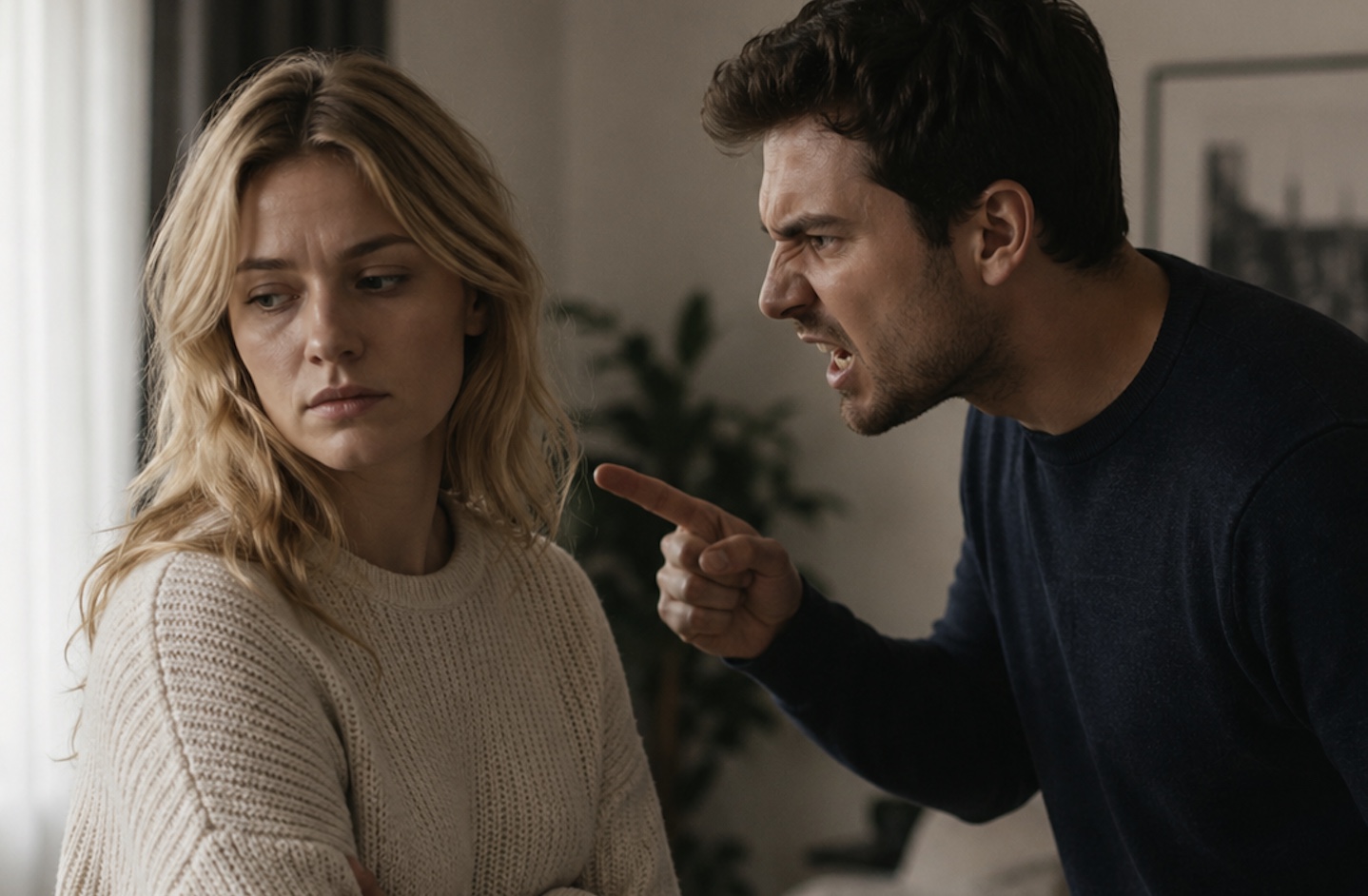
“Are you serious right now?” Angela shifted the phone to her left hand while her right hand kept searching through the depths of the balcony cabinet, hoping to find even the slightest trace of the child’s bike. “Edik, I’m asking you. Do you hear me? Where is Nastya’s bicycle? The pink one with the basket.”
“I hear you, I hear you. Why are you making such a fuss?” her husband’s voice sounded cheerful through the phone. In the background, a circular saw buzzed loudly, cutting through his words. “I gave it away. To Dimon. His little one has grown up and doesn’t have anything to ride. What’s the problem? It was just standing there doing nothing.”
Angela froze.
Something inside her snapped like a string pulled too tight. Slowly, she straightened up and stared at the empty corner of the glassed-in balcony, where only yesterday the carefully washed, oiled, ribbon-decorated bicycle had stood.
“Eduard,” she said, trying to keep her voice low so she would not frighten her daughter playing in the room, “we agreed on this. You knew perfectly well that my brother Oleg was coming today. You knew we had decided to give that bicycle to Pashka. Nastya was waiting for it. She tied the ribbons onto it herself. How could you give away something that didn’t belong to you?”
“Oh, come on, don’t start,” her husband snorted, and Angela could easily picture his dismissive smirk. “What are you lecturing me for? Who bought that bike? I did. Whose money was it? Mine. That means I’m the owner, and I can give it to whoever I want. Dimon is a good guy. He needs it more. Your brother can manage somehow. He won’t fall apart. Let him buy his own kid one, they’re not exactly starving. That’s it. I’ve got work to do. See you tonight.”
The line went dead.
Angela lowered the phone.
This was not just selfishness. It was open contempt for the opinion of the entire family.
A moment later, five-year-old Nastya ran into the room, hugging a plush bunny to her chest. Her eyes were shining with excitement.
“Mom, is Uncle Oleg coming soon? I also made a pony sticker for Pashka! Are we going to give him the bike?”
Angela crouched down and gently fixed a loose strand of her daughter’s hair. The graphite from her fingers left a faint mark on the child’s light T-shirt. Teaching graphic design had trained her to see the world in lines and shadows, but right now the composition of their life had been crudely ruined.
“Soon, sweetheart. Soon,” she forced out, feeling a lump rise in her throat.
The doorbell rang like a sentence being passed.
Oleg, her younger brother, stood on the threshold, holding three-year-old Pashka by the hand. The little boy shifted from one foot to the other, his eyes bright with curiosity. Oleg was smiling, but when he saw his sister’s face, the smile slowly slipped away like paint running down a wall.
“Angela, hi. What happened? You look awful.”
“Come in,” she said, stepping aside to let them in. “Would you like some tea?”
“Business first,” Oleg said with a wink, trying to lighten the mood. “Pashka talked about the ‘bike-bike’ the whole way here. Nastya promised to show him how to ride.”
Nastya ran into the hallway, happily hugged her cousin, and then, with childlike directness, tugged him by the sleeve.
“Come on, Pashka! Mom will take the bike from the balcony now. It’s so pretty!”
Angela closed her eyes.
She wanted the floor to open beneath her. Shame burned her cheeks, even though none of this was her fault.
“Oleg…” she began after the children ran into the living room. “There is no bicycle.”
Her brother raised his eyebrows in confusion.
“What do you mean there’s no bicycle? Was it stolen?”
“Worse. Edik gave it to his friend. This morning. While we were asleep.”
Oleg was silent for a few seconds, taking it in. He knew his brother-in-law had a difficult character, but this kind of pettiness was beyond anything he had imagined.
“Wait. But you prepared it. Nastya knew about it. He knew about it. How does that even happen?”
“He said that since he bought it, he could do whatever he wanted with it,” Angela said, nervously clasping her fingers together. “I’m sorry, Oleg. I didn’t know. I swear, I didn’t know.”
From the room came Nastya’s voice.
“Mom, where is it? Pashka is waiting!”
Little Pashka came out into the hallway, his lower lip already trembling. A child’s disappointment is the most sincere and the heaviest thing in the world. Seeing her cousin upset, Nastya ran out after him, dragging her own brand-new bicycle, the one bought only yesterday.
“Don’t cry, Pasha!” she said, barely holding back tears herself. “Here, ride mine!”
Angela looked at the scene, and something hard, cold, and sharp began to grow inside the part of her soul where patience and softness usually lived.
Anger.
“This won’t do,” she said firmly. “Oleg, get ready. We’re going to the store.”
“Angela, stop. We’ll buy one later…” her brother began, seeing the state she was in.
“No. We’re going now. Eduard thinks he has the right to treat a child’s things as his own property? Fine. Then we’ll do it differently.”
The trip to the store was quiet, but determined. Nastya and Pashka, sensing the adults’ tension, walked silently, holding hands. In the sports section, Angela chose the best balance bike suitable for her nephew’s height. The price tag was painful, but she did not even blink.
“Angela, that’s expensive. I can—” Oleg tried to protest.
“I’m paying,” she cut him off, taking out her card. “It’s a gift from Nastya. And from me. End of discussion.”
When a happy Pashka was already racing around the courtyard on his new ride, and Nastya, having forgotten her sadness, ran beside him, Angela looked at the receipt.
The amount was significant.
It was exactly what she had been saving for two months to buy a new graphic tablet.
But now those numbers meant something else.
They were the price of a lesson.
Eduard came home close to eight in the evening. He entered the apartment like a man entering his own kingdom, slamming the door loudly, fully convinced of his rightness and of his unshakable status as head of the family.
“Anything to eat? I’m hungry as a wolf!” he shouted from the hallway, pulling off his work boots.
Silence.
No smell of fried meat. No sound of knives against a cutting board.
Angela was sitting in the living room, checking her students’ assignments. A lamp glowed on the table, lighting the even pencil strokes on the paper.
Eduard looked into the kitchen.
Empty.
The pots were shining clean. There was not a crumb on the stove.
“Hey, woman, did you fall asleep or what? Where’s dinner?”
Angela turned her head.
Her gaze was calm and studying, as though she were looking at a failed sketch that would be easier to erase than fix.
“There will be no dinner, Eduard.”
“What do you mean, no dinner?” He froze in the doorway, thick brows drawn together. “Are you sulking because of the bike? Come on, enough of these womanly tantrums.”
“This isn’t sulking,” Angela said evenly. “It’s math. You gave away our daughter’s thing, something that cost money. I had to buy Pasha a gift to make up for your… generosity. The money that had been set aside for groceries and household needs went toward the bicycle. The budget is empty.”
For a few seconds Eduard blinked at her, trying to process what he had heard.
“What kind of nonsense are you talking about? What budget? I give you my salary!”
“Your salary covers utilities and your own little wants. I buy groceries with my money. And now my money is gone. For two months, judging by the cost of that bike. So, darling, enjoy your meal. There’s ice in the freezer. You can chew on that.”
“Have you completely lost your mind?” Eduard’s face began turning red. “I’m a man. I work. I want to eat. And you’re arranging a famine over some piece of metal?”
“It was your daughter’s bicycle, Eduard. Not a piece of metal. You stole the joy of giving from her. I merely restored the balance.”
The night passed in tense silence. Eduard made a show of slamming cabinet doors, found some pasta, cooked it, discovered an old can of condensed milk, ate it, and went to sleep in the living room without saying another word.
The next day, toward evening, the doorbell rang.
On the threshold stood Larisa Petrovna, Angela’s mother-in-law. She was a strong-willed woman of the old school, the kind who believed a wife should be the neck that turns the husband’s head, while never forgetting to bow while doing it.
She came in with pursed lips and headed straight to the kitchen, where Angela was drinking tea. Apparently, Eduard had already complained to his mommy.
“Angela, dear,” her mother-in-law began in a sweet, slippery voice. “Edik called me. He said you’re starving him. What kind of news is this? A man comes home from work, and there’s nothing in the house. Some kind of provocation.”
“Please sit down, Larisa Petrovna,” Angela said, pointing to a chair. “Would you like tea?”
“Don’t try to distract me. I understand you had a fight. But leaving your husband without food is low. It’s inhuman. Yes, he gave away the bicycle. Yes, he was foolish. But family is more important!”
Angela looked at her mother-in-law carefully.
The woman sat there with her favorite leather handbag placed on the table — expensive, high quality, a bag she was very proud of.
“Do you truly believe that?” Angela asked quietly. “That giving away someone else’s property is just foolishness?”
“He is the husband! The provider!” Larisa Petrovna threw up her hands. “And whatever is bought for the home is shared. So it belongs to him too.”
“Interesting logic,” Angela nodded. “By the way, your handbag is beautiful. Truly lovely. May I look at it?”
The mother-in-law, slightly thrown off by the sudden change of subject, pursed her lips but pushed the bag closer.
“Well, have a look. Italian leather, by the way.”
Angela took the bag in her hands. She felt its pleasant weight, the softness of the leather.
Then, with one sharp movement, she turned it upside down and shook all its contents onto the kitchen table.
Keys clattered. Lipstick rolled across the surface. A heavy wallet dropped with a thud. Pills scattered, along with a pack of tissues and several receipts.
“What are you doing?” Larisa Petrovna cried, jumping up from her chair.
Angela calmly placed the empty bag aside.
“I like the bag. I’ll give it to Nastya to play with. I don’t need your junk.”
“Are you out of your mind? This is my thing! My personal property!” the mother-in-law shouted, frantically gathering her belongings back into a pile. Her hands were trembling.
“But you are a guest in my home,” Angela replied calmly. “You’re drinking my tea. So we are practically one family. And in a family, everything is shared. I decided the bag is mine now. I have the right to dispose of it, don’t I?”
Larisa Petrovna froze with her wallet in her hands.
She stared at her daughter-in-law with wide eyes, and slowly, understanding began to appear in them.
The cruel, visual lesson had hit exactly where it needed to. She had felt the same humiliation and helplessness that her granddaughter and daughter-in-law had felt. The absurdity of the situation became impossible to ignore.
The mother-in-law silently gathered her things, snatched the bag back from Angela, and pressed it to her chest as if protecting it from enemies.
“You… you’re cruel,” she whispered, but her voice no longer carried its former certainty.
“And Eduard is kind?” Angela asked, looking straight into her eyes.
Larisa Petrovna could not find an answer.
She turned sharply and left the kitchen.
A moment later, the front door slammed.
An hour later, Eduard’s phone was ringing nonstop. His mother was calling him, overwhelmed with emotion.
“Edik! Your wife… she’s lost her mind! She dumped out my handbag! Right onto the table!” she shouted into the phone, but then her tone lowered. “But, son… I understood. I understood what it feels like. It’s vile, Edik. Give her the money back for that bicycle. Apologize to Angela. You can’t act like that.”
Eduard, sitting on a bench by the entrance with a can of beer, nearly choked.
He had expected support.
Instead, he got a lecture.
“What? Mom, are you taking her side now? Did she talk you into it too? To hell with all of you! You all decided to teach me, huh?”
He hung up and angrily threw the empty can into the trash.
Disgrace. Complete disgrace.
The women had conspired against him.
Fine. He would show them who was boss in that house.
Eduard came home furious, like a chained dog.
Angela was just setting the table. The smell of freshly cooked chicken fillet with vegetables filled the air. Two plates. One for Angela. The other small one, with a child’s drawing on it, for Nastya.
“Oh, food!” Eduard walked into the kitchen. “I told you you’d calm down.”
He pulled out a chair, sat down, dragged both plates toward himself, and picked up a fork.
Angela stood by the stove, frozen.
Nastya had just entered the kitchen, holding her doll.
“Eduard, that is Nastya’s dinner and mine,” Angela said in an icy voice. “Your portion is not included in the budget.”
“I don’t give a damn about your budget!” he barked, stuffing a piece of chicken into his mouth. “I’m compensating myself for moral damages. You and my mother drove me insane!”
He ate quickly, greedily, as if afraid someone would take the food away from him.
Nastya looked at her father, and her lower lip began to tremble.
“Daddy… that’s my chicken…” the girl whispered.
Eduard did not even look at his daughter.
He finished everything, wiped his mouth with his sleeve, and belched.
“Tasty. But not enough. Next time, cook more.”
Angela silently walked over to her daughter, picked her up, and held her close.
“You’re a brute, Eduard,” she said quietly. There was no emotion in the words, only a statement of fact. “You’re simply a brute.”
“Watch your mouth!” he snapped and went into the room to watch television.
The next morning, Eduard met with Dimon.
Dimon looked displeased.
“Listen, Ed, that bike of yours is total garbage. My kid rode it yesterday, the pedal fell off, and he nearly twisted his leg. The wheel is all crooked. What kind of rotten gift did you dump on me? My wife is on my case now, says it belongs in the trash.”
Eduard felt offended.
He had given it from the heart.
“The bike was fine! Your kid breaks everything. His hands probably grow from the wrong place.”
“Watch what you say,” Dimon bristled. “Anyway, take your junk back. I don’t need it.”
Eduard lost his temper.
Of course, Angela was to blame for everything. If not for her bad energy and greed, the bike would have ridden forever.
He called his sister, Sveta.
After hearing the story, she immediately took his side.
“Edik, she’s completely out of control! Her brain has gone sideways from greed! She bought something herself, got offended herself, and now she’s starving you too. Are you a man or a doormat? Put her in her place! Whoever paid for it owns it. That’s the law of life!”
That evening, Eduard went home firmly determined to “educate” his wife.
Angela decided to conduct one final experiment.
She cooked dinner. A lot of it. Delicious roast. She placed two full plates on the table and went with Nastya into the room to read a book.
She needed to see whether he would understand.
Whether he would stop.
Eduard entered the kitchen. He saw the food.
He smirked.
“So she finally understood who’s in charge,” he muttered.
Remembering his sister’s words about being a “doormat,” he sat down demonstratively and ate everything.
Both portions.
Until the plates were clean.
“That’s how it’s going to be from now on!” he shouted toward the hallway. “Until you understand what ownership is and what respect for your husband means!”
In the room, Angela closed the book.
“Come on, Nastya. Let’s go to Grandma’s. We’ll sleep there tonight.”
The next day, Nastya stayed with Angela’s mother. Angela returned home alone.
She knew what was coming.
Her morning conversation with her mother-in-law had been brief. Larisa Petrovna, still shaken by the handbag incident, had said, “I’ll talk to him again. But he’s stubborn, just like his late father. Stay strong, daughter.”
But his mother’s talks only provoked Eduard more.
When he returned from his shift, he was wound up to the limit. Seeing his wife, he said nothing. He went straight to the kitchen, took out a screwdriver, and began unscrewing the television from the wall.
“What are you doing?” Angela asked calmly, leaning against the doorframe.
“I’m taking down the TV!” Eduard barked. The buzzing of the tool nearly drowned out his voice. “I bought it! That means it’s mine! Sanka’s country house is empty, and they go there to relax. They need it more. Here it just hangs on the wall while you don’t even cook for me. So forget it. No TV for you!”
With effort, he removed the flat screen and set it on the floor.
“Eduard, this is a shared television. We bought it when I sold the old one. You added money, yes, but it is family property.”
“I added money, so it’s mine!” His eyes burned with an unhealthy shine. “And actually, I chose the sofa in the living room too. I’ll call the guys now, and we’ll haul it away. You can sleep on the floor, since you’re so smart.”
Angela looked at the man she had lived with for seven years.
She no longer saw a husband.
She saw a stranger — greedy, petty, and drunk on the thrill of destruction.
“So that’s the principle?” she clarified. “Whoever paid gets to take it?”
“Yes! Exactly!” Eduard looked at her triumphantly. “Learn while I’m alive!”
“Fine.”
Angela went into the hallway, picked up his bag, and took out his key ring. Then she walked over to the small table where the keys to Eduard’s car lay.
“Give me the keys,” she said, holding out her hand.
“What for?” he asked suspiciously.
“I bought the car. I paid off the loan with my project bonuses. The documents are in my name. That means the car is mine. I’m taking it. Right now, I’ll drive it to a paid parking lot.”
Eduard choked on air.
“What are you… I have work tomorrow!”
“That is your problem. Buses run perfectly well. Now, second.”
She removed the front door key from his key ring and jingled it deliberately.
“My parents gave me this apartment as a wedding gift. It is legally in my name. We did the renovation together, yes, but the walls, floor, and ceiling are mine. You pay utilities? Wonderful. You may take your share of electricity and water away in buckets. But you will not live here.”
“Are you kicking me out?” Eduard stared at her, stunned. All his aggressive energy began to evaporate, replaced by fear and rage.
“I am following your principle. Mine means mine. I’m keeping the apartment for myself and my daughter. And you, with your television and your broken logic, can get out.”
“You wouldn’t dare!” he clenched his fists so tightly that the veins in his neck swelled. “We have a child!”
“You left that child without dinner yesterday when you ate her portion. And you gave away her bicycle. So don’t hide behind Nastya. Out.”
Eduard stood in the middle of the kitchen, hugging the television, looking ridiculous and pathetic.
He understood that he had lost.
His trump cards had turned out to be nothing against her royal flush.
“Oh, so that’s how it is…” he hissed. “Fine. Live here alone! You’ll rot without a man!”
He grabbed the television, threw on his jacket somehow, and stormed out of the apartment.
The door slammed shut, cutting off her former life.
Angela slowly exhaled.
She was not shaking.
Ten minutes later, her phone came alive.
It was Eduard’s sister, Svetlana.
Angela turned on speakerphone and placed the phone on the table while pouring herself water.
“What the hell have you done, you witch?” her husband’s sister shrieked. “You threw my brother out onto the street? You greedy creature! Throwing the apartment in his face? He wasted the best years of his life on you!”
Angela listened silently to the stream of abuse.
It poured from the speaker like dirty water.
She did not interrupt.
What was the point of explaining anything to someone who had no intention of listening?
“May you be left with nothing! We’ll take you to court! We’ll sue you for everything!” Sveta screamed.
Angela pressed end and blocked the number.
Then Eduard’s aunt called, a woman Angela had seen only twice in her life.
“Angela dear, how could you?” the woman wailed, though there was aggression beneath the whining. “Edik is such a good boy, and you… This is shameless, dear. How can you throw out your husband? A woman must endure. She must be patient…”
“Endure theft from his own daughter?” Angela asked.
“Oh, come on, it was just a bicycle! A small everyday matter! And you’re destroying the family!”
Blocked.
The silence lasted until morning.
Angela picked up Nastya from her mother’s place, took her to kindergarten, and returned home ready to defend herself.
But no one rang the doorbell.
Her mother-in-law came.
On her own, without warning.
Angela tensed, expecting another scandal, but Larisa Petrovna looked tired and… guilty.
“May I come in?” she asked quietly.
Angela nodded.
Her mother-in-law went into the kitchen and sat in the same place where her son had sat the day before, devouring a child’s dinner.
“Sveta called,” Larisa Petrovna said, looking out the window. “And Edik called too. He slept at Sanka’s. He’s complaining, threatening divorce. Says he’s going to file the papers.”
Angela remained silent.
“You know,” her mother-in-law turned toward her, “I didn’t sleep all night. After you dumped out my handbag… At first, I was so angry. I thought I could kill you. And then I imagined myself as a little girl, having my favorite doll taken away. Just like that. Because my father decided to give it to a neighbor. And it hurt so much.”
She reached into her pocket and took out an envelope.
“Here. This is the money for the bike you bought your nephew.”
“No, please,” Angela shook her head. “I don’t need it.”
“You do!” her mother-in-law said firmly, slapping her palm on the table. “Take it. My son caused this, and I raised him into such an egoist, so I should pay. I failed to see it, Angela. We spoiled him. We thought we were raising a man, a master of the house. But what grew up was… what grew up.”
Larisa Petrovna sighed, and her shoulders dropped.
“He’s there now at his friend’s place, acting like some hero. Threatening to split the apartment, take the car. Fool. He has nothing. And no conscience either.”
She covered Angela’s hand with her own. Her palm was warm and dry.
“Listen to me carefully, daughter. The divorce will be hard. He will drain your blood, no doubt about it. Sveta and his aunt will wind him up. But know this: I am on your side. In court, with child services, wherever needed. I will not openly go to war against my son — I’m still his mother — but I will not lie. And I will not let anyone hurt Nastya.”
Angela felt tears rising to her eyes.
It was so unexpected.
And so needed.
“Thank you, Larisa Petrovna.”
“Don’t thank me. You opened my eyes. Harshly, but clearly. By the way, I bought Nastya another handbag. A child’s one, pretty. Mine would be too big for her anyway,” she added with a faint smile.
Eduard did file for divorce.
He was certain Angela would come running to him, begging him to return, because, as he liked to say, “who needs a woman with a child?”
But the phone remained silent.
Dimon returned the broken bicycle and stopped speaking to Edik, deciding he was a shady type who gave people trash and then demanded respect for it. His other friend, Sanka, quickly grew tired of Eduard’s whining and hinted that it was time for him to know when to leave.
He failed to split the apartment. The gift deed had been drawn up properly.
The car also stayed with Angela.
Eduard, who had counted on an easy victory and his wife’s humiliation, ended up in a rented room with a television he had nowhere to hang and an angry sister whose own personal life was cracking apart, so she now took out her rage on her brother.
He lost his family, his mother’s respect, and his comfort, all in exchange for the petty desire to be “the boss” where he should have simply been a loving father.
The bicycle with the pink basket became the one small stone that started the avalanche.
As for Nastya and Pashka, they raced around the courtyard together. Pashka rode his cool new balance bike, and Nastya rode her own bicycle.
Sometimes she asked about her father, but Angela knew how to explain it.
In drawing, if the perspective is built incorrectly, the whole picture falls apart.
Eduard had ruined his own perspective.
And there was no fixing it anymore.