“Did you really just say that, Marina Petrovna, or do you run a free circus for relatives every Friday?” Alexey hurled a white envelope onto the kitchen table so hard that the utility bills scattered across the oilcloth.
Yulia flinched. The envelope bounced, tipped onto its side, and slid to a stop beside a sugar bowl with a chipped lid. Five thousand rubles. For their family, that was not some casual pocket change. It was a full week of normal living without standing at the register and mentally subtracting every item.
“What happened?” she asked carefully, even though his face already said enough: everything that could go wrong had gone wrong, and then some.
Alexey dropped onto the stool as if he had not sat down at all, but collapsed.
“What happened? My mother happened. It’s her anniversary, apparently. Sixty years old. A celebration of cosmic importance. The elder son, Sergey, is the pride of the family, sunshine incarnate, practically a minister, just without a ministry. And me?” He laughed bitterly. “According to her, I’m a trailer with hands, a man who’s spent his whole life going in the wrong direction. And do you know who supposedly led me there? You.”
Without a word, Yulia placed a glass of water in front of him.
“What exactly did she say?”
“You want the exact words? Fine. ‘The older son respects his mother, the younger one only shames her. Sergey’s wife is a woman of class, and what do you have? A girl with a permanent discount card from Pyaterochka.’” He gave a harsh smile. “Good, right? Then it got even better. ‘You brought home some ragged nobody, and now she’s giving advice.’ After that she warmed up and went into her greatest hits: no proper apartment, no car, no future. I just stood there listening as if I’d been called in for some housing-office reprimand.”
Yulia pressed her lips together. What hurt most was not the insult to herself. It was him. The way everyone around him had grown so used to humiliating him, as if it were just another family tradition.
“Well, she…”
“Don’t start,” he snapped immediately. “Please don’t give me that ‘she’s just like that, she has a difficult personality.’ That’s not a difficult personality. That’s a habit of speaking to people like they’re dirty cookware.”
Yulia sat across from him.
“I’m not excusing her. But tomorrow is the birthday dinner. If you don’t go, there’ll be a second act. Then the calls will start, the accusations, and Inga will tell the whole family we were stingy with the gift and offended your mother.”
“Have we forgotten to offend anyone else?” Alexey said with a grim smirk. “Maybe the downstairs neighbors? Or the tax office? Yul, I don’t want to go. Not at all. Not even for a minute.”
“All right. Then don’t. I’ll stop by after work, give her the envelope, congratulate her, and leave. No dinner, no toasts, no parade of family success.”
He looked up at her.
“Why?”
“Because it’ll be easier afterward. We’ll close the matter and be done with it. Officially.”
“Officially, our fridge is almost empty,” he muttered. “That money was supposed to go toward shoes for you and the utility bill.”
“I know.”
“Then why are we once again playing ‘decent people’ for those who don’t even see us as people?”
Yulia was quiet for a moment. The kettle was softly simmering on the stove. Outside, in the gray March courtyard, someone kept trying to start a car that coughed like an offended tractor.
“Because I need to see it for myself,” she said at last. “Not hear it from you. See it with my own eyes.”
“See what?”
“That it’s over. That there’s nothing left to tolerate.”
He studied her for a long time, then took the glass, drank some water, and gave a joyless half-smile.
“Do what you want. Just don’t say I didn’t warn you.”
“I won’t.”
“And one more thing. If Inga starts dripping poison the way she always does, don’t stay quiet.”
“Mhm.”
“No, seriously. You have this terrible habit of smiling when someone is trying to humiliate you.”
“That’s not a habit. It’s a defense mechanism.”
“A bad one. Like antivirus software that opens the door for the virus itself.”
Yulia let out an unwilling snort.
“Thank you for that comparison.”
“I do my best to be romantic on a budget.”
The next day she left work an hour early. The head receptionist pursed her lips, but let her go, because she herself loved the word anniversary and said it with almost religious reverence.
Outside, a cold drizzle was falling. Yulia ducked into the flower kiosk near the bus stop.
“Something decent that doesn’t cost the moon,” she told the florist.
“You’ve just described my entire life,” the woman sighed, pointing to the chrysanthemums. “Take these. They last a long time, look respectable, and don’t make trouble.”
“I wish I had that personality.”
“Only flowers and some cashiers do,” the florist said philosophically.
Yulia smiled, bought the bouquet, and headed to her mother-in-law’s place. On the minibus, someone was loudly discussing bathroom tiles over the phone, and the teenager next to her ate croutons with the noise level of a brick grinder. Everything was normal, and yet something inside her felt tightly wound.
Three cars were parked outside Marina’s building. One of them was Inga and Sergey’s black SUV, polished to a shine like a commercial for somebody else’s life. The stairwell smelled of perfume, roasted meat, and fried onions. Laughter thundered behind the apartment door.
Yulia rang the bell.
The noise inside paused for a second. Then the lock clicked, and Marina Petrovna appeared in the doorway. She was wearing a dark navy dress, her hair styled, her makeup done, her back so straight that she looked less like a birthday woman in a Soviet-era apartment block and more like the hostess of a ballroom in a film about the rich and unpleasant.
She looked Yulia up and down and did not even try to hide her disappointment.
“Oh. It’s you.”
“Good evening, Marina Petrovna. Happy birthday.”
“And where is Alexey? Have his legs fallen off? Or his conscience?”
“Alexey didn’t come. I came to congratulate you on behalf of both of us.”
“So I don’t even deserve to see my own son on my birthday,” the older woman declared loudly into the apartment, clearly for everyone inside to hear. “How touching.”
Right on cue, Inga appeared in the hallway holding a wineglass. Perfect hair, expensive earrings, a dress that probably cost as much as Yulia earned in two months, and a smile sharp enough to cut glass.
“Oh, Yulechka, hi! We were starting to think you’d decided to save money on the visit too.”
“Inga,” Yulia said with a curt nod.
“Well, come in, why are you standing there? Though the living room is full. There’s a little stool in the kitchen. The hot dishes are already gone, though. First come, first served.”
“I won’t stay long,” Yulia said. “I just came to congratulate her and hand over the gift.”
Marina Petrovna took the bouquet with two fingers as if it were not flowers but suspicious paperwork.
“Nina, put this somewhere,” she tossed over her shoulder. “Just not in the big vase. The real bouquets are in there.”
Yulia felt her cheeks begin to burn.
“Thank you, Marina Petrovna. Very gracious.”
“And what exactly did you expect? Honesty is a rare commodity, and it’s my birthday. I can afford it. So? What have you got for me?” She held out her hand. “Come on, don’t drag it out.”
“Could I at least come inside first?” Yulia asked.
“Why? You said yourself you weren’t staying long.”
Someone from the living room called out:
“Marina, who is it?”
“The junior branch of the family!” Marina shouted back. “They brought a money transfer.”
There was stifled laughter somewhere deeper in the apartment.
Inga took a sip of wine and tilted her head with false sympathy.
“Yul, don’t be offended. It’s just cramped in here. When you have a lot of guests, you always have to seat people according to status. Nothing personal.”
“According to status?” Yulia repeated.
“Not job titles,” Inga said sweetly. “Just who’s inner circle and who isn’t. You’re a grown woman. Surely you understand nuance.”
“Ah. Nuance. Very useful word when you want to be rude elegantly.”
Marina Petrovna perked up at once.
“Oh, look at that, she found her voice. Yulia, spare me the attitude. You and Alexey can’t afford attitude. You barely scrape by as it is. If you came, behave modestly.”
Yulia slowly unzipped her bag and felt for the envelope. Her heart was beating hard and heavy.
“We’re doing fine.”
“Really?” Marina raised an eyebrow. “Fine is when your husband is forty, still taking the metro, and renting a place in the suburbs? Don’t make me laugh. Sergey gave his mother a television, paid for a holiday trip, and even wanted to book a restaurant, but I said why bother when home is more comfortable. As for your contribution, I’m almost afraid to imagine.”
“Don’t be,” Yulia said quietly. “It’s not contagious.”
Inga gave a little snort, then pretended she had coughed.
“Yul, don’t be like that. Marina Petrovna just worries about Alexey. She’s his mother.”
“If that’s what concern looks like,” Yulia said, “I’d hate to see your version of love.”
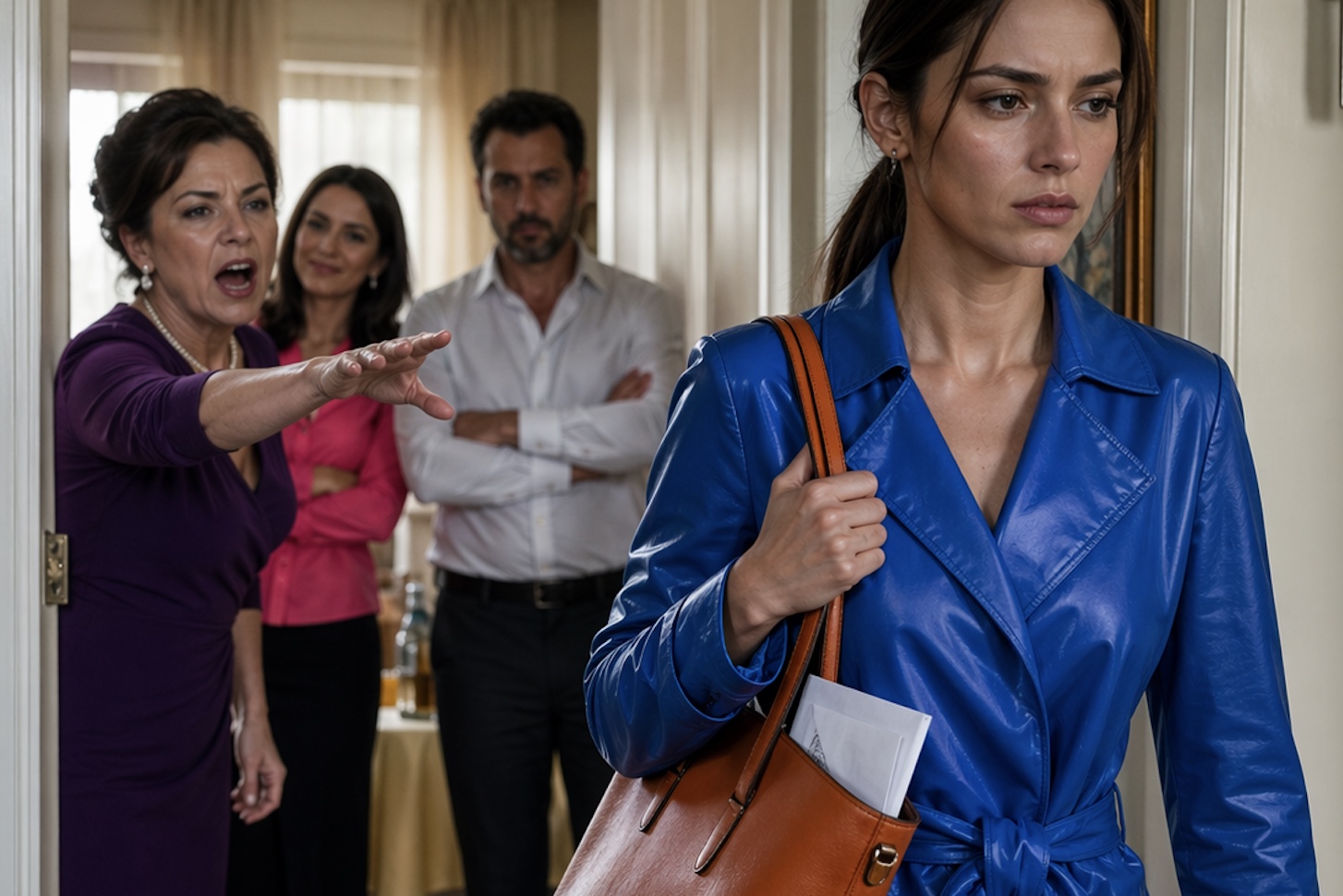
Marina stretched her hand out even farther.
“That’s enough. Give me the envelope and go. People are celebrating here, not sorting out family drama in the hallway.”
Yulia looked at that hand with its rings and polished nails, at Inga’s satisfied face, at the open doorway to the living room where relatives sat pretending not to listen while hearing every last breath.
And at that moment something inside her clicked. Not loudly, not theatrically. Just like a switch being turned off.
“You’re right,” she said unexpectedly calmly. “I won’t ruin your evening.”
And instead of pulling out the envelope, she zipped her bag shut.
The sound of the zipper was so sharp and clear that it felt as if someone in the apartment had switched off the music.
Marina blinked.
“What was that supposed to mean?”
“Basic safety procedure,” Yulia replied. “Money likes respect. And where I’m kept at the threshold and assigned a stool according to status, I don’t see any respect.”
“Are you out of your mind?” Marina hissed. “Give it here! That’s my birthday gift!”
“A gift is given. It’s not snatched out of someone’s hand like an advance from an employee being punished.”
“A son owes his mother!”
“Perhaps. But you do not owe it to his wife to shout at her. And yet you do it every chance you get.”
Inga stepped forward.
“Yulia, you are behaving very badly right now. Marina Petrovna is not a young woman. She doesn’t need this kind of stress.”
“Then why do you arrange it every time you see me?”
“No one is arranging anything,” Inga said with an icy smile. “You just shouldn’t confuse hospitality with an obligation to indulge someone else’s sensitivity.”
“Where did you learn to talk like that? Top of your class at passive-aggression school?”
A strangled laugh came from the living room. One of the relatives had failed to keep it in.
Marina Petrovna flushed.
“How dare you speak like that in my home!”
“And how dare you speak like that to my husband for years?” Yulia said, raising her voice for the first time. “Do you think he never tells me anything? Do you think I don’t see how he walks around after every call from you like he’s been run over? Out of your two sons, you decided one was a real person and the other was forever guilty. And now you’re surprised he didn’t come?”
“He didn’t come because he’s weak!” Marina snapped. “Sergey would never behave like this.”
“Of course not. Saint Sergey. Especially when he shows up once a month in a shiny car, brings some grand gesture so everyone gasps, and then leaves you to spend the next week calling Alexey about a leaking tap, paperwork, and lines at the municipal office.”
Silence dropped over the hallway.
Inga narrowed her eyes.
“Watch your mouth.”
“You should watch your face,” Yulia shot back. “Right now it looks like someone canceled your discount.”
“I do a lot for this family.”
“Of course you do. Mostly set decoration.”
Marina took a step closer until she was right in front of her.
“Get out. And don’t you dare show your face here again.”
“With pleasure,” Yulia nodded. “That, at least, is wonderful news.”
“And leave the money!”
“No. My husband did not earn that money so you could humiliate him with it.”
“I’ll tell Alexey everything!”
“Please do. While you’re at it, remind him how you welcomed his wife on your birthday: like a delivery courier on the landing.”
At that moment Sergey appeared from the living room. Tall, clean-shaven, wearing an expensive shirt and the exact expression men adopt when they desperately want to avoid getting involved but still be seen as decent by everyone.
“What is going on here?”
Yulia turned to him.
“Oh good, the chief investor in the family enterprise. It’s simple. I came to congratulate your mother, and they explained that I’m not high enough class to even step over the threshold properly.”
Sergey looked irritably at his mother, then at Inga.
“Mom, was all of this really necessary right in the doorway?”
“And what exactly did I say that was wrong?” Marina demanded. “I told the truth.”
“With you, truth is always served like a slap,” Yulia said.
Sergey let out a heavy breath.
“Yulia, don’t make a scene. Give her the gift, offer congratulations, and let’s end it.”
“And why should I pretend everything is normal?”
“Because it’s her birthday.”
“What a wonderful argument. So if it’s someone’s birthday, that automatically gives them unlimited permission to be rude?”
Inga let out a scoff.
“Don’t be so dramatic.”
“And don’t try to order me around. I’ve had enough of you already.”
Sergey looked at the envelope, then at Yulia.
“All right. How much is in there?”
“That is none of your business.”
“Yulia…”
“No, Sergey. And this is the funny part. Everyone in your family counts your younger brother’s money as if it were public property. When it’s time to chip in for a gift, Alexey is obligated. When someone needs to bring documents to your mother, Alexey is obligated. When something needs fixing, carrying, picking up, waiting in line for, Alexey is obligated again. But respect, apparently, is reserved only for people with bigger cars and wives in silk.”
Sergey pressed his lips together.
“You’re going too far.”
“Am I? And where was your sense of proportion when your wife kept turning me into a footnote to poverty? ‘Yulechka, did you come by bus?’ ‘Yulechka, things must be hard for you right now.’ ‘Yulechka, we have some leftover sushi rolls, do you want them for the kids?’ We don’t even have children, Inga. But thank you for making me look, in your world, like the kind of woman who should be grateful for leftovers.”
Inga went pale.
“That was concern.”
“No. That was the habit of looking down at someone and dressing it up as kindness.”
Marina Petrovna threw up her hands.
“God, what an ungrateful woman! We welcomed her, tolerated her…”
“Tolerated?” Yulia actually laughed. “Thank you so much. Should I get you a medal? For endurance? You never welcomed me. From the very beginning, you filed me away as Alexey’s mistake. Because I didn’t come with an apartment, or a car, or the right family background, and I never learned to smile as if humiliation were pleasant.”
From somewhere deep inside the apartment came the timid voice of some aunt:
“Maybe someone should pour tea…”
“Oh, do sit down already!” Marina barked into the room without turning.
Yulia adjusted the strap of her bag on her shoulder.
“You know what? Happy birthday. Truly. I sincerely wish that one day you notice that the people around you are human beings, not service staff and not your personal ranking system.”
“Oh, go to hell!”
“Already on my way.”
She turned and started down the stairs.
“Yulia!” Sergey called after her.
She stopped one flight below. Sergey came out after her, pulling the door partly closed behind him so everyone inside could hear while pretending not to.
“Let’s not be childish,” he said quietly. “Come back, hand over the money, and let it go. Why destroy the relationship completely?”
“It was destroyed a long time ago. Just not by me.”
“We only have one mother.”
“And Alexey only has one nervous system.”
“You’re turning him against the family.”
Yulia slowly turned to face him.
“No, Sergey. Your family spent years turning him against himself. That was much more convenient, wasn’t it? As long as one son shone, the other had to stand in the shadow and be grateful for the chance to exist.”
Sergey looked away.
“You don’t understand.”
“Then explain it to me.”
“Mom has always had a difficult character, yes. But she raised us alone after the divorce. She always wanted us to make something of ourselves.”
“And that led her to teach one son that he was golden and the other that he would always be a disappointment?”
“That’s not true.”
“Then why is every conversation about money, status, who achieved what? Why does Alexey go silent for half a day after speaking to her? Why, even now, aren’t you saying, ‘Mom, you’re wrong’? Why are you telling me instead to come back and swallow it?”
Sergey rubbed his face tiredly.
“Because I don’t want a scandal on her birthday.”
“And I don’t want to be a doormat on her birthday. Or ever again.”
At that moment Inga slipped out through the door.
“Sergey, are you coming? Everyone’s waiting for the toast.”
Then she looked at Yulia and smirked.
“Seriously, Yulia? All this drama over five thousand? That’s almost embarrassing.”
Yulia narrowed her eyes.
“Perfect. If the amount is so trivial, then you’ll manage just fine without it.”
Inga opened her mouth, then shut it again.
“You’re jealous,” she said finally. “You’ve always been jealous.”
“Of what? Your ability to smile at people’s faces and kick them under the table? No, thank you. My shoes are cheaper, but at least my conscience doesn’t pinch.”
“That’s enough,” Sergey said sharply.
“I agree,” Yulia replied. “Enough.”
She walked downstairs, left the building, and only once she was outside realized she was breathing as if she had been running. The rain had almost stopped. The pavement glistened under the streetlights. Someone was carrying grocery bags across the yard. A forgotten plastic shovel was getting soaked on the playground. An ordinary evening. And somehow that made everything feel strangely calm.
Yulia took out her phone and called her husband.
“Hello?” Alexey answered immediately. “Well? What happened?”
“I left.”
A pause.
“What do you mean, you left?”
“I mean exactly that. I congratulated her, listened to the free humiliation program, did not hand over the money, and left.”
Another pause. Then very carefully:
“Say that again.”
“The money is with me. I left.”
And then he exhaled so loudly that she smiled.
“Oh God, Yul.”
“What?”
“For the first time in the last twenty-four hours, I love you so much it’s almost frightening.”
“Now that sounds more like family support than your family’s usual sport.”
He gave a short laugh.
“Did she scream?”
“Like a fire siren on maximum.”
“Did Inga get involved?”
“Naturally. Without her, the family poison loses its commercial quality.”
“Sergey?”
“Stood between conscience and comfort and chose the familiar.”
“Right…”
“Lyosh.”
“Yeah?”
“I’m not going there again. And you don’t have to either. Not for birthdays, not for broken taps, not for certificates, not for ‘but your mother asked.’”
He was silent for a moment.
“I’m ashamed you had to take all of that on yourself.”
“Don’t be. I needed to see it. Now I have no illusions left.”
“And what do you want to do?”
Yulia glanced around. On the corner, the sign of a small pastry shop glowed beside a bakery that smelled of coffee and vanilla.
“I want to buy something sweet, go home, and celebrate the beginning of our adult life.”
“A holiday of disobedience?”
“A holiday of no more stupidity.”
“That sounds excellent. Get éclairs.”
“You have the taste of an exhausted office worker.”
“That’s because I am an exhausted office worker.”
“All right. I’ll get a poppy-seed roll too.”
“Then I’ll put the kettle on.”
“And take out the good plates, not those two chipped ones you keep for guests you don’t care about.”
“What if guests come?”
“Tonight the guest is me. And I’m demanding.”
When she got home, Alexey was already waiting in the hallway. He did not ask anything right away. He simply took the bag from her and hugged her so tightly that something inside her finally unclenched.
“Well?” she said into his shoulder. “The loser and the ragged nobody are home.”
“A brilliant duo, if you ask me.”
They went into the kitchen, small and cramped, with fridge magnets, an old curtain, and a radiator that lived by its own strange code: either tropical heat or eternal November. Alexey arranged the pastries on a plate, put out the éclairs and the poppy-seed roll, and switched on the kettle.
“Tell me everything in order,” he said.
“In order will take a while.”
“I’m not in a hurry. Unlike your mother rushing toward someone else’s envelope.”
Yulia sat down and told him the whole story, almost word for word. Where Marina had stood, how Inga had smiled, what Sergey had said, how the relatives in the living room had sat in silence pretending not to hear. Alexey listened, growing darker at first, then shaking his head more and more often, and by the end he suddenly laughed.
“What’s funny?”
“‘Top of your class at passive-aggression school.’ Yul, that was genius. I wish I’d seen Inga’s face.”
“Oh, the look on her face was as if someone had poured her compote instead of wine.”
“Listen…” He poured tea and sat down across from her. “I always thought I had to endure it. That a mother is a mother, that she’s just sharp-tongued, that she had a hard life. And now I’m sitting here realizing I spent forty years explaining it all away so I wouldn’t have to admit one simple thing.”
“What thing?”
“That people don’t get to treat me like that.”
Yulia said softly:
“Yes.”
“And they don’t get to treat you like that either. And I let you go there.”
“I’m not a child. And besides, if you hadn’t let me go, I might have spent another five years trying to be good enough.”
“Where does that even come from in you? That need to smooth everything over?”
“Probably from being poor,” Yulia said with a small crooked smile. “When you grow up always on edge, always short on something, you become very careful not to upset anyone. In case later they won’t help you, won’t include you, won’t approve of you. You get used to being convenient. And then one day you realize nobody loves you. They just use you as a soft layer between other people’s selfishness.”
“That was powerful.”
“I’m on form today.”
Alexey’s phone vibrated on the table. The screen lit up with one word: Mom.
They both looked at it.
“Go on,” Yulia said. “Historic moment.”
He picked up the phone and switched it to speaker.
“Yes?”
“Where were you all evening?!” Marina’s voice exploded from the speaker at once. “Your wife made a disgraceful scene! She humiliated me in front of everyone! She took the gift! What kind of upbringing is that?”
Alexey answered calmly.
“My upbringing is actually showing signs of life for the first time.”
“Don’t you dare speak to me like that!”
“I’m not. I’m saying Yulia was right.”
There was such a stunned silence on the other end that even the kettle clicked awkwardly.
“What?” Marina finally managed.
“Yulia. Was. Right. Would you like me to say it more slowly?”
“Have you lost your mind? She’s turning you against us!”
“No. You spent my whole life turning me against myself, and I used to call that ‘respecting my elders.’”
“I knew it! I knew from day one she was sly, insolent…”
“Stop,” he cut in. “Do not speak about my wife like that.”
Yulia raised her eyes to him. He was sitting straight, calm, without his usual guilty, shrinking expression. And that, perhaps, was the most unexpected gift of the entire day.
Marina shifted into wounded self-pity.
“So your mother means nothing to you now? After everything I’ve done for you?”
“For us?” Alexey gave a quiet, tired laugh. “Let’s be honest. Most of what you did, you did for the feeling of control. And I was supposed to stay your grateful errand boy.”
“How awful. I don’t deserve this.”
“Neither did Yulia today.”
“I never invited her!”
“Excellent. Then that won’t be a problem again.”
“Are you threatening me?”
“No. I’m informing you. We will not be coming to see you again until you learn how to speak to us properly. No humiliation, no comparisons, no endless ‘Sergey is good, you are bad.’”
“You’re jealous of your brother!”
“No, Mom. I’m just tired of living inside your grading system.”
They heard sharp breathing on the other end, and then Sergey broke in.
“Lyosh, don’t do anything rash.”
“No, Sergey, today you don’t get to play peacemaker,” Alexey said wearily. “You stood there and heard everything. And you said nothing.”
“It wasn’t the time.”
“For you, it’s never the time.”
Inga said something in the background too, but the words blurred together, as if even the phone itself refused to transmit that level of toxicity in high resolution.
Alexey ended the call.
The kitchen went quiet.
“Well,” he said after a second. “Looks like adulthood has officially begun.”
“How does it feel?”
“Like taking off painfully tight shoes after twelve hours on your feet.”
Yulia smiled.
“And you were worried we’d be poorer without those five thousand.”
“I think we just got a little richer. In self-respect.”
They drank tea, ate éclairs, and talked for a long time—not about Marina anymore, but about themselves. About how long it had been since they should have stopped living with one eye on everyone else’s expectations. About how maybe in the summer they should not save up for a respectable family gift, but go away for two days together instead. About finding a new rental, even if it was farther from the city center, as long as it had a larger kitchen and no radiator with psychological issues. About how Yulia really did need new shoes, and Alexey did not need another drill for his mother’s place but a proper jacket for himself.
And the longer they talked, the clearer it became: the loudest scandal they had had in years had somehow turned into the quiet beginning of something new.
Late that evening another message came. This time from Sergey.
“You shouldn’t have done that. Mom is crying. You could have handled it like human beings.”
Yulia showed the message to Alexey.
He let out a dry laugh and typed a reply aloud:
“We tried doing it the human way for years. Now we’re doing it the honest way.”
“Harsh,” Yulia said.
“Yes,” he replied. “But at least there’s no lace around the truth anymore.”
She turned off the kitchen light, leaving only the dim lamp above the stove. Outside, the streetlights flickered. In the neighboring building, someone was arguing over parking, then a car door slammed. An ordinary Russian evening in an ordinary suburb. No soundtrack, no cinematic glow. Just two people in a tiny kitchen realizing that what needed saving was not somebody else’s birthday dinner, but their own life.
The next morning, of course, Marina Petrovna called half the family and painted herself as the victim and Yulia as some cold-blooded schemer. But then something unexpected happened. Aunt Lida—the same one who had sat silently by the window in the living room—called Yulia herself and said:
“I kept quiet because I hate conflict. But you were right yesterday. It was long overdue. Marina really has stopped sparing anyone’s feelings.”
After that conversation, Yulia stood at the window for a long time, smiling.
“What?” Alexey asked as he zipped up his jacket before work.
“Nothing. It turns out that in the family theater, some people in the audience really do have eyes.”
“They opened too late.”
“Better late than applauding cruelty for a lifetime.”
He walked over, kissed her on the forehead, and as he reached the door turned back.
“Hey, tonight let’s buy dumplings, sour cream, and prove absolutely nothing to anybody.”
“A dangerously radical plan.”
“I’m a dangerous man now. Apparently I have opinions.”
“Take good care of them. They’re rare.”
“And you take care of your nerve. Last night it was a work of art.”
The door closed. Yulia remained alone. She looked at the white envelope lying on the chest of drawers and, for the first time in a very long while, felt no guilt, no fear, and no urge to become convenient for everyone.
She simply picked up the envelope, put the money into the drawer with the documents, and said out loud, this time to herself:
“That’s enough. Shop’s closed.”
And with those simple words, the apartment suddenly felt lighter, as if someone had flung open a window after a long, suffocating family feast where everyone had been tired of each other for hours but kept pretending it was happiness.