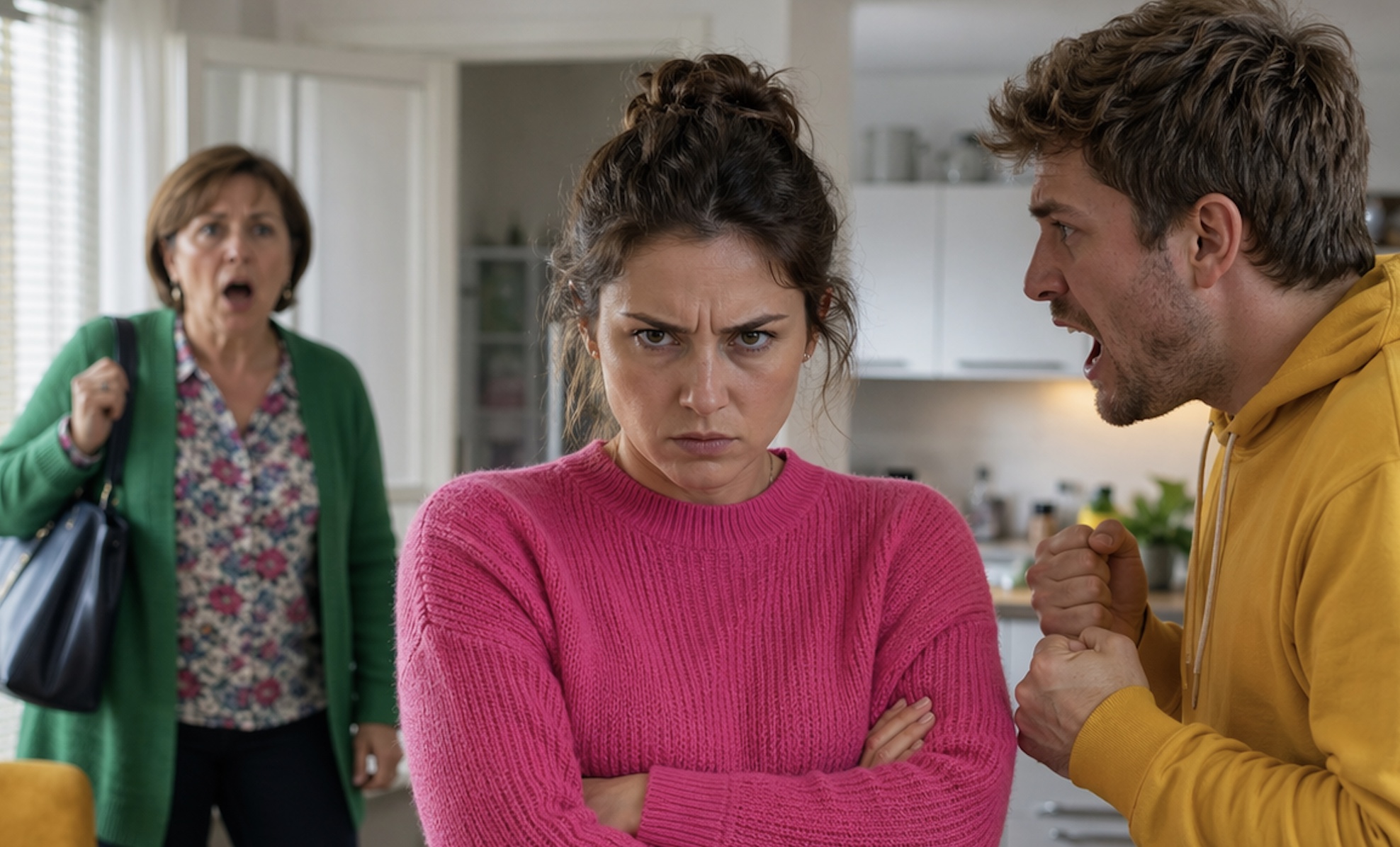
“Have you completely lost your mind, Ksenia, or are you just pretending?” her mother-in-law’s voice boomed from the kitchen as if this were not a cramped two-room apartment in an ordinary Soviet-era block on the outskirts of Yaroslavl, but the assembly hall of some village council.
Ksenia had not even managed to pull her key out of the lock. She froze there in the hallway, a grocery bag in one hand and her laptop in the other. The apartment was full of that sticky, чужой noise that instantly made her skin crawl—laughter, forks clinking against plates, stools scraping the floor, a man coughing, plastic bags rustling. And the smell. That exact smell that always made her eyelid twitch: cheap men’s cologne, tobacco, and fried chicken.
A pair of huge boots had been dumped on the mat, knocking her neat shoes to one side. Next to them were several plaid shopping bags stuffed to the brim, as if whoever had arrived had not come for a visit at all, but intended to move in on the spot.
Ksenia shut the door slowly, slid the strap off her shoulder, and called out in a loud voice,
“Am I understanding this correctly? Another family council in my home without me?”
From the kitchen came an immediate cheerful reply:
“Oh, she’s back! Vitya, tell your wife not to stand in the doorway. There’s a draft!”
Ksenia walked into the kitchen without even taking off her coat. And the sight in front of her made everything in her head snap into perfect clarity.
At the table, covered with her pale tablecloth, sat Zinaida Igorevna as though she chaired a committee for interfering in other people’s lives. Beside her was a heavyset woman of about fifty-five in a raspberry-colored sweater, with bright nails and a sharp, grasping stare. On a stool near the window sat Vitya, her husband, gnawing on a chicken leg with the busy look of a man occupied with important business. In the middle of the table lay a tape measure, a pencil, a notebook, and an open furniture catalog. Her vase with dried branches had been shoved toward the sink, right next to a bowl where someone had left a greasy spoon.
“Well, the lady of the house is here,” her mother-in-law said briskly without getting up. “We’re busy with something important, by the way.”
“I can see that,” Ksenia replied. “The tape measure and the chicken really make it obvious. You’ll just have to explain what exactly you’re doing in my apartment.”
The woman in the raspberry sweater smiled immediately, as if they were old friends.
“I’m Lyuba, Vitya’s aunt. We’re all family here. Not strangers.”
“How wonderful,” Ksenia said with a nod. “Then maybe, as family, you can explain why there’s a person in my home I have never seen in my life.”
Zinaida Igorevna waved a hand dismissively.
“Oh, don’t start the second you walk in. I’ve always said you have the temperament of sandpaper. We could sit down and talk calmly. We’re discussing ordinary things. Everyday matters.”
“Then let’s talk calmly. What exactly are we discussing?”
Without lifting his eyes, Vitya muttered,
“Ksyush, don’t start getting worked up right away.”
“I haven’t even started yet,” she said. “This is just the engine idling. The main performance comes later.”
Her mother-in-law pulled the notebook closer and tapped it with a finger.
“I’ll be direct—none of your office-style word games. The way you live makes no sense. This apartment is inconvenient. The hallway is long and useless. The kitchen is cramped. There’s nowhere to store anything. Vitya lives here too, and he ought to feel like the owner, not some lodger living on borrowed ground.”
“Is that what he told you?” Ksenia looked at her husband.
Vitya shrugged.
“Well… isn’t it true?”
“So you sit in an apartment I got before the marriage, eat my chicken, and still feel deprived because you don’t feel like the owner?”
“Oh, don’t start,” he grimaced. “You always turn everything into a fight.”
“And what else am I supposed to turn this into? A design contest? There’s a tape measure on my table. A stranger’s spoon in my sink. Size-forty-five boots on my doormat. This is either a fight or a soap opera.”
Aunt Lyuba gave a little snort as she poured herself some compote from Ksenia’s pitcher.
“She’s got a sense of humor, I’ll give her that. But family isn’t stand-up comedy.”
“And moving in with plaid travel bags is what, then? A touring show?” Ksenia shot back.
Her mother-in-law leaned forward.
“That’s enough with the sarcasm. Listen carefully. We talked it over and decided this apartment needs to be arranged properly.”
“What does that mean?”
“It means this: half of it should be put in Vitya’s name. Or better yet, the whole place signed over to him. You’re husband and wife. That’s what normal people do when they plan to stay together for the long haul instead of playing your little ‘mine, don’t touch it’ game.”
For one second the kitchen went so silent that Ksenia could hear water dripping from the bathroom faucet.
She looked from her mother-in-law to Vitya. Then to Aunt Lyuba. Then back to Vitya.
“Wait. I want to make sure I’m hearing this lunacy correctly. You let yourselves into my home, spread tools all over my table, invited an audience, and decided I’m supposed to transfer the apartment I owned before marriage to my husband?”
“Why are you saying ‘let ourselves in’?” her mother-in-law flared up at once. “My son has a key.”
“Not for much longer,” Ksenia said calmly.
Vitya finally looked up.
“Why are you looking at me like that? This is a normal conversation. We’re family. Mom is right—how long am I supposed to live like I’m nobody here?”
“And who exactly are you here, Vitya?”
“I’m your husband.”
“A husband isn’t a title you earn by sitting on a stool. It’s behavior. Responsibility. At the very least, it means being able to tell your mother, ‘Mom, slow down, this isn’t your property.’ Instead, you sit there chewing while they decide how to strip me of everything as politely as possible.”
“Nobody’s stripping you of anything,” he muttered. “Don’t make it into a tragedy.”
“Oh, of course not. Three people simply dropped by with travel bags and a furniture catalog because they’re passionate about architecture.”
Aunt Lyuba set her mug down.
“I didn’t come here for fun, you know. I need somewhere to stay for about a month. I’m looking for work. And you have space. I’d help too—with workers, with cleaning, with cooking. Not for free.”
Ksenia turned to her slowly.
“I’m sorry, but who invited you?”
“Well… family did.”
“Whose family?”
Aunt Lyuba opened her mouth, but her mother-in-law answered first.
“Vitya’s family. And you are his wife now. So that makes us yours too.”
“No, Zinaida Igorevna,” Ksenia said, her voice so even it was almost cold. “Don’t try that circus act about kindred souls with me. You’re not ‘family’ when you come to help. You become ‘family’ when you want to squeeze square meters out of someone, move in, and start issuing demands.”
“How dare you speak like that!” her mother-in-law snapped. “I’m doing this for your own good! You think it pleases me to see my son living in another person’s home like some stray bird with no rights?”
“He is not some bird on a branch. He’s a grown man who has spent the last two years saying he’s ‘about to start earning more,’ but somehow keeps borrowing money from his wife before payday.”
Vitya slammed the bone onto his plate.
“And what exactly was that for?”
“Because I’m tired of pretending we’re equals. Since you decided to stage a family forum, let’s take off the decorations. Who pays the utility bills? I do. Who helped cover the mortgage on your mother’s summer house last autumn? I did. Shall I remind you of the amount? Who paid for the repairs on your car because you were ‘delayed at work’? That was me too. And now I’m being told this poor little boy doesn’t feel like the owner.”
“You’re throwing money in my face now?” Vitya jumped to his feet. “Seriously?”
“No. I’m stating facts. There’s a difference.”
Her mother-in-law slapped her palm on the table.
“You’ve crushed him with money! That’s who you really are! With you, everything comes down to receipts and bank transfers. A woman should respect her husband, not keep accounting records on him!”
“A woman doesn’t owe anyone anything when people are trying to make a fool of her in her own kitchen,” Ksenia said sharply. “And enough with the lectures on how to live ‘properly.’ Run your own household however you like. Not mine.”
Aunt Lyuba gave a nervous smile.
“Why get so worked up? We can do this calmly. Transfer a share, and that’s all. Your husband gets security. You get peace and quiet. His mother gets peace of mind. And then maybe some renovations too.”
Ksenia almost laughed.
“You know what really touches me? The ‘and then renovations too’ part. Did you at least think the whole plan through? First a share of the property, then residency registration, then ‘Aunt Lyuba will just stay a little while,’ then ‘let’s only put in one wardrobe,’ then ‘why not glaze the balcony, since now the money is shared too,’ and after that I’ll be told I’m ungrateful and petty?”
Vitya twisted his face.
“This is exactly why it’s impossible to talk to you. You immediately assume there’s some hidden catch.”
“That’s because the catch is usually already sitting at the table, finishing off the chicken.”
He took a step toward her.
“You’re going too far now.”
“No, Vitya. Going too far is your mother measuring my apartment while I’m still alive and deciding which walls should come down. All I’m doing is calling things by their proper names.”
Her mother-in-law stood up, hands on her hips.
“Then let me make this simple. Either you stop acting like some landed aristocrat, or this family won’t last long.”
“Is that a threat?” Ksenia lifted an eyebrow.
“It’s a warning. A man won’t stay where he is reminded every single day that nothing belongs to him.”
“Really? Funny, because he hasn’t offered anything of his own except your ideas.”
“I did offer something!” Vitya burst out. “I said we need to live normally! Without your constant ‘that’s mine, that belonged to my grandmother, don’t touch this.’ What am I here, a museum guard?”
“You’re not a guard. You’re a man who confused marriage with free admission to real estate.”
“Oh, choke on your apartment then!”
“Excellent. Then we’ve settled it.”
Ksenia set the grocery bag on the windowsill, opened the hallway closet, and began methodically pulling out Vitya’s things. Jacket—onto the floor. Jeans—onto the floor. Gym bag—at his feet. The box with his wires and chargers—on top of everything else.
“What are you doing?” he asked, stunned.
“Helping you find emotional comfort. Since you feel so unwelcome here, go somewhere you’re treated like the owner from the moment you arrive. Go to your mother’s.”
“Ksenia!” her mother-in-law screamed. “Have you lost your mind?”
“Not at all. In fact, I don’t think I’ve been this clear-headed in five years.”
“You’re throwing your husband out?”
“No, Zinaida Igorevna. I’m removing from my apartment the problem you all insisted on calling ‘family.’”
Vitya stepped toward the closet and grabbed the sleeve of one of his jackets.
“Stop this ridiculous performance.”
“The performance ended the second you all decided to divide up my apartment without me. What you’re seeing now is the final scene. Exit stage left.”
Aunt Lyuba was the first to stand.
“Well, I think I’ll go. Honestly, this kind of drama isn’t for me.”
“A very wise decision,” Ksenia said with a nod. “And don’t forget your bags on the way out. They’re so expressive they ruin the mood just by existing.”
Her mother-in-law turned crimson.
“How dare you! I’m twice your age!”
“And what of it? Age is supposed to bring tact, not audacity.”
“Ungrateful girl! We came to you with open hearts!”
“People with open hearts usually come with a cake and ring the bell first. Not with a tape measure and a relocation plan for Aunt Lyuba.”
Vitya tried to grab her by the elbow.
“Let’s just calm down. We can still discuss this.”
Ksenia yanked her arm away.
“Too late. Calm discussion was possible yesterday. Or the day before. Or a week ago, when you still had the chance to say, ‘Mom, stop.’ You said nothing. You just sat there waiting for me to swallow it. I won’t.”
“You’re overreacting.”
“And you’re selling yourself cheap. You traded your dignity for half an apartment and a stool.”
He gave her a bitter smirk.
“Of course. I’m the villain now. And you’re the saint.”
“No. I’m exhausted. And furious. At least that’s more honest than your little family production.”
Her mother-in-law was almost hissing.
“You’ll end up alone. No one can live with a character like yours.”
“Wonderful. At least no one will be measuring my hallway for wardrobe space.”
“No one needs you!”
“Today, definitely not you. And that in itself feels like a holiday.”
From the hallway Aunt Lyuba muttered,
“Vitya, come on already. Why drag this out?”
But Vitya did not move. He looked at Ksenia as if he were seeing her for the first time.
“So that’s it? Just like that? Over one issue?”
“No, Vitya. Not over one issue. Over you. Over the fact that you’re not a husband—you’re your mother’s accessory. Over the fact that every serious situation gets the same response from you: ‘Ksyush, don’t get worked up.’ Over the fact that it suits you perfectly to live at my expense and still act offended because I won’t hand you the keys to everything. Over the fact that even now, you still don’t understand what the problem is.”
He angrily grabbed the bag and started stuffing his belongings into it.
“To hell with all of this. Stay alone in your fortress.”
Ksenia smirked.
“You might want to choose another word. That one makes it sound like I’ve been under siege. Though honestly, that’s not far from the truth.”
Her mother-in-law headed for the door, but turned around on the threshold.
“We’ll see how you sing when you’re left without a husband.”
“I’m practically singing already,” Ksenia said calmly. “And surprisingly, it doesn’t sound off-key at all.”
“Witch!”
“Maybe. But at least all my paperwork is in order.”
Vitya jerked the door open, stepped out onto the landing, and threw over his shoulder,
“I’ll return the key later.”
“Don’t bother. I’m changing the locks tonight.”
“You’re insane.”
“And you’re only now surprised by the consequences.”
The door slammed behind them so hard the mirror in the hallway trembled. Ksenia stood motionless for a few seconds while her mother-in-law’s outraged voice still echoed from the stairwell, mixed with Vitya’s irritated, “Mom, enough already.”
Then she quietly locked the inner bolt, hooked the chain, and only then allowed herself to exhale.
At first, the silence in the apartment felt strange. Then it felt good.
She went back into the kitchen, looked over the table, and let out a snort.
“Well, yes. A family council. Half a chicken gone, compote finished, and somehow I’m still the villain.”
Her phone vibrated immediately in her pocket. “VITYA.”
Ksenia looked at the screen and answered.
“Yes?”
“Do you even realize what you’ve done?”
“Of course. I removed three unnecessary people from my apartment.”
“I’m serious!”
“So am I.”
“You could at least not have done it in front of my mother!”
“And you could at least not have divided up my apartment in front of Aunt Lyuba. Funny how badly the day went for all of us.”
“You humiliated me.”
“No, Vitya. You humiliated yourself. I just stopped covering it up with a tablecloth.”
“There you go again with your words.”
“And there you go again without any of your own.”
There was a pause on the other end.
“Why don’t you cool off and we’ll talk tomorrow?”
“No.”
“What do you mean, ‘no’?”
“I mean we are not talking tomorrow. Tomorrow you come for the rest of your things. I’ll text you a time. Bring whoever you like, even an orchestra, just without any improvised performances.”
“You’re really throwing me out?”
“I already did. You just haven’t accepted it yet.”
“This is a marriage, Ksenia.”
“A marriage is when two people stand together. When one person carries everything, the second mumbles excuses, and the third gives orders, that’s not a marriage. That’s a communal scam with a touch of family extortion.”
A short, bitter laugh came through the speaker.
“You’ve always been harsh.”
“No. I was accommodating for far too long. That contract expired today.”
She ended the call and muted the phone.
A minute later it buzzed again. This time it was Zinaida Igorevna. Ksenia looked at the screen, sighed, and answered anyway.
“I’m listening.”
“You can still fix this,” her mother-in-law said in an icy voice. “Apologize to your husband. Apologize to me. And sit down like a normal person so we can talk properly.”
“About what? The most elegant way to hand over my square meters?”
“About family.”
“You and I have very different definitions of that word.”
“Of course we do. To you, family only matters while it’s convenient.”
“No. To me, family means no one rummages through my paperwork with someone else’s hands.”
“You call everything yours!”
“Because it is mine. Imagine what an inconvenience that must be for you.”
“We do not want your whole apartment! Stop making things up! We just wanted Vitya to feel protected.”
“Protected from whom? From me—the woman who fed him, covered for him, listened to him, and stretched her money to his payday for two years?”
“How dare you speak about my son that way!”
“And how dare you play landlady in my home?”
“He is a man!”
“On paper, perhaps. In real life the performance is less convincing.”
Her mother-in-law nearly choked on outrage.
“You’ll regret this! You’ll come crawling back to him yourself!”
“Highly unlikely. The only time I crawl is under the bathtub when the cat’s ball rolls there. And even then, not happily.”
“You are such a—”
“Have a pleasant evening, Zinaida Igorevna.”
Ksenia hung up, placed the phone face down, and began silently clearing the table. Plates into the sink. The furniture catalog into the recycling bag. The notebook filled with numbers and notes—“wardrobe here,” “folding cot for Lyuba,” “Vitya will talk to her gently later”—straight in after it.
She opened one page and read another note: “If she resists—pressure her through the family.” Ksenia actually snorted.
“Gently. Right. I’m deeply moved.”
Her phone chirped again. A text from Vitya: “You went too far. Mom is crying.”
Ksenia typed back quickly: “Then she should stop crying and start looking for a place for Aunt Lyuba to stay. And buy a new tape measure.”
His reply came immediately: “Are you mocking me?”
She wrote: “No. I’m just speaking plainly for the first time in a very long time.”
Then she opened her chat with her friend Olya and sent: “If I didn’t kill anyone with words today, that’s already personal growth.”
Olya replied half a minute later: “I’m on shift until nine, but now I need details. Who did you throw out?”
Ksenia snapped a picture of the cleared table and the plaid travel bag by the door and wrote back: “My husband, my mother-in-law, and an aunt from the invasion force. They came to divide my apartment.”
Olya called her instantly on video.
“All right,” she said instead of hello. “Turn the camera around. I want to see the battlefield.”
Ksenia panned the phone across the kitchen.
“This was headquarters. They ate chicken here. Drew plans here about how best to compress me into a corner. Probably planned the landing zone for relatives here too.”
Olya whistled.
“That’s not even plain nerve anymore. That’s domestic cosplay of a home takeover.”
“That’s exactly what I thought.”
“And Vitya?”
“Sat there nodding along. Weakly, but with commitment. Like a houseplant that suddenly decided to become a notary.”
Olya burst out laughing.
“No, honestly, you do have a gift. So what now?”
“What now? I change the locks. Pack up the rest of his junk. Check whether he stole any documents. Then I suppose I sit around and process the fact that I’m officially the worst daughter-in-law of the year.”
“But you also take gold in the category ‘didn’t let them scam her.’”
For the first time that evening, Ksenia smiled for real.
“You know what the worst part is?”
“What?”
“I’m not even surprised. Not at all. It’s like I’ve known this all along and just spent all this time pretending I didn’t. All those things he used to say—‘Mom’s just worried,’ ‘You overreact,’ ‘Why do you always make things complicated?’ And now his mother is literally arranging furniture in my kitchen.”
“Because they were testing how far they could push you,” Olya said. “And for a long time, it worked. You kept tolerating it.”
“Yeah. I was always afraid of seeming too harsh. Too unattractive. Too difficult. And today I looked at that tape measure lying in greasy sauce and thought—absolutely not. To hell with all of you.”
“A magnificent moment of awakening.”
“Practically spiritual.”
Olya turned serious.
“Just don’t back down now. This is when it starts: ‘let’s talk,’ ‘Mom went too far,’ ‘you misunderstood everything,’ ‘we only wanted what’s best.’ They’ll try to wear you down.”
“They already are.”
“Don’t let them. And change the locks immediately. Tonight.”
“The locksmith will be here in an hour. I already booked him.”
“That’s my girl.”
After the call, Ksenia put on the kettle, then changed her mind and made coffee instead. Strong, bitter, no sugar. She sat on the windowsill, took a sip, and heard the doorbell ring again.
She didn’t even flinch. She walked over and asked through the door without opening it,
“Who is it?”
“Ksyush, it’s me,” Vitya’s voice came. “Open up. Let’s talk properly.”
“Properly is by phone. Everything improper already happened in here.”
“I’m alone. Mom’s not with me.”
“Congratulations.”
“Don’t joke right now.”
“I’m not joking.”
“I need my things. I didn’t take everything.”
“Tomorrow.”
“My documents are in there.”
“Which ones exactly?”
“My license. Passport. Bank card.”
Ksenia thought for a moment, opened the cabinet in the hallway, took out his black folder, and said,
“Fine. Step away from the door.”
She opened it on the chain, slid the folder through the gap, and shut it immediately again.
“That all?”
“Ksenia, what even is this?”
“This is a forgotten-items service. Open until ten p.m.”
“You won’t even let me talk?”
“And you never once managed to protect me. So now we’re even.”
“No one was attacking you!”
“They were dividing up my apartment. That’s enough.”
“Mom just got carried away.”
“Your mother has not ‘just gotten carried away’ since yesterday. Before, she at least used to take her shoes off.”
There was silence outside. Then Vitya spoke again, but now his voice sounded tired and angry.
“You think life will be easier without me?”
“It already is.”
“What do you even know about family?”
“Apparently more than you do.”
He slapped the door with his palm in anger.
“You’ve lost your mind.”
“Careful,” Ksenia said calmly. “As you so often like to remind me, this isn’t yours.”
He cursed under his breath and walked away.
When the locksmith arrived forty minutes later to change the lock, Ksenia ended up telling him half the story before she could stop herself. He shook his head as he replaced the cylinder.
“You know,” he said, “you’re the sixth woman like this in the last six months.”
“What do you mean?”
“I mean exactly that. One husband brings his mother, one wife brings her brother, then all of them together decide that someone else’s apartment is a family asset. I’m starting to think I should print business cards: ‘Changing locks after family revelations.’”
Ksenia laughed so unexpectedly that tears sprang to her eyes.
“Sorry.”
“No need. Laughter helps in cases like this. Otherwise all you’ve got left is swearing.”
“Swearing helps too.”
“Agreed,” the locksmith said with a solemn nod.
When the door finally closed again with a new lock in place, Ksenia walked into the living room, sat down on the couch, and looked around. On the dresser stood a framed wedding photo. Vitya in it was smiling broadly, confidently, almost beautifully. Ksenia picked up the frame.
“Well then,” she said aloud. “Amazing how respectable everyone looks in photographs.”
Her phone pinged. This time it was a long message from her mother-in-law:
“You are destroying a family because of your greed. Vitya did everything for you, and now you’ve shown your true face. Don’t think people won’t find out the truth.”
Ksenia read it, snorted, and replied:
“Then start the truth with the tape measure, Aunt Lyuba, and the demand for a deed transfer. It makes for a very convincing opening.”
Three dots appeared instantly—Zinaida Igorevna was typing. Ksenia didn’t wait. She simply put the contact on silent.
Then she opened the wardrobe, took out a large box, and began putting in everything of Vitya’s that remained. His razor, shorts, old sweater, shower gel, two belts, the charger he was always searching for, earphones missing the rubber tips, for some reason three empty wallets, and a tangled bundle of random cables—a whole museum of masculine chaos.
“So this,” Ksenia muttered, “is the priceless inheritance worth demanding a property transfer for. Especially the bag of wires. Without that, a family is nothing.”
She suddenly realized she was not crying. Not one tear. There was only anger, relief, and an almost indecent sense of freedom.
Olya texted again: “Well?”
Ksenia replied: “Lock changed. Husband whining outside the door is already in the past tense.”
Olya: “Proud of you. Just don’t soften tomorrow.”
Ksenia looked at the box of Vitya’s things and slowly typed:
“Too late to soften. Today I saw far too clearly who I’ve been living with.”
She got up, carried the box into the hallway, and set it by the door. Then she returned to the kitchen, wiped down the table, pulled off the tablecloth, and threw it into the wash. She opened the window. Evening air flowed into the apartment, and with it, it felt as though that sticky family stench had finally been blown out for good.
On the windowsill lay the car keychain Vitya had forgotten. Ksenia turned it in her fingers, gave a small, dry smile, and placed it on top of the box.
“You can pick that up tomorrow too, king of the castle.”
Then she made herself another coffee, sat by the window, and for the first time in a very long while felt that her home was truly quiet. Not because no one else was there. But because no one would ever again decide for her where she should live, whom she should endure, or how much space in her life could be taken up by other people’s bags.
And that feeling turned out to be worth more than any square footage, any family slogans, and any husband who had spent far too long confusing love with convenience.