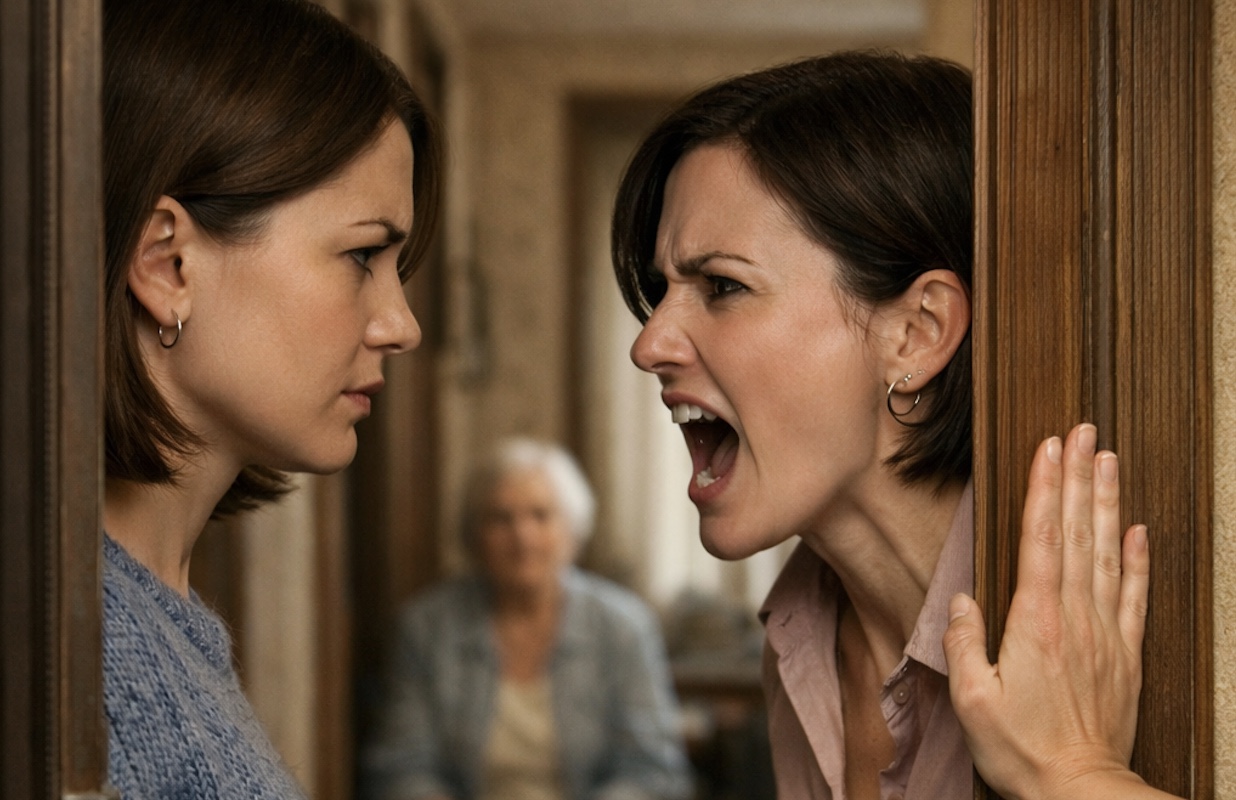
March smelled of dampness and melting snow. I stood in the entryway of my mother’s apartment, fastening my coat with trembling fingers, listening as she shouted at Kristina from behind the closed bedroom door.
“How could you let her leave? Ungrateful girl! I raised her, and now she’s abandoning her own mother!”
I gave a bitter little smile. Raised me. What a joke.
The last suitcase was already waiting in the hallway. I let my eyes travel over the peeling wallpaper, the worn linoleum I had scrubbed every day for the past three years. That hallway remembered me as a little girl. It remembered my tears when Mom would once again say, “Kristina is our beauty, and you’re the smart one. Everyone has their role.” It remembered me coming home from school and heading straight to the kitchen to make dinner because Mom was tired from work, while Kristina was “too delicate for housework.”
“Lena, are you really leaving?” Kristina stepped out of the room. She was wearing a new robe—turquoise silk—the one I had ordered for Mom’s birthday, but which, somehow, had ended up on my sister.
“Yes,” I answered shortly, lifting the suitcase.
“But we had an agreement! You said you’d stay with Mom a little longer!”
I set the suitcase back down and slowly turned toward her.
“We had an agreement? Seriously? Kris, I’ve stayed with Mom for three years. Three years I changed her diapers, cooked, cleaned, took her to doctors. Three years I used up time off work to drive her to treatments. Three years without movies, without friends, without any kind of personal life. And you showed up once a month for a couple of hours, kissed Mom on the cheek, and went back to your wonderful life.”
“I have a job!” Kristina crossed her arms. “I can’t just throw everything away like you did.”
“I didn’t throw everything away. I switched to remote work specifically so I could take care of Mom. You just didn’t want to come.”
“That’s not fair.” Kristina puffed out her lips, and for a second I saw the same spoiled little girl who had always gotten the best piece of pie, the newest doll, our mother’s attention. “I love Mom too.”
“I know,” I said with a nod. “Especially her apartment. A two-bedroom in the city center. Nice property, right?”
Kristina went pale.
“What are you talking about?”
I pulled a crumpled photocopy from my coat pocket—the gift deed I had found by accident two days earlier while searching through Mom’s papers for her medical file.
“I’m talking about the fact that Mom signed everything over to you. A month ago. The apartment, the country house, even the bank savings. Congratulations, Kris. You got what you wanted.”
A silence fell so heavily that I could hear Mom move a glass on the bedside table in the other room.
“Lena, I can explain…” Kristina began, but I raised my hand.
“No need. I understand everything now. You remember when you came by in the middle of the week? Said you missed her? Brought cake and flowers? I remember thinking it was strange. Then you and Mom shut yourselves in the room for two hours. You had already gone to the notary by then, hadn’t you?”
Kristina said nothing, only bit her lip.
“And do you know what’s funny?” I felt tears burning in my eyes, but I forced myself to smile. “I’m not even angry about the apartment. I would have given it to you for free if you’d just asked. I don’t need the apartment. I needed a family. A mother who would say thank you at least once. A sister who would share this burden with me. But instead, the two of you made your decision behind my back.”
“Mom decided on her own,” Kristina said quietly. “She said I’m her favorite daughter. That you already live here for free, and I… I should get something in return for not being able to be here.”
I laughed. Really laughed, until tears spilled over.
“In return for not being able to be here. Brilliant. Kris, do you know how many times Mom called for you these past three years? How many nights she cried and whispered your name? Were you there even once when things were truly bad?”
“I couldn’t…”
“No. You didn’t want to. That’s different.”
I picked up the suitcase and headed for the door. Kristina grabbed my sleeve.
“Lena, wait! What about Mom? I… I can’t handle this alone. I don’t know how to take care of her. I don’t know which medications to give her, how to talk to her when an episode starts…”
“You’ll learn,” I said, slipping my sleeve free. “I didn’t get an instruction manual either. I just did what had to be done. Day after day.”
“But—”
“Kris.” I looked her straight in the eyes. Blue, just like Mom’s. Beautiful. “You wanted Mom’s inheritance? Then take Mom with it.”
I opened the door and stepped onto the stairwell landing. Cold air hit my face, but I felt lighter than I had in three years.
“You can’t just leave!” Kristina shouted after me. “It’s inhuman! She’s your mother!”
I turned back one last time.
“She made her choice a long time ago. She chose which of us was her favorite daughter. Now live with that choice.”
The door slammed shut. I heard Kristina start crying on the other side, but I didn’t go back. Instead, I started walking down the stairs, counting the steps. Nineteen. Like the nineteen years I had lived in that apartment before moving out the first time.
Back then, I had gone away to another city, enrolled in university, convinced I was starting a new life. But then Mom got sick, and I came back. Because that’s what good daughters do. Because I thought that maybe, in her illness, she would finally see me. Appreciate what I was doing. Love me.
But she loved Kristina. She always had. And she kept loving her even now, when her favorite daughter showed up once a month with expensive gifts and left an hour later, while I stayed behind wiping tears from Mom’s cheeks.
Outside, I hailed a taxi. The driver, a man in his fifties with a kind face, helped me load my suitcase.
“Where to?” he asked.
I gave him the address of the apartment I had rented a week ago. One room, on the outskirts of town, but mine. Entirely mine.
As we drove, I stared out the window at familiar streets. There was the bakery where I used to buy Mom’s favorite cabbage pies. There was the pharmacy where I knew the pharmacist so well she gave me discounts. There was the park where I used to take Mom when she felt better, pushing her wheelchair along the paths.
My phone buzzed. Kristina.
“Lena, Mom is crying. She says you’re an ungrateful bitch. She says she always loved me more because at least I don’t try to control her.”
I let out a dry laugh. Control her. So reminding Mom to take her pills—that was control. Not letting her eat greasy food and sweets because the doctor had forbidden it—that was control too. Spending my own money on medication and treatments—apparently that counted as control as well.
Another message came in.
“And did you know you’re ugly? Mom says she was always ashamed to show you to her friends. She says I’m her pride and you’re her disappointment.”
I switched off the phone and dropped it into my bag. Enough. I was done reading those messages. Done absorbing their poison.
The new apartment welcomed me with silence. Unfamiliar, almost ringing silence. No one calling me from another room. No one asking for water, for the blanket to be fixed, for the television to be turned on. I stood in the middle of the empty room—the furniture was only arriving the next day—and for the first time in three years, I didn’t know what to do.
Then I sat down on the floor, leaned back against the wall, and cried. Quietly, without sobbing, just letting the tears run down my face. I wasn’t crying over the apartment. Not over the inheritance. I cried because all that time, I had still been hoping. Hoping Mom would one day wake up and say, “Lenochka, thank you. I see how hard you try.” Hoping Kristina would come and say, “I’m sorry I didn’t help. Let’s do this together.” Hoping for a miracle that never came.
My phone buzzed again, but I didn’t look. Instead, I opened the window—the apartment was on the first floor—and let in the spring air. It smelled of melting snow, wet earth, and something new. Something that had not begun yet, but soon would.
My first night in the new apartment was spent on an air mattress. I lay there listening to unfamiliar sounds—cars outside, footsteps in the stairwell, music drifting from the neighboring apartment—and felt strangely split in two. Free and lonely at the same time.
In the morning, the doorbell woke me. I threw on my robe and opened the door. On the threshold stood a woman of about forty with a cheerful face and a bag in her hands.
“Good morning! I’m Marina, I live next door. I saw you moving in yesterday and thought I’d bring a pie. It’s kind of a tradition here—we welcome new neighbors.”
I took the bag, flustered, feeling something warm spread through my chest.
“Thank you,” was all I could manage.
“If you need anything, just knock. My teenage son can help put furniture together if necessary. And anyway,” Marina said with a smile, “I’m glad we’ve got a new neighbor.”
When the door closed, I looked inside the bag. It was an apple pie, still warm. I broke off a piece and ate it standing by the window. It tasted wonderful. Maybe even better than the pies I had baked for Mom all those years.
The furniture arrived later that day. Marina’s son, Danila—a tall boy with dreadlocks and kind eyes—really did help assemble everything. He worked quickly and confidently, chatting about college, the band he played drums in, and the girl he had recently started dating.
“So, do you have anyone?” he asked as he screwed a leg onto the sofa.
I paused. Three years ago, there had been Andrei. He left six months after I moved back in with Mom. Said he wasn’t willing to wait until I was free. Said he wanted a normal family, not a woman who was always tied to someone else.
“No,” I said. “There wasn’t time.”
“Well, now there will be,” Danila said with a wink. “There’s a nice café nearby. Young people go there all the time. If you want, I can show you.”
I smiled. When was the last time someone had invited me somewhere just for pleasure?
That evening I sat on my new sofa, drinking tea and looking out the window. My phone lay beside me, switched off. I knew there were dozens of messages from Kristina waiting there. I knew she was panicking, not coping, demanding that I come back. But I didn’t turn the phone on. Not that day.
That day, I let myself simply exist. To sit in silence, drink tea, listen to music from the next apartment. To think about myself. About who I was without the role of full-time caregiver, without the role of unwanted daughter.
The next day I finally turned my phone back on. Forty-three missed calls from Kristina. Fifteen messages. I opened the thread.
The first ones were furious: “How could you!” “You heartless egoist!” “Mom was right about you!”
Then they became frantic: “Lena, I don’t know what to do, Mom’s fever is up,” “She won’t eat,” “Which pain pills should I give her?”
The last messages were almost desperate: “Please answer,” “I’m scared,” “I can’t do this.”
I typed back: “The doctor’s number is in the red notebook in the kitchen. Pain pills are in the white box on the second shelf in the bathroom, two after food. If her temperature goes above 38.5, call an ambulance.”
A minute later she replied: “Thank you. Lena, when are you coming back?”
I stared at the words for a long moment. Then I wrote: “Never, Kris. This is your life now. You wanted the inheritance—you got it. Everything that comes with it belongs to you too.”
“But I didn’t want it LIKE THIS! I thought we’d share the responsibilities…”
“You thought you’d get the apartment and I’d keep taking care of Mom for free. That’s not how this works.”
“So you really aren’t coming back?”
“No.”
After that, Kristina didn’t write for three days.
I returned to working in the office. My colleagues were genuinely happy to see me—they knew I had been working remotely all those years because of Mom. My boss even arranged a small celebration with cake and champagne.
“Glad to see you among the living again,” said Olya, my colleague and the only friend who hadn’t disappeared during those years. “So, how are things?”
“I moved out,” I said simply.
Olya let out a low whistle.
“Seriously? And how does it feel?”
“Strange. Good. Scary. All at once.”
“I get it,” she said, squeezing my hand. “But you did the right thing. Really.”
At lunch we sat in the café across from the office, and I told her everything. About the deed, about Kristina, about the final words Mom had passed on through my sister.
“And do you know what’s worst?” I said, finishing my coffee. “I still feel guilty. Like I’m the one who did something wrong.”
“That’s normal,” Olya said, shaking her head. “Years of manipulation don’t disappear in a day. But listen to me: you are not guilty. You gave three years of your life, and they didn’t even say thank you. You have every right to live for yourself.”
I nodded, feeling tears rise again. But these were different tears. Not bitter ones—freeing ones.
A week later, Kristina called. I stared at the screen for a long time before answering.
“Hello.”
“Lena…” Her voice was tired, almost unfamiliar. “I need your help.”
“I already helped. I gave you instructions.”
“No, you don’t understand. Mom… she’s very bad. The doctors say she doesn’t have long. Maybe a few months.”
Something inside me tightened, but I forced myself to breathe evenly.
“I’m sorry.”
“Lena, she’s asking for you. She wants to apologize.”
I laughed.
“Now? When she only has a few months left? How convenient.”
“Don’t be so cruel!”
“Kris, for three years I wasn’t cruel. For three years I was gentle, accommodating, willing to do anything. And what did I get? Kicked aside and told I was ugly and ungrateful. So don’t lecture me about cruelty.”
“But she’s dying…”
“We all are, Kris. Some people just get time to understand what they’ve done. Mom had that time. Three years. She could have said thank you once. She could have avoided signing the apartment over behind my back. She could have treated me like a daughter instead of a free caregiver.”
“Please…”
“No. And you know what? Tell Mom I forgive her. But I’m not coming.”
I hung up and turned the phone off. My hands were shaking, my heart was pounding, but inside there was a strange clarity.
A month passed. I started going to the gym—for the first time in my life, I had time to take care of myself. I met my upstairs neighbor, Maxim, a programmer with a great sense of humor and kind eyes.
We had coffee in the evenings and talked about everything and nothing. He never asked about my family, and I appreciated that. He just accepted me as I was now. Without my past. Without all the baggage.
Kristina didn’t call again. Sometimes she sent short messages about Mom’s condition. I read them, but I didn’t answer. That was their life now. Not mine.
One evening, as Maxim and I sat on the roof looking at the stars, he asked me:
“Are you happy?”
I thought about it. Was I happy? Maybe not exactly. But I was calm. For the first time in years, simply calm. No guilt. No constant anxiety. No sense that I owed someone my life.
“I’m on my way,” I answered honestly.
He nodded and took my hand. We sat there in silence, and I thought about how strange life can be. Sometimes you have to leave in order to find yourself. Slam one door shut in order to open another. Say no in order to learn how to say yes to yourself.
When Kristina texted that Mom had died, I was at work. The message was short: “Mom passed this morning. The funeral is on Saturday.”
I looked at the screen, expecting tears to come, but they didn’t. There was only emptiness and a strange sense of relief. It was finally over. No more midnight calls. No more demands to come back. No more accusations of heartlessness.
I went to the funeral. I stood off to the side while Kristina sobbed by the coffin, accepted condolences, and played the role of the devastated daughter. Mom’s friends glanced at me with judgment in their eyes—Kristina had probably already told them what a heartless monster I was.
After the funeral, my sister came over.
“Thank you for coming,” she said. Her face looked drawn, dark circles shadowing her eyes. Three months had taken their toll.
“I came to say goodbye,” I answered. “To Mom. And to you.”
“Lena, wait. Maybe we could… start over? You and I are all we have left. We’re family.”
I looked at her. Beautiful, worn out, lost. Once, I had dreamed we would be close. That she would be more than a sister—she would be my friend. But those had been the dreams of a little girl who only wanted to be loved.
“You know, Kris, family isn’t the people you’re tied to by blood. Family is the people who stay when you’re falling apart.”
“But—”
“Take care of yourself, Kristina. And take care of the apartment too. It’s everything you ever wanted.”
I turned and walked away.
Without looking back.