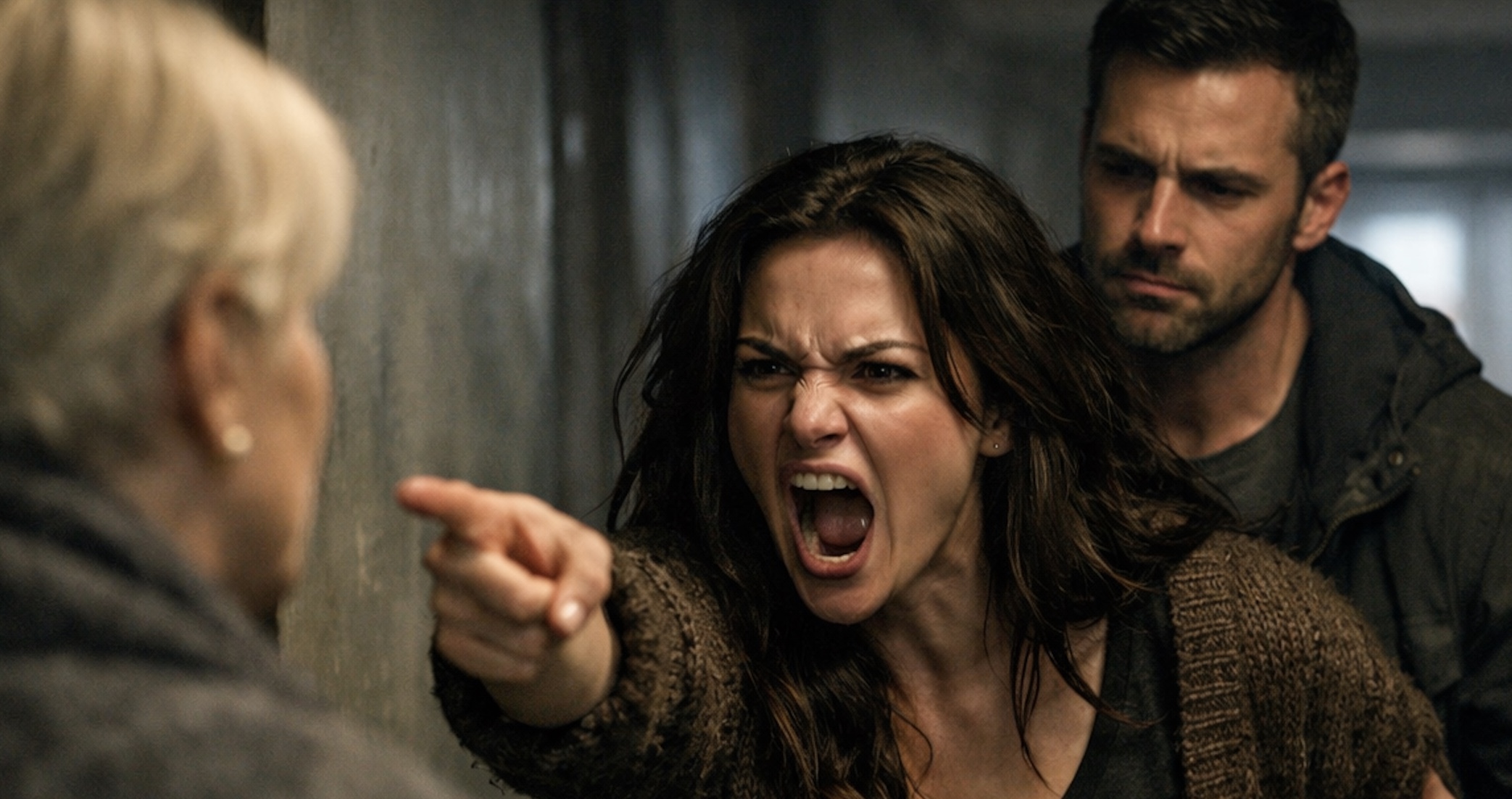
“Not one trace of her in this house!” Rimma screamed into the phone, her voice breaking into hysteria.
A moment later, her mother, Tatyana Alekseyevna, peeked into the room. When Rimma finally ended the call, the older woman let out a heavy sigh and asked:
“What is it now? At least tell me nobody’s throwing punches.”
“Mom, leave me alone,” Rimma snapped. She opened the cabinet bar, pulled out a bottle filled with amber liquor, and splashed some into a glass. “I’m not in the mood for you. Garik has decided to bring that stray child here.”
Tatyana Alekseyevna lowered herself onto the couch and gave her daughter a long, piercing look.
“You fool, Rimma. Life has taught you absolutely nothing. Have you forgotten that both of us are living here on borrowed rights, in his apartment? You should be welcoming that girl into this house as if she were your own, brushing dust off her shoulders, winning her over, making him appreciate you and feel indebted to you. But what are you doing instead? Do you honestly think he won’t throw both of us out if you offend his little Nastya? He’s dreamed of children for years, and you keep refusing to have one with him. So at least use your head now.”
With shaking hands, Rimma filled her glass again, tossed it back in one swallow, then disappeared into the bathroom. She turned on the tap and broke down sobbing like a trapped animal.
She hated that child.
Hated her simply for existing — чужая, unwanted, appearing as if by spite. Igor himself had never known about her before. Yet fate had twisted itself in such a cruel way: somewhere out there, there had been an eight-year-old girl all this time, his daughter, and now they were planning to “bring her into the family.”
Rimma had never liked children at all. She did not know how to talk to them, did not understand them. Truthfully, Rimma did not know how to love anyone.
When she married Igor, what she really chose was not love, but safety. Stability. A spacious apartment in the city center, a dependable man with no bad habits, a life that finally felt secure. After years of dragging herself and her mother through one rented room after another, Igor had looked like salvation.
They had met at mutual friends’ anniversary party — ten years of marriage. In the noisy restaurant, among candles and champagne, Rimma noticed him at once: tall, neat, self-assured, without the crude restlessness so many men carried. Her friend had leaned over and whispered, “He’s a widower. Lives alone.”
That was enough to spark her interest.
A month later, Igor had already suggested they make things official. Everything moved so smoothly it felt unreal.
After the wedding, they moved straight into his apartment.
Together with Tatyana Alekseyevna, of course.
Igor didn’t object. On the contrary, he said, “A woman should have her mother nearby.” Rimma had nearly glowed with relief. At last, everything in life seemed to be falling into place.
She tried hard to be a good wife. She got up before him every morning, fried eggs, ironed his shirts. On weekends she cooked borscht, though she couldn’t stand the smell of boiling beets. Igor seemed pleased. Her mother kept quiet and made herself almost invisible. Sometimes he even joked that he was lucky enough to get “two wonderful women” at once.
But the moment the conversation turned to children, everything cracked.
Rimma would change the subject, pretend not to hear, steer him toward talking about vacations or renovations instead. Later she grew openly irritated whenever he so much as hinted at it.
“Later, Garik, later,” she would say with a dismissive squint, pretending it was nothing. “I’m about to go back to work. A child? Are you out of your mind?”
And he would back off. He hated arguing with her, and more and more often he simply fell silent.
But now… now everything had collapsed.
Lately Igor had become like a stranger — quiet, distant. He came home late, barely spoke. When Rimma asked questions, he answered in monosyllables.
Then came that cursed phone call.
Late one evening, when they were already preparing for bed, Igor’s phone rang. The number was unfamiliar. He answered calmly, but after only a couple of seconds, the color drained from his face. He listened in silence, longer and longer, until at last he sat down and buried his head in his hands.
“Garik?” Rimma asked carefully, a chill running down her spine. “What happened?”
He stayed silent for a long time. His lips trembled as though the words were stuck somewhere deep inside him. Then, gathering himself, he said quietly:
“They called… from Nizhnegorsk. There’s a woman there. She said Natalia is in the hospital.”
“What Natalia?” Rimma asked, instantly tense.
“Do you remember? I once told you that before the army, I was seeing a girl. I really loved her. I was going to marry her. But two months into my service, a friend sent me photographs — she was walking through town arm in arm with some man, smiling. I was young and stupid… I lost my temper. I wrote her a letter saying not to wait for me, that I’d met someone else. Stupid, I know. After that, I never got a reply. And when I came back, she was gone. People we both knew said she had moved to a nearby town.”
Igor exhaled heavily and rubbed his forehead.
“Later I found out that the man in the photograph was her cousin,” he added with a bitter half-smile. “Can you imagine? And I had believed the worst about her. I tried to find her later, but I couldn’t. It was like she had disappeared. Then I married Lena, and… you know the rest. She died a year later.”
Rimma listened in silence, but inside, everything was boiling.
“And now?” she asked at last.
“A woman called and said Natalia is in a coma. She has a daughter, Nastya. And apparently, before she lost consciousness, Natalia said my name. That woman barely managed to track down my number. She says the girl is eight years old… and she’s my daughter.”
“And what are you going to do?” Rimma asked, her throat suddenly dry.
“I’m going there, of course. I can’t stay away if that’s really my child.”
He said it calmly, almost without emotion, but there was something firm in his voice, something final. Rimma knew that tone. There was no arguing with it.
Igor left as soon as dawn broke. He packed a suitcase in silence, kissed Rimma on the temple almost like she was a stranger, and said only:
“Don’t worry. I’ll be back soon.”
But he didn’t come back.
One day passed. Then another. His phone stayed silent. By the third, she was nearly frantic — pacing the apartment, picking up the phone, putting it down, dialing again and again with no answer.
And when he finally called, Rimma nearly shouted into the receiver:
“Where are you?! I’ve been losing my mind here!”
“Everything’s fine,” he replied in a tired voice. “I did a DNA test. Nastya really is my daughter. Natalia is still in a coma. The doctors say… the chances aren’t good. Her friend asked me to take the child. I’m finishing the paperwork. Tomorrow we’re coming home.”
…
Rimma didn’t know how long she sat there.
She came back to herself only when Tatyana Alekseyevna knocked on the bathroom door.
“Rimma, what are you doing in there? Did you die?”
“I’m coming out,” she answered hoarsely, wiping her face with a towel.
When she stepped back into the hall, her mother was waiting with folded arms.
“So? Have you decided?”
Rimma took a deep breath and forced herself to speak evenly.
“You were right, Mom. I’ll… accept the girl. I’ll try.”
“That’s better,” her mother said, softening.
“Only…” Rimma narrowed her eyes, and a metallic edge rang in her voice. “I’ll accept her in my own way. I’ll do everything I can to make Garik want to send her to an orphanage himself.”
Tatyana Alekseyevna said nothing. She only sighed.
Igor came back the following evening.
Rimma stepped into the hallway and saw them. He stood there holding the hand of a thin little girl in a worn coat and a bright pink pom-pom hat. Nastya clung to him fearfully, her large dark-gray eyes exactly like her father’s.
“This is Nastya,” Igor said, then turned to the girl. “Say hello to Aunt Rimma.”
The child stayed silent, only gave the slightest nod.
“Come in,” Rimma said with a strained smile, stepping aside. “This is your home now.”
Nastya didn’t move until Igor gently nudged her forward.
The evening passed strangely. Rimma did her best to seem welcoming — served dinner, tried to get the girl talking — but Nastya barely responded, as though she hadn’t heard a word.
“She’s shy,” Igor said with a smile when he noticed his wife stiffen. “She’ll get used to it. Everything will settle down.”
Rimma nodded, though inside she was burning.
When they had put Nastya to bed — in the guest room, where Rimma had hastily changed the sheets and set out a nightlight — Igor came over and squeezed her hand.
“Thank you, Rim. I know this isn’t easy. But you… you’re golden.”
She smiled without raising her eyes.
“The important thing is that she doesn’t feel like an outsider,” he continued. “You understand, don’t you? She’s terrified right now.”
“Of course,” Rimma answered softly. “I understand.”
Satisfied, Igor kissed the top of her head and went to the bedroom, while Rimma sat in the kitchen for a long time afterward, listening to the silence.
Tatyana Alekseyevna understood everything without words. She saw how the tension in the house thickened day by day, how Rimma’s gaze grew colder and heavier, while the little girl moved through the apartment as if across a minefield — quiet, cautious, trying not to make noise, trying not to be seen.
At first, Tatyana tried not to interfere.
But one day, when she heard Nastya quietly sniffling while sitting on the windowsill, she couldn’t take it anymore. She went in, sat beside her, and wrapped an arm around the child’s shoulders.
“What is it, sweetheart? Missing your mama?”
The girl nodded without looking up.
From then on, it began little by little. Tatyana Alekseyevna would visit Nastya with a mug of cocoa, a book, an apple. She would sit on the edge of the bed and speak softly, kindly. Slowly, the child began to thaw. She started answering, smiling, bringing her drawings — crooked little houses, a bright sun, stick-figure people with long arms.
And Rimma watched all of it from the sidelines, seething.
Her own mother — her own mother! — taking the side of this little foundling.
The liquor cabinet in the cupboard was opened more and more often.
Rimma tried not to show her irritation when Igor was around, but there was something in her eyes that made the girl shrink like a beaten puppy. The moment Rimma entered a room, Nastya would fall silent at once, drop her gaze, and clutch her stuffed teddy bear tighter.
The final straw came the day Igor came home without his paycheck and said he had sent the money to the clinic where Natalia was lying. He said it calmly, as though it were nothing unusual.
But inside Rimma, something exploded.
“What?” Her eyes widened, hysteria cutting into her voice. “You did what?”
“Rim, try to understand,” Igor said, attempting to explain. “She’s very ill. The medication is expensive, and the doctors say there’s still a chance if they can switch her to another machine. I couldn’t do otherwise.”
“You couldn’t?!” she screamed. “And what about me — I’m supposed to just manage? I’m paying the utility bills, I’m buying food with my own card, and you’re sending money to some other woman? Who is she to you, exactly?”
“The mother of my child,” he answered quietly.
The words hit like a slap.
“I see,” she hissed. “So now we have a new family, is that it? Are you going to pay for her funeral too? Maybe we should sign the apartment over to the child while we’re at it?”
“I’m asking you to stop,” Igor said, raising his voice for the first time. “I’m doing what I have to do.”
“Well, I’m not going to feed your illegitimate daughter!” she shouted, trembling with rage. “I’m not! Let the state feed her! You choose right now — either me or her! And that dying ‘beloved’ of yours, who, by the way, could have dragged in a child from God knows who! DNA tests make mistakes too, you know!”
The air in the room seemed to thicken.
Igor turned pale. His lips trembled, but he said nothing. He only looked at Rimma with a new expression — heavy, stunned, as though he were seeing her for the first time, stripped of every mask.
Then the front door creaked.
“Nastya?” Igor spun toward the hallway, rushed to the door, and looked out into the stairwell. The apartment door stood wide open. The landing was empty.
“Nastya!” he shouted, but only the echo from the staircase answered him.
Rimma pressed her lips together and folded her arms across her chest.
“You see?” she hissed. “Even she can tell she doesn’t belong here.”
Igor turned to her, and in that instant she knew — it was over. His voice was quiet, and that made it even worse.
“Pack your things. Now.”
“What?” she stared at him. “Garik… are you serious?”
“Completely.” He stood rigid, fists clenched. “Pack everything that’s yours, and help your mother do the same. Both of you are leaving.”
“Garik…” Her voice faltered. “You can’t do this. This is our home!”
“No, Rimma. This is my home. And my bank account — the one you’ve somehow grown used to calling ‘ours.’ It’s over. You already made your choice. I’m going to find my daughter. When I get back, I don’t want to see either of you here.”
He grabbed his jacket and ran out of the apartment without looking back.
Rimma flew from room to room, tearing things off shelves. Bags, suitcases, clothes — everything hit the floor.
“May all of you—” she spat through gritted teeth, choking on rage and tears. “Him, that Natalia of his, and her little brat—”
Tatyana Alekseyevna stood in the bedroom doorway, watching her daughter with exhausted despair.
“Well? Happy now? I told you not to touch that child. Couldn’t you keep your mouth shut just once?”
“Mom, don’t start!” Rimma snapped. “If he’s so noble, let him live with her!”
“He will,” her mother said bitterly. “And now you’ll go back to drifting from one borrowed corner to another. You ruined all of this yourself.”
Rimma didn’t listen. She shoved clothes into a bag and muttered through her teeth:
“He’ll regret it. Just wait. He’ll see who he chose.”
Meanwhile, Igor was tearing through the streets like a madman. First he searched the entire courtyard, then the nearby blocks, then called neighbors — no one had seen the girl. Only two hours later, when evening was beginning to fall, did he spot a familiar little figure at the bus station.
Nastya sat on a bench with her knees hugged to her chest, her jacket buttoned crookedly, eyes red from crying.
“Nastenka!” He ran to her and dropped to his knees. “My God, where have you been, my little girl?”
She wouldn’t look at him. Her lips quivered.
“I don’t want to go home,” she whispered. “Aunt Rimma is always angry. She doesn’t love me…”
Igor took her hands and pulled her into his arms.
“It’s all right. Hush now. No one will hurt you again, do you hear me? No one. I promise.”
Two years passed.
Rimma was sitting behind the counter of a small kiosk in the park, selling pies and coffee in plastic cups. She watched children shouting and running around the fountain with dull, tired eyes when suddenly her gaze caught on a familiar figure.
Igor.
He was walking slowly and confidently, holding Nastya’s hand. The girl had grown — she was smiling now, wearing a light blue dress. On his other side walked a fair-haired woman with a gentle face. Rimma recognized her at once. She had seen photographs among Nastya’s things.
Natalia.
Alive. Not just alive — radiant. And she was clearly pregnant, even from a distance, the loose dress unable to hide it.
Rimma followed them with her eyes. The family was heading toward the Ferris wheel, laughing. Nastya was chattering animatedly about something, Igor nodded, then leaned over and kissed Natalia on the cheek.
“Well, I’ll be damned…” Rimma muttered under her breath.
She swore quietly, turned away, and opened the drawer beneath the counter where a hidden bottle waited. Pulling out a disposable cup, she filled it to the brim.
“It’s fine,” she muttered, raising it to her lips. “My day will come too.”