On the wedding photos in the album my mother loves to take out on holidays, we look flawless. I am wrapped in lace, Pasha is standing beside me in a sharp suit, and our eyes are glowing. If someone had told me then that twelve years later this same man would wipe his feet on my dignity in front of my own parents, I would have laughed in their face.
What hurt was not the volume of his voice. It was how ordinary it sounded, how casually he said it.
November in Nevyansk is always gray and heavy. That evening we were celebrating my father’s sixtieth birthday. I had set the table myself: roasted meat, his favorite Caesar salad, even a custom cake from a pastry chef I knew. I am a wedding planner. I know how to make things beautiful. My job is to wrap happiness in elegant details.
I just never realized I had failed to do that with my own life.
“Pasha, pass the cold cuts to Dad,” I said quietly when the conversation turned to repairs at the dacha.
Pavel did not even look up. He was finishing his second shot and tapping away on his phone. Across from him sat his mother, Galina Alexandrovna, nodding approvingly at everything he did. She was always there, the invisible third person in our bedroom, our kitchen, and every argument we ever had.
“Pasha?” I repeated, a little louder.
“Natalya, stop fussing,” he threw back without lifting his eyes from the screen. “If your father wants it, he can take it himself. And could you keep quiet for once while the adults are talking?”
The silence that followed was so deep I could hear the faucet dripping in the hallway. I had meant to call a plumber for weeks, but there was always something else: the mayor’s niece’s wedding, the city festival, another event, another emergency.
My mother looked at my father in alarm. My father slowly placed his fork on the rim of his plate. His lined face turned still and hard, as though carved from stone.
“Pasha, is that how you speak to your wife?” my father asked.
His voice was calm, military, the same voice that used to make me straighten my back as a child.
Pavel smirked. Over the past year he had changed a lot. He got promoted, bought a used German SUV, and apparently decided that made him the dominant male in every room. And me? I “organized parties.” Ribbons, flowers, dancing, decorations.
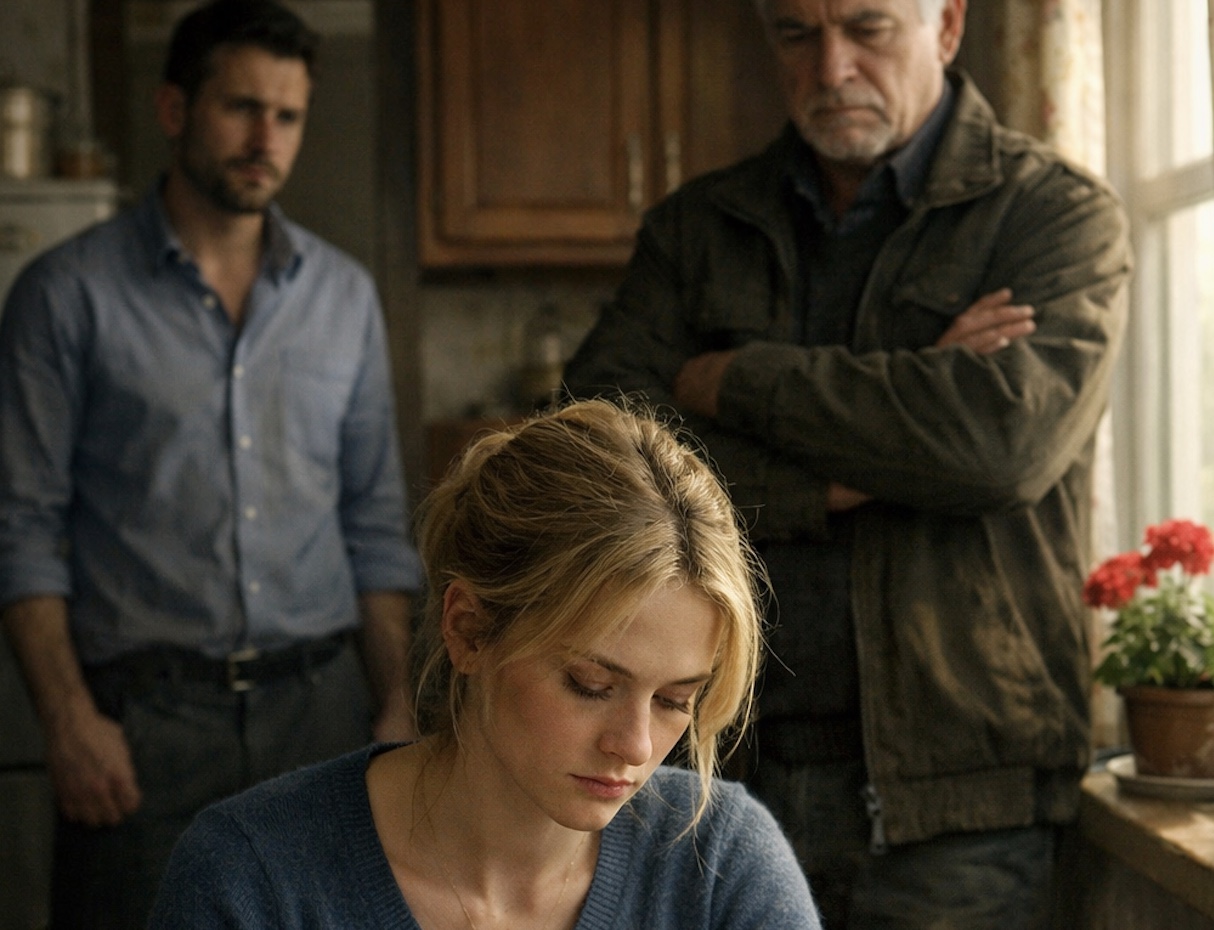
“Oh, come on, Ivan Petrovich,” Pavel said, leaning back in his chair with lazy arrogance. “What kind of wife is she, really? She’s just a household accessory. Your daughter is nothing. If it weren’t for my salary and my mother’s connections, she’d still be slogging away in some tiny office for pennies. She lives off me and still thinks she gets to tell me what to do.”
It felt as if ice lodged in my throat. My mouth went dry. I could barely breathe.
My mind flashed with facts. This apartment is mine. Mine. My grandmother left it to me long before I ever knew Pavel existed. I pay the utilities. I buy the groceries. I cover his car payments when he has his “temporary setbacks.”
And still, somehow, I was “nothing.”
Galina Alexandrovna pressed her lips together in satisfaction. She already knew he thought of me that way. He told her everything. Every weakness. Every tear. Every fear.
My father stood up slowly, one hand braced against the table. He was not a tall man, but in that moment he seemed enormous, like he had risen high enough to block out the light overhead.
“Stand up,” he said to my husband.
“Ivan Petrovich, come on now…” Pavel began with a grin, but the smile died halfway across his face.
“I said stand up.”
Pavel rose. He was a head taller than my father, yet suddenly he looked like a schoolboy caught misbehaving.
My father looked straight into his eyes. Ten long seconds passed. Then he said the sentence that changed everything:
“The only empty thing I see here is the chair you’re sitting on. Masha, get ready. We’re leaving. And Natalya is coming with us.”
“Dad…” I whispered.
“Quiet, daughter. Put on your coat.”
I looked at Pavel. He was staring from my father to me, and for the first time that night I saw fear flicker in his eyes.
It sounds foolish, doesn’t it? I had spent years waiting for him to understand on his own. But all it took was one person finally calling things by their real names.
I stepped into my parents’ house as if I were entering a shelter, though at thirty-six that felt almost humiliating. The entryway smelled of old wood and the cabbage pies my mother baked better than anyone. My father took my bag without a word and nodded toward the kitchen. Under the warm lampshade that had hung there since my school years, everything felt unreal: the table, the room, the evening, and Pavel’s words still ringing inside me like the echo of shattered glass.
“Drink your tea, sweetheart,” my mother said, setting a mug in front of me. Her hands were warm and smelled faintly of flour. “Don’t think about anything tonight. We’ll deal with it tomorrow.”
I took a sip. Bitter.
Oddly, I did not feel pain then. I felt numb, as if I were watching a film about another woman. I am a wedding planner. I know how to manage any disaster: a cake collapsing five minutes before serving, a groom disappearing, a bride tearing her dress on a door handle. I have always been the one who says, “It’s fine, we’ll fix it.”
But there was nothing to fix here. The foundation itself had rotted through.
My phone kept vibrating in the pocket of my coat. Pavel. First came the calls, one after another, every minute. Then WhatsApp messages began flooding in.
“Where did you go? Have you lost your mind?”
“Natalya, come back right now. This is embarrassing in front of my mother.”
“Who’s supposed to pick up my documents from the service center tomorrow? I won’t make it.”
I read those messages and realized he still did not understand what had happened. To him, this was just another “female tantrum,” something to outlast or crush with authority.
My father sat across from me, his hands heavy on the tablecloth.
“Has he been like this for a long time?” he asked, staring out the window into the darkness of the yard.
“I don’t know, Dad. Maybe. It just… became normal little by little. First the jokes, then ‘be quiet,’ then ‘you don’t understand anything.’ And I believed him. I thought maybe a husband always knows better.”
At the bottom of my bag, beneath a pile of clothes, was our wedding album. I pulled it out without knowing why. Smooth cover. Embossed lettering. On page thirteen there was a photograph of us outside the registry office. Galina Alexandrovna stood beside us. That day she had leaned in and whispered, “Watch him carefully, Natasha. My Pasha has a strong character. He needs to be guided.”
Guided. I guided him, all right. I carried our household on my back, paid his debts, organized parties for his friends for free, “as a favor.”
And then it hit me.
A month earlier I had lost a major client. The couple had gone with a competitor. I had cried in the kitchen, and Pavel walked in, looked at me coldly, and said, “Well, then maybe it’s not your thing. Go be a cashier.”
The very next day his mother called to lecture me about “saving every penny” because my “business was a joke.”
He told her everything. Every failure, every weak point, every humiliating moment. He carefully packaged my pain and delivered it to her like a gift. Together they dissected my life behind my back like a frog in a biology class.
Anger began to rise from somewhere deep inside me. Not the tearful hurt I had gotten used to, but real fury, dark and burning. The “nothing” he had named me suddenly began to fill with something solid and hot.
“Dad,” I said, my voice finally steady, “the apartment is mine.”
“It is,” he nodded. “Your mother and I saved for it our whole lives so you would always have something to stand on.”
“And he’s sitting there now. In my apartment. Eating my food. Drinking your homemade liqueur. Calling me nothing.”
I stood up. My cup rattled against the saucer.
“Where are you going?” my mother asked, startled.
“To get my things. And my keys.”
“Natalya, it’s the middle of the night,” my mother said, stepping in front of me. “Sleep here. Morning is wiser than evening.”
I sat back down. My body felt like lead.
My phone buzzed again. A voice message from Pavel. I put it on speaker.
“…Listen, my mother says if you don’t come back by tomorrow, she’ll come herself and set things straight. Stop filling your father’s head with nonsense. He’s an old man, it’s bad for him to get upset. Be home by midnight. And warm up dinner.”
My father gave a short, bitter snort.
I did not sleep that night. I turned the pages of the album, looking at our smiling faces, and saw only lies. A beautifully staged image with emptiness behind it. Not mine. His. The ringing emptiness inside the man I had once believed was closest to me.
By morning I knew one thing for certain: I would not keep arranging happiness for other people while my own life was reduced to ashes.
Morning in Nevyansk arrived wrapped in sticky fog and the sound of the factory siren. I woke on the old sofa in my parents’ living room. My back ached. My mouth still tasted of bitter tea. The wedding album lay on the side table. I opened it, took a pair of office scissors, and with one precise motion cut my own face out of the photo by the registry office. On the picture, Pavel remained standing there in his suit, with Galina Alexandrovna embracing empty space.
That was the first event of my day.
As an event planner, I knew something simple: every celebration begins by tearing down the old decorations.
I went back home with my father. He did not ask whether I wanted him to come. He simply put on his old jacket and grabbed the garage keys. We climbed to the fourth floor. In the hallway of our—my—apartment, the air smelled of stale food and alcohol. Pavel was asleep in the living room, still dressed. In the kitchen, at my table, sat Galina Alexandrovna. She had already rearranged my spice jars and thrown away my favorite basil because, as she put it, “Why keep useless weeds around?”
“So you’re back,” my mother-in-law said without turning around. “And you dragged your father into this too. Aren’t you ashamed? Pasha was up half the night worrying.”
Pavel woke at the sound of us and came into the hallway rubbing his face. When he saw my father, he tried to straighten himself, but in his wrinkled shirt he looked ridiculous rather than intimidating.
“Natalya, enough with the circus,” he muttered. “Sit down and have breakfast. Mom made pancakes.”
“Pack your things, Pasha,” I said evenly. “And Galina Alexandrovna, yours too. You have two hours.”
“Have you completely lost your mind?” Pavel stepped toward me. “This is my home. I’m registered here.”
“Registered,” I said with a nod. “But I’m the owner. And the paperwork is with the lawyer. The apartment was bought before the marriage by my parents. Legally, you are a guest who overstayed. Dad, show him.”
My father silently placed a folder on the table. Inside was a copy of the property register and a police statement about obstruction of lawful use of a residence. We had prepared it at eight that morning.
“You…” Pavel’s voice broke into a shrill shout. “Without me you’d starve! Who’s going to cover your car loan? Who’s going to bankroll all your ribbons and bows?”
“My car loan?” I let out a bitter laugh. “Take a look at your bank statements. Every payment for your German SUV came from my account. From those same little ‘ribbons.’ I blocked access to the card this morning.”
At that exact moment his phone rang. Pavel grabbed it, no doubt expecting support. But as he listened, the color drained from his face.
“Yes… yes, Valery Borisovich… what do you mean, downsizing? But I… I understand.”
He slowly lowered the phone.
His reckoning came faster than I expected. The logistics company where he worked had been cutting staff for a while. The “connections” he bragged about turned out to be just as hollow as his ego.
“So, provider,” I said, looking straight at him. “Turns out you’re not exactly irreplaceable either.”
Galina Alexandrovna immediately began wailing and rushed to her son.
“Pasha, my poor boy… how can this happen? Natasha, you won’t abandon him now, will you? He’ll fall apart! You know how sensitive he is. He told me everything about your fears, how scared you get of responsibility, how you shake at night before big events…”
I froze.
Those were my words. The things I had whispered into his shoulder in the dark, admitting how afraid I was of failing on a major wedding. He had fed them to his mother like dessert.
Pavel looked at me. There was no remorse in his eyes. Only calculation. How to recover. No job. A car about to be repossessed. Nowhere to live.
“Natalya, I overreacted yesterday,” he said, taking a step toward me. “It happens. Let’s forget it. I’ll do better. You love me.”
I looked at him and saw only that empty chair my father had named.
“Leave,” I said.
“What? Natasha, just listen—”
“Leave.”
It was the only word I had the strength left for. One word instead of a thousand carefully prepared plans.
Two hours later the apartment was empty. Galina Alexandrovna carried out her pancakes in a plastic container. Pavel dragged his bags behind him, shooting me angry, hunted looks.
That evening I sat alone in the kitchen. The faucet no longer dripped; my father had fixed it before leaving. It was quiet. Truly quiet. For the first time in twelve years I was not waiting for a complaint about an unwashed plate or a laugh that was too loud.
Now I am standing in a banquet hall at a hotel in Yekaterinburg. Tomorrow there will be a wedding here for three hundred guests. I am checking the seating chart, straightening chair covers. My hands ache a little from work, but my mind is clear.
My mother called at lunchtime. She told me Pavel is living with his mother now, trying to fight for the car, but the bank has already sent notice. She asked if I felt sorry for him.
Honestly, I did not know what to say.
I did not become some movie heroine. I do not have a secret bank account with millions in it. I still count every ruble I spend on advertising for my agency. Some evenings I still flinch when I hear a key turning in a neighbor’s door.
But today I bought myself a new pair of sneakers. Expensive ones. The kind Pavel used to call “a pointless waste of money.” I walk across the hall in them, and every step sounds certain.
I am not a conqueror. I just crawled out from under the ruins of someone else’s lies.
And that is more than enough to begin editing my life again.
This time, there will be no empty places in the leading roles.