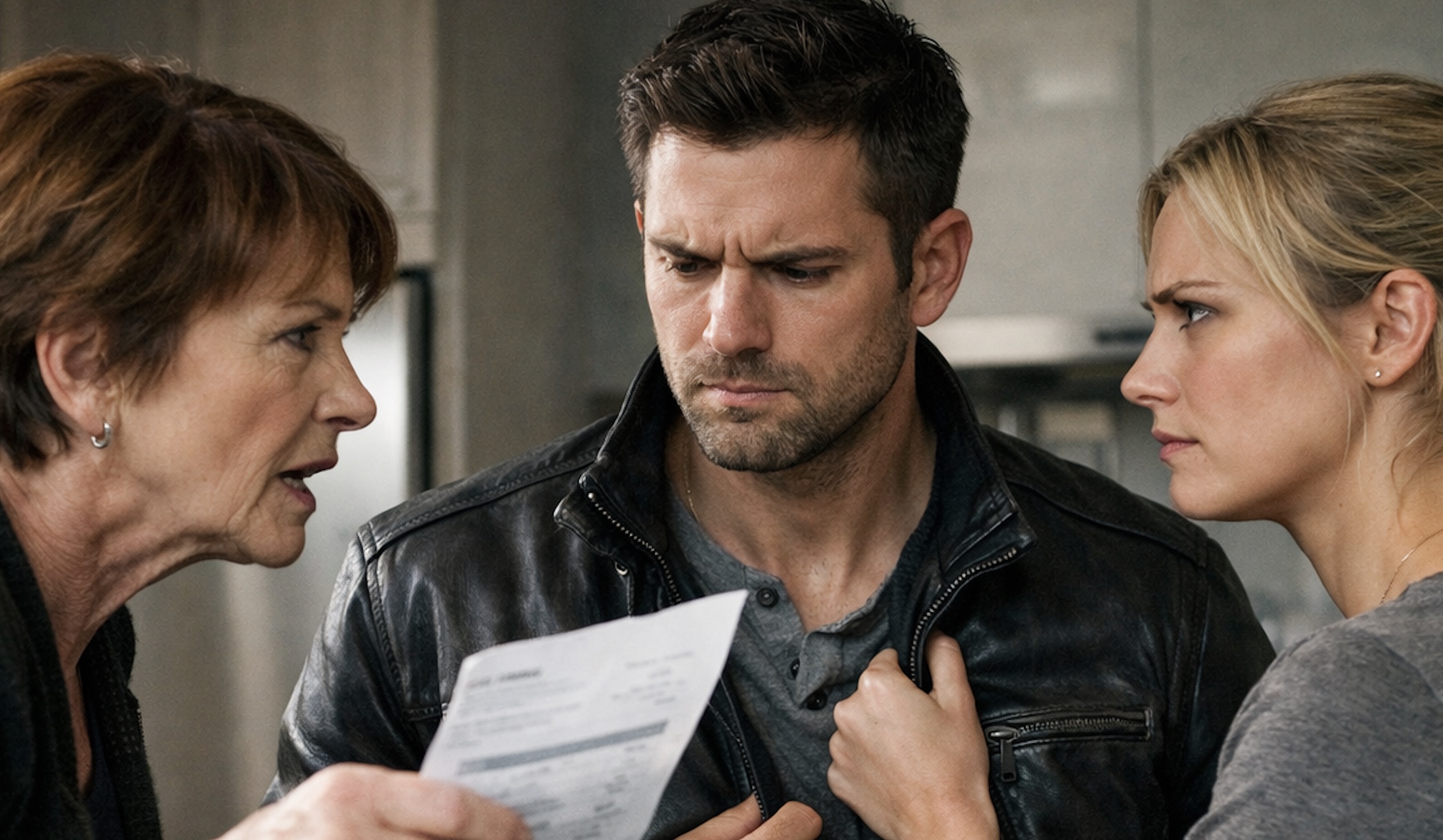
The doorbell rang sharp and insistent. Oksana looked up from her laptop and checked the time—half past nine on a Saturday morning. Who would show up that early without warning? Nikolai had gone to the store thirty minutes earlier for bread and milk. He had his keys; he would not ring the bell.
She walked to the hallway and looked through the peephole. On the landing stood Lyudmila Petrovna, her mother-in-law, in a beige coat, her face tight with tension. Next to her loomed her husband’s brother, Boris—thirty-five, already going bald, with the permanently anxious look of a man who was always waiting for disaster.
Oksana frowned. Lyudmila Petrovna never came over without calling first. Something had happened.
The door opened. Her mother-in-law swept into the apartment first without even saying hello. Boris followed behind, muttering a vague greeting before heading straight to the kitchen. Oksana shut the door and turned around.
“Good morning, Lyudmila Petrovna. What happened?”
“Where’s Kolya?” her mother-in-law asked, shrugging off her coat and scanning the hallway.
“At the store. He’ll be back soon. Come into the kitchen, I’ll put the kettle on.”
Lyudmila Petrovna went into the kitchen and sank heavily into a chair. Boris stood by the window, nervously tugging at the belt loops of his jeans. Oksana filled the kettle and pulled out cups. The air felt oppressive, thick with tension. Her mother-in-law sat in silence, lips pressed into a thin line. Her brother-in-law stared outside, avoiding Oksana’s eyes.
Ten minutes later Nikolai came home. He heard voices in the kitchen, walked in carrying grocery bags, and stopped.
“Mom? Borya? What are you doing here?”
“Sit down, Kolya,” Lyudmila Petrovna said, nodding toward the empty chair. “We need to talk. It’s serious.”
He set the bags on the floor and sat. Oksana poured tea, placed the cups on the table, and took her seat across from them with her arms folded. She waited.
Boris was the first to break the silence. He cleared his throat and began speaking quickly, stumbling over the words.
“I’ve got a problem. A big one. A really big one, to be honest. I messed up. Badly.”
“What happened?” Nikolai asked, already frowning.
“You remember that investment project I told you about? The one that promised twenty percent a month? I put money into it. A lot of money. I thought I’d make enough to buy a car, help Mom renovate her apartment. Turned out it was a scam. A financial pyramid. The whole thing got shut down, the people running it disappeared, and now I’m left with debt.”
“What kind of debt?” Nikolai’s voice changed immediately.
“I didn’t invest only my own money,” Boris admitted, rubbing his face with both hands. “I borrowed from people I know. Told them it was safe, a guaranteed return. They believed me and lent me money. Some gave me a hundred thousand, some two hundred. I promised to repay them with interest in six months. Now the deadline has passed, and they want it back.”
“How much do you owe?” Nikolai asked, turning pale.
“Eight hundred and fifty thousand.” Boris lowered his head. “And they’re not joking around. They call every day. They threaten me. One guy came to my place in the middle of the night, pounding on the door and screaming that he’d drag me to court. Another said if I didn’t pay within a month, he’d break my legs. I don’t know what to do.”
Oksana said nothing. She simply watched.
Boris had always been like this—reckless, gullible, always chasing easy money. A year earlier he had tried his luck in the stock market and lost two hundred thousand. Then he launched some online store that collapsed in three months. Now this. A predictable ending.
Lyudmila Petrovna laid a hand on her younger son’s shoulder.
“My poor boy, don’t worry. We’ll think of something. Family is supposed to help each other when times are hard.”
Then she looked at Nikolai. Then at Oksana. A meaningful, expectant look.
“Kolya, you and Oksana have savings, don’t you?” she began carefully. “I know Oksana is careful with money. She puts things away. Maybe you can help Boris? He’ll pay it back, of course he will. He just urgently needs the money now to settle the debt.”
Nikolai slowly turned toward his wife. Oksana met his gaze calmly, coldly. She had known exactly where this was heading the moment she saw the two of them on the doorstep. They had come to squeeze money out of her. They assumed she would get emotional, open her account, and rescue the irresponsible relative.
“Oksana has savings,” Nikolai said quietly. “She’s been building them up for years.”
“There, you see, Borya,” Lyudmila Petrovna said brightly, grabbing her son’s hand. “Oksana will help. She’s one of us. Family doesn’t abandon family.”
Oksana leaned back in her chair and folded her arms tighter.
“Do you know how much I’ve saved, Lyudmila Petrovna?”
Her mother-in-law hesitated.
“Well, not exactly. But Kolya said you’d been saving for a long time. It must be enough to help Boris.”
“Nine hundred thousand,” Oksana said evenly. “I’ve been putting money aside for seven years. I work two jobs. In the morning I’m an accountant at a trading company. In the evenings I do remote bookkeeping for two private businesses. My main salary is fifty-two thousand, and the side work brings another twenty-five. Out of that money I pay the household bills, buy groceries, and cover utilities. I save twelve thousand every month. Seven years of twelve thousand a month—that’s how I got to nine hundred.”
“Nine hundred thousand!” Boris lit up. “That’s even more than I need! Oksana, please, save me. I swear I’ll pay you back. As soon as I get a good job, I’ll start returning it.”
Oksana held his gaze for a long moment.
“Borya, where are you working right now?”
“Nowhere,” he admitted. “I quit three months ago. I thought I’d live off the investment returns. Didn’t work out.”
“So you’ve been unemployed for three months, got yourself into eight hundred and fifty thousand in debt, and now you want me to hand over the savings I spent seven years building?”
“Not hand over,” Boris said with a nervous laugh. “Just lend it. I’ll return it.”
“When?”
“As soon as I get a job. Two or three months, probably.”
“Your last job paid you thirty thousand a month. How exactly are you planning to repay nine hundred thousand on that salary?”
“I’ll find something better. Or I’ll pay you back bit by bit.”
Oksana smiled without warmth.
“What, five thousand a month? That would take fifteen years. By the time I’m fifty-two, you’d finally finish paying me back. Very optimistic plan.”
“Oksana, why are you talking like this?” Lyudmila Petrovna said, raising her voice. “Boris is in trouble! People are threatening him! He’s family. We’re supposed to help each other!”
“Family,” Oksana repeated. “Interesting word. Let’s talk about what that means in our case.”
She stood and walked to the window, looking down into the courtyard.
“Seven years ago I married Nikolai. This apartment came to my mother from my grandmother, before the wedding. We had an agreement—I could live here until I saved enough to buy my own place. Two rooms, forty-eight square meters, right in the city center. Nikolai moved in here with me. I pay the utility bills. I buy the groceries. I paid for the renovations out of my own money. Nikolai earns sixty thousand a month. Do you know what he spends it on?”
Silence.
Lyudmila Petrovna pressed her lips together. Boris stared at the floor. Nikolai turned red.
“Car expenses,” Oksana went on. “His old 2000 Toyota. Gas, repairs, insurance, car washes—around twenty-five thousand every month. Another fifteen thousand goes on nights out with his friends: bars, restaurants, football matches. The rest disappears into personal spending—clothes, gadgets, entertainment. He contributes nothing to this household. He has lived at my expense for seven years.”
“Oksana!” Nikolai jerked as if he might stand, but stayed seated.
“Is that true or not?” she asked, turning toward him.
“Well… not exactly…”
“Exactly. I’m an accountant. I keep records. Every last ruble. For seven years I’ve carried all the expenses while you drive around in your car and drink beer with your buddies. And now your mother and your brother walk in here demanding my savings. Savings I earned by working two jobs, sleeping five hours a night, skipping vacations, and denying myself basic things. And somehow that’s called family duty.”
Lyudmila Petrovna rose from her chair, straightened up, and planted her hands on her hips.
“We’re not demanding anything. We’re asking. Boris is in trouble! Or do you not care that your brother-in-law could be crippled?”
“I do care,” Oksana said, turning toward her. “But that doesn’t mean I’m giving him money he will never return.”
“I’ll return it! I swear I will!” Boris jumped to his feet. “Oksana, just give me a chance! I’ll change. I’ll find a good job!” “Borya, you’re thirty-five. You’ve changed jobs twelve times. You’ve never stayed anywhere longer than a year and a half. You’re always chasing easy money—stocks, online businesses, scams. You’re not going to change. You’ll take my money, pay off your debt, and in six months you’ll be in another scheme. I’m not financing your endless experiments.”
“You’re selfish,” Lyudmila Petrovna said quietly. “Cold. Greedy. Money matters more to you than people.”
“Lyudmila Petrovna, do you own any property?” Oksana asked, looking her directly in the eyes.
Her mother-in-law flinched and looked away.
“What does that have to do with anything?”
“Answer me. Do you own anything besides the apartment you live in?”
“Yes,” she admitted reluctantly. “A dacha outside the city. And a garage.”
“How much is the dacha worth?”
“I don’t know exactly. Maybe five hundred thousand.”
“And the garage?”
“Two hundred thousand, perhaps.”
“So that’s seven hundred thousand altogether,” Oksana said. “Almost enough to cover Boris’s debt. Why don’t you sell your property and help your son?”
Lyudmila Petrovna turned crimson.
“That’s my property! I’m leaving it to Borya after I die!”
“So you don’t want to touch your own assets, but mine are fair game?”
“Your money is just sitting there! My property is real estate. I use it. I отдыхать there!”
“My money isn’t just sitting there. I’m saving for a studio apartment. A safety net for the future. If something goes wrong, I’ll have a place of my own. I planned to put it in my mother’s name to protect it legally from any claims.”
“Oh, so that’s it,” Nikolai said suddenly, jumping to his feet and slamming his fist on the table. “You wanted to protect it from your husband. I knew it. You never trusted me. You’ve been saving in secret so you could run.”
“Not run,” Oksana replied calmly. “Have a backup plan. In case the marriage didn’t work out. Which is exactly what’s happening now.”
Nikolai paced the kitchen in jerky, angry movements.
“Oksana, this is my family. My brother. He’s in trouble. We have to help.”
“We?” she said with a dry smile. “Kolya, for seven years you have not invested a single ruble in our shared life. You’ve lived off me. And now you want me to give my savings to your brother, who got himself into debt through his own stupidity. And you call that family duty?”
“Yes, I do!” he shouted, spinning toward her. “Because in normal families, people help each other! But you count every kopeck, write down who spent what, like some kind of financial inspector!”
“I am an accountant. And thanks to the fact that I count every kopeck, we’ve had a roof over our heads, food in the fridge, and paid bills.”
Lyudmila Petrovna stepped up to Oksana until they were nearly face to face and jabbed a finger into her chest.
“You will give Boris the money. Do you hear me? You will. Because if you don’t, my son will leave you. And then you’ll be all alone with your precious savings.”
Oksana stepped back and looked at her with icy calm.
“Oh, so now it’s urgent? Let your mother get rid of her property and leave my savings alone!”
The words landed like a shot.
Lyudmila Petrovna recoiled, her mouth falling open.
“What did you say?”
“I said if Boris urgently needs money, then you can sell the dacha and the garage. He’s your son. You help him. My savings are not yours to touch.”
Her mother-in-law clutched at her chest and rolled her eyes dramatically.
“I won’t survive this! How dare you speak to me like that! I’m not some stranger to you. I’m your husband’s mother!”
“You’re my husband’s mother,” Oksana said, “the same woman who has spent seven years treating me like domestic staff. Criticizing my cooking, my furniture, my job. Complaining that I don’t pay enough attention to Nikolai. And yet when your son needed fifty thousand for new tires, you gave it to him without hesitation. As a gift, not a loan. But now that it’s a serious amount of money, suddenly the daughter-in-law comes to mind. Convenient.”
Nikolai walked over and took her by the shoulders.
“Oksana, listen to me. They’re really threatening Boris. This isn’t a joke. If we don’t help, they could break his legs. Or worse. Is that what you want?”
“No,” Oksana said, pulling free from his hands. “But I also do not want to hand over seven years of savings to someone who will never pay me back. Let Lyudmila Petrovna sell her property. Or let Boris get a bank loan.”
“The bank won’t give me one!” Boris cried. “My credit history is ruined! Two years ago I defaulted on a loan. I’m blacklisted!”
“All the more reason,” Oksana said, spreading her hands. “If the bank won’t lend to a man with bad credit, why should I?”
“Because you’re his sister-in-law!” Lyudmila Petrovna shouted, stamping her foot. “Because we’re family!”
“No,” Oksana said firmly. “We are not family. Family supports, respects, and helps one another. What do we have? Nikolai has lived off me for seven years. You constantly criticize me and interfere in our marriage. Boris shows up only when he needs something. That’s not family. That’s me being a walking wallet for all of you.”
“Shut up!” Nikolai roared. “How dare you talk about my mother like that!”
“I’m telling the truth. I kept quiet for seven years. I’m done.”
He stood there breathing heavily, fists clenched, face red, the veins in his neck swollen.
“Fine. Then I’m leaving. I can’t live with a woman who sees my family as a burden. A woman for whom money matters more than people.”
“Then go,” Oksana said calmly. “You know where the door is.”
He blinked, confused. He had expected her to panic, to stop him, to beg him to stay. But Oksana stood by the window, steady and emotionless.
“You’re… serious?”
“Completely. Pack your things and leave. The apartment belongs to my mother. You’re not staying here.”
Lyudmila Petrovna seized her son by the hand.
“Come on, Kolya. We’re not going to humiliate ourselves in front of this snake. You can stay with me until you find a decent woman.”
Nikolai went into the bedroom and began stuffing clothes, shoes, and phone chargers into bags in a frenzy. Lyudmila Petrovna stood in the doorway lamenting loudly:
“You see, Borya? This is what wives are like nowadays. Cold, greedy, only thinking about money. Nothing sacred left.”
Boris sat in the kitchen with his phone in his hand, probably messaging other people, looking for more money.
Half an hour later Nikolai came out with two bags. He stopped in the hallway and gave Oksana one last look.
“Oksana, I really will leave. You’ll be all alone. You’ll never find another husband as good as me.”
“I can only hope so,” she replied.
The door slammed. Footsteps and voices faded down the stairwell. Silence returned.
Oksana moved through the apartment, gathering the things he had left behind and putting them into a box. She placed it in the storage closet, washed the cups, wiped down the table, opened the windows, and let in the fresh air.
Then she sat on the sofa, took out her phone, and called her mother, Alla Yegorovna.
“Mom, hi. I have news. Kolya and I split up. For good. I’ll explain.”
She briefly told her what had happened. Her mother listened and sighed.
“You did the right thing, sweetheart. You carried him for seven years, and he never appreciated it. What are you going to do now?”
“Tomorrow I’m going to the bank. I’ll transfer the money to your account. Next week we’ll look at the studio I found. If it’s good, we’ll put it in your name. Then I’ll file for divorce.”
“Good,” her mother said. “Come by tomorrow and we’ll talk everything through.”
Oksana ended the call and stood still for a moment in the quiet apartment. Without Nikolai and his belongings, it felt different—lighter, wider, easier to breathe.
The next morning, Sunday, she went to the bank and transferred nine hundred thousand to her mother’s account. The money vanished in seconds—just numbers moving from one line on the screen to another. Seven years of effort wrapped into a single electronic transaction.
On Monday she called a realtor and arranged to view a studio apartment in a new building on the outskirts of the city. Thirty square meters, fresh renovation, seventh floor, balcony. The price was one million two hundred thousand. With her mother’s additional savings—three hundred thousand Alla Yegorovna had put aside—it was enough to buy it outright, no mortgage needed.
The studio was exactly what she wanted: bright, clean, with new plumbing and a built-in wardrobe. They signed a preliminary agreement. It was registered in her mother’s name, just as planned. Legally it belonged to Alla Yegorovna; in reality it was Oksana’s. Protected from any claim her future ex-husband might ever try to make.
Two weeks later she moved in. She wanted a clean start, a life without reminders of a failed marriage. She took only her own things from the old apartment—clothes, books, her laptop, dishes, and a few essential pieces of furniture. Everything else could be bought later. She told Nikolai to collect his belongings. By then she had already filed for divorce.
A month later he called. His voice sounded uncertain, pleading.
“Oksana, can we meet? We need to talk.”
“What is there to talk about?”
“I wanted to come back. We can still discuss everything, try again. I realize I overreacted.”
“Kolya, I filed for divorce. The papers are already in court. In two months it’ll be final.”
“But we can withdraw it! Oksana, come on, let’s give it another try!”
“No, Kolya. It’s over. I moved out. I live in another part of town now. And the apartment we used to live in is being sold. There’s nothing there for you to come back to.”
“What do you mean sold? That was our apartment!”
“It was my mother’s apartment, inherited from my grandmother. She can do with it whatever she likes. You have no rights to it.”
Nikolai fell silent. Then he asked more quietly,
“Where are you living now?”
“That’s none of your business. Goodbye, Kolya.”
She hung up and blocked his number. He never called again.
The divorce went through without complications. There was no property to divide. Perhaps his conscience had finally stirred and he chose not to go after the savings Oksana had carefully shielded. Or perhaps he thought she would calm down and eventually come back.
After studying the housing market and talking it over with her mother, they decided not to sell the old apartment after all. A month later they rented it out. Forty-five thousand a month—not a bad income.
A friend later told Oksana that Nikolai had moved back in with his mother and was living in her two-room apartment. He still worked at the same place and still earned the same sixty thousand. He had sold his car to help his brother. Lyudmila Petrovna had sold the dacha for four hundred and fifty thousand—less than she had hoped for because the market had dropped—and gave the money to her son to help cover his debts. Boris, meanwhile, was still living off both of them.
Oksana listened to the news without emotion. They were no longer her concern. She had spent seven years on a marriage held together entirely by her money and her patience. Now she was free. She lived in a small but truly hers studio apartment, worked, and saved toward new goals.
In the evenings she sat on her balcony with a cup of tea and looked out over the city. Quiet. Peaceful. No one demanding money. No one calling her heartless. No one taking advantage of her kindness. Her savings were intact, protected from чужие hands. The safety net had done exactly what it was meant to do: it saved her finances and freed her from people who had only ever seen her as a wallet.
Freedom had cost her seven years of endurance and one firm word:
“No.”