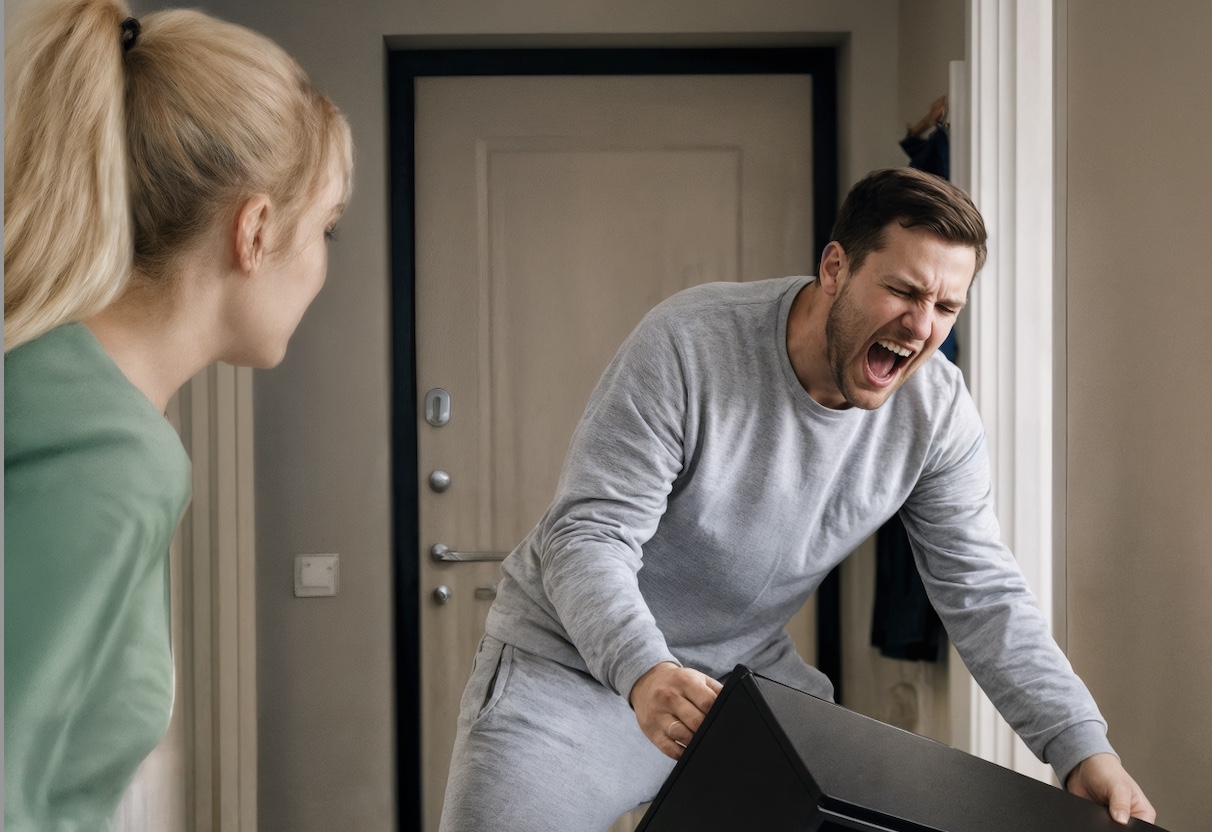
That Tuesday, Dunaivtsi was waking beneath a soft May rain. The little town stretched along the Ternava River and usually moved at an unhurried pace, but inside a third-floor apartment in an old Khrushchyovka on Shevchenko Street, the air itself seemed to hum with tension.
“Where are my keys? I’m asking you!” Stepan’s voice cracked into a rough rasp. He was furiously rummaging through the hallway cabinet, scattering receipts, business cards, and random odds and ends all over the floor. “Oksana! Have you seen my keychain with the trident on it?”
Oksana stood by the kitchen window. Slowly, almost absentmindedly, she dried a porcelain cup with a towel, watching raindrops crawl down the glass. There was not a trace left of her old nervous haste.
“I have,” she said calmly, without turning around.
“Then where are they? I’m supposed to be at Epicenter in ten minutes. They’re already waiting for me!”
“With me, Stepan. In my bag.”
He froze, one hand still stretched forward, then slowly straightened and stared at her back. His face, swollen from last night’s drinking, turned an even deeper shade of red.
“What kind of game is this? Why did you take them? Give them back right now, I have somewhere to be!”
“You’re not going anywhere. At least not from here,” Oksana said, turning toward him at last. Her gaze was cold and steady. “I changed the locks this morning at eight, while you were sleeping at Pavlo’s after another football night with drinks. The locksmith came quickly.”
For a second Stepan went silent, as though the air had been knocked out of his chest. Then he exploded.
“Have you lost your mind?!” he shouted, stomping so hard that the crystal glasses in the cabinet rattled. “This is my house! Mine! Did you forget how my parents gave us money for the down payment? They saved every last coin!”
Oksana carefully set the cup on the table. The sound was quiet, but sharp.
“Your parents helped twenty years ago. And that amount barely covered a quarter of it. The rest we paid off together for twenty years. And for the last seven, while you were ‘finding yourself’ after losing your job at the sugar factory, I carried everything alone. I worked triple shifts, put up with rude customers, hauled heavy boxes. So this is more my house than yours. And starting today, it’s only mine.”
“You’ve gone completely insane!” he yelled. “Do you even understand what you’re doing? I’m a respected man. The whole town knows me!”
“I understand perfectly well,” she answered evenly. “Last night you dragged your friends here at two in the morning. You shouted, sang, smashed my flowerpot, and ate everything I had cooked for the week. And when I asked you to at least lower your voices because I had to get up at five, do you remember what you said?”
Stepan looked away, muttering something under his breath.
“You said, ‘Be quiet, woman. I’m the master here. If I want songs, there’ll be songs. If I want, I’ll turn this place into a circus.’ And then you added that I was nobody here, just the hired help.”
“So what?!” he flared up again. “Now I can’t even say a word? I have to ask permission to have a drink with my friends?”
“You should have before. Now it doesn’t matter anymore. Because you won’t be living here.” Her voice stayed calm. “I packed your things during the night. They’re by the door. Take them. You’ll get the keys when you remember what respect looks like. Until then, go stay with Pavlo or with your mother.”
Stepan stared at her without recognizing the woman in front of him. This was not the old, patient Oksana. This was someone strong, composed, and certain of herself, and in front of that quiet strength, his usual anger suddenly lost its force.
“You mean it? You’re throwing me out?” he asked in a low voice.
“Yes. Your bags are in the hall. The door is open. Goodbye, Stepan.”
It had not started yesterday. Not even a year ago. The real turning point had come when Stepan took early retirement. Oksana kept working at the grocery store near the bus station in Dunaivtsi. The job was hard: endless customers, exhaustion, nerves worn thin.
She would come home longing for peace and instead find disorder—dirty dishes, clothes thrown around, an overflowing ashtray, and Stepan planted in front of the television.
“Stepa, you were home all day,” she would say wearily. “Was it really so hard to at least put the dishes away?”
“Oksana, don’t start,” he would answer. “I spent forty years breaking my back at that factory. I’ve earned the right to rest.”
“And I haven’t? I still have years of work ahead of me!”
“You’re still young. You’re fifty-three. I’m over sixty. I need peace.”
Only his version of “peace” was always loud. Soon his friends started coming over—Kolya, Sergey, and Pavlo. They would settle into the kitchen with snacks and bottles.
“Oksanka! Out of pickles?” Kolya would laugh. “Come on, hostess, bring out the pork fat. The men are relaxing!”
At first she put up with it, hoping it was only temporary. But temporary became routine.
“I have to be at work at six tomorrow!” she would beg in the middle of the night. “Ask them to keep it down!”
“If you don’t like it, go sleep in the other room,” he would wave her off.
The final straw came the night before. The company showed up before dawn—noise, banging, the television blaring at full volume.
When Oksana came out and asked for silence, Sergey smirked.
“Oh, grandma’s awake! Bring us some pickle brine, will you? We’re drying out here!”
And Stepan merely smirked along with him. That was the moment Oksana understood that the man she used to know was gone.
She did not sleep until morning. At six she found the locksmith’s number, and by eight the locks were already being changed.
“You’ve lost your mind!” Stepan ranted, stumbling into the bags. “My mother is coming here now! What, is she supposed to stand outside in the yard?”
“She can drive you home,” Oksana replied calmly as she folded his shirts. “Since that’s where you’re going.”
“I wasn’t going anywhere! This is my home!”
“Then start packing now. Your car is still here. I left your keys. Go.”
Suddenly he grabbed her by the shoulders.
“Oksana, enough of this! We’re adults. So we drank too much yesterday—who hasn’t? I’m not cheating on you. I brought money into this house!”
“Yes, adults,” she said, gently freeing herself. “Which is why we’re dealing with this like adults. You wanted to be the master? Fine. Be one. Just without me.”
“What did I even do that was so terrible?!”
“Nothing special. You just turned my life into hell.”
“Fine! I’ll change! I promise!”
“Too late. I listened to your promises for twenty years.”
“You’re throwing me out after twenty years?!”
“You pushed me out of my own life long before this.”
He sank down onto the stool, suddenly lost.
“So where am I supposed to go now?”
“To think. And to learn how to live on your own.”
Forty minutes later, an old Niva pulled up outside the building. Nina Petrovna had arrived.
The doorbell was followed by loud pounding on the door.
“Oksana! Open up! Where is my son?”
“He’s right next to you,” Oksana answered through the door. “Look down. His bags are by the threshold.”
“Have you lost your mind?! You threw your husband out?!”
“Yes. My patience ran out.”
“This apartment belongs to my son! We gave money for it!”
“Twenty years ago. And I paid that back. We owe you nothing.”
Her mother-in-law shouted, “I’m going to the police!”
“Go ahead. I have the ownership papers.”
Stepan spoke quietly then.
“Mom, enough. Let’s go.”
“Break the door down!”
“I’m not doing that. Let’s go home.”
“You’ll regret this!” she shouted one last time.
“Silence is better than living in hell,” Oksana said softly after everything finally went quiet.
That evening, for the first time in a long while, she had dinner in peace: lemon balm tea and a slice of cheese. The apartment was quiet and fresh.
Then the phone rang.
“Oksana… maybe I could come back? I understand now. I’ll find a job…”
“You’ve said that many times before,” she answered calmly. “Stay with your mother. I’m going to live for myself now.”
“And what will Artyom say?”
“He already has. He said, ‘Mom, you should have done this a long time ago.’”
“Is this forever?”
“For now, I’m happier without you.”
She hung up and looked out the window. The town was going on with its life, and for the first time in years, she felt like herself again.
Now it was her home. Her life. Her rules.
And the most important of them was simple: to be happy.