Evening always seemed to arrive without warning. One moment, the last rays of sunlight were still clinging to the glass high-rises outside, and the next, the city had sunk into a dense velvet-blue dusk stitched with yellow-lit windows and neon signs.
Olga sat in the silence of her living room, inside her own small kingdom—a place she had wrestled back from the chaos of the world. In one hand, she held a nearly empty glass with the last of her cold tea. A laptop rested on her knees, its screen filled with a social media feed she was scrolling through without really seeing any of it.
Peace.
Fragile, but hers.
The creak of a cabinet door, the whisper of a page turning—those were the only sounds in her evening symphony.
Until the armchair by the doorway creaked.
Maxim was standing there.
His posture was that of a man preparing for battle. His face held a blend of determination and that particular expression people wear when they are convinced they are right, but already sense their “rightness” is about to provoke a storm.
Olga felt something cold and heavy settle beneath her ribs.
A familiar feeling.
A warning.
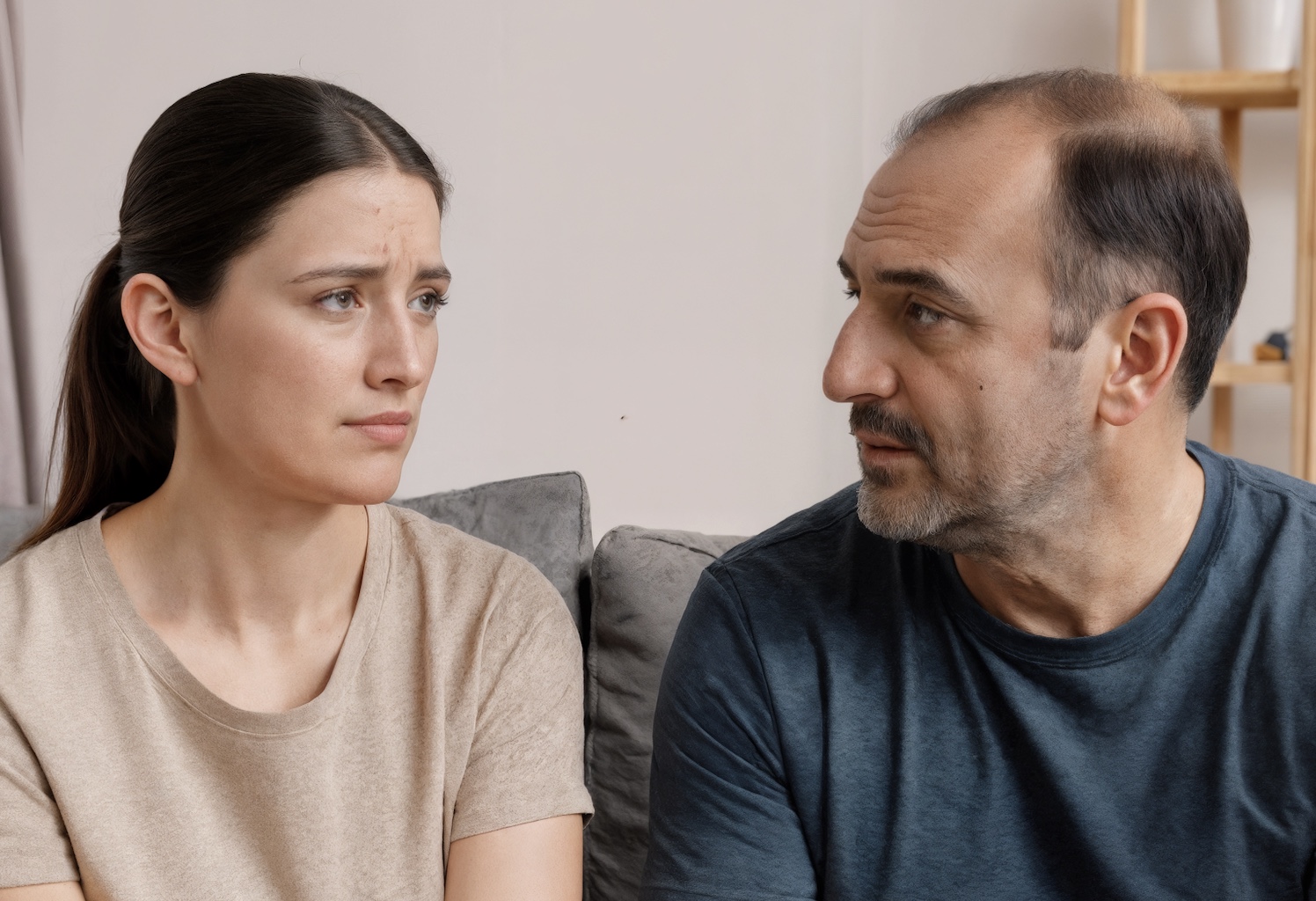
“Olga,” he began, taking a step forward while somehow still looking like he was delivering lines from a stage. His voice sounded unnaturally loud in the quiet room. “I’ve been thinking. Seriously thinking. We need to move Mom here. Into this apartment. With us.”
The silence that followed did not merely hang in the air—it crashed down like a slab of concrete.
Very slowly, Olga placed her glass on the coffee table. The soft touch of glass against glass sounded like a gunshot.
“Move her?” she repeated, stretching the word. Her voice was calm, nearly expressionless, but inside, everything had clenched into an icy, barbed knot. “Your mother? Here? Into our apartment? Into my apartment?”
“Yes!” Maxim brightened, taking her repetition as the start of a real discussion, a sign that she was finally ready to hear his arguments. He stepped closer, gesturing more animatedly. “She’d feel so much safer here! Think about it: we’re in the center, it’s a good neighborhood, the elevator works—it’s nothing like her old Khrushchyovka. She’s on the fifth floor with no lift, she has trouble breathing, her heart is acting up… it’s hard for her, Olga. Here she’d have comfort, safety—and I’d be right nearby.”
Olga raised her eyes to him.
There was righteous filial devotion burning in them. It was dramatic, almost noble. Sincere? Possibly.
But the apartment…
That so-called “our” apartment was hers.
She had bought it with money earned in endless business trips and brutal deadlines while Maxim was “trying to find himself.” Her nerves, her sleepless nights, the vacation she had given up so she could save for the down payment—everything had gone into these walls, this renovation, every inch of this space where she had finally learned to breathe freely.
And then there was her mother-in-law.
Anna Petrovna.
A woman whose very presence felt like an unwanted draft on a hot day—sudden, intrusive, and always at the wrong moment. Her “care” for her beloved son was always seasoned with a razor-thin poison aimed directly at her daughter-in-law.
“Safer, you say?” Olga lifted one eyebrow slowly. Her voice stayed quiet, but steel had entered it. “Max, remind me of something. Your mother already has her own apartment. Two rooms. Perfectly decent. Yes, it’s on the outskirts. Yes, it’s on the fifth floor. Yes, there’s no elevator—I agree, that’s not ideal. But it is her home. Her fortress.” She motioned around the room. “And this… this is mine. My fortress. Bought with blood and sweat, in case you’ve forgotten.”
“Oh, come on, what do you mean yours? It’s ours!” Maxim protested, flicking his hand as though brushing away a technicality. “We’re a family. One household. And Mom is family too—the closest kind!”
“A part of the family who has lived quite happily on her own for the last ten years,” Olga shot back. For the first time, a faint tremor slipped into her voice—not fear, but gathering outrage. “And thank God for that. Because your mother is happiest when she is the unquestioned ruler of her own kitchen and living room. And I am a hell of a lot happier when I’m the one in charge here.”
She leaned back and looked him straight in the eye.
“Imagine it, Max. Honestly imagine it. She’s living here. Every morning: ‘Olga dear, why do you make coffee like that? My son only likes it this way, let me teach you.’ Every lunch: ‘Maksimka, look what she cooked for you. Again not the food you like.’ Every evening: ‘Olga dear, you hung the curtains wrong, that’s where dust collects. And the rug shouldn’t be there.’ Is that what you call peace? Is that your vision of family happiness?”
Maxim winced as if she had pressed on a bad tooth.
He knew.
He knew perfectly well she was not inventing any of this.
His mother was difficult. Demanding. Never satisfied.
“Olga, you can’t be this cynical!” he burst out, his voice cracking. “She’s getting older! Weaker! She needs help, support, closeness! She needs her own son nearby—not just visiting every couple of days!”
“Nearby?” Olga let out a short, dry laugh without the slightest hint of amusement. “From the entrance of her building to ours is exactly forty minutes by metro. One direct line. No transfers. An hour in rush hour, maybe. Max, this isn’t some remote province. This is Moscow. The only city I’d compare it to in sheer density is probably Tokyo. If what she truly needs is your physical presence twenty-four hours a day, then fine—there’s an easy solution. A very simple one. Move in with her. Into her two-bedroom Khrushchyovka. There’s plenty of room. You take one room, she takes the other. You can’t get much closer than that. Problem solved.”
“What?!” Maxim recoiled as if someone had shoved him. His eyes widened with genuine disbelief and injured pride. “What are you even saying? We’re a couple! Husband and wife! We’re supposed to live together!”
“Yes, a couple,” Olga said with a nod, cold sparks flashing in her eyes. “A couple where the husband decides, without asking and without discussing it, to move his mother into the apartment where he lives with his wife. Just because she’d feel ‘safer’ there. And what about me? Where exactly am I supposed to find this so-called peace? On the stairwell? In the basement? Or are we supposed to cram ourselves into the kitchen while Anna Petrovna rules the living room, drinks tea from my favorite china set, and criticizes my wallpaper choices? Is that your blueprint for a perfect married life?”
She could see the color spreading across his face.
Anger? Shame? Confusion?
A little of everything.
Her own calm was something different entirely—icy and burning at the same time. The calm of someone standing at the edge of a cliff and refusing to take another step.
“You… you’re just selfish!” he blurted out at last, as though he had finally found his trump card. “You can’t even think about an old, helpless woman! All you care about is yourself!”
“Selfish?” Olga got to her feet. She was not tall, yet in that moment her figure seemed solid, immovable. “Selfish is someone willing, without a second thought, to push his wife out of her own home—out of her own rightful space—for the sake of his mother’s convenience. Selfish is someone who couldn’t even be bothered to ask, to discuss, to suggest alternatives, and instead simply announced it. Like an ultimatum. Like a sentence. ‘Mom is moving in.’ Full stop. No, Maxim.” She paused and looked him straight in the eye. “She is not moving in. Not today. Not tomorrow. Not next year. Never.”
She turned sharply and walked to the desk where her laptop sat. She opened it. The quick, crisp clicking of keys broke the silence like drumfire, clashing with his heavy, uneven breathing.
“But… but what are we supposed to do then?” Maxim muttered, sounding suddenly lost. His fighting spirit was dissolving fast under the cold shower of her certainty. He stood in the middle of the room, which now seemed to have become hostile territory. “I can’t just… abandon my mother…”
“What are you supposed to do?” Olga turned the laptop screen toward him.
A major real estate site glowed on the screen.
“If Anna Petrovna truly needs to live within walking distance of her beloved son, then there is a perfectly logical and civilized solution. Here. A list of available apartments. In our neighborhood. In nearby blocks. Within fifteen minutes on foot. With elevators and without. Newly renovated and unfinished. More expensive, less expensive. Take your pick. You can even rent a one-bedroom for the two of you—you and your mother. Then you can stay close, like Siamese twins. Would that suit you?”
She looked at him—not with malice, not with triumph, but with tired, immovable resolve. Somewhere in that gaze was the faintest trace of a bitter smile, the smile of someone who knows exactly what promises are worth and, more importantly, how much personal boundaries cost.
“You… you’re serious?” Maxim stared at the screen overflowing with apartment listings as if it were something alien. “You’re suggesting… I move out?”
“I’m suggesting that you and your mother find housing that works for both of you,” Olga corrected him. Her finger tapped lightly on the trackpad, highlighting the search bar. “Look carefully. Here’s a one-bedroom in the building just across the street. See? A little farther away, but in a newer complex—there’s a two-bedroom. There are studios too—compact, but modern. Some furnished, some empty. You can even use filters yourself—price, floor, distance to the metro, elevator access. It’s all transparent, all convenient. Save the ones you like, show them to your mother. Talk it over. Choose whatever fits her needs and yours. And your budget.”
She nudged the laptop closer to the edge of the desk, clearly inviting him to sit down and start looking. Then she walked over to the coffee table and picked up her empty glass.
The cold tea was gone.
So was her patience on this particular front.
“You can’t just… throw us out like that…” he began, but his voice had lost its strength. “That’s… that’s not humane.”
“I can,” Olga said simply. She stood with her back to him at the kitchen counter, filling a glass from the water filter. The sound of running water seemed strangely loud. “And it isn’t cruelty, Max. It’s the highest form of common sense. And, oddly enough, of respect. Respect for my personal space, which I spent years building. Respect for our marriage, which probably wouldn’t survive six months in that kind of ‘crowded family arrangement.’ And even… respect for your mother. Believe me, from experience and plain female instinct, she would be far calmer and more comfortable in her own separate apartment nearby—even if it were rented—than in someone else’s home, where the woman in charge is a daughter-in-law she doesn’t particularly like. And where her beloved son would be torn forever between wife and mother, like a man caught between a hammer and an anvil. That would be pure hell. For all three of us. I am not going to drag myself, you, or Anna Petrovna into that. That wouldn’t be life—it would be a permanent minefield.”
Maxim said nothing.
He kept shifting his gaze between the glowing screen full of endless listings and his wife’s back.
Even without turning around, Olga could practically see what was running through his head: his mother’s constant complaints about her health, her reproaches, impossible demands, fights over an unwashed cup or the volume of the TV…
Only this time, all of it would not be in his mother’s apartment, where he could eventually leave.
It would be here.
On his territory.
No—on Olga’s territory.
Where she was the one in charge.
“But… it costs money, Olga,” he said at last, forcing out the most obvious, most practical argument. “Rent… that’s a permanent expense. A big one. And Mom’s pension…”
“Then you’ll look for something cheaper,” Olga said with a shrug, coming back into the living room with a full glass of water. She sat across from him—not on the sofa, but in the armchair, deliberately placing distance between them. “Or you’ll consider other options. For example, selling her Khrushchyovka. With that money, you could buy a decent one-bedroom right here in the neighborhood. Or use part of the proceeds to improve her current place—install solid handrails along the stairwell landings, maybe even see if the homeowners’ association would allow some kind of stairlift, if that’s possible. There are options. They need to be discussed, weighed, calculated. But our home…” She took a sip of water. “Our home is not one of them. Not for her. Not for us. That’s an axiom.”
She stood, carried the glass back into the kitchen, and then stopped in the doorway, leaning lightly against the frame.
“I’ll send you the link to this подборка in Messenger in five minutes. Save it. Look through it calmly, without rushing. Talk it over with your mother. If you need help with the search, with evaluating listings, or even with viewings, tell me. With my real-estate background, I can advise you and point out what to pay attention to.” She paused. “But as the owner of this specific apartment… my decision is final. Anna Petrovna is not moving in here. Under any circumstances. This is not a question of emotion, Max. It’s a question of boundaries.”
Her tone was as level and still as the surface of the water in her glass.
No hysteria.
No threats.
Just a fact.
A clear line drawn with something stronger than ink.
Maxim was still standing by the desk, staring at the screen. The list of apartments no longer looked like a solution to him. It looked like a vast and humiliating reminder that he had been wrong. He heard Olga set her glass down on the kitchen counter. The sound was soft, but final. Like a door closing.
Metaphorically.
He let out a heavy sigh, as though shaking off an invisible weight.
Not the weight of responsibility for his mother.
The weight of his illusions.
“All right…” he muttered at last, finally lowering himself into the chair in front of the laptop. His fingers moved uncertainly toward the keyboard and mouse. “I’ll see… what’s here… Maybe there really is something nearby that’s cheaper…” He clicked on the first listing. A one-bedroom. Thirty-five square meters. “Euro renovation.” The price hit him like a punch to the stomach. He swallowed. “Or maybe I should talk to Mom… about selling her apartment… though she’d never agree…”
Olga said nothing.
She stood looking out the window at the vast sea of lights of the big city.
Her fortress had held.
Today’s assault had been repelled.
She knew this was not the end of the war. She knew Maxim’s conversation with Anna Petrovna would be a circus of its own. She knew that once her mother-in-law learned about the “links,” she would put on an epic performance, accusing her daughter-in-law of every sin imaginable. She knew Maxim, under pressure, might one day try to revive the same old song again.
But Olga was ready.
Her arguments had been forged out of steel: the law—her ownership documents were lying safely in the lockbox; cold logic—the total impossibility of two alpha women peacefully sharing one territory; and simple, universal psychology.
Anna Petrovna did not really want “peace” or “closeness to her son.”
What she wanted was control.
The ability to influence, command, and remain at the center of his life.
A separate apartment nearby took away her main weapon: the image of the “poor abandoned old woman whom the evil daughter-in-law refuses to let near her only son.”
Now the choice was hers:
real comfort and actual closeness—but without the right to rule Olga’s home,
or endless guerrilla warfare on someone else’s territory, where ultimate authority would always belong to Olga.
A week later.
The phone rang unexpectedly.
Olga was finishing a report when she saw who was calling. On the screen was a photo of her mother-in-law, taken by Maxim in some park somewhere. Anna Petrovna was looking into the camera with her usual expression of permanent grievance against the world.
Olga sighed and answered.
“Hello?”
“Olga? This is Anna Petrovna.” Her voice sounded… strangely restrained. Almost polite. That alone was alarming.
“Hello, Anna Petrovna. What happened?”
“What happened? Nothing happened!” came the falsely cheerful reply. “I’ve been calling Maxim and he won’t answer. Do you know where he is?”
“At work, probably. Or at a viewing.” Olga paused deliberately. “A viewing?”
“Of what exactly?” The innocent tone failed badly. Curiosity—and something like anxiety—leaked through.
“An apartment. In our neighborhood. Weren’t you and Maxim discussing options for moving closer? He sent you the listings.”
Olga said it calmly, as though she were commenting on the weather.
“Oh… that…” There was rustling on the other end, as if Anna Petrovna had shifted the phone in her hand. “Well, yes, he sent something. But those prices are ridiculous! For that kind of money you get a closet on a rope. And anyway, why should I move? I’ve lived in my apartment all my life!”
“Well, you wanted to be closer to Maxim,” Olga reminded her gently but firmly. “So he could be nearby and help you. In your fifth-floor walk-up, it’s hard for him to come often—you said so yourself. Here, he’d be close. He could help, stop by for tea, all without crossing half the city.”
“Close…” her mother-in-law said bitterly. “Close, but still in some stranger’s little corner. For insane money. And who’s to say it would even be quiet there, or that the neighbors would be decent? Here I know everything.”
“Of course, the choice is yours, Anna Petrovna,” Olga replied. “We only offered options for your convenience. If you decide to stay where you are, Maxim will continue visiting you like before. Maybe a little less often, but at least with a clear conscience, knowing he offered a solution. If you decide to move, we’ll help with the search and the move—within reason, of course.”
A heavy silence settled on the line.
Olga could almost feel Anna Petrovna grinding through the meaning of it all. The option of “moving in with them” had not even been mentioned. It had been buried under a mountain of listings.
And Anna Petrovna understood.
She understood that this front was closed to her forever.
“Well… all right,” she muttered at last. It sounded almost like a surrender, though an incomplete one. “Tell Maxim to call me back. When he has time. About that bathroom repair—he promised to deal with my leaking faucet.”
“I’ll tell him,” Olga said. “Goodbye, Anna Petrovna.”
“Mmm… yes.”
The line went dead.
Olga put down the phone. The corners of her mouth twitched in the faintest smile. Not gloating.
Something more like tired satisfaction.
The first probing attack had shown that the enemy finally understood the fortress could not be taken. Anna Petrovna would complain, whine to the neighbors, try to pressure her son with tears—but she was already torn between fear of those “insane” rent prices and her unwillingness to sell her own stronghold.
Most importantly, she now understood that moving into Olga’s apartment was no longer possible.
At all.
Maxim, though he grumbled about the prices, had already gone to a couple of viewings. Once, he had even taken Olga with him “as an expert.” She had silently pointed out crooked walls, suspicious stains on the ceiling, and a shaky balcony in a “wonderful studio at a reasonable price.” He frowned, but he listened. He was no longer looking for “anything at all.” He was searching for something halfway decent.
Progress.
Another month passed.
Olga was sitting on the balcony with a cup of evening tea—hot this time. Lights glowed outside. The apartment was quiet.
Peaceful.
Her peace.
On the table in the living room lay a printed rental contract.
Not for Anna Petrovna.
For the very same one-bedroom apartment in the neighboring building that Maxim had rented.
“For work,” he had muttered. “Sometimes I need a place to be alone and focus.”
Olga chose not to comment.
She knew it was his way of saving face.
And his way of staying “closer” to his mother while also having his own refuge.
A step toward compromise.
A fragile one, but still a step.
Anna Petrovna remained in her own Khrushchyovka. Maxim bought her a chair-lift to help with the first flights of stairs and arranged for a plumber in the building next door to check in on things regularly. He visited once a week, sometimes twice.
Without the old crushing sense of guilt and duty.
Because the decision had been made.
And though it was not ideal, it was the only workable one.
Olga finished her tea. The cold stars above looked as sharp and unbreakable as the boundaries she had managed to defend.
Not with a screaming match.
Not with hysterics.
But with cold tea, iron logic, and a timely link to a real estate site.
The battle for her personal space had been won.
Not loudly.
But permanently.
The absurd theater called “Mother-in-law moves in forever” had closed before it even had the chance to open.
Curtain.