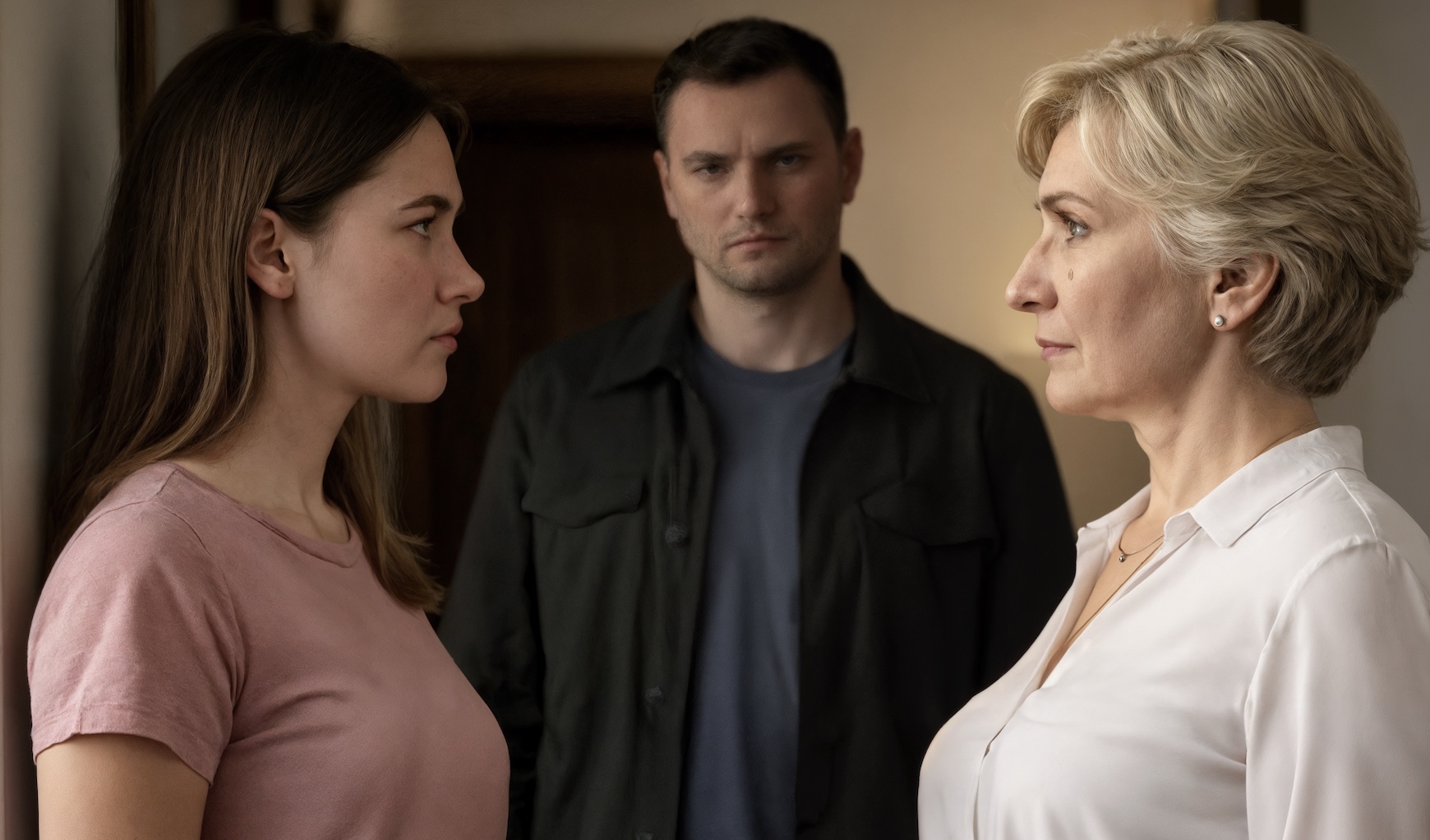
That weekend—the one that set everything in motion—arrived wrapped in an almost eerie kind of peace. Sunlight spilled across the table, catching on the rim of a large mug where fresh coffee still steamed. I sipped slowly, savoring the warmth in my hands and the calm expression on my husband’s face. Maksim was reading the news on his tablet, pausing now and then to make some amused remark. In moments like that, our home felt like a fortress—cozy, secure, untouchable.
“More?” Maksim reached for the coffeepot, and in his eyes was that rare kind of stillness that makes life feel worth living.
I was just about to nod when the harsh, relentless buzz of the intercom sliced straight through the morning calm. My heart gave a sinking jolt. Nine o’clock on a Saturday? That could only mean one of our own. Or rather, someone who believed they had every right to barge into our lives without warning.
Maksim frowned, walked over to the panel, and pressed the button.
“Hello?”
“Son, it’s me!” my mother-in-law’s lively, commanding voice rang through the apartment. “Open up—my hands are full and these bags are heavy.”
The click of the lock sounded like a verdict. I looked at Max. For a moment, something close to apology flickered in his eyes, but he buried it almost immediately.
“Mom brought treats,” he muttered with a shrug.
Less than a minute later, the door swung open and Galina Petrovna glided into the apartment. She never simply entered a home; she arrived as if stepping onto a stage where everyone was expected to follow her script. In one hand she carried a net bag full of apples, in the other a huge plastic container with something unidentifiable inside.
“Well, here I am!” she declared, sweeping the room with a brisk, appraising look. “Maksyusha, help me with this. Oh my, it’s dusty in here.”
She set the bags down and, without even taking off her coat, walked straight into the living room. Her gaze passed over the shelves, the TV, and paused on my favorite vase.
“So, you’re drinking coffee,” she observed, and somehow turned the words into a silent reproach. “My Ira,” she said after a dramatic pause, making sure we absorbed the comparison, “has already finished everything by this hour. Floors washed, laundry done. But of course, her husband has golden hands—he manages it all. And you two are just… lounging.”
I clenched my teeth, feeling a cold ripple run down my back. Maksim gave her an uncertain smile.
“Mom, sit down. Want some coffee?”
“What am I, idle?” she scoffed. “I’ve already done everything at home.” She flicked her hand dismissively and headed into the kitchen.
We followed after her as though under a spell. Galina Petrovna opened the refrigerator and, with a long, suffering sigh, began rearranging jars of pickles that were apparently standing in the wrong places.
“You should never keep milk in the door. It spoils faster. Don’t you know that?” she said to the air. “And I brought you homemade salad. Olivier. My Mitya loves it. Alisa, take a look—this is how it should be made properly.”
I stayed silent. The words were stuck in my throat, tangled in anger and humiliation. Maksim tried to joke.
“Mom, this isn’t a health resort. We manage just fine.”
“Oh, I can see how well you manage,” she shot back, shutting the refrigerator. Her long, bony fingers ran across the countertop, checking for dust that wasn’t there.
Then her gaze fell on the couch where we’d been sitting just moments earlier.
“And what’s this? Crumbs? Do you eat right on the sofa?”
“Probably from the cookies,” I said through clenched teeth, feeling like a schoolgirl being scolded.
“At Ira’s house—” my mother-in-law began again, and that was the moment something inside me nearly snapped.
I had already opened my mouth to say something sharp when Galina Petrovna suddenly turned to us, as if only just remembering the true reason for her visit.
“Oh, right, the most important thing. By the way, Mitya will be using your sofa for a week. His apartment’s under renovation, you know, Max, and renting somewhere is too expensive right now. Let him stay with family.”
A heavy silence dropped over the room.
A week?
This from a man who could turn even a utility closet into chaos in three days.
I looked at Max. He lowered his gaze and studied the pattern in the parquet floor. He avoided looking at me, and in that posture, in that mute surrender, I understood everything.
The battle had been lost before it had even begun.
He showed up the following evening. Not that same day—no, that would have been too easy, too predictable. He gave us one full night to live in tense anticipation, the way a condemned person waits for dawn.
The doorbell rang while I was washing dishes after dinner. Maksim opened it. On the threshold stood Dmitry, my husband’s brother, with a small backpack slung over one shoulder and that unshakable confidence of a man who believes the entire world owes him space.
“Hey, family!” he boomed cheerfully as he stepped inside without waiting for an invitation. “Let the poor sufferer in—save me from the renovation!”
He dropped his backpack right there in the hallway, next to my neatly lined-up shoes, and strolled into the living room with the air of a man inspecting his new property.
“Not bad. Cozy place,” he announced, dropping onto the very sofa that had apparently been set aside for him. His gaze slid toward me. “Hey, Aliska. Miss me?”
I said nothing, drying my hands on a towel. Maksim nervously patted his brother on the shoulder.
“All settled, Mitya?”
“What is there to settle? I’m just crashing a couple nights,” he said, stretching out more comfortably and pulling out his phone. “As long as the internet works, I’m good. Got things to handle.”
His “things” started almost immediately. Less than half an hour later, he was already pacing around the living room, talking loudly on the phone.
“Yeah, Petrovich, we’re talking a million-dollar project here, obviously! I’m in meetings with partners right now, at the office.” He paused, listening, and lit a cigarette without asking permission. “Investors are all over me, you get it? Money’s moving around the clock. You know how it is… By the way, brother, send me a bit till tomorrow, just to get things rolling? I’ll make it all back, one hundred percent!”
I stood in the kitchen chopping vegetables for the salad I was making for the next day. Through the hiss of potatoes frying in the pan, his smug voice carried clearly. Maksim sat at the table pretending to watch TV, but the tension in him was obvious.
Mitya ended the call and shouted from the couch without bothering to move.
“Alisa, what smells so good in there? I’m hungry! Got any barbecue planned?”
Something in me twisted. I stepped to the kitchen doorway, still gripping the vegetable knife in my hand.
“Dinner’s been over for a while, Dmitry. I’m cooking for tomorrow.”
“Then heat something up,” he replied without even lifting his eyes from the phone. “A man needs fuel. I’ve been running around hungry all day.”
Maksim looked at me, and in his eyes was a silent plea. Don’t start. Please. I took a long breath, turned around, and ladled the leftover soup into a bowl. I heated it in the microwave. The hum of it seemed unnaturally loud.
I set the bowl down on the coffee table in front of him. He poked at the soup with his spoon.
“No bread? That’s it?”
“The bread’s in the bread box,” I said through gritted teeth. “In the kitchen.”
He grunted unhappily, but got up and shuffled into the kitchen in his socks. A minute later he came back carrying half a loaf and sat there eating, smacking loudly while watching some livestream on his phone. Crumbs rained down onto the clean carpet.
That night, when Maksim and I lay down in bed, I finally couldn’t keep it in any longer.
“Max, this is already his third day here, and he hasn’t even washed a single dish after himself! Did you hear the way he talks to us? Like we’re his servants!”
“Just bear with it, Alisa,” my husband said wearily, rolling onto his side. “He won’t stay forever. The renovation’s temporary. He’s family—where else is he supposed to go?”
“Family? The same family member who begs people for money while planning to buy himself a new car?” I snapped, remembering his conversation from the day before.
“You must have misheard something,” Maksim muttered, switching off the light. “Go to sleep. Everything will settle down.”
But nothing settled down.
In the darkness of the room, through the closed door, I heard Mitya’s muffled voice again. He was back on the phone, and a few words came through so clearly it was as if he were standing right beside the bed.
“Come on, the renovation’s practically done. But this place is free, and they feed me too. I’ll hang around a little longer—need money for a new ride. Sold the old one.”
I froze, listening. My blood pounded in my ears. Practically done. Free apartment. They feed me. New car.
I turned toward my husband’s back—he was already drifting off—and whispered into the darkness:
“So that’s your ‘family blood.’ I wonder if your blood realizes he’s nothing more than a freeloader in this house.”
The silence after Galina Petrovna’s last visit lasted exactly two days. On the third day, toward evening, the intercom rang again—the same call I had been expecting without fully admitting it to myself. My mother-in-law’s voice sounded sweet and worried all at once.
“Maksyusha, open up! I came to see Mitenka. I’m worried about him. And I brought food.”
The second he heard her, Mitya came alive, as if someone had flipped a switch. He hadn’t cleared away his breakfast dishes all day, and the dirty plate with dried crumbs on it was still sitting right there on the coffee table in plain sight.
When Galina Petrovna walked in, her eyes locked onto it immediately like a radar signal. She stopped short in the doorway, and her face stretched in dismay.
“Mitenka, darling, are you eating at the coffee table?” she said reproachfully as she removed her coat. “That’s not a table, it’s part of the décor! Alisa, don’t you have a proper kitchen table?”
Before I could answer, she walked up to the couch where her younger son was sprawled out and affectionately stroked his hair.
“How are you, son? They’re not mistreating you here, are they?”
“Well… depends how you look at it, Mom…” Mitya sighed dramatically and shot me a loaded glance. “Sometimes I practically have to heat my own food. I kind of feel unwelcome.”
I nearly lost my breath at the sheer audacity of the lie. I was standing at the sink at that very moment, washing the pot in which I had boiled him pasta for lunch.
“Wait a second, Dmitry,” I said, unable to hold back as I dried my hands. “Which days are you talking about? I cooked for you yesterday and today.”
“Well, you warmed something up,” he said with a dismissive wave. “A man needs real hot food, not reheated leftovers.”
Galina Petrovna’s brows flew up, and her eyes flashed with cold anger. She turned to me, and her voice vibrated like a wire pulled too tight.
“So this is how you treat my son in your home? I thought you’d have at least a little care for him! He’s a man—he needs support, not constant criticism! He’s under stress. He’s dealing with a renovation!”
My patience, worn thinner day after day, finally snapped. The lump in my throat dissolved into something colder and sharper.
“What renovation, Galina Petrovna?” I asked with deliberate calm. “You were the one who said it was almost finished. Or am I mistaken?”
“Stop playing stupid!” she flared. “You’ve made his life miserable here! You look at him like he’s your enemy! And you can’t even keep up with your own place—” Her gaze slid venomously over my simple house robe. “There’s dust under the cabinet, I noticed it last time! Maybe that’s why you don’t have children—because you live in filth.”
The cruelty of it was so low and so sudden that my vision darkened. Maksim, hearing the raised voices, came out of the bedroom. He stood there pale, like a frightened teenager.
“Mom, Alisa, calm down,” he tried weakly.
“Don’t you dare, Maksim!” I snapped, turning toward him. “Are you going to say one word that isn’t in their favor for once? Or are you just going to stand there like always?”
But he only lifted his hands helplessly. That silence of his—that familiar, spineless silence—was the final drop.
“You know what, Galina Petrovna?” My voice shook, but I spoke clearly, looking her straight in the eye. “If I’m such a terrible daughter-in-law, such a slob, practically a threat to your son—then why are you all so irresistibly drawn to my apartment? Why don’t you go stay with your precious daughter Ira? Everything is perfect there, isn’t it? Go inspect the dust under her furniture if that’s your favorite measure of family happiness!”
A deathly silence followed.
Galina Petrovna stood rigid, her lips pressed into a thin white line. Mitya stared at me with open contempt, though there was curiosity in his eyes too—he was enjoying the spectacle. And I looked at Max’s pale face and felt something vital between us collapse with a deafening crash. My faith in us. My marriage. It cracked, and that fracture ran deeper and more dangerously than any argument ever could.
After they left, the apartment fell into a silence so dense it rang in my ears. I stood in the middle of the living room with my fists still clenched and couldn’t move. The words from the fight still seemed to hang in the air like poison.
Maksim was the first to speak. He didn’t come to me. He didn’t try to hold me. He only whispered, staring at the floor:
“Why did you do that? She’s my mother…”
His voice sounded tired, hopeless. Instead of answering, I turned and went into the bedroom, closing the door behind me. The soft click of the lock wasn’t loud, but for both of us it meant something final—an obstacle neither of us could cross.
I sat on the bed and stared out at the darkening sky. Inside me there was no rage left, no hurt. Only emptiness. Emptiness and a cold, perfectly clear understanding: I was alone. The man who was supposed to be my support, my partner, had chosen the other side. His “family blood” was thicker and more important than our years together, our vows, our shared home.
Memories drifted past in front of me. Our wedding. Maksim looking at me as if I were the only person in the world. Our first apartment, the one we set up together, arguing over wallpaper colors and laughing at shelves hung crookedly. We used to dream about children. We made plans. It felt then as though nothing could break our little universe.
Now that universe had split open. And the crack hadn’t started with Mitya’s arrogance or Galina Petrovna’s tyranny. It had started with my husband’s silent consent. His refusal to defend me, to defend our home, our shared space.
I walked up to the mirror and looked at my reflection. I memorized that face—tired, bruised by sleeplessness, but with something new in the eyes. Something I had never seen there before.
Resolve.
There were no tears. Only steel.
I took my phone out of my bag, opened the voice recorder, and pressed the red button. My voice sounded quiet but steady in the stillness of the room.
“Recording dated October twentieth,” I said. “Today Galina Petrovna and Dmitry once again caused a scene. My husband did not defend me. From this moment on, I am collecting evidence. Audio recordings, photographs, videos. Everything that will help me defend my right to peace in my own home.”
I switched off the recorder.
The first step had been taken.
The next morning I woke before everyone else. My day didn’t begin with coffee, but with a cold, deliberate plan. I had trained as a lawyer, and it was time to remind everyone of that—including myself.
I made breakfast only for myself. I sat at the table and ate slowly, enjoying the silence. Mitya was the first to wake. Unshaven and rumpled, he wandered into the kitchen and peered around at the stove and refrigerator.
“Where’s breakfast?” he asked irritably.
“There are eggs and bread in the fridge,” I said indifferently, not looking up from my plate. “Men need strength, remember? Especially great businessmen like you.”
He muttered something under his breath and started frying eggs, banging the pan around for emphasis. I didn’t scold him. I simply watched. And remembered.
Maksim came out later. He looked miserable and lost. He tried to speak to me, his voice soft and guilty.
“Alis, let’s talk…”
“Not now, Maksim.” I stood up and carried my plate to the sink. “I need to go to work.”
I left them behind in that suffocating atmosphere of everything unsaid. But inside me the old pain was already fading. All that remained was a heavy, icy determination. They wanted war? Fine. They would have it. But on my terms.
That evening, when I came home from work, I didn’t cook dinner for everyone. I walked into my apartment like I was entering a fortress occupied by enemy troops. Mitya was sprawled on the couch watching TV. Maksim, apparently, had locked himself in the study.
I went into the kitchen, made myself tea and a sandwich, and carried them into the bedroom. The door closed behind me with a soft but decisive click.
I opened my laptop and created a new file. Blank. Clean. The cursor blinked on the white screen, waiting. I placed my fingers on the keyboard and typed the title:
Fortress.
It was time to defend myself.
The silence in the bedroom was deceptive. Through the thin wall I could hear the muffled sounds of the television—Mitya was watching yet another game. But inside my head there was absolute clarity. The bright light of the laptop screen illuminated my face. The file called Fortress was no longer just a metaphor. It had become a battlefield.
I started with the most basic thing: memory. Before I got married, I had graduated from law school. Not the most prestigious university, but enough to give me a solid foundation. Civil law. Housing regulations. All of it had once seemed distant, unnecessary in my calm life with Maksim. Now it was becoming my strongest weapon.
I opened browser tabs and began reading legal articles. Slowly. Carefully. I didn’t just need to understand the rules—I needed to build a flawless strategy.
Hours later, after patient work, I found exactly what I had been looking for. Article after article. Explanations from lawyers. Examples from court practice. The picture that emerged was precise and undeniable.
Dmitry was not registered in our apartment. In legal terms, he was not considered part of our household. He was simply a guest. And a guest, according to the law, has no right to live in a residence against the will of an owner. Yes, Maksim was one of the owners. But so was I. And my refusal was enough.
I opened a new document and began typing. A formal complaint concerning unauthorized occupation of a residential property. Every word was measured. Every sentence hit like a hammer blow. I wasn’t threatening anyone. I was stating facts. Dates, duration of unlawful residence, references to the law. It wasn’t an emotional outburst—it was a cold legal document.
When I finished, I read it again. The language was dry, emotionless, exactly as an official statement should be. That was precisely what gave it weight. It contained none of my hurt, none of my humiliation—only facts and legal provisions.
I printed it out. In the silence, the printer’s hum felt almost ceremonial, as if it were producing the physical embodiment of my resistance. I picked up the warm sheet of paper.
Now came the next move. File it with the police? No. Too direct. Too crude. Mitya and Galina Petrovna didn’t understand diplomacy, but they respected force. They needed to see that I wasn’t just a wounded woman. I was an opponent playing by rules they had never even imagined.
I folded the paper neatly and stepped out of the bedroom. Just as expected, Mitya was lounging on the sofa, muttering into his phone. When he saw me, he quickly ended the call.
“Aliska, any dumplings on the horizon?” he asked with a forced smirk.
“The fridge is empty,” I said flatly. “Just like your future here.”
I went into the kitchen and pretended to look for something in the utensil drawer. Then, as if by accident, I let the folded sheet slip from my hand onto the table directly opposite the living room entrance. It landed with a soft rustle. I acted as though I hadn’t noticed and walked out, heading for the bathroom.
With the door barely closed, I listened.
At first there was silence. Then hesitant footsteps. The rustle of paper. And then a long, heavy stillness that lasted almost a full minute.
When I came back out, the paper was gone. And the look Mitya gave me in passing was full of anger, but also unmistakable fear. Without saying a word, he grabbed his phone and hurried out onto the balcony, urgently dialing someone—most likely his mother.
I returned to the bedroom, to my laptop. The file titled Fortress was still open. I added a new line:
First move made. The enemy has seen my cards. Awaiting counterattack.
I leaned back in my chair. Now the initiative was theirs. But for the first time in this entire war, I no longer felt like a victim. I felt like a commander—someone who had finally unfolded the map and identified the enemy’s weak points.
They didn’t take long.
The next day, toward evening, the intercom didn’t just ring—it shrieked in one long furious buzz, as if someone had planted a finger on the button and refused to let go. I walked to the panel already knowing exactly who it was. My heart was racing, but not from fear. From the cold concentration of anticipation.
“Hello?” I said evenly.
“Open this door! Right now!” hissed Galina Petrovna’s voice, distorted with rage. “What do you think you’re doing, you shameless girl?”
I unlocked the door. Before opening it, I took three deep breaths, slipped my phone into the pocket of my robe, turned on the recorder, and made sure it was running. My palms were dry.
The door flew open, and Galina Petrovna stormed into the apartment like a hurricane. Behind her came Mitya, wearing the smug expression of a man expecting a show. My mother-in-law’s cheeks were flushed, and her eyes burned.
“Where is it? Where is that paper?” she demanded, glaring at me with pure venom. “How dare you threaten my son? Throwing your husband’s own brother out onto the street! What kind of person are you?”
Mitya planted himself in the doorway to the living room, arms folded, clearly prepared to enjoy every second.
“Mom, calm down,” Maksim muttered, appearing in the hallway. He looked shattered.
“Stay out of this, Maksim!” she snapped without even glancing his way. “Your wife has completely lost her mind! Threatening our Mitenka with the police!”
I didn’t move. I stood there, watching her with cold composure.
“Galina Petrovna, Dmitry is living here without my consent. I object to it. I have every legal right to object.”
“What consent?” she scoffed, stepping almost nose-to-nose with me. “This is my son’s apartment! He decides what happens here! You’re the temporary outsider!”
“Mom!” Maksim burst out, sharper this time, but once again no one listened.
I held her gaze. In my pocket, I could feel the faint reassuring vibration of my phone, the silent proof that the recording was ongoing.
“Galina Petrovna,” I said slowly and very clearly, emphasizing each word, “please confirm for the record: are you officially stating that your son Dmitry is living in this apartment—of which I am also an owner—without my knowledge and against my will?”
She froze for a second, thrown off by the calm, almost formal tone of my question. But her fury won out.
“Don’t try to confuse me with your ‘for the record’ nonsense!” she roared. “Yes, I’m stating it! And what are you going to do about it? He has every right to live here! More right than you!”
Without taking my eyes off her, I reached into my pocket, pulled out the phone, stopped the recording, and set it down on the small table by the door.
“Thank you,” I said quietly. “That’s enough. It’s all recorded. Either Dmitry packs his things and leaves my apartment for good within the next hour, or in two hours the police will be here with this statement”—I nodded toward the printed paper on the table—“and all of you will be explaining yourselves at the station. At the very least, under the article concerning unlawful self-help.”
A crushing silence fell over the apartment. Even the television had gone quiet. Galina Petrovna stared at me, and I watched the rage in her eyes slowly give way to confusion, and then to understanding. For the first time, she was no longer seeing me as a daughter-in-law she could harass at will. She was seeing a person holding a weapon. And that weapon was the law.
Mitya stopped smirking. He straightened up, his face suddenly tense.
“Mom?” he said uncertainly.
But Galina Petrovna didn’t answer. She kept looking at me, and in her eyes there was something new.
Fear.
Fear of official documents. Fear of the police. Fear of a humiliating trip to the station and the system she could not bully her way through.
Slowly, as if she had aged ten years in a minute, she turned to her younger son.
“Pack your things, Mitya,” she said dully. “You’re coming with me.”
Without another word, without looking at me or at Maksim, she walked out into the stairwell and pulled the door shut behind her. That exit said more than any screaming fit ever could.
Mitya stood there one moment longer, threw me a look full of hatred and fear, spat at the floor, and trudged into the living room to collect his backpack.
I remained in the hallway, looking at my husband’s pale face.
The battle had been won.
But the air smelled not of victory.
It smelled of ash.
The silence that settled after the front door slammed behind them was different this time. Not sharp and ringing, like the silence after a scandal, but thick and heavy, like molten lead. It pressed against my ears, my lungs, my heart. I stood in the hallway, one hand braced against the doorframe, unable to move.
There was no triumph inside me. Only exhaustion. A cold emptiness that sank all the way to the bone.
Mitya had left muttering something bitter and unintelligible. Galina Petrovna had retreated, humiliated and broken. And Maksim… Maksim was still there, staring at me. His face was white as chalk, and in his eyes stormed a mix of hurt, anger, and genuine horror.
He said nothing at first. The silence stretched between us, endless and raw. He was gathering himself, searching for words. And when he finally spoke, his voice was barely above a whisper—but every word burned.
“Happy now?” he asked. “You got what you wanted. You threw my brother out. You humiliated my mother. You made her cry. Are you satisfied?”
I straightened slowly. I had no strength left for shouting. Only cold certainty.
“I defended my home, Maksim. Our home. The one you stopped being the master of a long time ago.”
“What home? What master?” His voice broke into a shout. “You turned this place into a battlefield! You brought the police into it! Against my own family!”
“Family doesn’t behave like that!” I shot back, and for the first time a tremor of exhausted pain entered my voice. “Family doesn’t climb onto your neck and spit into your soul! Family doesn’t lie about a renovation and joke behind your back about ‘staying in a free apartment a little longer’! Want to hear it?”
I didn’t wait for an answer. I grabbed my phone from the hallway table and found the recording I needed—the one where Mitya bragged about his scam. I turned up the volume and pressed play.
In the dead silence, his voice sounded even more cynical than before:
“Come on, the renovation’s practically done. But this place is free, and they feed me too. I’ll stick around a while longer. Need money for a new car—I sold the old one…”
Maksim listened, and I watched his face change. The anger drained out of it, replaced first by confusion and then by something darker—recognition. Bitter, humiliating understanding. He dropped his gaze. His shoulders sagged.
“You… you knew all this time?” he finally said.
“Yes, Maksim. I knew. And you? You chose not to know. You chose to look away and force me to endure this circus. All because of your ‘family blood.’”
I let the silence settle so he could feel the full weight of it. Not Mitya’s betrayal. His own.
“And now,” I said quietly, “you have a choice to make. Their shameless, selfish greed wrapped up in pretty speeches about family… or us. You and me. But understand this: I will never let them cross the threshold of my home again. Never. So decide.”
He looked up at me, and in his eyes I saw a struggle so deep it was almost painful to witness. On one side: a lifetime of being told never to betray your own. On the other: me, his wife, and the truth he had spent so long refusing to face.
He stayed silent for so long that I already knew what his answer would be.
Then, like a man moving on instinct rather than will, he turned away, went into the bedroom, and came back a few minutes later carrying a small sports bag stuffed with a few things. He still wouldn’t meet my eyes.
“I need… I need to be alone,” he said hoarsely, heading for the door.
“At your mother’s?” I asked. There was no accusation in my voice, only quiet fact.
He didn’t answer. He simply opened the door and left.
The lock clicked behind him.
This time softly.
This time finally.
I was alone in the hallway. Alone in the quiet, clean, hard-won apartment. I let my eyes travel across the empty living room, the tidy kitchen. The intruders were gone. The fortress had been defended.
But the air did not smell like victory.
It smelled like ash.
And loneliness.
Slowly, I sank to the floor, leaned my back against the wall, and closed my eyes. And only then—only there, in that complete silence—did the first tears come. Hot, bitter tears, the first I had shed through all of it.
The weeks after Maksim left passed in a strange, ghostly rhythm. I lived as if in a dream, where every action was clear and precise, yet stripped of meaning. Wake up. Make coffee. Go to work. Come home. Cook dinner for one. Go to bed.
At first the silence in the apartment pressed down on me, rang in my ears. Then I got used to it. It became my shelter, my private sanatorium after a long illness called someone else’s family.
I didn’t cry anymore. Those tears had stayed behind on the hallway floor the night he left. What remained inside me was only a quiet, tired clarity.
I never called him. He never called me. Sometimes I caught myself checking my phone, but that was only reflex. Deep down, I had already accepted the truth: by defending my home, I had lost my husband. The cost had been high, but I was prepared to pay it. Peace was more valuable than the illusion of family.
I began seeing my friends more often. I returned to old interests I had abandoned because of endless “family circumstances.” One weekend I even traveled alone to another city, just to feel what freedom was like again.
I was learning how to be alone. And it no longer frightened me.
One evening I sat on the balcony with a cup of tea, watching the sunset, thinking that my fortress—though empty—now truly belonged only to me. I was its sole mistress.
The satisfaction it gave me was bitter, but real.
It was on an evening exactly like that—quiet, ordinary—that the doorbell rang.
Not harsh and demanding like before.
Just one short, almost hesitant chime.
My heart gave a small jolt. I walked to the door and rose onto my toes to look through the peephole.
Maksim was standing there.
Alone.
No suitcase. No bags. In his hands he held a modest bouquet of irises—my favorite flowers, the ones he seemed to have forgotten long ago.
But it wasn’t the flowers that mattered.
It was his eyes.
The old certainty was gone. So were the anger and the resentment. What I saw there instead was weariness—deep, hard-earned weariness—and the same painful clarity that had come to live inside me.
He didn’t ring again. He didn’t call my phone. He just stood there and waited.
Slowly I lowered myself from my toes. My hand moved toward the lock almost on its own. My fingers wrapped around the cold metal handle.
He said he understood everything now. He asked for forgiveness. He called it our home. My home.
I looked at his face through the blurred circle of the peephole, and I found no rage in myself. No desire for revenge. Only quiet exhaustion and caution—the kind an animal feels after it has once been trapped.
Very slowly, I reached for the door handle.
The decision was mine alone.