The morning began the way it always did—an alarm at seven, her son grumbling because he didn’t want to get up, the coffee maker hissing in the kitchen as if to say the day had already started whether you liked it or not.
Olga had already pulled on her jeans and sweater and swept her hair into a ponytail in front of the mirror when her phone rang—sharp, urgent, tearing through the familiar rhythm of the morning. An unknown number. She frowned and answered, expecting a sales pitch or an offer to “upgrade her plan.”
“Olga Viktorovna? This is City Hospital No. 7. Your husband, Pavel Andreyevich, was admitted about thirty minutes ago. He suddenly felt unwell at work—his coworkers called an ambulance.”
Her stomach dropped, as if the floor had vanished beneath her. A high, ringing sound flooded her ears. The kitchen, the window, the refrigerator—everything blurred and tilted.
“What’s wrong with him?” Her voice came out tight and unfamiliar, as if it belonged to someone else. “What exactly happened?”
“The doctors are examining him right now. For now, we suspect an acute episode, but we’ll know more after the tests. Please come as quickly as you can.”
Olga flung the phone onto the sofa and snatched her jacket from the hook. Her hands shook so badly the zipper refused to close—its teeth snagging and slipping apart. She swore under her breath, yanked harder, and finally the zipper gave.
Her son wandered out of his room, sleepy and rumpled, in dinosaur pajamas, staring at his mother as she raced around the apartment like a cornered animal.
“Mom… what happened?” he croaked, his voice rough with sleep.
“Dad’s sick,” Olga breathed, shoving her feet into her boots without even untying them. “They took him to the hospital. I have to go—now.”
“And me?” Gleb stared up at her, eyes wide and lost. “Mom, what about me?”
Olga froze.
Damn it. She’d forgotten. Gleb was eight—she couldn’t leave him alone. And there wasn’t time to hunt down a babysitter or beg a neighbor. No time at all. Options flickered through her mind in a panic—Lena? At work. Marina next door? Gone to her parents for the week.
That left only one person…
Her mother-in-law.
Nina Petrovna lived in the next district, about twenty minutes away, in an old two-room apartment with high ceilings and creaky parquet floors. She often offered to help, especially when it came to her grandson, but Olga tried not to take her up on it. Nina was the kind of woman who treated “help” like an investment—and later collected interest, reminding you of every favor in excruciating detail. But right now, Olga had no choice.
With trembling fingers, she dialed, silently begging her to pick up.
“Hello, Nina Petrovna? It’s Olya. Pavel got sick—an ambulance took him to the hospital. Could you watch Gleb? I need to get there urgently. Right now. Please.”
“Oh my God…” Nina’s voice sounded genuinely shaken, almost frightened. “What happened? His heart? His blood pressure?”
“I don’t know yet—they’re testing him. Nina Petrovna… can you do it?”
“Of course, of course—bring him over immediately! Right now! I’ll take care of everything, don’t worry. The main thing is you get to Pasha as fast as you can.”
Her mother-in-law’s tone was unusually gentle, almost affectionate—none of the familiar judgment, none of the hidden irritation. Olga let out a breath she hadn’t realized she was holding, feeling the tension in her shoulders loosen slightly.
“Thank you. Thank you so much. We’ll be there in twenty minutes.”
Twenty minutes later, Gleb stood at Nina’s door with his backpack and tablet, hurriedly dressed in the first jeans and hoodie Olga had grabbed. Nina opened the door in a floral housecoat, her hair arranged in a neat wave—she always looked put together, even at home, even early in the morning. A worried crease sat between her eyebrows.
“Why are you standing there? Come in, sweetheart!” She hugged Gleb, pressed him to her chest, smoothed his hair. Then she took Olga’s hand—warm, dry, strong fingers wrapping around her. “Go. Don’t worry. We’ll manage. We’ll do everything properly. The only thing that matters is that Pasha will be okay. God… just let him be okay.”
Olga nodded, not trusting herself to speak. Her throat tightened. She kissed her son on the top of his head—he smelled of shampoo and that faint, clean sweat children always have—and hurried to the car, forcing herself not to think about anything except getting there.
The drive to the hospital felt endless. Traffic everywhere. Red lights, buses crawling along, some idiot in a SUV weaving without signaling—everything seemed determined to slow her down. Olga drummed her fingers on the steering wheel, bit her lip until she tasted blood, switched radio stations again and again, but nothing helped.
Her thoughts spun in circles, each one darker than the last: What’s wrong with Pasha? His heart? A heart attack? A stroke? Blood pressure? He’d complained last night about exhaustion and a headache, and she’d brushed it off—You’re just overworked. Drink some tea and go to bed early. What if that had been a warning? What if she should have forced him to see a doctor?
At last she pulled up at the emergency entrance—parking crookedly, half on the grass, not caring about fines—and ran inside. The sliding doors hissed open and swallowed her into the hospital’s harsh, sterile world. The corridors smelled of bleach, iodine, and something sour and clinical that clung to your clothes.
Three people stood at the reception desk, but Olga pushed to the front, ignoring the indignant shout from a woman in a headscarf.
“Excuse me, I need to know—urgently. My husband, Pavel Andreyevich Sokolov, was brought in by ambulance. Where is he?”
“Fourth floor, cardiology, Room eighteen,” the nurse said without looking up from the monitor, where a cursor blinked on a pale blue screen.
The elevator crawled upward like it was doing it on purpose. One floor. Two. Three. At every level someone came in or out—stretchers, gurneys, wheelchairs. Olga pressed her forehead to the cold metal wall, fighting the tremor in her knees, focusing on her breathing.
In. Out. In. Out.
On the fourth floor, a doctor met her—a woman around fifty with short hair, a white coat over jeans, tired kind eyes, and a strained smile.
“You’re Pavel Andreyevich Sokolov’s wife? Come with me—he’s in Room eighteen at the end of the corridor. We stabilized him. There’s no immediate danger to his life right now, but we need to monitor him. It looks like a hypertensive crisis—his blood pressure shot up sharply to critical numbers. We’ve given medication and started an IV. We’ll watch how he does over the next twenty-four hours.”
“He… he’s going to live?” Olga whispered, her voice breaking.
“He will,” the doctor said firmly, nodding. “The important thing is he got help in time. Another hour or two, and it could have been much worse. But now it’s under control.”
Olga entered the room on legs that felt like they weren’t hers.
Pasha lay on a narrow hospital bed, pale as paper. An IV was taped to his arm, wires ran from sensors to a monitor that beeped softly, counting his heartbeats. When he saw her, he managed a weak smile—his lips moved, but his eyes stayed tired and dull.
“Sorry I scared you,” he rasped, barely audible. “I didn’t mean to.”
She sat on the edge of the bed and took his hand. His fingers were cold, clammy, weak—nothing like the strong, warm hands that had held her the night before.
“You idiot,” she whispered, squeezing his palm as if she could warm him through sheer will. “Idiot… How did you let it get this bad? Why didn’t you say you felt terrible?”
“I thought it would pass,” he muttered. “I thought I was just tired.”
They sat in silence. Time dragged—thick, sticky, suspended somewhere between the life they’d had yesterday and whatever came next. Doctors came in every half hour, checked the monitor, changed medication bags, wrote notes in his chart.
By noon, Pasha looked noticeably better—color returned to his face, his breathing steadied, and he even asked for water.
“We’re keeping him for twenty-four hours under observation,” the same doctor said when she stepped in around one o’clock. “If everything stays stable and his numbers settle, we’ll discharge him tomorrow with recommendations. You can go home for now—rest, eat something proper. We won’t be letting him out of here until tomorrow anyway.”
Olga nodded. Only then did she remember her wallet. It was still at home, on the small table in the entryway where she always left it. And her phone was nearly dead—five percent battery.
She needed to grab some things: the charger, some cash just in case, maybe food, maybe clothes for him.
“Pash, I’m going to run home quickly, okay?” she said softly. “Forty minutes, an hour tops there and back. I’ll grab my wallet, a charger—maybe bring you some things. I’ll come right back. Alright?”
He nodded, already closing his eyes, drifting into a medicated doze.
The drive back was easier. The midday traffic had thinned, and the car glided along the streets. Olga turned on the radio—someone chatted about weather and congestion and news—but she didn’t really hear it.
She needed to call her mother-in-law and warn her she’d pick Gleb up later—maybe not until evening. Thank God Nina had agreed so fast, without the usual lectures. Olga always felt uneasy leaving her son with her; Nina loved unsolicited advice, criticized Olga’s parenting, hinted that she was too soft and Gleb needed a firmer hand.
But today none of that mattered. Today the only thing that mattered was that Pasha was alive—and would stay that way.
Olga parked by the building and started up the stairs. Of course, the elevator wasn’t working; a paper sign hung on the door: Out of order. Under repair. By the third floor she was breathless and had to stop, leaning against the wall.
Her key turned in the lock with a familiar click. The door swung open.
And Olga stopped.
The door hadn’t been locked properly. The lock turned too easily—without the usual resistance, without that second turn she always made. As if someone had forgotten… or deliberately hadn’t bothered.
In the entryway stood чужие boots.
Women’s boots—black, expensive leather, low square heels. Not hers. Not Pasha’s. Not a child’s.
Someone else’s.
Olga slowly took off her jacket, hung it up, and listened.
Voices drifted from the living room—two women. One voice she recognized immediately: Nina Petrovna, with that distinctive rasp and commanding edge. The other was unfamiliar—cool, controlled, professional.
Olga moved down the hallway slowly, trying to step quietly, though she didn’t even know why. This was her home. Her apartment. Why was she sneaking around like an intruder?
She stopped in the living room doorway and saw everything.
At the table—the pale pine IKEA table she and Pasha had bought three years ago—sat Nina Petrovna and an unfamiliar woman around forty-five, dressed in a strict gray suit, short hair, glasses, a folder open in front of her and a costly pen in her hand.
Papers were spread across the tabletop—the very documents Olga kept locked in the secretary drawer in the bedroom: their marriage certificate, the apartment paperwork, the mortgage agreement, bank statements, even her old passport.
And her wallet.
Open.
With bills laid out neatly on the table—five thousand, two one-thousand notes, loose change.
Nina Petrovna was speaking, tapping a finger at the documents, her voice confident, almost demanding.
“You see? Everything is in her name. Only her name. But my son is in the hospital, and who knows what will happen. The doctors aren’t saying anything clearly. And she, you know… she’s not practical. Too careless. Doesn’t track money, doesn’t think about the future. We need to get everything sorted while there’s still time. While he’s lying there unconscious, it’s the perfect moment to take care of the formalities. Do you understand?”
The woman in gray nodded, writing something down in neat handwriting.
“I understand your concern, Nina Petrovna, of course,” she said calmly. “But without a notarized power of attorney directly from Pavel Andreyevich, we can’t do anything. Absolutely nothing. The law is the law. If he’s in serious condition, you’ll have to wait until he recovers, is discharged, and is fully lucid, and then—”
“He gave me a power of attorney ages ago!” Nina snapped, cutting her off, her voice rising. “Two years back, when he went on a business trip! I just… well, I haven’t found it yet. Must have misplaced it. But it exists, I swear! I’m his mother—I wouldn’t lie!”
Olga stood perfectly still. Something inside her didn’t explode into anger or shock—it simply collapsed into a cold, empty space, like the inside of a freezer.
Her fingers curled into fists on their own. Her breathing became steady—slow, deep, controlled.
Then she stepped into the room.
Nina Petrovna turned and went pale, her face stretching, her mouth falling open.
“Olya… you… I wasn’t expecting… you were supposed to be at the hospital…”
Olga didn’t answer. She walked to the table, picked up her wallet, and gathered the money—one bill at a time—slowly, carefully, stacking it the way she always did. She closed the wallet. Then she collected the documents—every page—checking calmly that nothing was missing.
“Olya, wait—wait, you misunderstood!” Nina blurted, fast and nervous, jumping up from her chair. “I was only trying to help! You know Pasha is in the hospital, and what if—what if something happens? God forbid, of course, but still! You have to think ahead, prepare for anything! It’s for your own good!”
Olga looked at her for a long time—quietly, closely, as if studying her. The woman in gray hurriedly slid her pen into her bag, shut her notebook, and stood, clearly uncomfortable.
“I… I think I’ll go, Nina Petrovna,” she murmured, avoiding Olga’s eyes. “If anything changes—if the power of attorney turns up—call me. Here’s my card.”
And she left quickly, almost running. The front door slammed.
Silence dropped into the room—thick, heavy, crushing.
Olga placed the papers into a folder, secured her wallet, put everything in her bag, and turned to her mother-in-law.
“Where’s Gleb?”
“In… in the bedroom, playing on his tablet,” Nina said weakly, stepping back. “Listen, Olya, I really didn’t mean—”
“Get him ready. We’re leaving. Now.”
“Olya, wait! Let’s talk calmly!” Nina rushed forward and grabbed her wrist, her fingers digging in. “I really was trying to help! You know I’m worried about my son! He’s my only one! What if it’s serious? We have to protect the family, the grandson, the future!”
Olga yanked her arm free—sharp, final.
“Protect?” she repeated softly, every word perfectly clear. “Or take?”
“What are you saying?!” Nina’s voice shot up. “I’m his mother! I have the right to take care of my son! I’m not some stranger!”
“You don’t have the right to go through my things,” Olga said evenly, staring straight into her eyes. “You don’t have the right to take my documents without permission. You don’t have the right to bring strangers into my home—into my private life—without my knowledge. And you certainly don’t have the right to talk about my property while I’m sitting at your son’s bedside in the hospital.”
Her voice was flat, almost colorless—but each sentence landed like a stamp, heavy and irreversible.
“I… I’m just scared for my son!” Nina sobbed, tears filling her eyes. “He’s my only one! And you… you’re always so cold—so ungrateful! I’ve helped you so much, done so much for you!”
“Gleb,” Olga called, louder now, ignoring her. “Get your things. We’re going home. Right now.”
Her son came out holding his tablet, looking between them—his grandmother with red, wet eyes and his mother’s face like stone.
“Mom, what happened? Why is Grandma crying?”
“Nothing that’s your fault. We’re just going home. Grab your backpack and your jacket.”
Gleb obediently pulled on his jacket, slung his backpack over his shoulder. Nina stood by the wall, arms wrapped around herself, her lips trembling, tears running down her cheeks.
“Olya… I didn’t do it out of malice. I truly didn’t. I just thought it would be… the right thing… that it had to be done…”
Olga paused at the door and turned back once.
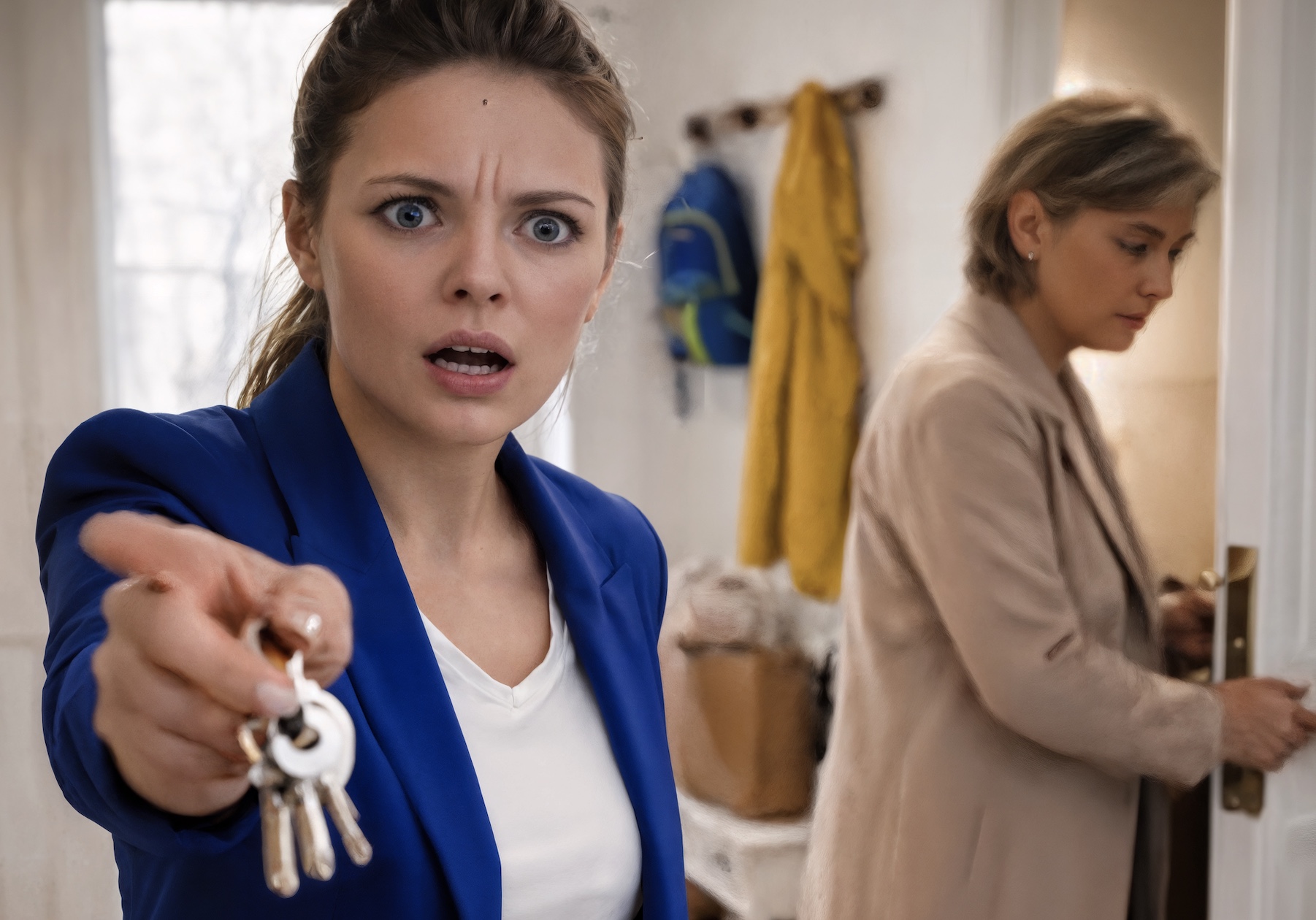
“The keys.”
“What keys?” Nina whispered.
“The keys to my apartment. The ones you took from the entryway today so you could come in here without asking me.”
Nina went even paler, but with shaking hands she reached into her robe pocket and pulled out a key ring with three keys.
“I… I didn’t want anything bad. I thought—”
Olga took the keys, closed her fingers around them, and slid them into her pocket.
“Don’t come into my home again without my personal permission. Ever. Not for any reason.”
The door closed quietly—no slam—but with absolute finality.
They walked down the stairs in silence. Gleb stayed close, holding Olga’s hand, glancing up at her now and then.
“Mom… Grandma was crying?”
“Yes.”
“Why? Because of me?”
Olga stopped on the landing between the first and second floors, crouched down in front of him, held his shoulders, and looked him straight in the eyes.
“Gleb, remember this for the rest of your life: when someone does something wrong—something dishonest—when they cross someone else’s boundaries, they can feel ashamed afterward. And sometimes they cry. But shame isn’t a reason to feel sorry for someone who hurt you. It’s a reason for that person to think—and not repeat their mistake. Do you understand?”
The boy nodded solemnly, even if he didn’t fully grasp it yet.
“I understand, Mom.”
In the car, Olga started the engine and sat still for a few seconds, staring straight ahead at nothing—at the gray wall of the building across the way.
Her hands were no longer shaking. Her breathing was calm. Her heartbeat steady.
She drove back to the hospital. An hour later, she and Gleb were sitting by Pasha’s bed as he woke and looked at his son in surprise.
“Why is he here?” he asked hoarsely. “Couldn’t Mom watch him longer?”
“No,” Olga said shortly. “She can’t anymore. Not at all.”
He looked like he wanted to ask for details, but when he met Olga’s eyes and saw something hard and unmovable there, he fell silent.
That evening, when Gleb had curled up asleep on a hallway couch in the hospital, covered with Olga’s jacket, Pasha asked quietly:
“What happened? Why is Gleb here? What’s going on with my mom?”
Olga told him—briefly, without dramatics, without extra emotion. About the papers spread out on their table. About the wallet and the money taken out. About the woman in the gray suit. About Nina’s words—protect the family, get everything in order.
With every sentence, Pasha grew paler.
“I… I didn’t think she was capable of that,” he whispered, his throat tight. “She’s my mother…”
“I know,” Olga said calmly. “And you’re not responsible for what she does.”
He squeezed her hand—weakly, but firmly.
“I’m sorry.”
“For what?”
“For my mother being like this. For you having to go through it.”
Olga shook her head.
“Don’t apologize for someone else’s choices, Pash. You didn’t do anything wrong. Just understand this: in our home, no one will make decisions or handle our things without both of us agreeing. No one. Not relatives, not friends—no one.”
He nodded in silence.
The next day, closer to noon, Pasha was discharged with instructions, medication, and strict orders to protect his nerves. The three of them went home—exhausted, wrung out, but together. Olga put the kettle on. Gleb climbed onto the couch with his tablet. Pasha stretched out beside him under a warm blanket.
The phone rang again and again—“Nina Petrovna” flashing on the screen. Olga declined every call without even looking.
“Maybe you should talk to her,” Pasha suggested carefully. “She is my mother. Maybe she really thought she was helping, she just… misunderstood things.”
“Later,” Olga said, firm. “When she understands she crossed a line. That she broke trust. That what she did wasn’t help—it was betrayal. Until then, no. I’m not ready.”
That night, after everyone was in bed—after Gleb was softly snoring in his room and Pasha had finally fallen asleep—Olga stood for a long time at the window in their dark bedroom, looking out at the shadowed courtyard, at the few windows glowing yellow.
She thought about how sometimes a small thing—a forgotten wallet, an unlocked door, five extra minutes on the road—can rip away a mask and show you what’s been hidden for years behind “care” and “love.”
She thought about how fragile trust really is. Break it once, and it never fits back together the same way—no matter how hard you try.
And she thought about how protecting what’s yours—your boundaries, your space, your rights—isn’t greed or selfishness.
It’s dignity.
It’s self-respect.
She drew the curtain, shutting the outside world out, lay down beside her husband, and pulled the blanket up.
The apartment was quiet.
Calm.
Safe.
And that was how it should be.