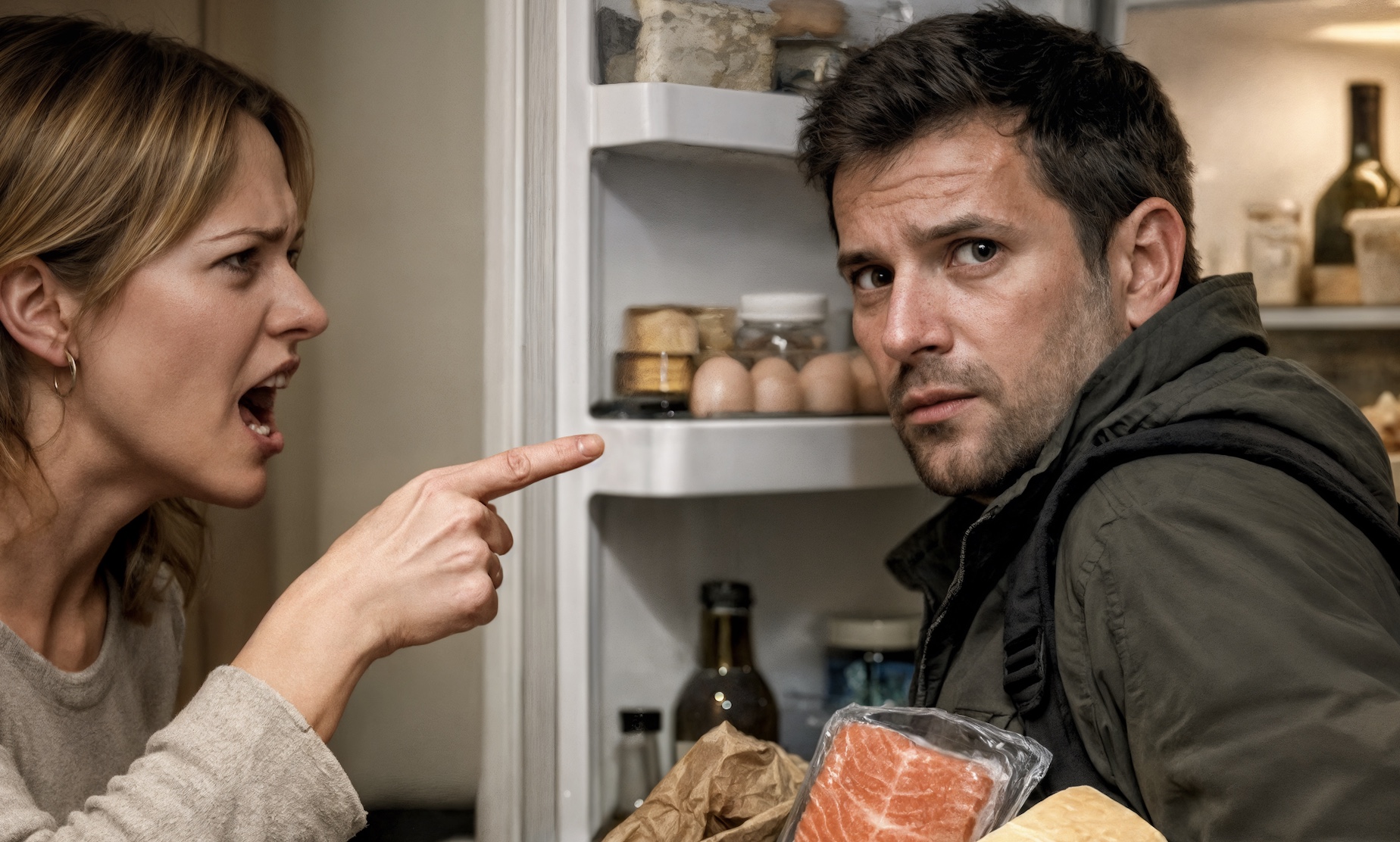
“Freeze.” Victoria said it softly, but with a tone so final that Anton—his hand already on the front-door handle—stopped as if he’d been pinned to the mat.
He turned around slowly, trying to wear that familiar mask of offended innocence. It didn’t fit, though—not with the heavy, overstuffed bag hanging from his right hand. The plastic was stretched tight, betraying the hard edges of boxes and the rounded shapes of jars inside.
Victoria stood there without even taking off her coat, raking him with her eyes the way a customs officer inspects suspicious luggage. The air carried her perfume—cold and expensive—and the sharp tang of his nervous sweat.
“I’m asking you,” she said, nodding at the bag where the unmistakable tip of a baguette stuck out—the one with sun-dried tomatoes she’d driven across town for after a twelve-hour shift—“where exactly do you think you’re going with my dinner?”
“To Lenka,” Anton grunted, shifting his weight. He tried to tuck the bag behind his back, but in their narrow hallway it looked pathetic. “She called. She feels awful. Says her blood pressure dropped, her fridge is empty. I figured I’d swing by, give her a hand.”
Victoria took two steps forward, closing the space between them. No screaming. No flailing. Her movements were controlled, precise. She simply reached out and yanked the bag toward herself.
Anton, caught off guard, instinctively tightened his grip.
The plastic tore with a loud snap.
The contents hit the floor with a dull, ugly thud.
On the tile by the entrance—right beside Anton’s muddy boots—slapped down a vacuum-sealed pack of lightly salted trout, glossy red-gold, priced like three café lunches. A wheel of aged cheese in a little wooden box rolled after it. A jar of olives with anchovies clinked against the baseboard. Hard, dark avocados scattered like billiard balls.
Victoria stared at the wrecked still-life, and inside her something cold and thorny began to grow.
These weren’t just groceries. They were her bonus. Her tiny celebration for finally closing a brutal project. She’d planned the evening—wine, bruschetta, silence, good food. And now her celebration lay in the grit by the door, ready to be shipped off to the usual address.
“So that’s ‘support,’ is it?” she asked, picking up the fish. “With trout? Seriously, Anton? Does Lenka’s blood pressure only respond to black caviar? Buckwheat makes her nauseous?”
“Don’t start,” Anton winced, crouching to gather the avocados. “She’s not okay. She’s sad. Autumn slump. She’s alone—she doesn’t even have anyone to drink tea with. And you’re grilling me over a piece of fish. What, you can’t spare it? We’re not starving.”
Victoria stepped back with clear disgust so his jacket wouldn’t brush her.
“You’re sneaking food out of our fridge and taking it to your sister—who doesn’t work and lives off your parents! Anton, I buy expensive fish and cheese for us, not for your lazy relatives.”
She hit every word like a hammer while he carefully wiped the olive jar with his sleeve, as if it were something precious.
“I got up at six. I sat through three meetings. I fixed supplier screwups until eight in the evening. I earned that damn cheese with my nerves. And what did Lenka do today—sleep till noon? Watch another Turkish series? And now she’s ‘sad,’ so she gets to devour my dinner?”
“You’re greedy, Vika,” Anton straightened, clutching the rescued items to his chest like newborns. His voice turned wounded. “You’ve got a calculator where your heart should be. It’s just food—consumable stuff. And she’s my sister. My blood. She needs support, not your lectures. So she eats a couple sandwiches—do we go broke? You’ll buy more. Your salary can handle it.”
“My salary can handle it because I work instead of whining,” Victoria said, stepping to the door and blocking the exit with her body. “And I buy this for myself. Not so your grown-up sister can snack on delicacies paid for by me. If she has nothing to eat, she can boil pasta. There’s a pack in the cupboard—cheap brand, forty rubles. Take it. Deliver that.”
“She doesn’t like pasta,” Anton blurted—and instantly realized how ridiculous it sounded.
Victoria gave him a smile that held no warmth at all.
“Oh—she doesn’t like it? What a tragedy. And I don’t like being treated like an idiot. You didn’t even ask me. You waited until I went to shower, gathered up everything tasty and expensive you could find, and tried to slip out. Like a rat, Anton. Like some station rat dragging off whatever isn’t nailed down.”
“Don’t you dare insult me!” he flared, red blotches spreading across his face. “I was trying to do the right thing! I thought we were a family—that everything was shared. But you split it into ‘mine’ and ‘yours.’ That’s petty.”
“Shared is when both people contribute,” Victoria shot back, arms folding across her chest. “When I contribute and you act like a delivery courier for ‘humanitarian aid’ to your sister’s apartment—that isn’t family. That’s parasitism. Put the food on the cabinet.”
“No.” Anton shook his head stubbornly, hugging the baguette and cheese tighter. “I promised Lenka. She’s waiting. I can’t show up empty-handed like some loser. I’m a man—I gave my word.”
“You gave your word at my expense,” Victoria said, her voice dropping into something quiet and venomous. “You spent my labor, my time, my money—so you could look like a ‘man’ in front of your sister. Funny how easy it is to be generous with someone else’s wallet. A hero-savior with a bag of stolen trout.”
She held out her hand, palm up—an order, not a request.
“Give it to me. Now. Or you walk out—and you don’t walk back in. Your keys are in your pocket; I’ll change the locks tomorrow. Choose, Anton. Act like an adult and return what you didn’t buy, or go feed Lenka with yourself. Completely. With your stuff and your address.”
Anton froze, searching her face for the familiar softness—for that old reflex to give in “for peace.” But there was only ice-cold certainty. No tears. No doubt. She was looking at him not like a beloved man, but like a nuisance stuck in her doorway.
“You won’t do that over a piece of cheese,” he said, uncertain, taking half a step back. “That’s insane. That’s… petty.”
“It’s principles,” Victoria cut him off. “And you have exactly ten seconds to decide what matters more: free trout for your sister, or a roof over your head. Time starts now.”
She pointedly glanced at her wrist where an expensive watch caught the light—another thing she’d bought herself, with no help from anyone. The silence in the hallway thickened until it felt physical. From the kitchen, the refrigerator hummed steadily—the same fridge Anton had been shamelessly emptying.
Anton exhaled heavily, as if someone had dropped a sack of cement onto his shoulders, and shuffled toward the kitchen. Victoria followed—no longer like a wife, but like an escort. Her eyes tracked his hunched back, the rigid shoulders under his T-shirt. He was furious. Not at himself, not at the mess he’d created—at her, for daring to count her own money.
In the kitchen he slammed the bag onto the glass table. The sound was sharp and unpleasant, the kind of rattle that makes you think the glass might crack under the pressure hanging in the air.
“Happy now?” he spat, dropping into a chair and turning toward the window. “Feel in charge? Humiliated your husband—good day’s work.”
Victoria walked up to the table without a word. She began laying the groceries out with methodical care, like a pharmacist arranging rare medicine. The trout went onto a cutting board. The cheese beside the fruit bowl. The wine bottle took the center. Every movement was calm—and that calm made it even more terrifying.
“Humiliated you?” she repeated, smoothing the prosciutto packaging. “Anton, humiliation is a grown, healthy man stealing food from his wife to take it to another grown, healthy woman. That is humiliation. What’s happening now is inventory.”
“Lenka isn’t a ‘woman,’” Anton snapped, turning on her. “She’s trying to find herself! She’s having a hard time. You know she quit that call center because the team was toxic. She’s creative—she can’t be thrown into a meat grinder like that. She needs time to breathe and figure things out.”
“Creative?” Victoria’s laugh was sharp enough to slice fillet. “Lenka’s been ‘finding herself’ for four years, Anton. Ever since she got kicked out of college for skipping classes. And you know where she’s looking? In Netflix shows and Instagram feeds. I’ve seen her stories. Two in the afternoon: ‘good morning with a latte.’ Four: ‘life is so hard in this gray world.’ Of course it’s hard when you live off your parents and your brother’s handouts.”
“She’s not freeloading!” Anton sprang up, banging his knee on the table leg. The pain only fueled him. “Our parents help voluntarily! That’s normal in loving families. And I help voluntarily too—because I care. And you… you’re just jealous. You have nobody but work. You’re a dried-up cracker, Vika. You measure love in supermarket receipts.”
Victoria braced her hands on the counter and leaned toward him across the table, across the heap of delicacies that had turned into a battlefield.
“I measure reality in receipts because I’m the one paying them,” she said quietly, mercilessly. “Let’s do the math, ‘loving brother.’ This apartment is rented. Who pays the rent? Me. Utilities? Me. Groceries, cleaning supplies, internet—everything goes on my card. Your mid-level paycheck goes to gas, your lunches, and… right. Lenka. You pay for her fuel, you pay for her manicure, and now you decided to feed her delicacies too. You live here like a tenant, Anton. A free, demanding tenant with opinions.”
Anton’s neck flushed deep red. The truth hit hard, and he had nothing to block it with except empty arguments.
“I contribute!” he shouted. “I take out the trash! I put up a shelf in the bathroom!”
“You put that shelf up after six months—until I finally called a handyman,” Victoria shot back, picking up the olive jar. “And the trash—yes, heroic. Hercules is trembling. But back to Lenka. You say she quit because the team was toxic? She left the job before that because ‘getting up early is torture.’ Before that—‘the boss is an idiot.’ Anton, your sister is twenty-eight. She’s healthy, strong—built for work. But instead she sits in your parents’ three-room apartment, eats on their dime, and complains about how hard life is. And you, instead of giving her a push, bring her trout. You’re not helping her—you’re pampering her.”
“She needs support!” Anton slammed his fist on the table, making the wine bottle chime. “She’s depressed! Do you even know what that is?”
“Depression is treated by doctors, not by sandwiches with red fish,” Victoria snapped. “If she’s sick, take her to a psychiatrist. I’ll even pay for the first appointment, fine. But something tells me her ‘depression’ disappears the second someone offers her a trip to Turkey or a new iPhone.”
Anton went silent, breathing hard. He stared at the groceries on the table, and his expression wasn’t guilt—it was frantic calculation. Victoria’s logic didn’t matter. The budget didn’t matter. Only one thing mattered: he’d already promised.
“Listen, Vik,” he said, abruptly switching from rage to pleading, almost syrupy—and that made it even more disgusting. “Can we skip the principles, yeah? I already told Lenka I’m bringing something tasty. She’s waiting. We were going to have some wine, talk. I can’t call her and say, ‘Sorry, my wife took the food back.’ I’ll look whipped. Just let me take at least half. The fish and the cheese. Keep the wine. Please. I’ll pay you back when I get paid.”
Victoria went still. She looked at him and felt something inside her finally snap—some thin thread of respect that had been holding this marriage together broke with a dry, final crack.
He hadn’t heard a word she said about the budget, about leeching, about exhaustion. It all went right past him. For Anton, the real disaster wasn’t that he was stealing from his wife—it was that he might look pathetic in front of his sister. His “generous brother” image mattered more than the woman he lived with.
“Pay me back?” she echoed, voice like ice. “Your paycheck is two weeks away, Anton. And it’s already spoken for—your car loan, the car you use to chauffeur Lenka around. You won’t pay me back. You never do.”
“Oh, here we go again!” Anton snapped, anger rising when pity didn’t work. “You can’t spare something for family? You’re selfish, Vika. Pure selfishness! You hoard money like a dragon and rot on it. People are supposed to help each other!”
“People, yes,” she agreed, opening the refrigerator. “Parasites get removed. Here’s how it is: we’re done talking. The food stays here. That’s my dinner, my breakfast, and my lunch tomorrow. And you… you can go to Lenka. She’ll have tea. Sugar too, I hope. Sit together and discuss what a monster I am. They say therapy helps.”
She started putting everything back onto the shelves—trout, cheese, olives—hiding it deep in the clean white cabinet, far from his greedy hands.
Anton watched with the face of a child whose candy had been taken away, but behind it something darker was catching fire—real, adult hatred. He felt himself losing, and that infuriated him most of all. He wasn’t used to being told “no,” especially not after he’d already decided.
“You’ll regret this,” he hissed. “You’re destroying a relationship not over cheating, not over booze, but over food. That’s rock bottom, Vika.”
“Rock bottom, Anton,” she said, shutting the fridge and turning to him, “is a man trying to steal cheese from his own home to buy the love of a sister who doesn’t even care about him. That’s the real bottom. And you’ve been living down there for a while.”
“Rock bottom is counting bites in your own house,” Anton said quietly. His voice lost its hysterics and turned heavy, metallic. He stopped defending himself and went on the attack. “You know what your problem is, Vika? You’re empty. Nothing inside you except Excel sheets and payment schedules. You fill that emptiness with expensive cheese, branded clothes, and your career—but there’s no soul in you. Lenka has one. She’s alive. She feels this world in her skin; its imperfections hurt her, she suffers. And you… you just function. Like an ATM.”
Victoria blinked slowly. The words were meant to cut, but they didn’t land. They bounced off the armor of her fatigue without leaving even a scratch. She looked at her husband and, with startling clarity, saw a stranger. Not a partner she’d planned a future with, but a parasite who’d learned the right speeches about “family” and “support” so he could keep feeding.
“How fascinating,” she said, not raising her voice. “So I’m an ATM with no soul. Then what are you—my PIN code? Or maybe the armored-car guy, collecting cash from the ‘empty’ wife to deliver it to the ‘spiritual’ sister? You’re standing here in sneakers I gave you for your birthday, in a jacket bought with my bonus, lecturing me about my lack of depth? Anton, your ‘spirituality’ ends precisely where you need to open your wallet.”
“Don’t you dare turn everything into money!” Anton barked, stepping toward her, his face twisting. “Money is paper! Dirt! You’re throwing sneakers in my face? Seriously? Choke on them! I’m talking about relationships! About helping people when they’re hurting, not only when it fits your budget! Lenka is in hell right now—do you get it or not? She needs attention! And this stupid bag of food is just a sign—a symbol that she’s not alone!”
“A symbol,” Victoria repeated, meeting his eyes. “A perfect symbol. Stolen trout as a symbol of brotherly love. Very poetic. Why don’t you buy that symbol yourself? Oh right—I forgot. Your card’s empty. Because ‘spiritual’ Lenka wanted sushi last week, and before that she wanted new earbuds. You burned through it all. And now, to keep playing the saintly brother, you reach into my pocket.”
“I’m taking the food,” Anton said suddenly, voice hardening. There was a dangerous gleam in his eyes—the look of a fanatic willing to do anything for his idea. “I’m not asking you, Vika. I’m telling you. I promised my sister. I’m not calling her to say my wife is a greedy bitch who refused a piece of fish. I’m taking the bag, I’m going to her place, we’ll sit, I’ll calm her down. Then I’ll come back and we’ll talk—when you cool off and remember what humanity is.”
He moved toward the fridge, trying to edge past her. His shoulder bumped hers—rough, proprietary, as if she were furniture blocking the way.
Victoria didn’t move. She planted her hip against the refrigerator door and folded her arms. Barely half a meter separated them now. She could smell his deodorant mixed with stale beer from last night—beer he’d been drinking while she finished a report.
“Move,” Anton ground out. “Don’t push me into sin. I don’t want to use force, but you’re making me. It’s just food, Vika! For God’s sake—it’s just damn food!”
“For you, it’s food,” she answered coldly, holding his gaze. “For me, it’s a boundary. One you crossed without even noticing. You think this is about fish? It’s about the choice you made. You already chose—back in the hallway, when you hid that bag behind your back. You chose Lenka’s whim over my work. You chose to be good to her by being vile to me.”
“I didn’t choose!” he shouted, veins standing out in his neck. “I’m trying to sit on two chairs so everyone’s okay! So my sister doesn’t cry and you stay calm! But you won’t let me! You’re clinging to this fridge like a chained dog!”
“Then don’t try to sit,” Victoria advised, her calm almost sinister against his hysteria. “You’ll split yourself in half. You say I’m empty? Fine. In my ‘empty’ world there’s a rule: if you don’t work, you don’t eat. And you definitely don’t eat delicacies. Your sister leeches off your parents, and you’re trying to leech off me to feed her leeching. It’s a food chain, Anton—and I’m stepping out of it.”
She watched his throat jump, his fists clench and unclench. He was right on the edge. He wanted to shove her aside, rip the food away, prove his right as the “alpha” to claim the добыча—the cave’s resources. But something in her eyes stopped him. There was no fear there. Only absolute indifference mixed with disgust. The way you look at a cockroach crawling across the dinner table.
“If you touch me,” Victoria said very softly, almost a whisper, yet every word dropped like a stone, “or if you touch that refrigerator handle—there is no road back. No ‘we’ll talk later.’ No ‘you’ll cool down.’ That will be the end. Final. Credits. Do you understand me?”
Anton froze, breathing hard, staring at the white enamel door hiding his “prize,” then at his wife’s face. His mind raced. He was used to Victoria softening. Used to her grumbling, then forgiving, “meeting him halfway.” He’d always exploited that.
But now he felt it: the ice wasn’t just cracking—it had already given way.
“You’re bluffing,” he tossed out, trying to claw back control. “You won’t throw your husband out over a pack of trout. That’s ridiculous. Any court would tell you it’s joint property. I’m entitled to half of what’s in that box!”
“Legally—maybe,” Victoria nodded. “But we’re not in court, Anton. We’re on my kitchen floor. And I’m not dividing property. I’m dividing my life into ‘before’ and ‘after.’ In the ‘after,’ there’s no place for a grown man who steals food from his own family for the whims of a sister who refuses to grow up.”
She paused, letting it sink in.
“So decide. Right now. Either you turn around, take off your jacket, and go fry potatoes—the ones you bought with your own money last month. Or you open that fridge. But understand: along with the fish, you’ll take your freedom. Complete and irreversible.”
Anton stood there rocking heel to toe, eyes darting. He hated her in that moment—hated her for being right, hated her for being stronger. But most of all he hated the fact that without her card, without this warm apartment and stocked fridge, he’d become what he truly was: an errand boy with a king’s ambitions.
Still, the picture of Lenka waiting with “treats,” the picture of himself as savior and benefactor, was intoxicating. He couldn’t lose. He couldn’t show up and admit, “Vika wouldn’t let me.” That would kill his ego on the spot.
His hand snapped toward the refrigerator handle—fast, rough.
“Move,” he barked, shoving Victoria aside with his shoulder. “I’ll take what I want. And you should get your head checked.”
Victoria stumbled, her shoulder hitting the countertop, but she stayed on her feet. She didn’t fight him. She simply stepped back and watched as he yanked the door open and grabbed greedily—fish, cheese, olives—everything he could, clutching it to his chest like the most valuable treasure on earth.
“That’s right!” he shouted triumphantly, kicking the fridge door shut. “I’m a man! I decided! And I don’t care about your ultimatums!”
He looked at her, expecting tears, screaming, a meltdown—something he could use to justify himself. But Victoria was silent. She stared at him the way you look at someone who has already died.
Without a word, she turned and walked into the entryway. No shouting, no smashed dishes—the scene he was probably waiting for so he could say, See? She’s hysterical. Her silence was worse than any tantrum. It swallowed the apartment. Sounds went soft, distant, irrelevant.
She passed him without brushing him, as if he were a ghost.
Anton, still hugging his pile of packages, followed with a stupid, victorious grin. Adrenaline bubbled in his blood, making him feel like a conqueror—a provider who had defended his right to distribute the cave’s resources.
“See?” he tossed after her, smug and bright. “The sky didn’t fall. I’ll drop this off to Lenka, sit for an hour, she’ll calm down, and I’ll come back. I’ll even buy you a chocolate bar on the way so you won’t sulk.”
Victoria swung the front door wide open. Cold stairwell air poured into the warm apartment, carrying cigarette smoke and damp plaster. She stepped aside, one hand on the door, and looked at Anton with the calm appraisal of a pathologist examining a failed sample.
“You don’t understand,” she said evenly. “You’re not coming back.”
Anton stopped on the threshold, shifting his feet. The vacuum-packed trout slipped in his hands; he awkwardly pinned it under his chin to keep from dropping it, instantly looking ridiculous and small.
“Stop the drama, Vika,” he snorted, trying to squeeze past her. “‘You won’t come back,’ ‘I’m leaving’—kindergarten theatrics. I live here. My things are here—my computer, my life. Nobody gets divorced over a piece of fish. It’s laughable.”
“Laughable is a thirty-year-old man stealing food from his wife to feed a sister who simply doesn’t want to work,” Victoria said, stepping in front of him again, blocking him with her body. “You made your choice, Anton. You said you’re a man and you decided. So live with it. You chose Lenka—her whims, her laziness, her ‘depression.’ Congratulations. That’s your life now. Full package. All-inclusive.”
“You can’t do this!” Anton shrieked, finally understanding she wasn’t playing. “This is my apartment too! I’m registered here!”
“Temporary registration,” Victoria reminded him, lips curling into a mean little smile. “Which expired a month ago. I just forgot to mention it—and you, as usual, didn’t check the paperwork. So legally? You’re nobody here. A guest who overstayed.”
She reached toward the little cabinet where his keys lay. Anton jerked, trying to intercept—but his hands were full of stolen groceries. The olive jar slipped again and thudded onto the floor, rolling toward the threshold.
Victoria scooped up the keyring and closed her fist around it.
“And now—get out.”
“You’re insane!” Anton screamed, fear and rage twisting his face. “Where am I supposed to go at night?! My things are in there! My laptop! Documents!”
“To Lenka,” Victoria said calmly, gesturing toward the dark stairwell. “Go to Lenka. Comfort her, feed her, sleep on her doormat if you want. Isn’t that what you were so eager to do? Here’s your chance to be the best brother in the world. Live together. Moan together about the cruel world. Eat that miserable fish—on your own dime. I’m not a charity.”
Anton stood in the doorway, stunned by the absurdity. In his arms was expensive food—but behind him there was no home. He stared at the woman he’d lived with for three years and saw someone he didn’t recognize: hard, cynical, unbreakable.
“Vika, come on,” he whimpered, switching tactics so fast it was almost pitiful. “Okay, I went too far. I snapped. Fine. I’ll leave the food. Screw Lenka. Let her eat pasta. I’m not going anywhere.”
“Too late,” Victoria said flatly.
She placed her palms against his chest—right over the crinkling packages of cheese and meat.
“You already left,” she said. “You left the moment you decided my feelings were worth less than your sister’s appetite.”
Then she shoved him. Hard. She put the whole evening into that push—the exhaustion, the disgust, the last thin scraps of patience.
Anton didn’t expect it. He lost his balance, stumbled, and flailed—spilling out onto the landing.
The groceries flew everywhere. The cheese rolled across the filthy concrete. The trout slapped into a puddle left by someone’s wet boots. The wine bottle he’d been pinning with his elbow slipped free and shattered against the metal railing. Dark red liquid splashed across his light jeans, the walls, the floor—like a crime scene.
Anton, slipping in the wine, barely stayed upright, grabbing the railing with both hands.
“You bitch!” he roared, staring at his ruined jeans and the broken bottle. “You’ll pay for this! You’ll regret it! You’ll come crawling back! Who would want you—an old, cold, dried-up hag!”
Victoria stood in the doorway of her bright, clean entryway, looking down at him like a judge. She took in his twisted face, the wine stains, the scattered “luxury” food smeared into stairwell dirt. It was pathetic.
And the most frightening part was this: she felt nothing. No pain, no pity, no love. Only a huge, ringing relief—like a tumor had finally been cut out of her.
“I’ll pack your things into bags and put them by the trash chute tomorrow at eight a.m.,” she said in a voice like ice. “If you don’t pick them up by nine, the homeless will. They need them more than you do. At least they don’t pretend to be decent.”
“Vika!” He took a step toward the door, animal panic in his eyes.
“Goodbye, Anton. Enjoy your meal.”
She pulled the door toward herself. The heavy metal slab began to close, sealing her world off from his chaos.
“Vika, wait! The keys! At least give me my phone charger!”
Click.
The door shut.
Victoria turned the night bolt twice. The metallic scrape sounded like a final chord.
She listened. Outside: shuffling, curses, fists slamming metal, shouting that she was a “psycho” and a “bitch.” But the sounds already belonged to somewhere far away—to another universe that no longer touched her.
She exhaled slowly, resting her forehead against the cool door.
Silence.
At last, blessed silence. No whining. No demands. No lies.
Victoria walked back into the kitchen. On the table lay the olive jar Anton had forgotten—the single survivor of the battle. She smirked, popped it open with a crisp little snap, and took one olive.
It was salty and sharp.
It tasted like freedom.
She picked up her phone and blocked Anton’s number. Then Lenka’s. Then their mother’s.
“Poor thing—she’s sad,” Victoria whispered into the empty kitchen, and for the first time that evening, she smiled for real. “I’m not.”