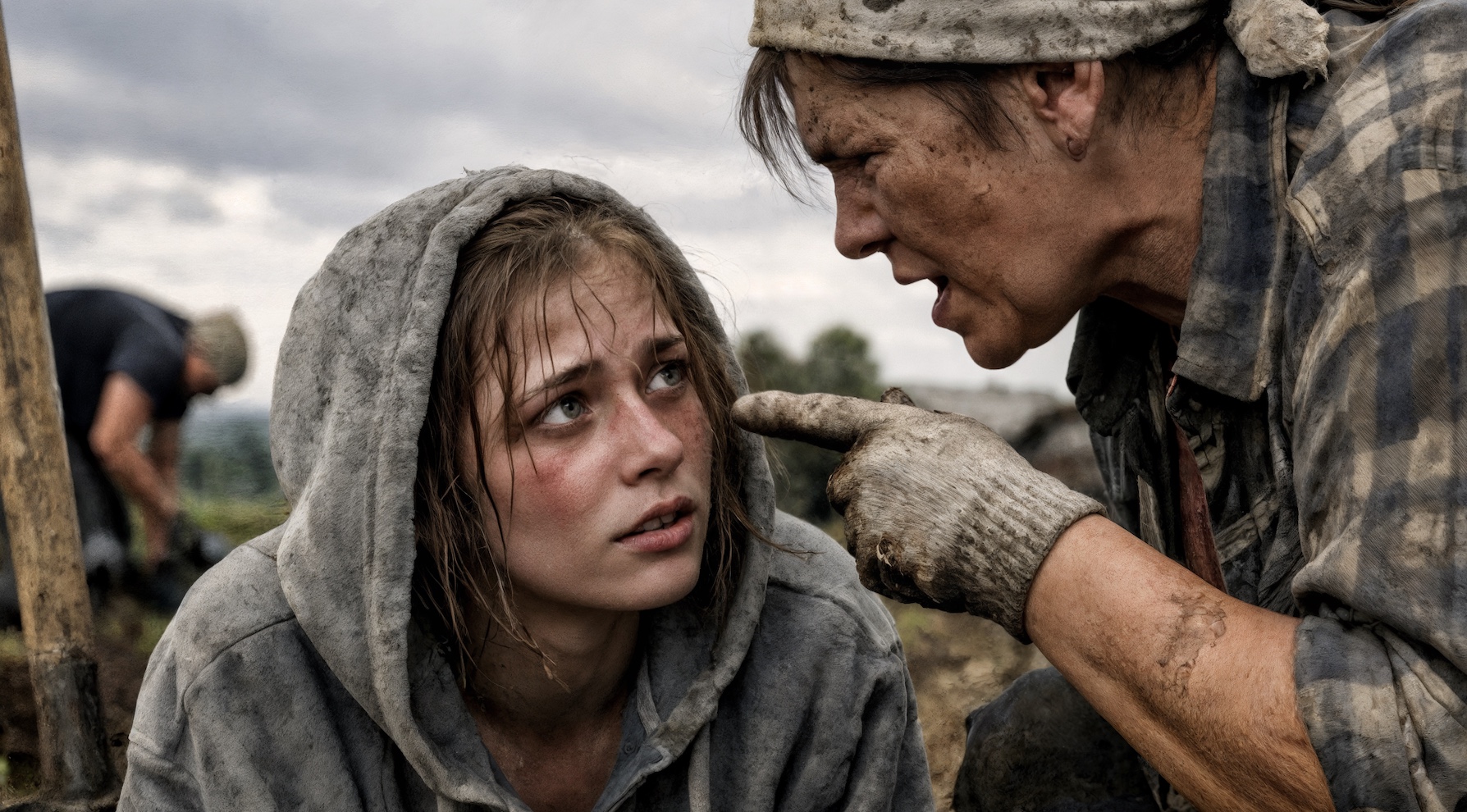
“Are you deaf or what? I’ve said it three times already—get up!”
Vitalik’s voice didn’t simply echo through the bedroom; it bored into Olga’s fevered mind like a dull, rusted drill bit. Each word pulsed in her temples, sharp and relentless. The thin blade of light slicing through the heavy curtains felt blinding, scorching her eyes. She tried to swallow, but her throat felt scraped raw, as if lined with crushed glass and sand. With enormous effort, she forced her eyelids apart.
Vitalik stood over the bed, already dressed for battle. He wore his old camouflage pants, baggy at the knees—the ones reserved exclusively for trips to his mother’s dacha, which he grandly called the “family estate”—and a large plaid flannel shirt that carried the stale scent of long storage. He looked energized, irritated, and determined, like a commander preparing for war against potato beetles.
“Vital…” Olga rasped. Her own voice startled her—it sounded hoarse, almost crow-like. “I feel terrible. I’m burning up. The thermometer… look at it…”
She nodded toward the nightstand, where the digital thermometer lay, its earlier beep still echoing faintly in her memory.
He didn’t even glance at it. Instead, he adjusted the strap of his backpack with an impatient jerk of his shoulder.
“I don’t care if your fever’s sky-high! Mom said the potatoes need digging today. That means you get up, swallow something, and get moving—or I’ll make your life so miserable you’ll wish you hadn’t tested me!”
Olga shut her eyes. The bed seemed to spin beneath her like a runaway carousel. She shivered violently under two thick wool blankets, her teeth rattling.
“Can’t you hear me?” she whispered without opening her eyes. “I can’t stand up. My legs feel like cotton. I’m nauseous. Why are we even talking about potatoes? They said it’s going to rain…”
“Exactly!” he bellowed, making her flinch. “It’s going to rain! That’s why we have to hurry! Are you even thinking, or has your brain melted? If we don’t dig them up now, they’ll rot! You want my mother starving all winter? Living off her pension and buying that chemical garbage from the supermarket?”
He began pacing—three heavy steps forward, three back. The floorboards trembled under his boots, and every vibration thudded against the base of Olga’s skull.
“We have money,” she tried weakly. “We can buy her potatoes. The best ones. I’ll pay for them. Just let me rest.”
He stopped abruptly and loomed over her. His face flushed crimson, a vein bulging on his forehead. He despised being reminded that she earned more than he did. It was his sore spot—and she had pressed it.
“Keep your charity to yourself!” he snapped, spraying spit. “It’s not about money—it’s about respect! She worked all summer, watered those plants, picked off bugs! And you’re lying here like some princess, turning your nose up? ‘We’ll buy them!’ You’re supposed to work, Olga! Not hide under blankets while others sweat!”
He strode to the window and yanked the curtain open. Gray autumn light flooded the room, cold and lifeless. Outside, wind bent the bare branches of the poplars, and the sky hung heavy and metallic, ready to burst into freezing rain. Perfect weather for pneumonia—not manual labor.
“Get up!” he barked, kicking the bed frame. “Stop pretending. I know your ‘flu.’ Last night you were fine, laughing at your show. But when there’s work—suddenly you’re dying. Take some medicine and move. Fresh air will fix you. You’ll sweat it out with a shovel.”
Olga struggled to sit up. Her head felt forged from iron, filled with molten lead. The room tilted sideways. Nausea surged upward. She clutched her head to steady it.
“I’m not faking,” she said softly. “Touch my forehead if you don’t believe me.”
“As if I want your germs,” he replied with disgust, stepping back. “I have responsibilities. Unlike some people, I won’t let my mother down. I have a conscience.”
He grabbed the jeans she had set aside the night before and hurled them at her face. The metal button struck her cheek sharply.
“Get dressed. Five minutes. If you’re not ready, I’ll dress you myself—and I won’t be gentle.”
She pulled the jeans off her face slowly. Her cheek stung, but that was nothing compared to the cold clarity spreading inside her. This wasn’t fever chills. It was realization—terrible and crystalline. She finally saw exactly who she was married to.
She looked at him and no longer saw a husband. She saw a bitter, insecure overseer. If she coughed up blood, he’d probably hand her a tissue and tell her not to stain the car. The potatoes mattered more. His mother’s command mattered more. His need to be the “good son” mattered more than her health—maybe even her life.
“What if I collapse out there?” she asked quietly. “What if my heart gives out? My pulse is over one twenty.”
He smirked as he zipped his jacket.
“You won’t die. A shovel’s the best heart workout. Stop whining. Clock’s ticking.”
He checked his watch theatrically and stomped out. In the kitchen, dishes clattered—apparently he was fortifying himself while his “lazy wife” prepared.
Left alone, Olga stared at the gray window, the jeans on the bed, her trembling hands. Beneath the fever and weakness, something dark began to rise. Not hysteria—but a deep, silent fury. The kind that builds in a trapped animal that realizes there’s nowhere left to retreat.
Five minutes passed. She didn’t measure them by the clock but by his footsteps returning down the hallway—sharp, impatient, like a guard coming for a prisoner. The door flew open, slamming against the wall.
She hadn’t moved. Curled under the blankets, she shook violently.
“Well?” he demanded, hands on hips. “Still here? Think I’m joking?”
He stepped in, bringing the smell of fried sausage and cheap coffee. Normally comforting, now it made her stomach twist.
“I need a doctor,” she whispered. “Or rest. Please.”
“Rest!” he mocked. “Does my mother not need help? Should the potatoes rest in the ground and rot? You’re selfish, Olga. Completely selfish.”
He yanked the blanket off her without warning.
Cold air lashed across her sweat-damp skin like a whip. She gasped as the blanket flew to the corner. Curled in her thin pajamas, she shivered uncontrollably.
“Maybe you needed some air,” he sneered, throwing clothes at her. “My mother stands in the garden with sky-high blood pressure and doesn’t complain! And you collapse over a little fever. Aren’t you ashamed?”
“Mare…” she repeated faintly when he called her that.
“Yes, a mare! A healthy, lazy woman! I feed you, I support you, and you can’t show a little gratitude!”
Something inside her snapped.
Feed me? her mind echoed. In my apartment? On my salary—which is double yours? Driving my car you pretend is yours?
The fever remained, but beneath it burned an icy clarity. The love she once felt was gone—burned away by contempt. The man in front of her was a stranger who saw her as property.
She slowly stood, gripping the mattress for balance.
“There, see?” he smirked. “Suddenly you have strength.”
“I’ll warm up the car,” he ordered. “Ten minutes. And no tricks. Smile for my mother.”
He left, whistling.
Olga stood swaying. Then she moved—not toward her clothes, but to the dresser. From the bottom drawer she pulled out heavy-duty garbage bags. The black plastic rustled ominously.
She walked to the closet and began emptying his side. Shirts, sweaters, jeans—everything went into the bags. Clean or dirty, expensive or cheap—it was all the same now. Just remnants of a man she no longer loved.
She swept his gadgets, chargers, and prized fishing gear into another bag. The expensive spinning rod snapped as she shoved it inside.
He stormed back in, freezing at the sight.
“What are you doing? Have you lost your mind?”
“This isn’t for a trip,” she rasped, tying a tight knot. “It’s for departure.”
She dragged the bags to the balcony and flung them over the railing.
They hit the muddy garden below with a wet, heavy thud. The plastic tore, spilling his clothes into the sludge. The fishing rod cracked against concrete.
Vitalik howled.
“Open the door!” he screamed later from below, covered in mud, clutching a filthy sock. “I’ll call the police! You can’t do this!”
“Apartment’s mine,” she replied calmly from above. “I’m changing the locks today.”
She went inside, locked the door—once, twice, slid the bolt.
From the balcony she watched him scramble in the mud, trying to salvage what he could as rain began to fall again.
Then she went back to the bedroom. The room was a mess, but the air felt different—lighter.
She collapsed onto the bed, pulling the blanket to her chin. The fever still burned, but now it was just illness. The real parasite—the one draining her life for years—was gone.
“Your mom said the potatoes need digging,” she murmured into the pillow as sleep overtook her. “So go dig, Vitalik. Dig all you want. I’m going to rest.”
Within minutes she fell into a deep, healing sleep. Even the persistent ringing of the doorbell couldn’t wake her.
Her temperature began to fall.