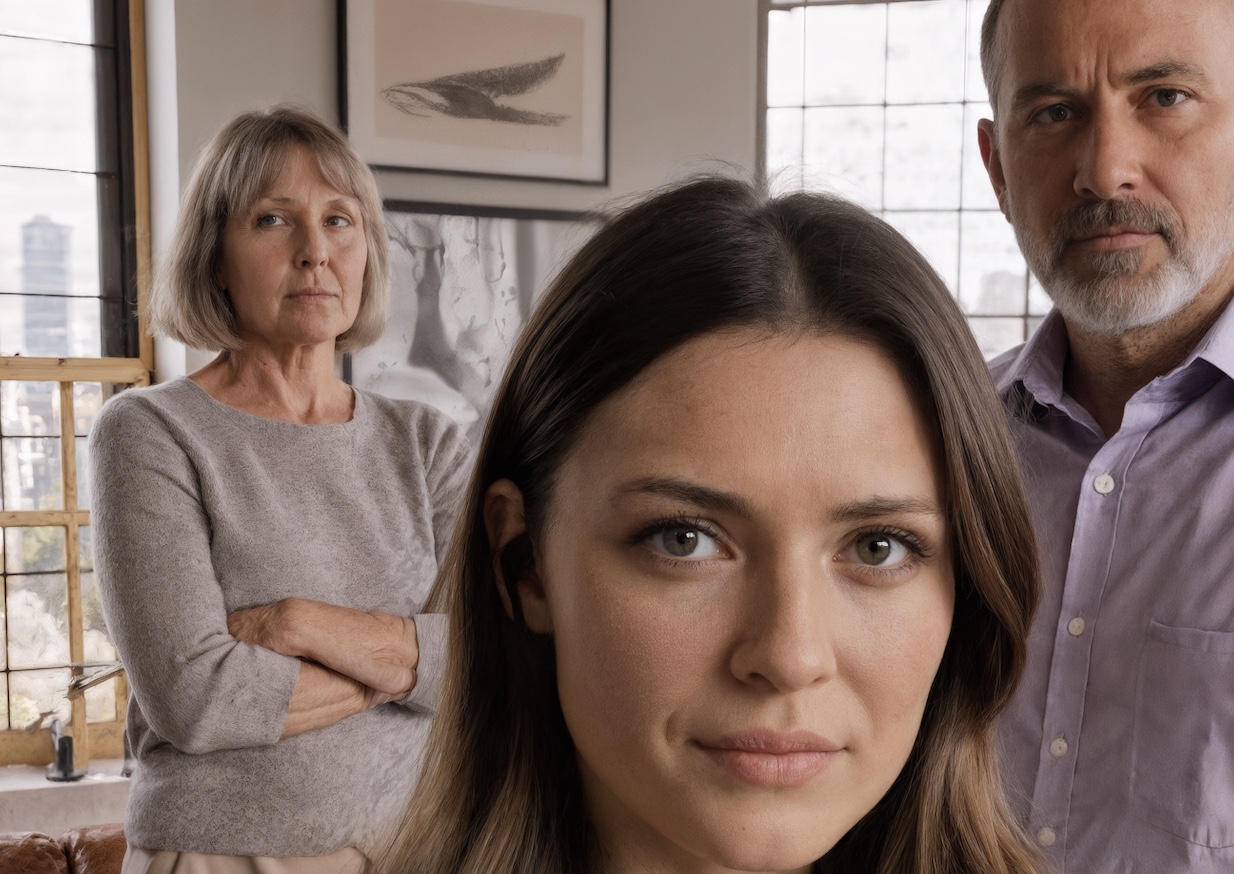
I stood in the entryway mirror, taking my look apart with a critic’s precision.
The three-thousand-ruble jeans were gone—replaced with a cheap mass-market pair. My expensive jacket had been traded for a puffer coat from Avito that I’d bought специально for this little show. Even my purse was swapped out for a scuffed fabric tote I’d found in my mom’s closet.
“Are you for real?” Anton watched me, baffled. “Why are you doing this, Vika? What’s with the costume?”
“I want to see what your relatives are actually like,” I said, adjusting my intentionally plain hairstyle. “You told me yourself your mom is… very selective about people.”
In a whole year of dating, Anton had never invited me to meet his parents. There was always a reason: his mother was sick, his parents were out of town, the timing was wrong. But now that we’d decided to get married, the meeting couldn’t be avoided.
“She’s just cautious,” he said, nervously straightening his tie. “After my brother married… well—let’s just say it didn’t end well.”
I knew that story.
His older brother, Maksim, had gotten involved with a woman who, according to the family, “latched onto him.” Their divorce was a scandal—property division, endless court hearings, the whole mess.
“I get it. That’s exactly why I want to check,” I said, taking my fiancé’s hand. “Anton, I just need to understand who I’m dealing with. If your family is willing to accept me only because of money, then what sincerity are we even talking about?”
He sighed like someone walking toward a storm.
Anton was a programmer and he earned well—but my income was in a different league. I led the digital marketing department at a major IT company, and my 400,000 a month was the result of ten years of relentless work and constant self-education.
But Anton didn’t know that. He assumed I earned like an average manager—maybe 100,000 at most.
“They’re good people,” he said, putting an arm around my shoulders. “They just worry about me. Mom loves order and stability. Dad’s calmer, but he follows Mom’s lead.”
“And that’s why I want to understand what ‘stability’ means to them,” I replied. “My wallet—or who I am?”
We drove to their place in Butovo in my car. Well—not in my usual Mercedes. I’d borrowed an old Solaris from a friend.
Anton was quiet the whole way, only occasionally glancing at me with concern.
“And what if you don’t like how they behave?” he asked at last.
“Then I’ll tell the truth about what I think,” I said, slowing at a traffic light. “Anton, we’re getting married. That means your parents become mine too. I have to know who I’m dealing with.”
“Sometimes you’re too principled,” he muttered.
“Is that bad?”
“No,” he said, then softened. “Honestly, that’s probably why I fell in love with you.”
I smiled.
Anton truly loved me. I didn’t doubt it. But his family mattered to him—deeply. And I understood that if they rejected me, our relationship would be hanging by a thread.
That’s why I staged this little performance: to test everyone and finally put the dots on every ‘i.’
We parked outside a typical nine-story building. Anton tugged at his clothes and looked at me.
“Maybe you’ll just be yourself?” he tried one last time.
“Too late,” I said, picking up the worn purse. “We’re already here.”
We climbed to the sixth floor on foot. The elevator, of course, was broken. Anton didn’t speak, but I could feel the tension in him.
On the landing he took out his keys, but before he could unlock the door, it opened. A woman in her fifties stood there—hair neatly styled, wearing a home outfit that was very much not cheap.
“Antosha!” She hugged her son, then examined me over his shoulder. “So this is your Victoria?”
“Yes, Mom. Meet her. Vika, this is my mother—Elena Borisovna.”
I held out my hand, doing my best to look slightly shy.
“Nice to meet you. Anton has told me so much about you.”
“Come in, come in,” Elena Borisovna said, sweeping me with a quick, appraising glance. “Take off your coat.”
I removed the cheap puffer jacket. Underneath was a plain turtleneck from a budget brand. Anton’s mother looked me over from head to toe, pausing on my boots—thankfully, also not designer.
“Go into the living room. Vladimir Petrovich!” she called into the apartment. “They’re here!”
The apartment was a standard three-room place, but with good renovation and sturdy furniture. Diplomas and photos hung on the walls. Books and travel souvenirs lined the shelves. The atmosphere felt warm—almost comfortable.
A man came out of the room: tall, gray-haired, in house pants and a shirt. интеллигентный, the kind of person you could picture reading a newspaper with his morning tea.
“Dad, this is Vika,” Anton introduced me.
“Vladimir Petrovich,” his father said, shaking my hand. “It’s very nice to finally meet you.”
He seemed more open than his wife. His smile was honest—without the cold measuring look Elena Borisovna had given me.
“Sit down at the table,” the hostess said, gesturing toward the kitchen. “I made your favorite pies, Antosha.”
At the table, the usual interrogation began—dressed up as polite conversation. Elena Borisovna asked about my work, my family, my plans.
I told the truth about my parents. My mother is a nurse at a clinic, my father a factory mechanic. About my job, I lied, introducing myself as an ordinary manager at a small firm.
“And your salary?” she asked bluntly. “You understand, it’s important to us that Anton isn’t the one carrying the whole family.”
Anton flushed.
“Mom, come on…”
“It’s fine,” I said with a smile. “I understand your concern. I make around forty thousand. Not much, but it’s enough to get by.”
Elena Borisovna and Vladimir Petrovich exchanged a look. I could practically see her calculating our “future family budget” in her head.
“And do you have ambitions? Career growth?” his mother continued.
“I try,” I said, playing timid. “But you know, without connections or a university degree, it’s hard. I only went to a technical college.”
In reality, I had two university degrees—economics and marketing—plus an MBA I’d earned part-time while already working.
“And where is Victoria’s family from?” Vladimir Petrovich joined in.
“Ryazan. My parents live there, in their own house. Small, but it’s theirs.”
“I see,” Elena Borisovna nodded. “And have you thought about children? Anton really loves kids.”
Anton and I had talked about it more than once. We both wanted a family—just not immediately. We wanted to live for ourselves first.
“Of course,” I said. “But not in the first year. I want us to get firmly on our feet first.”
“Right,” Vladimir Petrovich supported me unexpectedly. “A family is responsibility.”
But Elena Borisovna had clearly already formed an opinion of me. She turned noticeably colder, answered in short phrases, and then switched to talking to her son about family matters as if I weren’t even there.
Anton felt the awkwardness and tried to pull me into the conversation, but his mother stubbornly ignored anything I said.
At the end of dinner she stood up.
“Antosha, help me clear the dishes in the kitchen.”
I was left alone with Vladimir Petrovich. He poured himself tea and looked at me carefully.
“Don’t take Lena’s behavior personally. She just worries about her sons.”
“I understand,” I said honestly. “Any mother wants the best for her child.”
“Exactly. After what happened with Maksim she became extremely cautious,” he sighed. “His wife seemed like such a sweet girl. And then…”
“And then what?” I asked.
“It turned out she had one and a half million in debt. Maksim paid it off—thought it was temporary trouble. Then it came out she gambled. More debt. Again he paid. And when they divorced, she went to court and got half the apartment—one he bought with his own money.”
It was a sad story, and I understood the family’s fears. But something else hurt more: it was obvious that, from the start, I’d been filed away under “potential problem.”
From the kitchen came muffled voices.
Anton was explaining something. His mother replied sharply, though quietly. I listened, tense, but couldn’t make out the words.
“Do you not doubt your son?” I asked Vladimir Petrovich. “I mean—his ability to choose people?”
He smiled.
“Anton is a good boy. Maybe too trusting. He always sees only the good in people.”
“And that’s bad?”
“Not bad. Just dangerous in this world.”
The kitchen argument grew louder. I heard Elena Borisovna raise her voice:
“Look at her! What is she, really? Forty thousand salary, a technical college, parents from the provinces…”
“Mom, what does that have to do with anything?” Anton answered. “I love her.”
“Love is wonderful, son. And how will you live? On your salary alone? And when kids come? She’s obviously not the kind who’ll bring real money into a family.”
I felt sick. Vladimir Petrovich looked embarrassed—he clearly realized I was hearing everything.
“Maybe we should go to the balcony?” he suggested.
“No,” I stood up. “It’s not necessary. I’ve heard enough.”
“Victoria, don’t take it to heart…”
“How else am I supposed to take it?” I grabbed my purse. “Excuse me, but I’m leaving.”
At that moment something clattered loudly in the kitchen. Anton rushed out, red and disheveled.
“Vika, wait!”
“Don’t,” I said, heading toward the door.
“What happened?” Elena Borisovna came out after him, drying her hands with a towel. Not a trace of sympathy in her voice. “We haven’t finished talking.”
“We’ve said everything we needed to,” I turned to her. “And I understand perfectly how you feel about me.”
“What do you mean how I feel? I just want to understand what kind of person is trying to become my son’s wife.”
“Trying?” Heat flared in my chest. “I’m not ‘trying’ for anything. Anton and I simply love each other.”
“Love, love,” she waved her hand dismissively. “And then what? He’ll work himself to death to support you, and you’ll sit at home having babies. Or you’ll work for your pathetic forty thousand!”
“Mom!” Anton tried to cut in.
“Don’t ‘Mom’ me!” she snapped. “I have the right to know who my son is tying himself to. I’ve already watched one life collapse because of a bad choice.”
“I’m not your former daughter-in-law. And I don’t have debts.”
“Not yet,” Elena Borisovna smirked. “And what about in a year? Two? You’ll get used to a decent lifestyle, you’ll want things you can’t afford. And who will pay? Anton, of course.”
“I work and support myself.”
“Forty thousand isn’t supporting yourself—that’s surviving,” she said with open contempt. “Look at you! Market clothes, a purse so embarrassing you shouldn’t even ride the metro with it. Do you realize my son is used to a different level?”
I watched Anton dart between us—blushing, opening his mouth—yet never actually defending me.
“What level?” I asked quietly.
“A normal one!” she blurted. “Where there’s money in the house. Where you don’t count every ruble. Where you can afford quality вещей, vacations, education for children.”
“And you think I can’t provide that?”
“And what can you provide?” She stared straight into my eyes. “Honestly. What? Other than problems and the need to carry another человек on your back?”
I waited for Anton to step in—say something, anything—but he only fidgeted and muttered:
“Mom, please… enough… Can we just be calm…”
“There will be no calm!” she shouted. “Remember this, girl: I won’t let him повторить my son’s brother’s mistake!”
“You know what?” I took a deep breath, feeling my patience snap. “Let’s be honest then. You think I’m a poor provincial idiot trying to trap your precious boy, right?”
“And isn’t that exactly what you are?” Elena Borisovna folded her arms. “Technical college, forty thousand salary, parents are simple workers. What can you give my son besides being a burden?”
“Mom, stop!” Anton finally spoke—but it sounded more like a plea than a защиту.
“I won’t stop!” she brushed him off. “Let her explain how she plans to help the family. Or is she only planning to take and take and take?”
“And what if I tell you I’m not going to take anything?” I met her stare. “What if I tell you I have my own apartment, my own car, my own savings?”
Elena Borisovna snorted.
“On forty thousand a month? Don’t make me laugh. Did you fall from the moon? Or do you think I’m an idiot? For that money you can only rent a tiny one-room somewhere out in Lyubertsy.”
“Maybe I saved every kopeck.”
“Saved,” she mocked. “How old are you? Twenty-eight? Even if you’d been saving half your salary since eighteen, what would you have? A used car at best.”
I looked at Anton, waiting for him to stand up for me. He only stood there, mumbling about everyone calming down.
“And anyway,” his mother kept going, “what apartment could a girl with that salary even have? A thirty-year mortgage? And who’s going to pay it, I wonder?”
“Mom, please,” Anton looked completely lost. “Let’s not…”
“And how should we?” she snapped. “Open your eyes, son! She’s clearly planning to паразитировать on you. First a wedding at your expense, then a bigger apartment, then children… and she stays home while you work.”
“That’s not true!” I burst out. “I’ve never been a freeloader!”
“Then what have you been?” she asked with a nasty little smile. “A successful businesswoman? Or maybe an oligarch’s daughter?”
Vladimir Petrovich tried to stop her.
“Lena, you’re going too far…”
“And you be quiet!” she barked. “One son already stepped on that rake. That’s enough.”
Anton looked humiliated, but he still couldn’t find the courage to defend me. He was torn between wanting to support me and being afraid of his mother. And that hurt the most.
“You know what, Elena Borisovna,” I said as calmly as I could. “Let’s test your theory. What if I tell you I don’t make forty thousand, but ten times that?”
“What?” She froze for a second—then laughed. “Sure! Four hundred thousand a month! And you probably work as a top executive at Gazprom?”
“No—not Gazprom. An IT company. I run the digital marketing department.”
“Right. And your car isn’t a ten-year-old Solaris—it’s a Mercedes. And your apartment isn’t a rented one-room—you own a place downtown.”
“A Mercedes is exactly what I have,” I said. “And I own an apartment in Khamovniki too.”
Anton stared at me as if I were a ghost. Elena Borisovna looked shaken for a moment—then quickly pulled herself together.
“Very funny,” she said stiffly. “And your sweater from O’stin is your way of ‘disguising’ yourself as a simple girl? Too many TV dramas?”
“Exactly,” I said, pulling my phone from my bag. “What proof do you need—bank statements? Work chats? Photos of my real apartment?”
The entryway went silent. Vladimir Petrovich’s eyes widened. Anton opened his mouth again—still said nothing.
“That can’t be,” Elena Borisovna finally whispered, but doubt had crept into her voice.
I took out my work business card and handed it to her.
“Here. Viktoria Morozova, Head of Digital Marketing. You can google the company and see what people at my level earn.”
She took the card, read it, and went pale. Vladimir Petrovich leaned in over her shoulder.
“That’s… that’s a serious company,” he murmured.
“A very serious one,” I confirmed. “And yes, I really make 400,000 a month. Plus bonuses. I drive a Mercedes. And I own my Khamovniki apartment—no mortgage.”
“But why…” Anton started, but I cut him off.
“Why did I lie? To understand who I was dealing with. And you know what? I understood.”
“Vika, I—”
“What, Anton?” My voice sharpened. “An hour ago you listened while your mother called me a паразит, an иждивенка. She insulted me, my parents—everything. And what did you do? You timidly begged her to stop.”
“I tried—”
“You didn’t try,” I snapped. “You were scared. Instead of defending the woman you planned to marry, you hid behind your mother’s skirt.”
Elena Borisovna tried to вмешаться:
“Listen, if you really—”
“And you be quiet,” I cut her off. “We’ll deal with you separately. First I’m finishing with your son.”
Anton stood there crimson, eyes down.
“You know what upset me most?” I continued. “Not that your mother assumed I’m a gold digger. Not that she humiliated me. But that you allowed it. I need a husband, Anton. A man who protects his family. Not someone who’s terrified of upsetting Mommy.”
“Vika, I didn’t know you were—”
“You didn’t know I’m successful?” I said. “And that changes what? If I really made forty thousand, would I deserve this treatment? If I really came from a simple family, would I be unworthy of respect?”
“No, of course not…”
“Then why did you let your mother talk to me like I was dirt? Why didn’t you tell her you love me as I am—at any salary?”
Anton said nothing. He knew I was right.
“And now you, Elena Borisovna,” I turned to her. “For thirty minutes you explained that I’m unworthy of your son because I earn too little. Now it turns out I earn four times more than him. What changes in your attitude?”
“Well… if you truly are well-off—”
“Stop,” I raised a hand. “Wrong answer. The right answer is: ‘I’m sorry. I was wrong to judge a person only by their income.’”
Elena Borisovna pressed her lips together, clearly unwilling to apologize.
“You know what’s the saddest part?” I slipped the card back into my bag. “I was ready to love my husband’s family. I was ready to accept you as you are, build a relationship, find compromises. But you labeled me an enemy from the start.”
“We just wanted to protect our son,” Vladimir Petrovich said quietly.
“From what—love?” I let out a bitter laugh. “No. You wanted to protect him from responsibility. You wanted a wife-ATM—someone who’d finance his life and quietly be grateful.”
“That’s not true!” Elena Borisovna protested.
“It is,” I said. “And the saddest thing? Your son turned out exactly the way you raised him—weak, and dependent on his mother’s мнение.”
I moved toward the door. Anton stepped after me.
“Vika, wait! We have to talk this through…”
“There’s nothing to talk through,” I said. “How will you protect our children if you couldn’t protect their future mother? How will you make decisions in a family if you’re still afraid to upset your mom?”
“I’ll change…”
“Anton, you’re a good person,” I said, and meant it. “But I need a partner—not a child I have to raise. I’m thirty. I’m a made woman. And I’m not competing with your mother for the right to be the main person in your life.”
I stepped onto the landing and looked back.
“And you, Elena Borisovna—I hope you find your son a wife who matches your criteria. But I suspect that kind of woman will put you in your place fast. Because successful people don’t tolerate хамство—especially from a mother-in-law.”
As I went down the stairs, I felt a strange mix of sadness and relief. It hurt to lose Anton. I really did love him. But it would have hurt far more to spend my life with a man who wasn’t ready to fight for me.
Outside, I took out my phone and texted my friend:
“Thanks for the car. I’ll bring it back tomorrow. There won’t be a wedding.”
Then I pulled off the cheap hair tie and shook my hair free.
Tomorrow I’d return to my real life—successful, independent, head held high, and with a clear understanding that I deserve a man who values me not for my money, but for who I am—and who won’t be afraid to defend that.
Justice wasn’t that I’d humiliated snobs. Justice was that I didn’t let them break me. And that was the most important victory of all.