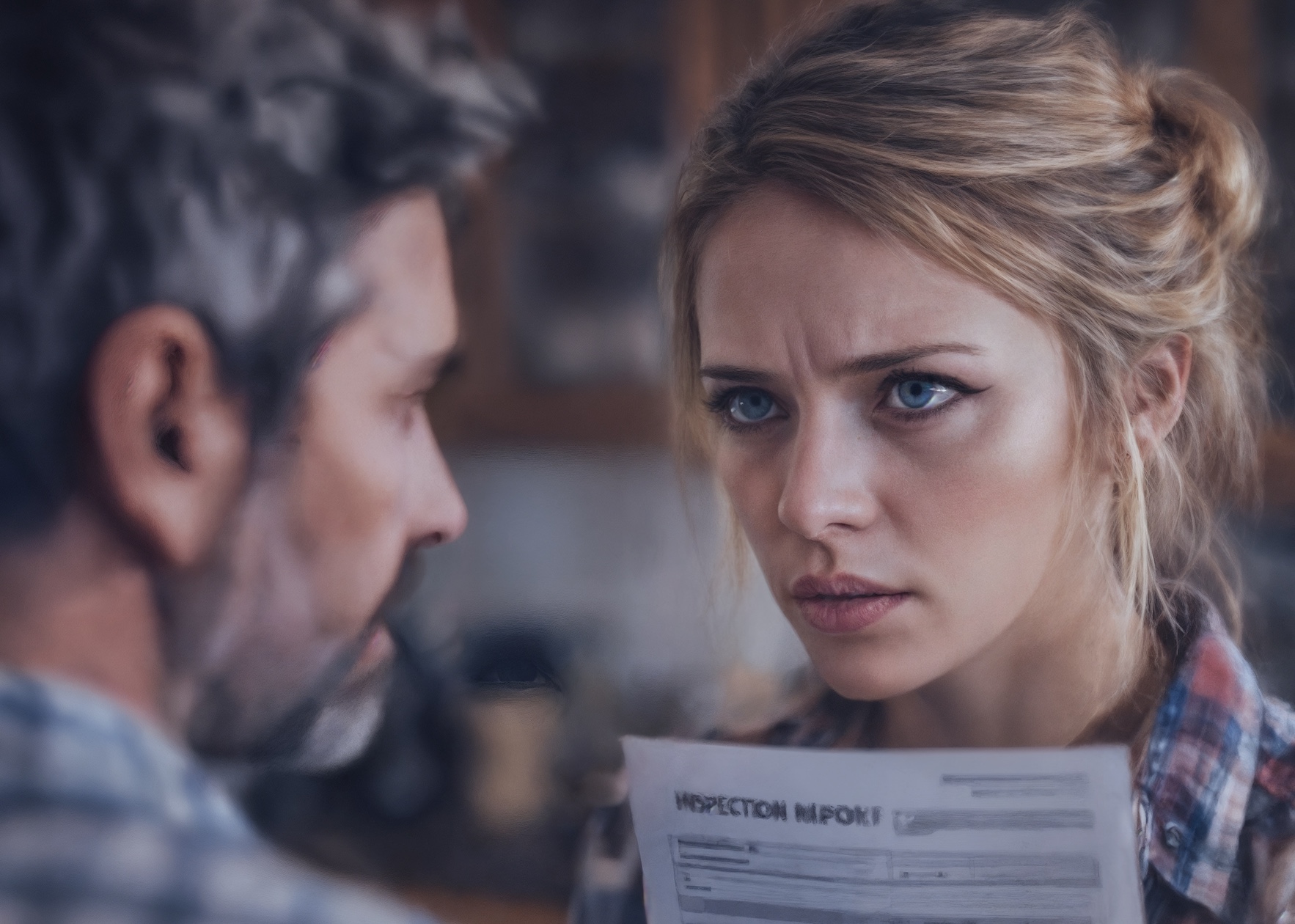
“You didn’t fix the brakes on my car even though you took money for the garage—and you spent it on new spinning rods? You sent me out on black ice in a car with faulty brakes to go to the store?” the wife asked quietly, holding an inspection report from an independent mechanic.
The paper didn’t tremble in her hands. It was thick, slightly rough, with a greasy oil stain in the lower-right corner and a blue stamp that, to Olga, now felt like the most important legal document of her life. She stood in the kitchen doorway, her whole body stretched tight like a wire about to snap—only instead of a clean twang it gave off a dull, low hum.
Sergey sat at the table, sprawled back in his chair. In front of him was a half-empty plate of fried potatoes and an open can of beer. On the TV mounted in the corner, someone ran after a ball with the sound muted. When he heard her question, he didn’t even choke. He only slid a lazy glance toward the sheet and then stared back at the screen, nudging a strip of bacon with his fork.
“Ol, not this again,” he drawled, his voice syrupy with the satisfied calm of a man who’d spent the whole weekend on the couch. “What report? What mechanic? They scammed you like a schoolgirl and you fell for it. I checked the pads a week ago. They’ve got plenty of life.”
He popped a potato into his mouth and chewed noisily. That sound—smacking mixed with a swallow of beer—scraped Olga’s nerves worse than the screech of tires half an hour earlier. She took one step forward and set the paper on the table, right over the bread crumbs.
“Read it,” she said.
It wasn’t a request. There was so much metal in that single word that Sergey flinched without meaning to.
“‘Remaining thickness of friction lining: zero millimeters,’” Olga read aloud, not waiting for him to react. “‘Metal on metal.’ ‘Deep grooves on the brake discs.’ ‘Operation of the vehicle is prohibited.’”
Sergey finally looked away from his food. He pinched the page between two fingers as if it were contagious, skimmed it, snorted, and tossed it back on the table.
“What a load of crap,” he announced with the confidence of a world-renowned expert. “Your ‘independent’ guy—who is he, some Ashot from the garage row? Or those dealers who charge five grand to replace a lightbulb? Olga, use your head. I’ve been behind the wheel for twenty years. I know what worn pads look like. There were at least three millimeters left. That’s half a year, easy—if you don’t mash the pedal at every light. They just pushed you into replacing discs so they could jack up the bill.”
Olga stared at him, not recognizing the man in front of her. This wasn’t the husband she’d lived with for seven years. This was something from another planet, where the laws of physics worked differently and a human life cost less than a set of Bosch pads.
“Three millimeters?” she repeated, feeling an icy rage start to boil. “Sergey, today I nearly went under a KamAZ. At the interchange. It was ice—bare ice with a dusting of snow. I started braking early, the way you taught me. And the pedal just dropped. It went soft—like cotton. The car didn’t slow down; it rolled faster. Do you understand what that is? When you press and nothing happens?”
She stopped to breathe. The picture was still burned into her eyes: the dirty, salt-splattered side of the truck rushing toward her windshield, and the helpless chattering of ABS trying to save a situation that was already beyond saving.
“I jerked the wheel,” she went on, looking straight at the bridge of his nose. “It threw me onto the shoulder. Into a snowbank. Inches from the barrier. If someone had been standing there… or if there’d been oncoming traffic…”
“Well, nobody was,” Sergey cut in, waving her off in irritation. “Why are you making a drama out of it? ‘If this, if that.’ The tire hit a patch of ice, ABS acted weird—so what? It’s winter, Olga. You drive more carefully instead of siccing your anger on your husband. What do pads have to do with it? I’m telling you—they were fine.”
His impenetrability was frightening. He either truly believed himself—or desperately wanted to, because the alternative was admitting he’d burned the money and gambled with her life, which didn’t fit with his cozy evening.
Olga slowly unzipped her puffer jacket. Heat crawled up her neck. The kitchen felt suffocating. The cheerful flowered wallpaper seemed to inch closer, pressing at her temples.
“I pulled into the first service station I saw the minute they got me out of the snow,” she said, crisp and measured. “The mechanic took the wheel off while I watched. I saw it with my own eyes, Sergey. There’s no lining left. It’s shiny metal, ground down until it turned blue. And he asked me, ‘Miss, are you immortal—or did your husband insure you for a big payout?’”
Sergey winced as if from tooth pain.
“Oh, here we go,” he groaned. “A jokester mechanic. You went looking for a reason, didn’t you? To pick a fight? I’m tired from work. I came home to eat in peace. And now you show up with your hysterics.”
“Where’s the money?” Olga ignored the whining. “I gave you twenty-five thousand. Two weeks ago. For a full service: oil, filters, and brakes all around. You said you did it. You said, ‘The car’s good—drive it.’”
She stepped right up to the table. Her shadow fell across his plate.
“So where did the money go if the pads are old and the oil on the dipstick is black as tar? I checked that too, Sergey.”
Sergey froze. His fork hung halfway to his mouth. For the first time something like alarm flickered in his eyes—not guilt, no—fear that his neat, convenient lie was collapsing under hard evidence. He set the fork down, wiped his mouth with a napkin, and leaned back, folding his arms across his chest like armor.
“So you’re auditing me now?” His voice sharpened. “Spying? Checking up on me? I’m the head of this family—I decide when and what gets changed on the car. The oil had another five thousand kilometers in it. And the pads… I decided we’d save for now. Times aren’t easy, in case you haven’t noticed.”
“Save,” Olga repeated. The word stuck in her throat like a fishbone. “You decided to save on brakes. On my safety. So you could buy what?”
Her eyes darted to the hallway, where a long tube covered in expensive cordura leaned against the wall near the sliding wardrobe. It had appeared a couple of days ago. Sergey had told her he’d “borrowed it from a friend for a while.” Now the pieces snapped together with a loud, ugly click.
“You bought them, didn’t you?” she asked, nodding toward the hallway. “Those Graphiteleader rods you wouldn’t stop talking about a month ago? ‘Japanese quality,’ ‘insane sensitivity,’ ‘every spin fisherman’s dream’?”
Sergey followed her gaze. For a moment his face brightened—irritation replaced by the proud glow of ownership. He couldn’t help himself.
“Ol, you don’t understand,” he said, even half rising with excitement. “They’re exclusive! Fifty percent off! That’s once in a lifetime. I couldn’t miss it. And the pads—I’d have changed them after payday, in a week. Nothing would’ve happened in a week! You were driving fine, right? Fine. Today was just ice—bad luck. But now I’ve got a set I won’t be embarrassed to take to the Volga.”
Olga looked at him and felt the floor rock beneath her feet—not from dizziness, but from the abyss opening between them. He was seriously comparing graphite sticks to the chance that she could’ve ended tonight in a morgue. And in his world, the graphite won.
“Show me,” she said softly.
“What?” Sergey blinked.
“Show me the rods. I want to see what I nearly died for.”
“You really want to see?” suspicion flashed, quickly replaced by boyish delight.
He took her request as surrender—proof the storm was over, and now they could move on to the pleasant part: him bragging. In his universe, where selfishness was normal, a wife’s anger was like bad weather—annoying, but temporary, especially if you distract her with something shiny.
He jumped up, instantly forgetting his potatoes, and rushed into the hall. He returned with the tube, holding it carefully, like a bomb technician carrying a defused device—only his face was reverent.
“Here—look,” he said, laying the hard case on the kitchen table and pushing aside the salt shaker and bread box. “These aren’t just sticks, Ol. They’re art. Japanese carbon, Torzite guides. You can’t imagine the action.”
He unzipped the case with that rich, expensive sound only quality things make. He pulled out two black velvet sleeves. His movements became slow, almost ritual. He untied the cords and drew the first rod into the light.
The thin, elegant blank gleamed predator-bright under the kitchen chandelier. The butt section shimmered deep violet fading into black. The handle—cork and EVA—looked like it had been designed for a surgeon’s hand, not for fishing a muddy river.
“Vivo Prototype,” Sergey breathed, stroking the lacquered surface with his thumb. “Light as a feather. Sensitivity so insane that if a perch just breathes on the lure, I’ll feel it in my hand. Take it. Just hold it.”
He handed it to her. Olga took it automatically. It really was weightless. Cold. And clearly expensive. She stared at the perfect thread wraps, the gold lettering, and she didn’t see a fishing rod. She saw brake pads. She saw new discs that hadn’t been bought. She saw the mechanic at the shop tapping his temple.
“Twenty-two thousand,” Sergey said smugly as he joined the second section and clicked it into place. “And I grabbed it at the old wholesale price—through a buddy at the warehouse. Retail now is closer to forty. You understand what kind of luck that is? That’s basically an investment.”
“An investment,” Olga echoed dully. “You invested in carbon by taking money out of your wife’s safety.”
“Oh, not this again,” Sergey grimaced, taking the rod back and giving it a quick sharp flick to test the action. The blank cut the air with a thin whistle. “Don’t start. I explained: the car’s drivable. The brakes brake. Yeah, they got a little worse—so what? Next weekend I’d have taken it to the guys in the garages, they’d rivet on new lining for pennies. Why feed the dealers?”
He leaned the first rod lovingly against the refrigerator and began unpacking the second.
“And this one’s for jigging—heavier,” he muttered, completely absorbed. “Test up to forty-two grams. Hooks zander on the cast like nothing. I’ve dreamed of it for two years, Ol. Two years! Don’t I have the right to make myself happy once? I work like a beast, by the way.”
Olga watched him and felt the veil drop from her eyes. Seven years of marriage. A mortgage they tried to pay off early by refusing themselves vacations. Her old jacket she wore for a third season because “we need to save.” And here he was, glowing in the middle of the kitchen like a polished coin, genuinely not understanding what was wrong.
“You don’t work like a beast, Sergey,” she said calmly—and that calm was more terrifying than any screaming. “You’re a mid-level manager with a salary that barely covers the mortgage and food. Everything else is on me—my overtime, my freelance work at night. I bought that car. And I was supposed to be the one to service it—I just trusted you because you’re a man. Because you said, ‘Don’t get involved, I’ve got it.’”
“There you go—throwing money in my face,” Sergey sneered, still assembling the second rod. “Classic. The second something happens it’s ‘I bought it,’ ‘I earned it.’ But the fact that I drive you everywhere, that I do the ‘man’s work’ around the house—that doesn’t count?”
“What work?” Olga swept her eyes around the kitchen. “The bathroom shelf that’s been crooked for six months? The faucet that leaks? Or maybe the brakes you ‘fixed’?”
“Those damn brakes!” he exploded. “Nothing happened! You’re alive, you’re fine—standing here frying my brain. That means everything’s fine. And these rods will be gone if you don’t buy them now. Then we’ll be kicking ourselves. You’re not a fisherman—you don’t understand that thrill. It’s… it’s for the soul. I need an outlet or I’ll die in that office.”
He finished assembling the second rod. Now two perfect, predatory tools stood by the refrigerator. Sergey stepped back, admiring them. There was more tenderness in his eyes than Olga had seen directed at her in a long time.
“Beauties,” he whispered. “Next weekend I’m heading to Ruza. Sasha’s bringing the boat. We’ll try them out.”
“Next weekend,” Olga repeated slowly.
She looked from his shining face to the inspection report still on the table. Then to the rods. Then back to her husband. Something clicked—the last piece sliding into place. He wasn’t simply careless. He didn’t care. He truly, completely didn’t care whether she’d be alive tomorrow, as long as he had a new “stick” for catching fish he didn’t even eat, only released back into the river.
His hobby cost over twenty thousand. Her life, by his math, cost less than a set of brake pads. He priced her safety at zero, betting on “it’ll probably be fine.”
“So it’s for the soul?” she asked, stepping toward the refrigerator. “You needed an outlet?”
“Of course!” Sergey nodded happily, convinced he’d finally reached her. “Every man needs a release. Some drink, some chase women—me, I fish. You should be grateful you’ve got a husband like me.”
“I’m so grateful, Sergey,” Olga said. “I’m over the moon.”
She reached out and took the first rod—the featherlight Vivo Prototype. The grip settled in her palm comfortably, warm and sure.
“Careful—don’t hit the tip on the chandelier. It’s very fragile,” Sergey said with genuine concern as he sat back down and pulled his plate closer. He decided the incident was over.
Olga weighed the rod in her hands. Graceful. Expensive. Fragile. Like their marriage—held together by promises and her patience. Only patience, unlike Japanese carbon, didn’t come with a safety margin.
“Fragile, you say?” she repeated, looking at her husband with empty, frightening eyes. “Let’s test that.”
“Be careful!” Sergey shouted again as he noticed how much the tip bent. “You’re overloading the blank! Olga, don’t bend it like that—the angle’s critical!”
He still didn’t understand. He thought she was testing the action the way people do in stores, pressing the tip against the ceiling or the floor. He couldn’t even imagine treating something sacred that way. It would be like watching someone light a cigarette with the Mona Lisa.
Olga didn’t answer. She shifted her grip, grabbed the thin, elegant rod with both hands, elbows out—and with a short, sharp exhale, brought the blank down across her knee.
A dry, ringing crack tore through the kitchen silence. The sound was sickening—like snapping the bone of a large bird. The expensive, high-modulus Japanese graphite—made for delicate lure work—shattered into three uneven pieces. Needle-sharp splinters flew; one scratched the refrigerator. The top guide clinked and rolled across the tile under the table.
Sergey sucked in air like he’d been punched. His eyes bulged; his mouth opened in a silent scream. He jumped up so fast he knocked the chair over. The chair crashed behind him, but he didn’t even notice.
“Wh—what did you do?!” he shrieked in a thin, high voice, horror and disbelief mixed together. “What have you done, you idiot?! That’s a Vivo! That’s twenty grand!”
He lunged toward her, hands out as if he could catch the falling fragments, as if he could glue them back together, revive them. But Olga didn’t move. She tossed the remaining handle pieces at his feet. The cork knocked his slipper and bounced away.
“Twenty grand?” she repeated, her voice terrifyingly calm. “And what are my legs worth? My spine? What if I’d been crippled? How much does a wheelchair cost, Sergey—more than your rod?”
Before he could recover, she stepped toward the second rod—the heavy one meant for big jigs. Sergey saw what she intended and sprang in front of it, trying to shield his treasure with his body.
“Don’t you dare!” he roared, spittle flying. “Don’t touch it! I’ll kill you! Touch it and you’re dead!”
But he was too late. The adrenaline still boiling in Olga from what happened on the road gave her unnatural speed. She grabbed the second rod by the middle of the blank, shoved Sergey aside with her shoulder—he stumbled, catching his foot on the leg of the overturned chair—and Olga swung the rod hard into the corner of the tabletop.
This time the sound was heavier, duller. The thicker carbon resisted for a split second, flexed like a spring—and then burst with a blunt pop. The break frayed into black fibers. The Torzite guides in their titanium frames, the ones Sergey had bragged about, crumpled and twisted out of shape.
“Aaah!” Sergey howled—an animal sound. He dropped to his knees in the middle of the kitchen, grabbing at the wreckage. He pressed the broken butt section to his chest, stroked the jagged break, and real tears filled his eyes.
“Why?!” he screamed up at her, hatred in his face. “Bitch! Psycho! Do you understand what you did? You destroyed money—real money! I could’ve sold them! I put my soul into those!”
Olga stood over him, breathing hard. Her hands shook—not from fear, but from the release of pressure. She looked at her husband crawling on the floor among black splinters and felt nothing but emptiness—and disgust.
“You didn’t put your soul into them,” she said, watching him try to fit two broken sections together. “You put my safety into them. You stole my brakes to buy your toys. So I balanced the scales. Now we have no brakes—and no toys.”
“To hell with your brakes!” he bellowed, flinging a piece at the wall. The graphite left a black smear and a dent in the wallpaper. “The car’s just metal! These are a dream! You broke my dream! Monster! You’re insane!”
He sprang to his feet, his face red and twisted with rage. His fists clenched and unclenched. For a second Olga thought he might hit her. She saw it in his eyes—the urge to strike, to hurt, to avenge his precious rods. He took a step toward her, looming.
“You’ll pay for this,” he hissed in her face, spraying spit. “Every penny. I’ll ruin you. Do you even know what that set costs now? You’ll work six months to cover it!”
Olga didn’t flinch. She didn’t even blink. She simply picked up a heavy ceramic mug from the table and gripped it by the handle—calm, steady.
“Try it,” she said softly. “Make one move. And I swear, I’ll go to prison—but you’ll never hold anything in your hands again.”
Sergey froze. His chest heaved. His gaze darted from her face to the mug, then to the broken pieces on the floor. His aggression wrestled with his cowardice. He was the classic home tyrant—brave only when the victim stays quiet and endures. But the woman in front of him now wasn’t a victim. She was someone he didn’t recognize—someone ready to go all the way.
He lowered his hands. His shoulders sagged. All his swagger and loud bravado deflated like a punctured balloon. He stared again at the floor, where pieces of cork and black carbon splinters floated in a puddle of spilled beer.
“You’re sick,” he breathed with disgust. “You need treatment. Hysterical. You trashed the place over some pads. I would’ve fixed everything… I would’ve done it…”
“You already did,” Olga cut him off. “You made your choice in the fishing tackle shop. And now I’ve made mine.”
She opened her fingers, and the remains of the second rod—which she’d still been holding—dropped to the floor with a dry clatter, joining the pile of ruin his “investments” had become.
“That was a Graphiteleader,” Sergey whispered, staring at the floor with glassy eyes. “The best on the market… How could you…”
He acted as if Olga had killed a puppy. His grief was real—and that made it even more terrifying. He still didn’t understand. Even standing in the wreckage, he mourned things, not the relationship. He cried for carbon, not for the trust that had just turned to dust like that same graphite.
Olga realized there was nothing left to say. Words were done. Any explanation, any attempt to appeal to his conscience would be as useless as explaining to a brake system that it needs to stop when there are no pads.
She stepped around him, careful not to step in the beer puddle, and headed to the entryway. There was one last thing she needed to do—put a final period on this farce.
A minute later Olga returned to the kitchen with a key ring in her hand—the car keys with the alarm fob. The same keys that, just that morning, had sat in her jacket pocket as a symbol of freedom and mobility, and now felt like an instrument of torture.
Sergey still stood amid the devastation, staring at the fragments. He looked like the captain of a sinking ship who, instead of saving the crew, mourns a shattered tea set in the lounge. Hearing his wife’s steps, he lifted his head. The rage was gone; only dull, childish resentment remained—along with the mental arithmetic of losses.
“Sell a kidney, fish with a stick—do whatever you want, but by tomorrow the money for the repairs and compensation for damages needs to be on this table,” Olga said. Her voice rang with strain, but there was no hysteria in it. It was the voice of a judge reading out a sentence.
She swung her arm and threw the keys straight at his face.
The key ring clattered into his chest, bounced off, and landed right in the beer puddle beside the mangled cork handle. Sergey jerked instinctively, but he didn’t try to catch them. He stared at the keys lying in the filth as if they didn’t belong to his world.
“What are you doing?” he muttered, bewildered. “Ol, are you serious? You’re kicking me out? At night?”
“And then—out of my life,” she finished, looking through him. “Pack your stuff. Now. You’ve got ten minutes before I call the police. And believe me, Sergey, I’ll know exactly what to tell them. I’ll say you came at me with a knife. With your little ‘temporary insanity because my fishing rods got broken’ story, they’ll believe you a lot less than they’ll believe me.”
Sergey straightened. Hurt flashed into angry disbelief.
“You won’t dare,” he snarled. “This is my apartment too. We’re both registered here. You can’t throw me out. That’s illegal.”
“Illegal?” Olga gave a bitter laugh. “Illegal is sending your wife onto the highway without brakes. Illegal is stealing from the family budget. Kicking out an asshole who nearly turned into a killer is basic sanitation. And just so you remember: this apartment was bought on my mortgage, in my name, before we got married. The only things you own here are your socks and this firewood.”
She nodded at the broken pile on the floor.
“Oh, so that’s how we’re talking now,” Sergey narrowed his eyes. “Firewood. You do realize you’re destroying a family over a piece of metal? Over consumables? I would’ve paid it back! I would’ve borrowed, found a way!”
“You wouldn’t have,” she cut him off. “You would’ve lied again. You’d say you borrowed it, and then you’d buy something else. Or drink it away. I see you clearly now, Sergey. You’re empty. There’s nothing inside you except ‘I want.’ You didn’t even get scared for me—you got scared for your rods.”
“Go to hell!” he snapped, crouched down, snatched the keys from the puddle, wiped them on his pant leg, and shoved them into his jeans pocket. “You think I’ll disappear? I’ll go to my mom’s! Or to Sasha’s! I’ll be welcome anywhere. And you—sit here alone in your mortgaged shoebox and chew your elbows. Who needs someone like you, all proper and righteous? Old hysteric!”
He started tearing through the apartment, grabbing things. He yanked his jacket off the hook, fumbling the sleeves. Snatched a backpack and began stuffing chargers, documents, and random items from the shelf in the entryway. His movements were jerky and frantic. He tried to make it look like a proud exit, but it was a pathetic retreat.
Olga leaned against the doorframe and watched in silence. She didn’t feel hurt—strangely, not at all. What she felt was enormous relief, as if someone had lifted a cement bag off her shoulders—one she’d carried for seven years, thinking that was what marriage was supposed to feel like.
Sergey burst out of the room with the backpack slung over one shoulder. In his other hand he carried his boots, not even bothering to put them on.
“I’ll never forgive you for those rods!” he shouted, stopping in the doorway, his face twisted with spite. “I saved for them for half a year! You’ll answer for it! I’ll sue you for property damage!”
“Go ahead,” Olga replied flatly. “And bring a psychiatrist’s note when you file for property division. A normal person doesn’t put a chunk of charcoal above a human life. And yes—money for the car repairs. Tomorrow. Or I’ll sell your boat motor. It’s on the balcony. I think that will cover brakes nicely.”
Sergey’s face went gray. He’d forgotten about the motor. That was his last trump card—his “untouchable reserve.”
“Don’t you dare…” he rasped. “Touch the Yamaha and—”
“Your time is running, Sergey,” Olga said, pointedly glancing at the wall clock. “Seven minutes left. Close the door from the outside.”
He froze for a second, as if weighing whether to rush her and grab the balcony keys. But something in her stare—cold, empty, dead to him—stopped him. He understood he’d lost. Not a fight over rods. The whole war.
He spat on the floor—right onto the clean doormat by the door—and stomped barefoot onto the landing.
The door slammed so hard the windowpanes rattled.
Olga was alone. The apartment rang with silence, broken only by the hum of the refrigerator and the ticking clock. On the kitchen floor, in a puddle of flat beer, lay black, shining shards of Japanese carbon—like a monument to their marriage, which turned out to be just as expensive-looking on the outside and just as hollow on the inside.
She slowly slid down the wall to the floor in the hallway. Her legs wouldn’t hold her. She had no strength to clean up the mess. No strength to cry either.
She pulled out her phone. A bank notification glowed on the screen: the monthly payment had been deducted. Life went on. Tomorrow she’d need to find a tow truck, take the car to a shop, explain at work why she was late, figure out where to get money if Sergey, as usual, disappeared when it was time to take responsibility.
But that was tomorrow.
Right now she simply sat on the floor and stared at the front door. The lock was turned twice. The bolt was slid shut.
For the first time that evening—for the first time in many years—she felt completely safe. The brakes had failed, but she’d managed to jump out before the car plunged off a cliff.
Olga stood, went to the kitchen, stepped over the broken rod pieces, and picked up a broom.
“Japanese carbon,” she said out loud with a crooked smile as she swept the splinters into a dustpan. “Probably burns nicely.”
She dumped the dustpan into the trash, tied the bag tight, and set it outside the door—out there, where five minutes earlier, her old life had gone too.