“I need to get out to the dacha—urgently. Check how the house made it through the winter,” Irina said, glancing at the calendar and trying to figure out when she could finally escape the city.
Spring was already in full bloom, and she still hadn’t managed to make the trip. Work, household chores, constant running around—everything kept pushing it further down the list. But now, at last, she had a free weekend. The weather was bright and warm, and Irina decided she was done postponing.
She packed quickly, grabbing a bag with the essentials: her notebook with the dacha checklist, a small tool kit, and a thermos of tea. She got behind the wheel and drove out of town. The trip took about an hour. Her plot was in a quiet garden cooperative where most of the houses belonged to older residents. In summer the place was lively, but in spring it was peacefully still.
As she drove, Irina mentally mapped out what needed doing: check the roof, inspect the pipes, make sure the winter frost hadn’t cracked the foundation. Maybe she could even dig up a couple of beds right away—if the soil had warmed enough. Last year she’d planted tomatoes and cucumbers and had a pretty good harvest.
But when she pulled up to her gate, she froze. Three unfamiliar cars were parked along the fence: a black SUV, a silver sedan, and an old station wagon. From behind the fence came voices, laughter, and low music. Irina frowned, switched off the engine, and stepped out.
“What on earth is going on?” she muttered, squinting against the sun.
She walked to the gate and checked the house number—though she knew perfectly well this was her property. There was no doubt: the address matched. The house number, the street name—everything. She pushed the gate, and to her surprise it wasn’t locked. She stepped into the yard.
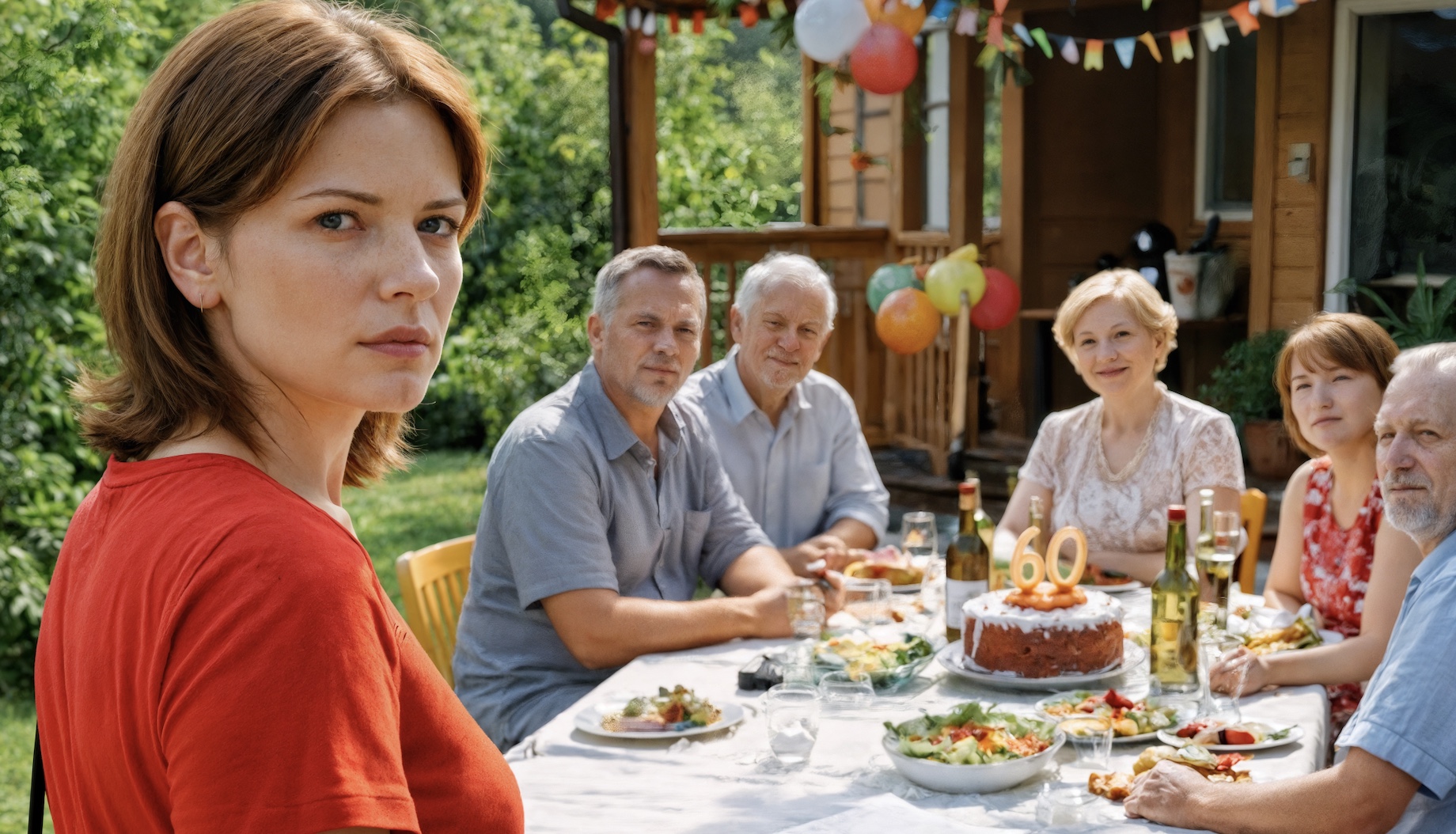
The sight made her stop short. A large table covered with a white tablecloth had been set up outside. Plates of appetizers filled it—sliced sausage and cheese, salads in crystal bowls, bottles of drinks, fresh fruit. Guests—at least ten people—sat around it, dressed up, laughing, chatting. Some held glasses; others were helping themselves.
At the center of it all sat Raisa Mikhailovna—Irina’s former mother-in-law. She was accepting congratulations, smiling and nodding, clearly enjoying the attention. She wore a burgundy dress with a gold-toned brooch. Her hair was styled in an elaborate updo, and a strand of beads shimmered at her neck. She looked festive—and pleased with herself.
“Happy anniversary, Raisa Mikhailovna!” someone called, raising a glass toward her. “May this house always be filled with joy and happiness!”
“Thank you, thank you, my dears! I’m so happy you’re all here,” Raisa Mikhailovna replied, pouring herself a little wine and lifting her own glass. “This house is special to me—our family place. My late husband and I came here for years. So many memories live in these walls. I remember how we rested here, how we planted the first apple trees…” She sighed theatrically and pressed a hand to her chest.
Irina stood a few meters from the table, watching in silence. Anger rose slowly in her, but she forced it down. Heat rushed to her face. Her fingers curled into tight fists; her breathing quickened.
A family place? Her late husband? Irina gave a short, bitter smile and shook her head. The audacity was unbelievable. Raisa Mikhailovna had never set foot on this plot while her husband was alive. In fact, he had died long before Irina ever met Oleg—back in the nineties. And the dacha itself? Irina had bought it with her own money—money she earned before she ever married, back when she worked as a manager for a large trading company. She had saved for years, denying herself almost everything. By the time she married Oleg, Raisa Mikhailovna’s son, the land was already registered in Irina’s name. The dacha had always belonged to Irina alone.
After the divorce three years ago, Oleg moved away to another city for work. Raisa Mikhailovna was left alone in her apartment and, from time to time, tried to rebuild contact with her former daughter-in-law—calling, inviting her for tea, asking how she was doing, offering help. Irina stayed polite, but distant. She had no desire to maintain close ties with her ex-husband’s relatives. Too many hurts remained from that marriage. Too many unpleasant memories.
But this had crossed every imaginable line. Raisa Mikhailovna hadn’t simply wandered onto someone else’s property—she’d thrown a full-blown celebration, invited guests, laid out a feast, and on top of that she was feeding people stories about a “family home” and a “late husband” who supposedly spent time here.
Irina took a few steps closer to the table. Her stride was calm and decisive, but inside she churned with outrage and disbelief. How had Raisa Mikhailovna gotten in? Where had she gotten the keys? How long had she been coming here?
The first to notice her was a balding middle-aged man seated to the right of the “birthday girl.” He stopped mid-sentence and stared at Irina, confused. A woman in a red cardigan with a knitted brooch turned next, then someone else, and then another—until every guest had turned to look. Conversations died away. Someone set down a fork. Someone froze with a glass halfway raised.
“Raisa Mikhailovna… someone’s come to see you,” the man said quietly, nudging her with his elbow.
Raisa Mikhailovna looked up and went still for a heartbeat. Her smile stuck to her lips; something like fear flashed in her eyes. But a second later she pulled herself together and forced a bright, stretched smile.
“Irochka! What a surprise! We weren’t expecting you at all. Why did you come without calling? You could’ve warned me—we would’ve invited you too,” she chirped, far too cheerfully, though her eyes betrayed unease.
“Without calling?” Irina crossed her arms and narrowed her gaze. “Raisa Mikhailovna, this is my dacha. My property. I don’t need to call anyone or ask permission to come to my own land.”
The guests exchanged looks; some were openly shocked. Someone coughed awkwardly. The woman in the red cardigan stared into her plate and began twisting her napkin. The balding man frowned and looked from Irina to Raisa Mikhailovna as if trying to understand what he’d walked into.
“Oh, come on, dear,” Raisa Mikhailovna tried to joke, waving a hand as if shooing away a fly. “We agreed ages ago that I could come here sometimes. Sit down with us, have some tea. Look at this table! I cooked so much!”
“We never agreed on anything,” Irina said firmly, not moving an inch. Her voice was calm, but it had the ring of steel. “I never—do you hear me, never—gave you permission to hold any events here. And I don’t understand how you got in at all. You shouldn’t have keys to my dacha.”
“Irochka, don’t be so strict!” Raisa Mikhailovna’s voice hardened; sharp notes crept into it. She was clearly getting irritated. “It’s my anniversary—sixty-five! I wanted to celebrate somewhere nice, outdoors. So what if we used the dacha for one day? No one suffered. You don’t live here full-time!”
“The dacha?” Irina lifted her eyebrows and stepped closer, her gaze turning cold. “It’s not ‘the dacha.’ It’s my property, paid for with my money—money I worked for over years, going without. This is my land. And after my divorce from Oleg, no one in your family has any connection to it. None. And you know that perfectly well.”
“But Oleg is my son! My only son!” Raisa Mikhailovna raised her voice; her cheeks flushed. “And you were his wife, you lived under one roof. That means the dacha was shared, doesn’t it? Or do you think you’re entitled to everything?”
“I was,” Irina answered evenly, though she was boiling inside. “That’s the key word—was. We divorced three years ago. This plot belonged to me before the marriage and it remained mine after the divorce. So you have no rights here. Absolutely none. And your son knows that—we discussed it during the divorce.”
Several guests began shifting nervously in their seats. The party atmosphere evaporated instantly. A fork clinked against a plate. An elderly woman with short hair and glasses leaned toward Raisa Mikhailovna and whispered:
“Raya… maybe we really should leave. This is awkward. I didn’t know it was like this. If you’d told me…”
“No one is leaving!” Raisa Mikhailovna snapped, slamming her palm on the table. Glasses trembled; a plate nearly slid. Someone flinched. “We’ve only just started! We haven’t even cut the cake! Irina, don’t ruin this for people. You see there are guests here! They came especially to congratulate me!”
“That’s exactly why I’m asking you to leave immediately,” Irina said, straightening to her full height and pulling out her phone. Her voice stayed calm, but it was unyielding. “If there’s even one person here in ten minutes, I’m calling the police. Trespassing and using someone else’s property without permission is a violation of the law. Article 330 of the Civil Code. I doubt your guests want to explain themselves to the police.”
Raisa Mikhailovna went pale. Her lips trembled; her hands balled into fists. She clearly hadn’t expected such a firm response.
“You wouldn’t dare! You wouldn’t dare call the police!” her voice shook. “It’s my birthday! My anniversary! You want to ruin my celebration? Humiliate me in front of everyone?”
“You ruined it yourself when you decided to celebrate on someone else’s dacha without the owner’s permission,” Irina replied evenly, staring at her phone as if dialing. “You have nine minutes.”
The guests hurried into motion. Someone started stuffing dishes into bags. Someone grabbed their coat. The woman in the red cardigan rushed toward the exit, throwing Irina a guilty, frightened look. The balding man reached for his jacket draped over the chair. The elderly woman spoke in a soft, apologetic voice to Raisa Mikhailovna:
“Raya, we really should go. This must be a misunderstanding—we didn’t know. Let’s continue at your place, all right? I’ll bring the salad I made. We barely even tasted anything. Don’t worry—your birthday isn’t ruined, the location is just changing.”
Raisa Mikhailovna sat rigidly, lips pressed into a thin line. Her face burned with anger and humiliation. Her eyes shone—whether from rage or tears waiting to fall. Her hands shook.
“This is all because of you!” she finally screamed, jabbing a trembling finger at Irina. “You’re heartless! Cold! You can’t even let me celebrate for one day! What, you begrudge it? Do you even have a heart? You’ve turned into a bitter, cruel person!”
“Seven minutes,” Irina said shortly, without looking up from her phone. She wasn’t going to argue or justify herself.
Within five minutes, the yard was almost empty. Guests packed up quickly and drove off one by one, casting apologetic looks at the property owner. Some tried to take plates of food with them; others left everything behind, desperate to escape the awkwardness. Raisa Mikhailovna was the last to move. She packed leftovers slowly, deliberately ignoring Irina, making a show of her displeasure.
When she finally headed toward the gate with two bags of food and her purse, Irina stopped her.
“The keys.”
Raisa Mikhailovna paused but didn’t turn around, pretending not to understand.
“What?” she snapped over her shoulder.
“The keys to the dacha. Give them to me. Where did you get them?” Irina’s voice stayed calm but demanding. She wasn’t backing down.
With a reluctant huff, Raisa Mikhailovna set the bags down, dug into her purse, and pulled out a key ring. There were three keys: the gate, the front door, and the shed.
“Oleg gave them to me ages ago—back when you were living together, your first year of marriage. ‘Just in case,’ he said. Anything could happen. If you needed help, I could come,” she said grudgingly, with defiance.
“Hand them over,” Irina said, holding out her open palm.
“And why do you need them now?” Raisa Mikhailovna tried to stall, hiding her hand behind her back. “Those locks are ancient. You should’ve replaced them long ago. Why do you want these rusty keys?”
“That’s exactly why I’m taking them,” Irina said, not lowering her hand and not breaking eye contact. “And I will replace the locks—today. Right now I’ll call a locksmith. And I need these keys as proof that you were entering my property illegally.”
Raisa Mikhailovna flung the keys at her so carelessly they almost hit the ground. Irina caught them and closed her fist around them. The metal was warm from sitting in her ex-mother-in-law’s bag.
“You’ll regret this! You’ll regret it!” Raisa Mikhailovna hissed, glaring at her. “Oleg will find out how you treated me! He won’t forgive you for disrespecting his mother—the woman who gave birth to him and raised him!”
“Oleg knows perfectly well this dacha is mine,” Irina replied calmly. “We discussed it during the divorce. And if you want to drag him into this, I’ll be happy to tell him how his mother has been using someone else’s property, throwing parties here, and telling fairy tales to her guests.”
Without saying goodbye, Raisa Mikhailovna grabbed her bags, turned, and hurried out. A car door slammed, the engine roared, and the vehicle jerked forward, raising a cloud of dust before disappearing around the bend, leaving only tire tracks behind.
Irina remained in the yard in complete silence. She looked around and slowly released the breath she’d been holding. Plastic cups and crumpled napkins littered the ground. Half-eaten appetizers sat on the table. Spilled juice had left sticky stains on the cloth; crumbs were everywhere. She would have to clean it all up. She sighed and closed her eyes for a moment, feeling the tension drain away into exhaustion.
Then she pulled out her phone and called a locksmith she knew—Viktor Petrovich, a reliable man who had helped her before. The locks had to be changed immediately. Who knew how many copies Raisa Mikhailovna had made over the years? Or whether Oleg had once made duplicates for someone else. Irina wasn’t taking chances.
“Hello, Viktor Petrovich? This is Irina Sergeyevna. I have an urgent situation. Can you come out to the dacha and replace all the locks—three of them: the gate, the front door, and the shed. Yes, today. As soon as possible, please. All right, I’ll wait for you in an hour. Thank you so much.”
While she waited, Irina began cleaning the yard. She gathered the cups into a garbage bag, picked up napkins, wiped the table with a damp cloth. She packed the food into bags—she’d throw it out later, or maybe give it to neighbors if anyone wanted it. She removed the tablecloth and carried it inside to wash. Little by little, the yard returned to normal—returned to her.
An hour later, Viktor Petrovich arrived right on time: a man in his sixties with gray mustaches and kind, steady eyes. He’d known Irina for years—long before her marriage. He’d helped with repairs in her apartment and installed doors.
“Hello, Irina Sergeyevna. What happened—lose your keys? Or did someone try to break in?” he asked, pulling a toolbox and new locks from the trunk.
“Not exactly,” Irina gave a tired smile. “I just need to replace all the locks for safety. It’s a long story—I don’t want to get into it.”
“Understood. Personal matter,” Viktor Petrovich nodded. “I won’t pry. We’ll do everything properly.”
He worked quickly and professionally, without unnecessary talk.
Two hours later he finished. Irina tested the locks: everything was solid and smooth, no sticking, no squeaking. The new keys felt reassuringly secure in her hand.
“Thank you, Viktor Petrovich. You saved me again. How much do I owe you?”
“Oh, come on—we’re old acquaintances,” he waved a hand, wiping his palms on a rag. “Just a symbolic amount for the materials and work. The main thing is that you’re safe and can have peace.”
Irina paid him, adding extra for the urgency, and walked him to the gate. When his car disappeared around the bend, trailing a light veil of dust, she went back inside.
Everything was in place, but it was obvious someone had been living here—and not just once. In the fridge were foods Irina definitely hadn’t left: expensive imported cheese, fresh vegetables, jars of homemade preserves, even caviar. In a cupboard stood new dishes—gold-rimmed plates, crystal glasses with slender stems, pretty cups. On the windowsill were potted flowers: violets in different shades and a lush geranium.
“Well, look at that—you’ve really settled in,” Irina muttered, staring at the чужие things with a mix of shock and anger. “So this isn’t the first party. She may have even slept here.”
She gathered everything that didn’t belong into boxes—dishes, preserves, even the flowers—and carried it outside, setting it neatly by the gate. Let Raisa Mikhailovna come and collect it if she wanted. Though Irina doubted she’d dare show up now. And she no longer had keys anyway.
Irina sat on the veranda with a mug of hot coffee and stared into the garden, thinking. How long had her ex-mother-in-law been using the dacha? Judging by the amount of stuff, it had been going on for a long time—maybe a year, maybe longer. And Irina hadn’t suspected a thing. Raisa Mikhailovna must have been coming regularly—maybe even staying overnight in the summer. Inviting friends and relatives, hosting gatherings, telling everyone it was her dacha, her “family place,” weaving legends about her “late husband.”
It had all started back when Oleg was still in the picture. Maybe he’d handed her a spare set of keys in the first year of their marriage without thinking how it could become a problem after divorce. Or maybe he had thought about it and kept quiet, not wanting to upset his mother. Oleg had always been too soft with her—unable to say no, always putting her wishes first. Maybe that was one of the main reasons the marriage ended. But it didn’t matter anymore. The past was the past.
What mattered was that everything was back where it belonged. Irina had drawn a line—and no one had the right to cross it again. She didn’t feel guilty for what she’d done. It was her property, her land, her right. And she had every right to defend it by any legal means.
She finished her coffee and stood up. She still had what she’d come for—bringing the place back to life after winter. She walked through every room, carefully checking every corner. The windows were fine—no cracks. The roof showed no damage; the tiles were intact. The basement was dry, with no signs of dampness. The pipes were whole. The house had survived the winter well.
Then she went outside. The apple trees were beginning to bloom—pink and white petals covering the branches like snow. Currant bushes were green with new leaves, promising a good harvest. The ground had warmed already. She’d come back in a couple of weeks to prune, weed, and plant vegetables. Maybe this year she’d add strawberries, too.
In the evening, when the work was done and the sun was sinking, Irina walked the perimeter once more. Everything looked the way it should. No traces of strangers. The dacha was hers again—her home, her refuge, her private space where no one could enter without permission.
Before leaving, she paused by the gate and looked down the quiet lane. Somewhere in the distance, neighbors’ voices drifted as they talked about their own affairs. Someone hammered at a fence. Children laughed as they played ball. The sun slid toward the horizon, painting the sky in orange, pink, and violet. The air smelled of freshness, damp leaves, and blossoms.
Irina locked the gate with the new lock and tugged the handle—solid. She got into the car and, in the rearview mirror, looked once more at the house. Her house. Her land. Her boundaries—now protected.
She started the engine and pulled away slowly. And in that moment she understood something clearly: if someone celebrates on your property as if it’s theirs, the best “toast” is to remind them who the owner is—and close the gate behind the last guest. No regret. No guilt. Just protecting what is rightfully yours. And that is the only right way.