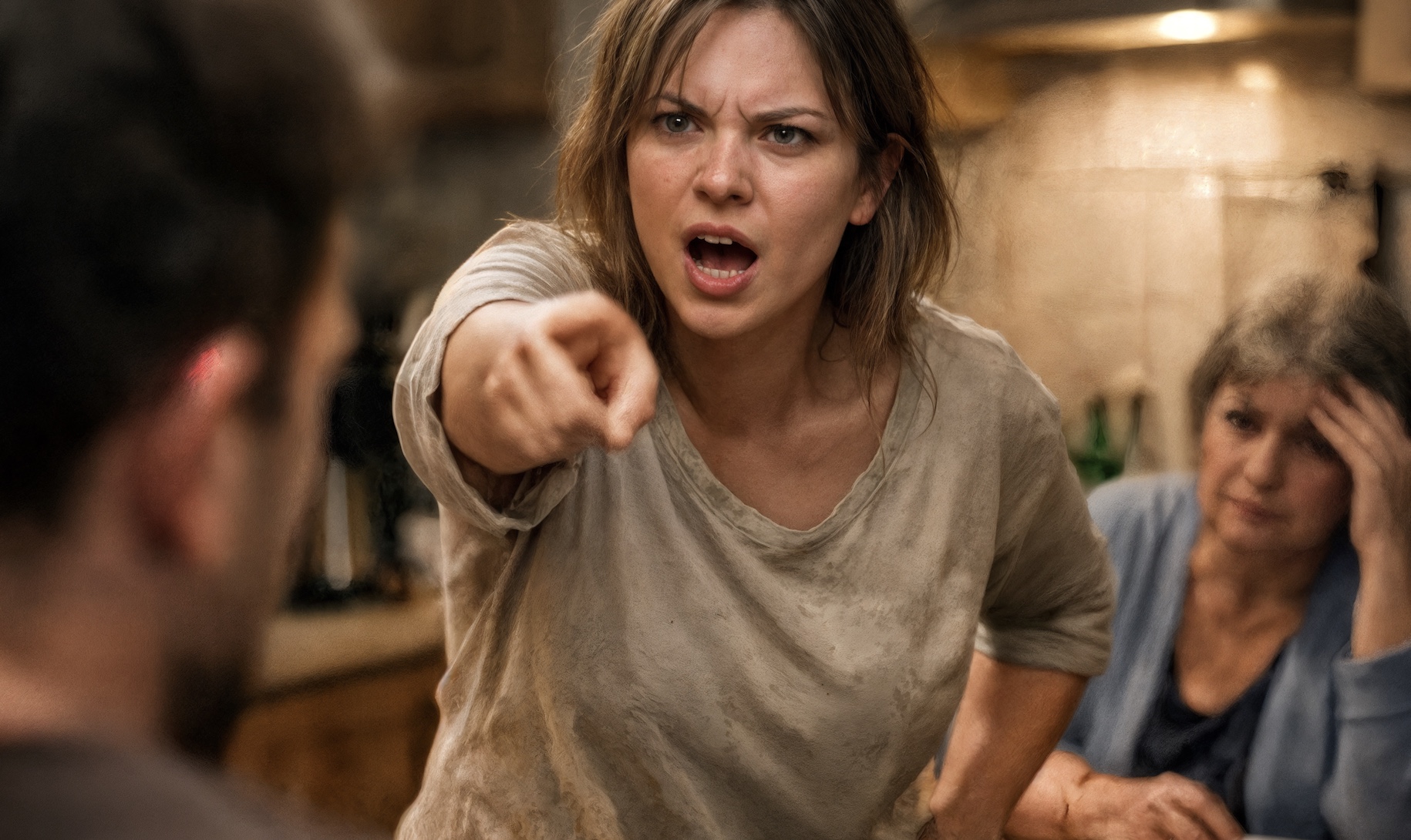
— “Sveta, come on… why are you blowing up right away? Mom only asked what we were having for dinner,” Denis coaxed, his voice soft and almost pleading. He could already feel the air in their tiny kitchen turning thick and sticky, like jelly setting.
Sveta didn’t reply. She kept stirring in silence—slow circles in a saucepan of dense, dark ruby sauce where chunks of beef simmered with wrinkled prunes, swollen and black like oversized pearls. The aroma was heavy with spice, promising something festive, something far from everyday. She’d spent nearly three hours on the dish after work. Not because she expected praise—she’d buried that hope a long time ago—but out of a stubborn need to prove to herself that she still could. That she could be a good homemaker, a good wife, that she could create warmth in a place where it was regularly burned down by “polite suggestions” like napalm.
The doorbell rang exactly on schedule—minute for minute. Anna Petrovna was a woman of ritual. Her Wednesday visits were as unshakable as the turning of the seasons. Denis hurried to the entryway. Sveta turned off the heat and drew a deep breath—so deep it made her slightly dizzy. She braced herself.
Anna Petrovna didn’t enter the kitchen right away. First, as usual, she inspected the hallway, dragging a finger across the shoe shelf. Then she marched into the room to make sure her precious Denis wasn’t living in dust. Only then did she appear in the kitchen doorway, looking like an auditor sent to a failing business. Her gaze was swift and sharp, predatory. It swept the countertop, paused at the sink, assessed the stove, and finally landed on the pots.
“Good evening, Svetochka,” she said, her tone gentle—almost affectionate—yet that affection felt like a draft through a cracked window. “Something smells unusual today. Not borscht, is it?”
“Beef with prunes, Anna Petrovna,” Sveta answered evenly, setting plates on the table.
Her mother-in-law walked straight to the stove. This was the centerpiece of her performance. She didn’t ask. She simply lifted the lid, peered inside, then took a clean knife from the stand and caught a drop of sauce on the tip. She didn’t so much taste it as examine it—brought it to her lips, then wiped the blade with a napkin in immediate, faint disgust. After that came the little tongue-click—quiet, almost nothing, but to Sveta it boomed like a funeral bell.
Dinner went by in near-total silence, broken only by forks ticking against plates. Denis ate with forced enthusiasm, trying to look like everything was fine, like this was just an ordinary family meal. Anna Petrovna poked at the meat, cutting it into tiny pieces and studying the cross-section like evidence. At last, chewing one such piece with the face of a martyr, she dabbed her lips and passed sentence.
“The meat’s a bit tough, Svetochka. You should have soaked it in kefir first—like I did for Denis when he was little. He likes it tender. And the prunes… too sweet. They drown out the flavor. You’d have done better to stew it with carrots. Simpler. Healthier.”
Sveta felt her food turn to paper in her mouth. She looked at her husband. Denis was staring at the pattern on his plate as if he were seeing it for the first time. He pretended he hadn’t heard a word.
“Mom, don’t start,” he finally squeezed out when the silence became unbearable. “It’s good.”
“I’m not starting anything, I’m advising,” Anna Petrovna replied with mild reproach. “I’m trying to help you both. Experience matters. Svetlana is still young—she’ll learn.”
Something inside Sveta—some thin, tightly stretched string—snapped with a dry, final click. Not a crash. Not a dramatic shatter. Just a quiet, absolute break. She finished her portion without tasting it, stood up, gathered the dishes, and carried them to the sink. Her body moved like a machine while her mind did its cold, feverish work. A plan that once seemed wild and impossible suddenly became painfully clear.
After they walked Anna Petrovna out and Denis closed the door behind her, he turned to Sveta with that guilty, appeasing smile she hated more than anything.
“You know Mom… she didn’t mean it.”
Sveta looked at him—at her husband—and for the first time she truly saw him: not as someone close, but as a stranger. A weak man who would never be her shield. He wasn’t a wall. He was a draft between her and his mother.
“Yes, Denis,” she said softly. There was no anger in her voice, no hurt—only icy, complete calm. “Now I do.”
A week passed in thin, diluted air. Sveta and Denis drifted through the apartment like two ghosts sharing the same space by accident. They barely spoke. He felt guilty but didn’t know how to fix it without jeopardizing his fragile alliance with his mother, so he tried to start harmless conversations about the weather or coworkers. Sveta replied in single words, eyes lowered. She wasn’t sulking like a wounded girl. She was working. Inside her, in the cold, quiet operating room of her soul, an amputation was underway. She was cutting away expectations, hope, attachment. It was meticulous and strangely painless—because the organ being removed, her love and respect for her husband, had been dead for a long time and didn’t bleed anymore.
The following Wednesday Denis came home with a heavy sense of dread. He hoped Sveta, cooled off, would cook something plain—something impossible to criticize. Fried potatoes. Pasta. Anything, just to avoid a repeat. He stepped into the hallway and froze. On the kitchen table, like a monument to his collapsed hopes, sat a large flat pizza box with a bright logo. His eyes latched onto it instantly—something alien, wrong, like evidence left at a crime scene.
Sveta came out of the room already changed into comfortable home clothes, calm and collected. No excuses. No fuss. She took two big plates and two napkins from the cupboard, set them beside the box, and looked at Denis.
“Mushrooms and ham? Or do you want a different slice?”
He didn’t answer. He just stared at her, his face a mix of confusion, anger, and fear of what would arrive in half an hour. Right then the familiar, methodical doorbell rang.
The show was short and vivid. Anna Petrovna performed her usual inspection route, entered the kitchen, and stopped dead. Her face didn’t twist in anger the way Denis expected. Instead, it showed cold, almost squeamish bewilderment—the look someone gives to something disgusting they can’t quite name. She scanned the table: two plates, two glasses of juice, and that vulgar box in the center. She said nothing. She simply pulled out a chair, sat down, and folded her hands in her lap, projecting that she was above all this.
“Mom… want some tea?” Denis squeaked, feeling his cheeks burn.
“Thank you, Denis. I don’t drink tea with… this sort of ‘food,’” Anna Petrovna clipped, staring through the wall.
Sveta calmly opened the box, put a large triangular slice on her plate, and began eating—with appetite, pinky slightly raised, as if she were in an expensive restaurant. Denis hesitated, then took a slice too. The sound of his knife cutting through the crisp crust felt deafening. So they sat in silence: two eating, one playing the part of offended virtue. After fifteen minutes, Anna Petrovna stood up.
“I should go, Denis. These smells are giving me a headache. Walk me out.”
When the front door closed behind her, Denis returned to the kitchen, pale. He was done being gentle.
“What was that, Sveta?” he hissed, pointing at the box. “Did you decide to humiliate her? On purpose?”
Sveta dabbed her lips with a napkin and looked him straight in the eyes—clear, steady, unblinking.
“Humiliate her? No. I just wanted to eat.”
“Eat?! You couldn’t cook dinner like a normal wife? You knew she was coming! You did this on purpose—don’t pretend! It’s disrespect. It’s obvious!”
And then she laughed—quietly, almost soundlessly, but it was worse than shouting.
“Disrespect?” she repeated, rising from the table. She stepped close until only half a step separated them. “Darling, I showed the highest form of respect for your mother’s culinary genius. I simply didn’t dare compete with her. I acknowledged her complete and absolute supremacy in the kitchen.”
He stared at her, stunned, not understanding where she was going. She stepped back, swept her gaze around the kitchen as if saying goodbye, and delivered her verdict. Her voice was flat, steady, not a tremor—like she was reading a market report.
“Yes, I ordered pizza! Because I came home from work and I want to eat, not listen to your mother telling me I boil potatoes wrong! If she’s such a culinary genius, let her feed you! I’m not cooking for you anymore!”
“Sveta…”
“So starting tomorrow, you’ll have dinner at her place! Every day! And I’ll eat what I want, where I want—without critical remarks as a side dish!”
Denis woke up to silence. Not the peaceful quiet of a sleeping world, but the ringing emptiness of an abandoned house. He expected the usual morning sounds in the kitchen—the soft rustle, the clink of cups, the kettle starting to hiss. Nothing. Sveta had already left for work.
On the table he found his mug and a jar of instant coffee. Beside them—a note: “Early meeting today.” No “good morning.” No little kiss mark. Just a fact.
He felt relieved. He told himself she’d cool off during the day. By evening the storm would pass and everything would return to normal—maybe with a small bitter aftertaste.
That evening he walked home rehearsing ways to make peace. Maybe buy her favorite pastries? Or just hug her and say she was wrong, but he forgave her. Yes—that’s what he should do. A man has to be wiser.
He opened the door with his key and immediately understood: he’d miscalculated. The apartment didn’t smell like food. At all. It smelled like dust, cold metal, and a faint trace of women’s perfume lingering in the entryway from morning.
He went into the kitchen. The table was immaculate. The stove was cold and dark. His stomach dropped. He yanked open the refrigerator, hoping to see at least a pot of yesterday’s soup.
There was no soup. But the fridge wasn’t empty.
On the middle shelf, lined up neatly, were two small cups of yogurt, a pack of farmer’s cheese, a sealed container of chopped vegetables, and a small piece of expensive cheese wrapped in wax paper. A dinner set. For one person. For her. On the bottom shelf lay his leftover sausages from yesterday, alone in their plastic. It was more eloquent than any argument, louder than any shouting. A manifesto.
At that moment Sveta came out of the room. She wore a soft home outfit, her hair still damp from the shower and twisted into a bun. In her hands was a tray with that same vegetable salad and farmer’s cheese. She walked past him to the coffee table in the living room, set the tray down, opened her laptop. No hello. No “how was your day?” She simply continued living a life that no longer seemed to include a place for him at the dinner table.
“And what am I supposed to eat?” Denis’s voice came out hoarse. He wanted it to sound threatening. It came out pathetic.
Sveta didn’t turn around. She clicked the mouse, starting some show.
“There are sausages in the fridge,” she tossed over her shoulder without looking away from the screen. “You can boil them.”
He stood in the middle of the kitchen, staring at her back, at the bright laptop screen, listening to strangers’ voices, and feeling a dull, helpless rage boil inside him. He hadn’t just been denied dinner. He’d been erased—humiliated by the methodical, ice-cold way she took care of herself.
He grabbed his phone, found “Mom” in his contacts, and hit call, feeling like a schoolboy running to complain.
“Mom, hi. Do you have something to eat? I’m coming over.”
He got dressed in silence. Sveta didn’t react, as if she hadn’t heard. When he was already in the hallway tying his shoes, she asked in the same even tone, eyes on the screen:
“You’ll be late? Should I turn off the light?”
That’s how their new life began. Every evening, like clockwork, Denis went to his parents’ place. He came back late, saturated with his mother’s kitchen—rich borscht, fried onions, cutlets. Those smells crashed into their sterile apartment like a reminder of another, “proper” life he’d been cut off from. Sveta met those smells with a slight wrinkle of her nose. She opened a window, aired the place out.
They lived like neighbors who happened to rent the same apartment. She bought groceries for herself. He bought groceries for himself. In the mornings they collided silently by the coffee machine. At night he watched TV in the living room while she sat with her laptop in the bedroom.
The cold war was exhausting—and Denis was the one losing it. He’d lost comfort, warmth, the feeling of home. And she, on the contrary, seemed to blossom. Calmer. Reading more. Starting yoga on Saturdays. It drove him mad.
One day, returning from his mother’s, he snapped.
“So… you enjoying your freedom?” he asked with a bitter smirk, stopping in the bedroom doorway.
Sveta lifted her eyes from her book and looked at him for a long moment—calm, steady, not an ounce of anger in her gaze. Only fatigue.
“Yes, Denis,” she said simply. “I am.”
This fragile, hostile peace—built on silence and separate refrigerator shelves—couldn’t last. It was too unnatural, too tense. And it collapsed on a Wednesday, exactly as it should have.
That evening Denis came home from work not alone. He walked into the apartment like a victor, wearing the expression of a man bringing not dinner, but a final decision—an ultimatum wrapped in terry cloth. In his arms he carried a large enamel pot, bundled in two towels so it wouldn’t cool. From it poured a thick, invasive scent: strong borscht, the smell of his mother’s home, the smell of “normal life.”
He marched straight into the kitchen, set his burden down on the cold burner with a clatter, and stared at Sveta, who was taking her salad container from the fridge. There was no request in his eyes, no offer of peace. Only barely hidden delight—he expected her surrender.
“Mom sent you her signature borscht,” he said deliberately loud, filling the kitchen with his words. “She said you should eat some real food.”
Real food. The phrase slapped Sveta across the face. This wasn’t just borscht. It was a flag planted on conquered territory. A declaration that her way of living—her salads, yogurts, her hard-won freedom from criticism—was “not normal.”
She closed the fridge slowly. Looked at the pot swaddled like a baby in those ridiculous towels. Then she looked at her husband’s glowing face. He was waiting—waiting for her to break, to take a bowl, to accept the gift with grateful humility.
She said nothing. For several seconds—seconds that felt like an eternity to Denis—she simply stood there, studying him. No anger. No hurt. Something else—something terrifying in its calm: the cold curiosity of a surgeon examining a hopeless tumor before issuing the final verdict.
Then she stepped to the stove. Her movements were smooth and precise. She took the pot with both hands, feeling its weight and the heat pushing through the fabric. Denis’s face spread into a satisfied smile—he thought she was carrying it to the table.
But Sveta, without even glancing at him, turned and walked out of the kitchen. Not toward the living room.
Down the hall. Into the bathroom.
Denis followed, not understanding.
In the ringing silence of the small white-tiled room, she walked to the toilet and lifted the lid. Then, with one short, measured motion, she tipped the pot.
A thick, dark-red river of borscht—chunks of tender meat, potatoes, bright beet swirls—crashed into the white ceramic mouth. The steaming food, the symbol of motherly care and Denis’s “victory,” vanished with a horrible slurping sound into the churning water. Denis stared as Sveta pressed the flush button and the powerful current dragged away the last remnants of his “real food.”
She didn’t throw the pot. She set it carefully on the tile at his feet—empty, hollow, still warm. A single drop ran down its white enamel side like a bloody tear.
“You… what did you do?” he managed, staring from the toilet to the empty pot. In his voice there wasn’t outrage—there was genuine, childlike horror at the destruction of something sacred. “That was Mom’s—”
Sveta raised her eyes to him. Her voice was quiet, even, and completely lifeless.
“Take the pot back to her, Denis. Tell her her little boy is hungry again. And tell her he’ll always be hungry—until he finally cuts the cord…”