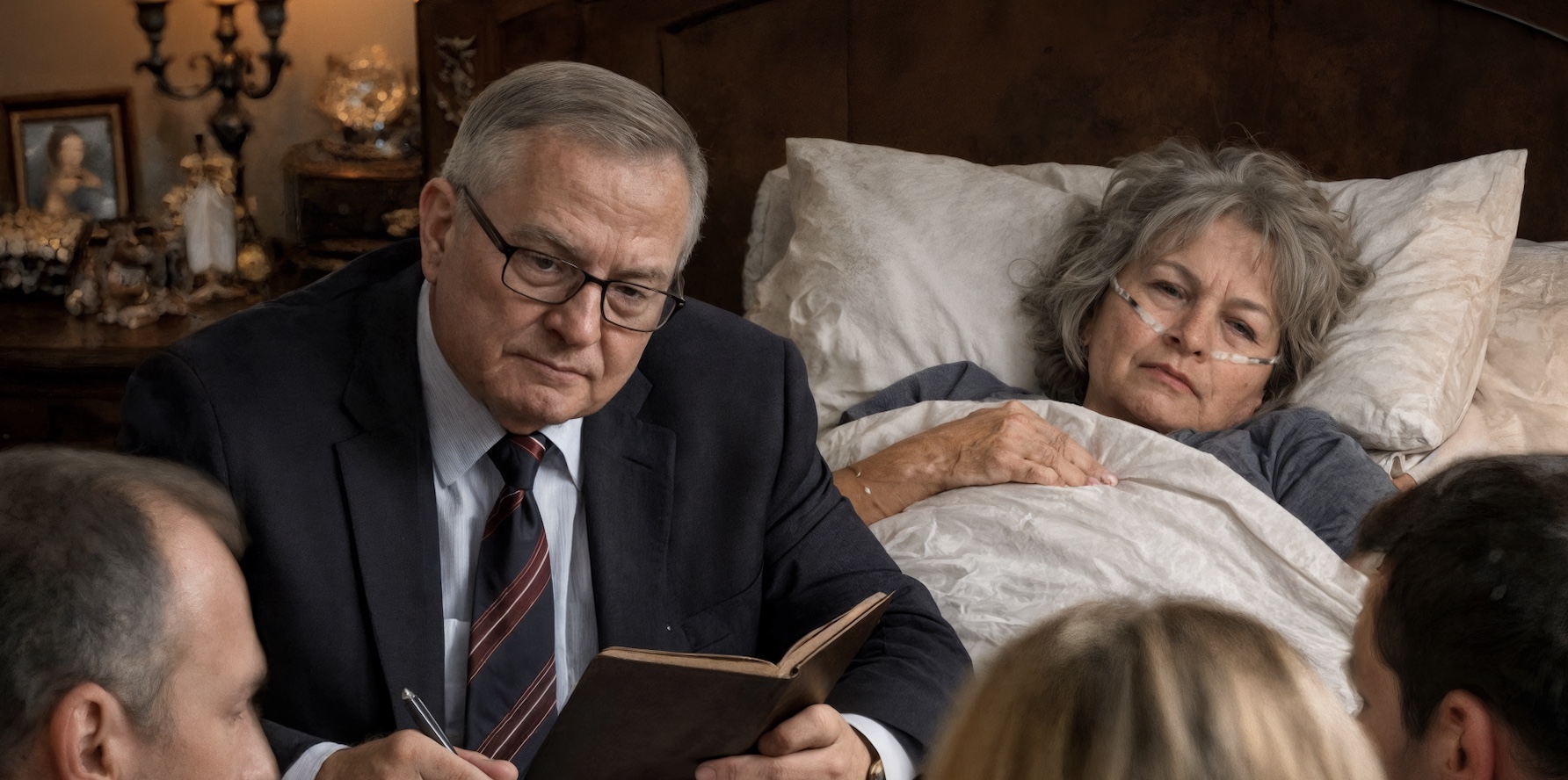
Klavdia Petrovna lay there, not breathing. The act had to be perfect.
The heavy, cloying reek of camphor and valerian—poured into the pillows by her own hands—now felt less like props and more like something suffocatingly real. She was awkward in this part, but backing out was no longer an option.
She had faked it. Told them on the phone she was “going,” that “the doctor gave her a couple of days.” Called them to come and divide whatever would be left.
Not out of malice. She did it because in the last few years she had started to feel invisible.
A blank space. A free nanny. A bank. A shoulder to cry on. Useful—yet unseen.
She wanted to jolt them. To catch fear in their eyes. Fear of losing her, not her square meters.
And they came—Yegor and Sveta.
They were standing a couple of steps from the bed now, whispering. Klavdia kept her eyelids shut, forcing herself to breathe in tiny, nearly undetectable sips.
“The cabinet, Yegor,” Sveta hissed, her breath sharp with mint gum. “You remember Mom promised it to me. You don’t even have room.”
“Sveta, let’s be rational,” Yegor mumbled back—her older, “logical” son. “Where’s the logic? My apartment is bigger. And the dacha… the dacha has to be valued fairly. We can’t undersell.”
“I don’t care about the dacha! Valera’s in debt again—I need something… solid!” Sveta was almost crying. “Everything’s always been easier for you!”
Klavdia pressed her head deeper into the pillow.
Not a word. Not a single “Mom, how are you?” No attempt to take her hand. No one even pulled up her blanket.
Straight to it. Business.
“And I need stability,” Sveta’s voice trembled, slipping into those familiar weepy notes. “You know how hard it is for me. I need… collateral.”
Collateral. What a neat word for a mother’s cabinet.
Under her closed lids, Klavdia felt dry, angry tears collecting. She swallowed.
“We’re just… so there won’t be chaos later,” Yegor stepped closer. Klavdia caught his scent—not tobacco, but something new and expensive, a cologne with a metallic edge. The smell of a stranger. Of a successful man she’d once been proud of. “Mom? You can hear us, right? We just want to put everything in order.”
She stayed silent. She was “on her deathbed.”
“See? She doesn’t even care anymore,” Yegor said, authoritative. “Let’s do it quietly. I’ll make a list, you check it.”
“And the beads?” Sveta suddenly darted to the nightstand. “Grandma’s amber!”
Klavdia’s hand, lying atop the blanket, twitched.
Those beads were her relic. The only piece of her mother she still had. She never wore them, but she took them out in her darkest moments just to hold them.
“I’m taking them. For remembrance. I need them more,” Sveta said, already untying the little pouch. Her fingers moved fast—like a pickpocket’s.
“Put it back,” Yegor snapped. “Not now. Don’t waste time on crumbs. The cabinet, the dacha—that’s the real value. Beads are dust.”
“You’ve always bullied me!” Sveta shrieked. “Everything goes to you! And what’s left for me?”
They forgot she was “dying.” They were already dividing the spoils.
Klavdia understood: her small, cunning test had turned into something monstrous.
“Calm down,” Yegor’s voice dropped, hard and steady. “I told you—everything will be fair. The notary will come, we’ll do it properly.”
Klavdia’s “dying” breath stalled.
A notary?
Yegor’s phone buzzed on the nightstand. He glanced at the screen and nodded to himself.
“There. He’s downstairs. I told you—reliable.”
He looked at his mother.
“Now, Mom. We’ll sign everything quickly. So you won’t worry.”
Klavdia Petrovna slowly opened her eyes.
She had invited them to divide her property, thinking it was her game.
I didn’t know they would bring not a simple notary, but… someone who had already prepared all the paperwork for her apartment—while she was still alive.
Yegor didn’t flinch. He met her gaze calmly, almost with relief.
Sveta, on the other hand, let out a theatrical gasp and jumped away from the nightstand, hiding her hands behind her back as if she’d been caught stealing.
“Mommy! You can hear us!” Sveta’s voice instantly turned thick as syrup. “We were so worried!”
“It’s good you’re conscious,” Yegor said evenly. “That actually makes things easier. You want order, don’t you?”
Order. Klavdia felt that “order” tighten around her chest like an ice ring.
A short, businesslike ring sounded at the door.
“That’s him,” Yegor said, stepping into the hallway.
Klavdia heard muted voices. “Yes, here, in the bedroom,” floated in. “Just… be delicate.”
Yegor returned with a short, twitchy man in a rumpled gray blazer. He smelled of mothballs—or cheap paper and sweat.
He carried a fat, worn briefcase. His eyes, magnified behind thick lenses, swept the room, lingered on the cabinet Sveta wanted, and stopped on Klavdia.
He didn’t look her in the eyes. He looked at her like an object. Like furniture.
“Pyotr Semyonovich,” Yegor introduced him with a nod toward his mother. “Our specialist.”
Specialist.
Pyotr Semyonovich arranged his features into mournful politeness.
“Klavdia Petrovna… my… uh… condolences regarding your condition. We’ll try not to exhaust you.”
He didn’t ask how she felt. He didn’t ask if she understood what was happening.
He snapped open the locks of his briefcase. The sound was thunderous in the camphor-soaked room.
“Yegor Andreyevich has explained everything. To spare you future… difficulties.”
He pulled out several sheets—already printed. Already filled in.
“We prepared a draft,” he said, spreading the papers on the dresser. “To save your time.”
Sveta hurriedly dragged a chair closer for him.
“What… is that?” Klavdia asked, barely audible. Her voice was hoarse from valerian and rage.
“A gift deed, Mom,” Sveta said, stepping closer and stroking her shoulder. Her hand was cold and damp. “You always… always said everything would be ours.”
Yegor picked up one page.
“It’s just a formality. So we don’t have to deal with inheritance later. That takes forever, Mom. This way you simply gift the apartment and the dacha to me and my sister.”
He said it as if he were offering her tea.
“Half and half,” Sveta added quickly, watching her mother’s face.
Yegor shot her an annoyed look, but stayed quiet.
Pyotr Semyonovich cleared his throat.
“Standard procedure. We will… uh… record your intention. In the presence of—so to speak.”
They hadn’t brought a notary. They’d brought someone who processed takeovers.
“But I—” Klavdia began.
“Mom, don’t,” Yegor interrupted, gentle but firm. “Don’t waste your strength. We’ve decided everything. It’s the most logical solution.”
He talked about her life. About her home. Like a project that needed to be closed.
“Right here,” the “specialist” Pyotr Semyonovich said, producing a plain ballpoint pen and offering it to her. “Your signature.”
He didn’t read her a single line.
Klavdia stared at the pen.
“My… hand is shaking,” she whispered. That was true—just not from weakness.
“No problem!” Pyotr Semyonovich chirped. “We anticipated that.”
He rummaged in the briefcase and pulled out an ink pad.
“A fingerprint will do. Or if it’s very difficult,” he lowered his voice conspiratorially, “just scribble something. I’ll certify the signature was made in sound mind.”
In sound mind.
Yegor took the pen from the man.
“Come on, Mom.”
He grabbed her limp hand lying atop the blanket.
And tried to wedge the pen into her fingers.
Not just wedge it—he started squeezing her fingers around the plastic. Forcing them closed.
That touch. That cold, administrative violence.
Sveta watched, barely breathing, her eyes locked on the pen.
“Don’t make it harder,” Yegor hissed at her ear. “Do what they’re asking. It’s for your own good.”
Klavdia Petrovna felt the sharp tip press into the blanket.
They truly believed she would die any minute. Or that she was already dead in spirit.
Slowly, she lifted her gaze from Yegor’s hand to his face. Then to Sveta. Then to Pyotr Semyonovich behind his grimy glasses.
And she smiled.
That smile was more terrifying than any scream.
It was wide, almost cheerful—while her eyes stayed completely cold.
Yegor froze, his hand holding the pen suspended in midair.
“Mom, what are you doing?” Sveta gave a nervous little giggle. “You’re totally…”
“Hand. Off.” Klavdia’s voice was quiet, but there was such steel in it that Yegor yanked his hand back as if he’d touched a stove.
The pen dropped to the floor with a light tap.
“Mom!” he snapped. “What are you—”
Klavdia Petrovna slowly, with a groan, sat up in bed.
The camphor and valerian hit her again, stronger now—but it smelled not of sickness, only of stage props.
She sat with her feet on the floor: an old nightgown, gray hair in tangles, a “dying” woman.
Except her eyes drilled like augers.
“Pyotr Semyonovich, is it?” she said to the “specialist.”
He sprang up too fast, knocking the chair over.
“I… yes… Klavdia Petrovna, you should be lying down…”
“I didn’t call you,” she said, staring straight into his foggy lenses. “And these people”—she jerked her chin toward her petrified children—“had no right to bring you into my home.”
“It’s… it’s just…” he stammered, looking to Yegor for help.
“That’s called ‘fraud by a group acting in prior conspiracy,’” Klavdia pronounced. She didn’t know if that was the exact legal wording, but it sounded heavy enough.
Pyotr Semyonovich’s face drained white. He looked like a petty hustler, not a hardened criminal.
“‘I’ll certify the signature was made in sound mind,’” she repeated, savoring his own words. “Are you a psychiatrist, Pyotr Semyonovich?”
“I… I’m leaving,” he blurted, snatching up his briefcase. Papers slid off the dresser and fluttered to the floor. “You’re not well!”
“I’m exactly well!” she shouted after him. “And I can call the police, too!”
The “specialist” shot out of the room. A second later, the front door slammed so hard the glassware in the cabinet clinked.
Klavdia slowly stood up.
She swayed—either from lying down too long or from rage.
Sveta was the first to recover, and of course her first weapon was tears.
“Mommy! What have you done? We were… we were just—”
“Stop,” Klavdia cut her off.
She turned to Yegor. He wasn’t crying. His face was dark red.
“You ruined everything,” he ground out. “Made a circus.”
“You made a circus, Yegor. With your notary.”
“We were trying to do what’s best! Put things in order!” he shouted.
“Put in order?” Klavdia went to the nightstand and lifted the pouch of amber beads. “Was this ‘putting in order,’ too?”
Sveta shrank into her shoulders.
“You came to divide,” Klavdia said, her voice even. “And you started dividing. Fine.”
She faced Yegor.
“You, Yegor Andreyevich, wanted the dacha. Fair enough. It’s yours.”
The tension eased in him from pure surprise. He blinked, not trusting it.
“Seriously?”
“Completely. Take it. Right now.”
She went to the wardrobe, opened it, and pulled out an old canvas tent and a rusty grill.
“Here. This is the dacha. Or rather, this is everything you’re getting from it. Take it.”
She threw the tent at his feet.
“Mom!” Sveta shrieked, realizing the show was over.
“And you, Svetlana Andreyevna, needed ‘collateral.’ The cabinet.”
Klavdia walked to the cabinet, opened it, and pulled out a stack of old plates.
“Here. Your ‘collateral.’”
She held them out. Sveta’s hands trembled.
“And now,” Klavdia Petrovna swayed but steadied herself on the back of a chair, “the division of property is over.”
She pointed at the door—the one Pyotr Semyonovich had slammed so dramatically.
“Out. Both of you.”
“You… you can’t!” Yegor started to redden again. “We—”
“I can. This is my home. And you came here to do this.”
“We’re not leaving!” Sveta dug in.
“You are.”
Then Klavdia did what they never expected. She grabbed the water carafe they’d prepared for her “final hours” and hurled it into the wall beside Yegor.
Water and crystal shards exploded in every direction.
Yegor and Sveta screamed.
“OUT!”
They bolted from the room, shoving each other, grabbed their jackets in the hallway, and a minute later Klavdia heard the front door slam behind them.
She was alone. The room smelled of camphor, valerian, and the sharp metallic tang of shattered crystal.
Slowly she went back to the bed and found the pen on the floor.
Then she picked up the “gift deed” papers the “notary” had left behind.
She sat down on the floor among the shards and began to read.
And what she read was worse than she’d imagined.
The papers lay fanned out. The “Deed of Gift” was on top.
Simple and cynical: the apartment, the dacha, the garage—everything she’d worked for her whole life reduced to dry lines on cheap paper.
But beneath it was another sheet Pyotr Semyonovich must have dropped in his hurry.
“Application for voluntary appointment of a guardian.”
Klavdia lifted it. Her hands no longer shook.
She read.
“I, Klavdia Petrovna… due to a sharp deterioration in health… and inability to fully make independent decisions… request…”
Request.
“…to appoint my son, Yegor Andreyevich, as my guardian… with the right to manage all my accounts and property and to make medical decisions on my behalf.”
She reread that phrase.
“To make medical decisions.”
There it was. That was the “most logical” part.
They didn’t just want her things. They wanted her. Her will. Her right to say yes or no.
They wanted to switch her off like an old television.
The gift deed was a cover—dust in Sveta’s eyes. Yegor’s true prize was total, absolute, legalized power.
He hadn’t brought just a hustler. He’d brought someone who turned living people into property.
And then she remembered.
She remembered how Yegor—her “logical,” “caring” Yegor—had come six months earlier to “help Mom with paperwork.”
“Your documents are a mess, Mom. Let’s organize everything.”
He’d sat at her kitchen table, clicking a scanner like a machine.
“Come on, Mom—let’s scan everything, make copies. Just in case. In this day and age… anything can happen. And we’ll have copies in the cloud.”
He scanned her passport. Her apartment documents. The certificate for the dacha. Everything—down to the last receipt.
“Just in case.”
He wasn’t waiting for her to get sick. He had been preparing for it.
Klavdia sat on the floor among the shards for a long time.
The suffocating valerian smell faded. All that remained was the cold draft from the hallway.
She didn’t cry. The anger passed too. What stayed was something hard, heavy, and crystal clear—like a foundation.
She stood up carefully, avoiding the glass.
Went to the window and threw it wide open. Frosty city air slapped her in the face.
She swept the camphor and valerian bottles off the table and tossed them into the bin.
Then she took a broom and dustpan and, methodically, she collected every shard of the broken carafe.
The phone on the nightstand started ringing—piercing, demanding.
It was Sveta. Or Yegor.
Klavdia stared at it.
She walked over, lifted the receiver… and yanked the cord out of the wall.
She took the pouch of amber beads from the nightstand and poured them into her palm. They felt warm—alive.
She put them on. For the first time in years.
Then she sat at the kitchen table, found a clean sheet of paper and a pen—not the one from the bedroom floor, but her own.
And she began to write.
“1. Change the locks. Tomorrow.”
“2. Put the tent and grill out in the stairwell.”
“3. Sell the dacha.”
She paused, thought, and added:
“4. Buy a new carafe. Blue.”
Klavdia set the pen down. She didn’t know what she would do about her children. Whether she would speak to them. Whether she would ever forgive them.
It didn’t matter.
She staged a performance to test whether they loved her—and instead she learned what they were capable of.
But more importantly, she learned what she was capable of.
She wasn’t dying. She had just been born.
Epilogue.
Three months passed.
Klavdia Petrovna’s apartment smelled of fresh paint and lemons.
The old worn runner from the hallway was gone, revealing sturdy oak flooring.
On the kitchen table stood the very carafe she’d written down. Bright blue, thick glass, catching the morning light.
The locks were changed the very next day. The repairman shook his head while installing them. “Ma’am, those weren’t locks, they were decoration. Good thing you acted when you did.”
As promised, she put the tent and the grill out on the landing. They sat there for two days, smelling of damp canvas, until Yegor took them. He took them at night, quietly—like a thief.
He didn’t call. He sent one message to her new button phone: “You’ll regret this.”
Klavdia didn’t reply.
Sveta called almost every day during the first week.
At first it was sobbing: “Mom, how could you? We’re family!”
Then accusations: “You provoked Yegor! He’s good—he’s just logical!”
Then manipulation: “Nikita (her son) has a birthday soon. He misses his grandma so much…”
Klavdia listened to the voicemails. Sveta’s mechanical, unfamiliar voice no longer got under her skin.
She deleted them all.
Once, Sveta came in person. She stood outside the door, pressing the new shiny bell over and over.
Klavdia was in the kitchen, drinking strong, freshly brewed fireweed tea. She heard every ring.
She didn’t go to the door.
Klavdia didn’t become a loner. She became selective.
She called her second cousin in Tver, someone she hadn’t spoken to in ten years.
“Zina? Hi. It’s Klava. Yes… alive. Listen, do you remember you invited me to visit?”
A week later she was on a train.
She came back two days later, rested—and angry at herself. Angry she hadn’t done it sooner.
She took out the old papers. The same ones the “specialist” had brought.
The “Deed of Gift” and the “Guardianship Application.”
She didn’t throw them away. She put them in a dresser drawer under a stack of clean towels.
It wasn’t a trophy. It was medicine.
Any time she felt the old urge to call Sveta, to pity her, to let her back into her life out of habit—she opened that drawer.
She stared at the line: “to make medical decisions on my behalf.”
And the urge disappeared.
She still didn’t know what would be in her will. Maybe she’d leave everything to Zina’s nephew. Maybe she’d donate it to a cat shelter.
Her performance failed. She had wanted to see love, and she saw truth instead.
But truth—unlike love—never lies.
Klavdia Petrovna touched her amber beads. They cooled her skin for a moment, then warmed.
She took her rolling shopping bag. There was a fair in the little park by her building today; they were selling saplings.
She decided she wanted an apple tree. A dwarf variety. One that could grow right on her balcony.
For herself.