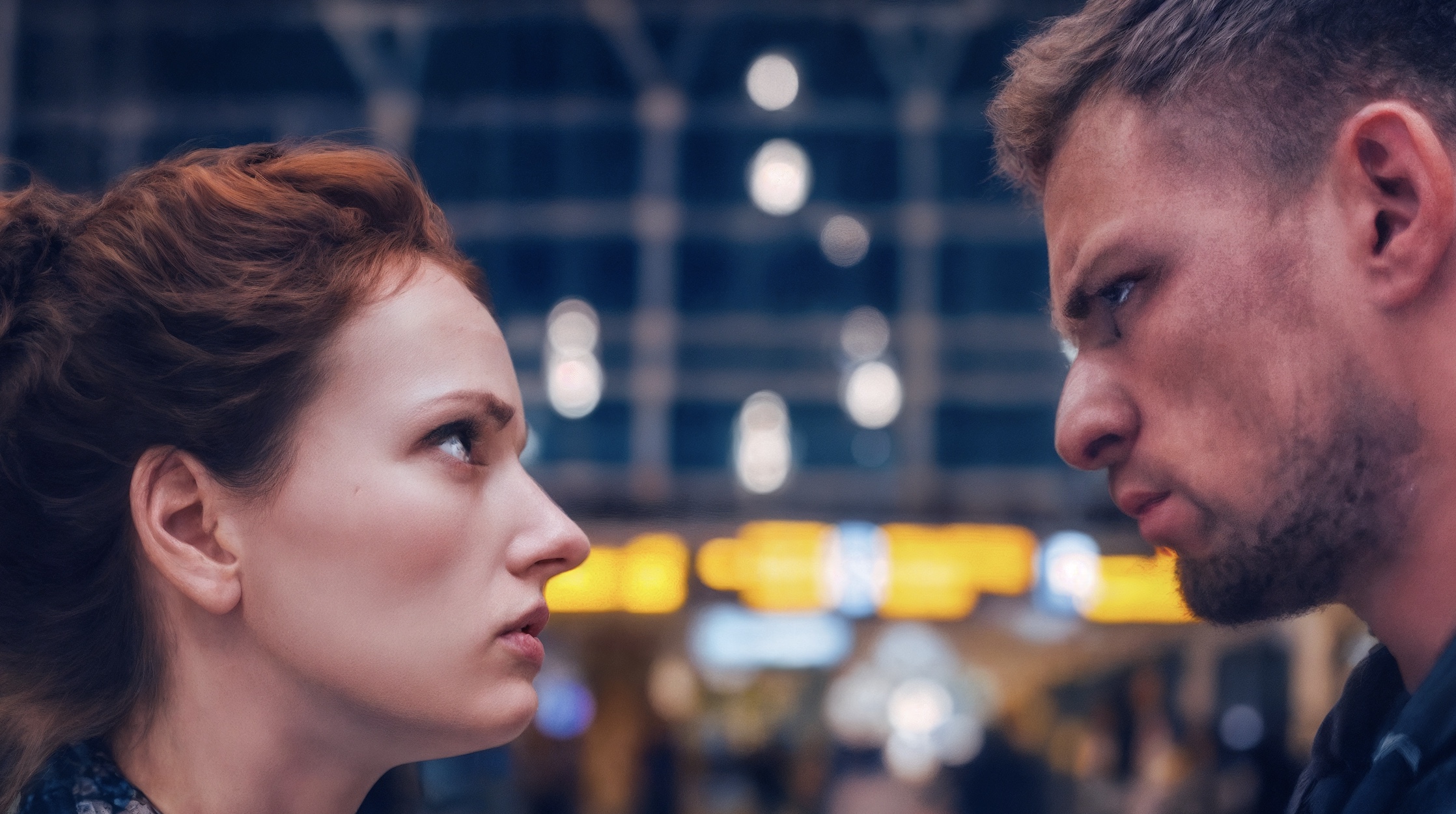
“Are you sure you brought your passport?” Nastya checked her backpack for the third time, even though she knew the documents were in the inner pocket. The excitement of the trip had made her a little absent-minded. “And the vouchers? Roma, can you hear me?”
Roman hitched his shoulder, adjusted his bag strap, and gave a lopsided smile. His eyes kept sweeping the terminal like he was expecting a police raid—or looking for an exit route. Normally calm, almost phlegmatic, today he looked like a kid who’d done something bad and was about to get dragged to the principal.
“I’ve got everything, Nastya. Calm down,” he grunted. But instead of walking toward check-in, he slowed near a column plastered with cellphone ads. “Listen… there’s something. I wanted to surprise you. You know… so everyone would be happy.”
Nastya stopped, a cold shiver skimming her spine. Roman’s surprises were rarely successful. The last one had been a cookware set for March 8 instead of the spa day he’d promised. But now, two hours before their flight to the Maldives, any “surprise” sounded like a threat.
“What kind of surprise?” Her voice sharpened. “We’re flying together. The hotel is paid for, the transfer is booked. What could you possibly have changed?”
Roman opened his mouth to answer—but a loud, painfully familiar voice drowned him out, slicing through the crowd noise and the announcer’s monotone:
“Romochka! At last! I thought you got stuck in traffic—I was going to call, but I put my phone in the suitcase so I won’t get irradiated on the flight!”
From behind a luggage cart stacked with three enormous bags—tight-wrapped in green plastic wrap so they looked like gigantic caterpillars—Galina Petrovna emerged. She was wearing her “travel outfit”: a sparkly tracksuit and a sun hat, even though they were indoors. A bulky little point-and-shoot camera dangled from her neck, and in her hands she clutched a stuffed supermarket bag that smelled unmistakably of fried dough and onions.
Nastya froze. The world seemed to sway for a second. She looked at her husband, then at her mother-in-law, then back at her husband. The pieces in her head fit together with torturous slowness—because her mind refused to accept something so absurd.
“Mom?” Nastya said it not as a greeting, but like she was questioning reality itself. “Galina Petrovna… what are you doing here? Are you seeing someone off?”
“Seeing someone off—don’t be ridiculous!” Galina Petrovna briskly rolled the cart up to them, nearly running over Nastya’s expensive white sneakers. “I’m flying with you! Roma said the sun there is savage, and with your pale skin you’ll burn the very first day. And it’s boring for young people to be alone for two weeks—you’ll go feral. Besides, I’ll watch your things while you’re swimming, and I’ll put sunscreen on your back.”
Nastya slowly turned her head toward her husband. Roman studied the departures board with great concentration, as if a flight to Antalya interested him more than his own life.
“Roma,” she said quietly. “Explain. Right now.”
At last he looked at her. In his eyes was a plea for mercy mixed with the stubborn certainty of a man convinced he’s doing something noble—and everyone else is simply too stupid to appreciate it.
“Nastya, don’t start, okay?” he lowered his voice and reached for her elbow, but she pulled away. “Mom has worked her whole life at the dacha. She hasn’t seen the sea in thirty years. Her blood pressure, her joints… the doctor prescribed sea air. And we’re flying anyway. What, are we going to be stingy? The room is big, there’s space for everyone. I was trying to do the best thing.”
“The best thing?” Cold anger began to boil inside her. She wasn’t shouting, but her whisper was worse than a scream. “This is our honeymoon, Roma. Honeymoon. That means two people. Do you even understand the word ‘intimacy’? Or are you planning for your mother to hold a candle so we don’t disrupt her schedule?”
“Oh please, what intimacy,” Galina Petrovna cut in, businesslike as she adjusted her son’s backpack strap. “You’ll have plenty of time for that later—your whole life ahead of you. You need to fix your health now. I baked pies for the trip, cabbage and egg. On the plane they serve chemical garbage, but we’ve got our own, homemade. Roma, you must be hungry—you haven’t eaten a thing since morning.”
Nastya watched this surreal scene and understood that her beautiful plan—white bikini, sunsets, cocktails, long nights of love—was being crushed under the copper washbasin Galina Petrovna usually used to make jam.
“Why am I finding out at the airport that you bought a ticket for your mother to come on our honeymoon because she, supposedly, has never been to the sea?” Nastya said through clenched control. “Roma, we’re going on a romantic trip, not a family health resort! Do you realize you’ve ruined everything?”
“Lower your voice, people are staring!” Roman hissed, glancing around. “What’s with the selfish act? The tickets are non-refundable. The money’s paid. Mom’s already excited. You want to make a scene and abandon an elderly woman at the airport with her suitcases? She’ll have a heart attack!”
“I’m the one who’s about to have a heart attack,” Nastya snapped. “You sprang this on me. You didn’t ask. You decided my opinion doesn’t matter. You dragged your mother into our bed—along with her pies and her hypertension.”
“Don’t exaggerate!” Roman’s irritation flared now that he felt supported by his mother’s presence. “What bed? We booked a room with an extra bed. We’ll just live in the same unit. It’s savings, Nastya! Do you know what a single room costs these days? We’d go broke! This way Mom’s happy and the budget stays intact.”
Meanwhile Galina Petrovna had started unpacking her bag. The smell of fried onions grew thicker, overpowering Nastya’s expensive perfume.
“Nastenka, why are you so pale?” her mother-in-law asked sweetly, offering a greasy bundle in a napkin. “Have a pie, you’ll feel better. And don’t scold Romka—he’s a good son, takes care of his mother. You should learn kindness from him. Instead you’re standing there pouting like a mouse sulking at grain. We’re one family now. And in a family, everything is shared. Vacations too.”
Nastya stared at the offered pie, then at her mother-in-law’s satisfied face—already mentally arranging her things in their room—and at Roman, chewing his lip as if waiting for his wife to sigh, surrender, and accept the rules like she always had.
“I don’t want a pie,” Nastya said, stepping back from the luggage cart. “And I’m not playing this ‘happy family outing’ game. Roma, show me the hotel confirmation. Right now.”
“Why?” he stiffened.
“Show it.”
Reluctantly Roman pulled out his phone, tapped the screen, and turned it toward her. Nastya scanned the lines.
“Room: Standard, triple occupancy (2 adults + 1 adult).”
The booking date had been changed three weeks earlier—exactly two days after they’d filed their marriage application.
“So you planned this for a month,” she said. “A month you lied to my face while we talked about champagne on the balcony. And meanwhile you were picking out a spare bed for your mom.”
“It’s not a spare bed, it’s a proper sofa…” Roman started, but Nastya no longer listened. She looked at the endless check-in line and realized it wasn’t leading to a paradise vacation. It was leading straight into communal hell—only with palm trees.
“Why are you standing around? Get in line! Over there by the families—it moves faster,” Galina Petrovna ordered, shoving her cart forward like an icebreaker cutting through Arctic ice.
Nastya followed mechanically. Her legs felt numb, her head buzzing as if she were already in a depressurized cabin. She stared at her husband’s back—stretched under the light blue polo shirt she’d chosen a week earlier “for pretty sunset photos.” Now that back felt чужой: hunched, guilty, and utterly dependent on the voice of the woman in the sun hat.
The check-in queue coiled like a long, sweaty ribbon. The terminal’s air conditioners were straining but couldn’t beat the heavy heat of the crowd. Galina Petrovna parked her luggage convoy right against Nastya’s feet.
“Roma, here,” her mother said, expertly fishing a plastic container from her cavernous carry-on. The lid popped open, releasing a cloud of fried dough and garlic. “While we’re standing, we should eat. You didn’t finish breakfast.”
“Mom, we’re not on a train,” Roman protested weakly, glancing at the stylish couple ahead sipping coffee from paper cups.
“And what difference does it make? Your stomach doesn’t know whether it’s on a train or in an airport,” Galina Petrovna declared, pressing a greasy pie into his hand. “Eat. Gastritis never sleeps. Nastya, want one? Cabbage, or do you like meat? I forget—you’re always on those diets, the wind could knock you over.”
Nastya silently shook her head and stepped away. It was physically unpleasant to stand in the middle of this epicenter of domestic absurdity. People around them really were turning to look. The smell of home cooking clashed with the sterile air of the departure zone, shattering any sense of “vacation.” But the worst part wasn’t the pies. The worst part was how Roman, after checking his surroundings, obediently took the food and began chewing—quickly, as if speed could erase his shame—while nodding along to his mother’s story about a neighbor whose greenhouse had burned down.
In that moment, Nastya didn’t see a man she could build a future with. She saw a grown boy being passed from hand to hand—first from his mother to his wife, but with one condition: Mother remained the controlling shareholder.
“Roma,” Nastya said, cutting through the greasy pause, her voice dry as snapping wood. “I looked at the hotel details. You didn’t just add a person. You changed the room category.”
Roman choked. Galina Petrovna immediately fussed, trying to thump his back, but he waved her away. He wiped his oily mouth with the back of his hand—a gesture Nastya hated—and looked at her like a trapped animal.
“Nastya, let’s use logic,” he began in the tone people reserve for explaining obvious things to children. “A junior suite with an ocean view costs two hundred thousand. A standard with a garden view is one twenty. Add Mom’s flight, add the surcharge for a third guest… it comes out to the same total! I just redistributed the budget. That’s called financial literacy.”
“Financial literacy?” Nastya felt one corner of her mouth twitch. “You stole our ocean view to cram us into a room facing bushes where we’ll live three adults together? Do you understand a standard room has one bathroom? One for three people? With a glass divider, Roma!”
“Oh please, like I haven’t seen everything,” Galina Petrovna cut in, licking her fingers. “What are you acting fancy for. You think I haven’t seen you both in diapers? I didn’t see you, Nastya, but we’re women—no secrets. I’ll turn away if you’re shy. Or I’ll take a walk while you wash. You’re inventing a problem.”
Nastya looked at her mother-in-law. The woman truly didn’t understand. In her world, personal boundaries simply didn’t exist. Her son and his wife were just extensions of her own body—attachments she had the right to control.
“It’s not about what you’ve seen, Galina Petrovna,” Nastya said softly, forcing herself not to shout though everything in her was boiling. “It’s about the fact that we planned this vacation for a year. I worked without a single day off to pay half the cost—specifically for that hotel. That room. And Roma, without asking me, took my money and his money and decided your wishes were more important than our comfort.”
“Your money is family money!” Roman snapped, raising his voice for the first time. Several people in line turned their heads with interest. “Why are you counting pennies? We’re married! My mom is your mom now. And you’re acting like a stranger—‘my half,’ ‘my comfort’… where’s ‘ours’? Where’s respect for elders?”
“Exactly!” Galina Petrovna chimed in, lips tight with offense. “I came to her with my whole soul, baked pies, didn’t sleep nights—and she gives me ‘view of bushes.’ Who cares what the view is, as long as the sea is nearby! You youngsters are spoiled. We lived in a shed in Gelendzhik—four of us on one cot—and we were happy! But you—oh, a glass divider is too much.”
Roman glanced at his mother with gratitude. There it was: support. Someone who understood. And his wife… she stood there with a stone face—beautiful, cold, and completely чужая. And suddenly irritation rose in him. Why can’t she just be happy? Why does everything have to be so difficult?
“Enough, Nastya,” Roman said, squaring his shoulders, convinced the argument was on his side. “Stop ruining the mood. We’re already here. Tickets in hand. The room is paid. Either you calm down and we have a normal vacation, or… I don’t know. Stand here and sulk. But it’s stupid. Mom’s abroad for the first time—you should show some empathy.”
He said the trendy word “empathy” with obvious pride. Nastya looked at him for a long, studying moment. She saw him reaching for a second pie from his mother’s container, saw him dutifully handing her a bottle of water. She saw a bond she couldn’t break. In that equation, she was the extra variable. Not a wife, not a beloved woman—just a travel companion expected to fund part of the trip and stay out of the way.
“So it’s a standard room with a garden view?” she repeated, and an unsettling softness appeared in her voice.
“Yes,” Roman nodded, chewing. “The balcony’s big, there are chairs. In the evening we’ll sit out, have some wine, play cards. Everything will be fine, Nastya. Don’t overthink it.”
He truly believed the conflict was over. He thought she’d surrendered. He didn’t notice the last spark of warmth in her eyes go out, replaced by a glacial emptiness. The line shifted, and Galina Petrovna briskly shoved her cart forward, almost knocking Nastya off balance.
“Come on, come on! Or the best seats will be taken and we’ll end up by the toilet,” she ordered. “Roma, don’t put your passport away. Nastya, why are you standing there? Give me your suitcase, I’ll put it on the cart—it’s heavy.”
“No,” Nastya said, gripping the handle until her knuckles whitened. “I’ll carry it.”
She stepped toward the counter—but not to hand her passport to the smiling airline clerk. In her head, a plan had formed: harsh, short, final.
Like a shot.
“Give me your passports—I’ll put them in a special folder and wear it around my neck, safer that way,” Galina Petrovna reached out, and Roman, without even glancing at his wife, obediently placed his document into his mother’s plump hand.
Nastya watched with detached curiosity, like a researcher observing insects. Here was the big female caring for her overgrown offspring. Here was the offspring—taller and broader than his mother—offering his neck willingly so she could straighten the collar of his polo.
“You’re all sweaty, poor thing,” his mother cooed, pulling out a paper tissue and dabbing her son’s forehead. “On the plane the air conditioning blows—don’t you catch cold. I’ll ask for a blanket right away. And I put warm socks in your carry-on—change as soon as we take off.”
Roman stood with his eyes half-closed and let her wipe his face. In that moment he looked completely safe, completely content. Nastya felt nausea rise—not from the food smell still hanging around them, but from pure physical disgust. Yesterday this man had seemed like her anchor. She’d imagined him as a passionate lover, the head of their family. And now she saw a thirty-year-old infant who still needed his diaper changed.
“Roma,” she called. Her voice came out dull, like it was echoing from a barrel.
He opened his eyes, and irritation flashed—she’d pulled him out of the warm cocoon of maternal care.
“What now?” he muttered, brushing his mother’s hand away but not stepping an inch away from her.
“Come with me for a minute. Without your mom.”
“Why? We’re almost at the counter,” he fussed.
“One minute, Roman. Or I’ll talk right here and the whole terminal will hear.”
He rolled his eyes, sighed heavily—the martyr’s gesture of a man bearing the heavy cross of married life—and took two steps toward an advertising board. Galina Petrovna pricked up her ears but stayed behind to guard the cart, theatrically checking the suitcase locks.
Nastya stepped close. She didn’t look into his eyes—only at the button on his shirt. It felt like if she met his gaze, she’d see emptiness, and it would break something inside her.
“I’m going to ask you one question. A simple, technical question,” she said, keeping her voice steady. “We’re going on a honeymoon. That implies a certain kind of vacation. Tell me how you picture this. Practically.”
“What do you mean?” Roman frowned, genuinely not grasping the complaint. “We’ll swim, sunbathe. Go on an excursion—Mom wanted waterfalls…”
“I’m not talking about waterfalls,” Nastya cut him off sharply. “I’m talking about us. Husband and wife. You booked a room where we’ll live the three of us. One room. One bathroom. How exactly are you planning to make love to your wife when your mother will be snoring two meters away on the next bed? Or do you expect us to do it in the toilet? Or by schedule—while she’s out buying pies?”
Roman blushed. Red patches rose up his neck to his cheeks. He flicked a nervous glance toward his mother, checking if she might hear this “indecency.”
“Nastya, you’re vulgar,” he hissed, and disgust rang in his voice. “That’s all you think about. We’ve lived together a year—what haven’t we seen? We can handle a week. Or do you have to run marathons every night?”
“Handle it?” she repeated. The word hit like a slap. “So our honeymoon is a time we’re supposed to ‘handle it’? For what?”
“For family!” Roman threw his hands up, then quickly lowered his voice again. “Mom’s old. She’s lonely. You’re young—we have our whole life to… fool around. And she might only have a couple active years left. Is it really that hard to show a little respect? You’re acting like a selfish bitch who only cares about getting what she wants.”
Nastya stared at him and understood: he truly believed this. Not as a defense, not as an excuse—this was his sincere worldview. For him, his mother’s needs were sacred, the highest priority, and his wife was expected to shrink herself, stay quiet, and be grateful she was included at all.
“So I’m a bitch because I want to spend my honeymoon with my husband, not his mother?” she clarified in an icy tone. “Because I don’t want to wake up to your mother going to the bathroom behind a glass divider? Because I want to walk around the room in lingerie, not in a tracksuit?”
“Oh, stop it!” Roman grimaced like he had a toothache. “You’re dramatizing everything. Mom’s family. And she even said she’ll go for walks in the evenings so she won’t interfere. She understands. You… you’re just looking for a reason to ruin everything. I put in so much effort—I organized everything, found tickets, changed the hotel so everyone would be satisfied—and you’re standing here shredding my brain over some nonsense.”
“Everyone?” Nastya gave a short laugh, and it was more frightening than tears. “You satisfied exactly one person, Roma. And it wasn’t me. And it wasn’t even you. You satisfied your mother. You sacrificed our marriage to her comfort. Do you realize you’re choosing right now?”
“I’m not choosing anything!” Now Roman’s anger became real. His eyes hardened in that way weak people do when they feel cornered. “We’re one family. If you can’t accept my mother, you can’t accept me. That’s it. Enough talking. Come to the counter—our turn is next. And fix your face. You’re upsetting Mom.”
He turned sharply and walked back to Galina Petrovna, who was already waving them over to a free agent behind the counter. Roman walked with confidence, backed by the righteousness of duty. He was sure Nastya would follow. Where could she go? The tickets were bought, the vacation was waiting. She’d sulk and then calm down. Women were like that—loved to suffer, and then still did what they were supposed to.
Nastya stayed by the advertising board. She watched his back moving away, watched him bend toward his mother at once, explaining something and patting her shoulder to reassure her. They looked harmonious—an airtight system, a perfect tandem where the third element wasn’t just unnecessary, but foreign.
The airport roared around her. Boarding was announced for Dubai, someone laughed, a child cried. But for Nastya, the sound had been turned off. Inside her head, everything was crystal clear. The last puzzle piece clicked into place. Roman had told the truth: she really didn’t accept this kind of family model. And more than that—she didn’t want to “endure” it. Not a week. Not a year. Not a lifetime.
She took a deep breath, drawing in the cool conditioned air that suddenly felt astonishingly clean—without the stench of cheap fried dough and stale compromise. Nastya adjusted her backpack strap and walked calmly but firmly toward the check-in desk. But not to stand beside her husband.
“Here are the passports—there are three of us,” Galina Petrovna announced triumphantly, slapping the stack of documents on the counter and pinning them under her plump elbow like she feared a draft might blow them away. “And we need seats together, so we can stretch our legs. My boy’s tall, he can’t be cramped.”
The airline clerk—a tired blonde with flawless makeup and empty eyes—nodded automatically and reached for the passports.
At that moment, Nastya’s slim, manicured hand covered her mother-in-law’s. The gesture was calm, but so strong that Galina Petrovna loosened her grip in surprise.
“Not three,” Nastya said clearly. “Two of you.”
She deftly pulled her own passport from the pile. The red cover with the gold emblem settled into her palm, bringing back the sensation of control over her own life.
“Nastya, what the hell are you doing?” Roman hissed, leaning into her ear. His face was blotchy red, sweat beading on his forehead. “The clerk is waiting! Don’t make a circus, give it back! People are watching!”
“Let them,” Nastya replied evenly, never raising her voice, yet each word landed like a stone dropped into the swamp of their “family harmony.” “Miss, please check these two passengers in. I’m not flying.”
The clerk froze, flicking her eyes from one face to another. Behind them, the line fell quiet, tasting the promise of free entertainment. Galina Petrovna finally understood and threw her hands up so dramatically she almost hit the monitor.
“What do you mean you’re not flying? And the money?” she shrieked, forgetting all about discretion. “Roma, do you hear her? She’s throwing money away! The tickets are non-refundable! Do you understand how much we’ll lose?”
“Mom, wait—” Roman waved her off and tried to grab Nastya by the sleeve. “Nastya, you’re having a meltdown. You overheated. Calm down, we’ll get on the plane, you’ll drink water… You can’t just walk away. It’s our honeymoon!”
Nastya stepped back and shook off his hand with disgust. She looked at her husband and saw a complete stranger: pathetic, fussy, frightened not of losing the woman he loved, but of losing money and his mother’s peace.
“Honeymoon?” She smiled, and that smile was sharper than a scalpel. “Roma, you already have your honeymoon partner. There she is—pies and a suitcase full of pills. You two are a perfect match. You understand each other without words, you share a budget, and you have the same ideas about comfort. Why do you need me? To sit quietly on a folding chair in the corner and applaud your mother-son romance?”
“You’ve lost your mind,” Roman whispered venomously, narrowing his eyes. “That’s my mother! You want me to throw her out? You’re giving me ultimatums?”
“No ultimatums,” Nastya shook her head. “I’m stating a fact. I refuse to be the third wheel in your marriage. Because that’s what it is, Roma. A psychological incest you’ve lived in for years. You’re not a husband—you’re an obedient son who’s terrified of upsetting Mommy. And I need a man. An adult, independent man. Not a mama’s boy whose nose gets wiped at thirty.”
“How dare you!” Galina Petrovna squealed, clutching her chest—without forgetting to keep an eye on the suitcase so it wouldn’t roll off without a tag. “Snake! I treated her like family and she… Roma, did you hear how she insults your mother? And that’s a wife? Throw her out!”
“You’re right, Galina Petrovna,” Nastya nodded, looking at her with cold composure. “Throw her out. Only I’m leaving on my own. You won. Take your boy back—he’s defective. I’m returning him to you in perfect condition, along with the non-refundable tickets and his complete lack of spine.”
Roman stood there opening and closing his mouth like a fish thrown onto shore. He was stunned. He was used to Nastya being accommodating, always compromising. He hadn’t expected her to destroy everything like this—publicly, five minutes before check-in.
“You’ll regret it,” he finally forced out, trying to scrape together a shred of dignity. “You’ll crawl back, Nastya. You’ll be alone. Who needs you with a personality like that?”
“Maybe I will be,” she agreed lightly. “But it’s better to be alone than to share a bed with a man who consults his mother in his head. Fly with your mom. Have your ‘standard’ room with a view of bushes. And when you get back, I’ll have the marriage annulled. Thank God we didn’t have kids—and there’s nothing to divide between us except your infantilism.”
Nastya turned and walked away. Her wheeled suitcase glided smoothly over the tile floor. She didn’t look back. She already knew what was happening behind her: Galina Petrovna was probably shoving heart drops at her son and wailing about the lost money, while Roman stood there dazed, trying to understand what had just happened.
And she didn’t care.
She walked toward the terminal exit against the flow of travelers rushing to their vacations. Happy couples passed her, families with children, sun-kissed tourists. And she felt as if she’d just taken a fifty-kilo backpack off her shoulders—the one she’d been dragging uphill for the last year.
Outside, the air—thick with exhaust from taxis and buses—felt sweet to her. Nastya pulled out her phone, opened her ride-hailing app, and without a tremor deleted the contact saved as “Husband.” Then she dialed her friend, a lawyer.
“Hi, Lena? Yeah, I’m in Moscow. No, I didn’t fly. Listen, I need you to urgently prepare paperwork to annul the marriage. Yes—right now. Long story, but let’s put it this way: the groom turned out to be married to his mother.”
She slid into a yellow taxi, shut the door, and cut herself off from the airport noise, the smell of fried pies, and the life that had nearly become her nightmare. For the first time in a long while, she knew exactly where she was going.
Home. To her life—where there would no longer be room for three.
Back in the terminal at the check-in desk, Galina Petrovna was already businesslike again, shifting her son’s belongings into her own suitcase to avoid an overweight fee, loudly scolding Roman for choosing such a “nervous, ungrateful” girl.
Roman stayed silent, staring at his wife’s retreating back. Two feelings fought inside him: panic at the realization that his married life had just collapsed, and the familiar obedience drilled into him since childhood—obedience to his mother’s authority. He made a timid step forward, as if he might drop the luggage and run after Nastya, catch her, beg, promise to send his mother home in the first taxi…
But Galina Petrovna’s heavy hand landed on his shoulder, pinning him in place more firmly than any anchor.
“Honestly, thank God, son,” she chattered, expertly jamming his things down so she could close the bulging zipper. “Good riddance. She picked a fine time to act up! What a princess—nothing’s good enough for her. Don’t worry, Romochka, we’ll have a wonderful rest, just the two of us. I’ll rub ointment on your back, we’ll go on excursions, we’ll save a fortune on her cocktails. You’ll find a normal, practical woman—none of this… hysterical nonsense.”
Roman looked at his mother. For the first time in thirty years, he didn’t see a caring parent. He saw a suffocating, all-consuming force that had just—smiling, a pie in her hand—eaten his future. And with sudden, frightening clarity he pictured tonight: a stuffy “standard” room, two narrow beds, the smell of medicine, and endless talk about seedlings and dacha neighbors instead of ocean surf and the whisper of the woman he loved.
“Miss, check us in!” Galina Petrovna ordered the clerk, thrusting out her chest. “And give me a window seat—I’ll photograph the clouds with my little camera. Put my son in the aisle so he can stretch his legs.”
Roman mechanically placed a suitcase onto the conveyor belt. He was leaving. Leaving by inertia—because Mom decided, because “the money’s paid,” because he didn’t know how to do anything else. But he understood: this plane wasn’t taking him to a tropical paradise.
It was carrying him into a lifelong loneliness for two—one he’d never managed to escape.
Meanwhile, the yellow taxi merged smoothly into traffic on Leningradskoye Highway, carrying Nastya away from the airport. Inside, it smelled of a cheap “pine tree” freshener and old leather, but to Nastya that scent was sweeter than any French perfume. She leaned her head back against the seat and closed her eyes.
Her phone buzzed briefly. She glanced at the screen, expecting frantic calls, apologies, threats—anything. But it was only a bank notification about the travel charge. The screen stayed dark. Roman didn’t call. He was probably obediently taking off his shoes at security while his mother arranged them in a tray.
Instead of tears—the tears she’d been afraid of—she let out a laugh. First quiet, then louder. It was the laugh of relief, the laugh of someone who had narrowly missed a catastrophe. She thought about the money spent on the trip—an enormous amount, enough to buy a car or refresh her wardrobe. Then she pictured the other price: five, ten years in a “communal apartment” with her mother-in-law, shredded nerves, a broken psyche, children raised by Galina Petrovna’s rules.
“Cheap escape,” Nastya whispered, watching gray industrial neighborhoods slide past the window. “I just bought my freedom. And it was the best investment of my life.”
The driver, an older man with kind eyes, glanced at her in the rear-view mirror.
“Are you okay, miss? Are you crying or laughing? Want me to turn on some music?”
“I’m great,” Nastya wiped a tear of laughter from the corner of her eye and smiled—wide and genuine, like she hadn’t smiled in a long time. “Put something on. Loud and happy. I’m celebrating today.”
“Birthday?” the driver asked, turning up the radio.
“Better,” she said, lowering the window and letting the wind toss her hair, blowing away the last traces of doubt—and the lingering smell of fried onions. “An awakening.”
Somewhere high in the sky, a jet roared, carrying two passengers toward their strange, symbiotic “honeymoon.” And down on the ground, in the flow of ordinary Moscow life, a young woman was going home—to an empty, quiet apartment where only her own rules waited, her own dreams, and an entire life that now belonged to her.
And that was real. Honest happiness.