Irina sat in the kitchen, watching the evening light slide across the old wooden table—the same one they’d once brought from her parents’ apartment after her mother died. Her father had passed earlier, five years ago, the first blow. Her mother’s death two years later felt like the last pillar giving way. All that remained was the dacha in Malakhovka, where Irina now went alone, because Sergey always found a reason not to.
Twenty-eight years of marriage. Two adult sons who already had families of their own. Irina had thought that now—finally—she and Sergey could live for themselves: travel more, enjoy the quiet they’d never had during years of children’s shouting and school worries. But Sergey, it seemed, had a very different definition of “living for ourselves.”
The first suspicions surfaced about six months earlier. A new cologne. Late hours at work. Phone calls after which he’d step into the hallway. Irina wasn’t a naïve woman—she simply didn’t want to believe it. She wanted to think that at fifty-two her husband was past that kind of stupidity. But when a message popped up on his screen from “Lenochka,” complete with hearts and the words “Waiting for you, my love,” there was no room for doubt.
She didn’t make a scene. She didn’t scream, cry, or hurl accusations. That evening, when Sergey came home and—as usual—sat down in front of the TV with a bottle of beer, Irina said evenly:
“I know about Lena. I want a divorce.”
Sergey didn’t even flinch. He took a sip, changed the channel, and replied without taking his eyes off the screen:
“A divorce? At fifty? Ira, are you serious?”
“Completely.”
“And what will you do afterward?” He turned toward her, and in his eyes she saw something like pity mixed with irritation. “You’re fifty. Nobody needs you. Who’s going to look at you? Gray hair, wrinkles… You haven’t even taken care of yourself for the last five years.”
Irina felt something tighten inside her. Not from hurt—hurt would come later. Right now it was a cold shock at how casually a person she’d lived with for nearly thirty years could pass judgment like that.
“So you don’t want a divorce?” she asked, working to keep her voice steady.
“And why would I?” Sergey shrugged. “I’m comfortable. I have my freedom, and you cook, clean, do the laundry. Why would I change anything?”
“You’re comfortable,” Irina repeated. “And what about me?”
“You should be comfortable too. You live in a nice apartment, I bring money home. You’ve got a dacha you can go to whenever you want. What more do you need?”
“Respect,” Irina said quietly. “I want to be respected.”
Sergey gave a dismissive snort and turned back to the TV.
That night Irina didn’t sleep. She lay on her half of the bed—they hadn’t touched each other in three years—and tried to figure out what to do next. In the morning she called her friend Sveta, a family-law attorney.
“File for divorce,” Sveta said without sugarcoating it. “Why drag it out? Gather the documents, submit the application. The apartment is yours—inheritance from your parents. The dacha is yours too. In the property division he only gets what was acquired during the marriage. And what do you even have jointly? Old furniture and a television?”
“The car,” Irina reminded her. “We bought it ten years ago.”
“Then you’ll split the car. Not a huge loss. The main thing is don’t bargain with pity. He’ll pressure you, manipulate you. Hold your ground.”
Irina held out for a week. She collected every document, made an appointment with a lawyer, even found a solid specialist who handled divorces. But when she brought it up with Sergey again, he suddenly changed his approach.
“Fine,” he said thoughtfully. “Let’s divorce. But I have a condition.”
“What condition?” Irina asked, instantly wary.
“You sign the dacha over to me, and I won’t fight over anything else. We’ll divorce quietly—no court drama.”
Irina went still.
“The dacha? My dacha?”
“Technically yours,” Sergey smirked. “But I put money into it too. Remember last year’s renovation? Who paid for the materials? Who hired the workers?”
“You paid out of our shared funds,” Irina argued. “From the family budget.”
“Doesn’t matter. I want the dacha. Give it to me and the divorce will be smooth. The apartment stays yours, everything else stays yours. I won’t even split the car.”
Irina stared at him, unable to believe what she was hearing. The dacha in Malakhovka wasn’t “property” to her. It was the last piece of her parents. Every corner was steeped in memory: the veranda where her father taught her chess, the apple trees her mother planted, the old shed with her grandfather’s tools. It held the scents of childhood—lilac in spring, ripe apples in August, stove smoke in the fall.
And Sergey wanted to take it away.
“Why should I give you my parents’ dacha?” Irina’s voice shook with outrage. “Have you lost your mind?”
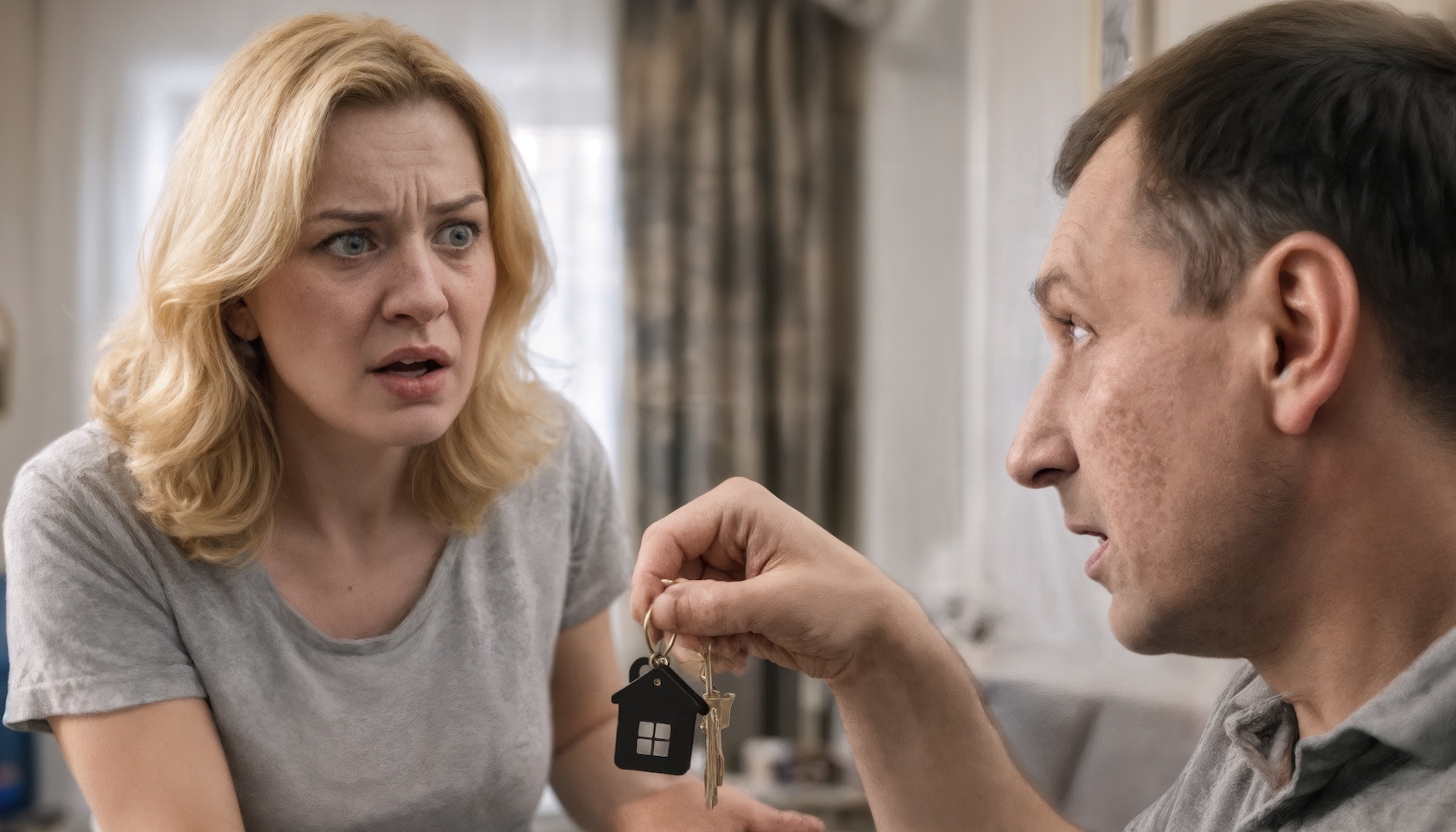
“You don’t have to,” Sergey said calmly. “It’s my condition. Want the divorce—hand over the dacha. Don’t want to—keep living as you are. I don’t care.”
“But why do you need it? You never even went there!”
Sergey was silent for a moment, then gave a crooked smile.
“Lena likes nature. I think we’ll be happy there. The place is freshly renovated, all the amenities. We can move in right away.”
A fierce anger rose from deep inside Irina. So that was the plan. He wanted to bring his mistress there—into her parents’ home. Into the place where her childhood lived, where she’d spent her best summers with her mother and father, where she’d taught her sons to ride bicycles and bake pies in the old stove.
“No,” she said firmly. “Never.”
“Then there won’t be a divorce,” Sergey shrugged. “Your choice.”
The next day Irina drove out to the dacha. She needed to be there, to think, to steady herself. She opened the little gate, walked up the path they’d paved with new tiles last year—yes, paid for with Sergey’s money, that part was true. She went inside. Everything was clean and neat: new windows, fresh paint, the veranda repaired.
How much effort she’d poured into that renovation. She’d chosen the wallpaper, the tile, the paint. Sergey had paid, yes—but could money measure how much heart she’d put into it? Every corner remembered her hands, her care.
Irina sat on the veranda and cried. For the first time in all those months, she let herself cry for real. Not because of Sergey, not even because of the affair—she’d almost expected that, as if it were inevitable. She cried from humiliation and helplessness. From the fact that the man she’d given her best years to was now bargaining with her like a trader at a market, trying to take what mattered most.
That evening, when Irina returned home, her younger son Dima called.
“Mom, Oleg and I want to come over. We need to talk.”
The sons arrived together the next day. Oleg, the older one, had always been serious and thoughtful. Dima was more emotional, but no less decisive. They sat at that same kitchen table, and Oleg began:
“Mom, Dad called. He said you two are getting divorced.”
“Yes,” Irina nodded. “I want the divorce.”
“He said you won’t agree to his terms,” Dima added. “That you’re being unreasonable.”
Irina gave a bitter smile.
“He wants me to give him the dacha—in exchange for the divorce.”
The brothers looked at each other.
“Grandma and Grandpa’s dacha?” Oleg clarified. “He’s serious?”
“Very. He says he invested in the renovation.”
“But it’s yours!” Dima burst out. “You inherited it! What right does he have?”
“Legally, none,” Irina answered calmly. “But he’s blackmailing me. He says if I don’t hand it over, he’ll drag everything into court, demand division of property, and stretch the process out.”
Oleg rubbed the bridge of his nose—a gesture he’d inherited from his father, though in temperament he was far more like Irina.
“Mom… do you want to fight him in court?”
“I don’t,” Irina admitted. “I just want it to be over. I want him out of my life.”
“Then let him leave,” Dima said firmly. “But we’re not giving up the dacha. That’s our childhood home. Grandma and Grandpa’s ashes were scattered in that garden. That place is sacred.”
Irina looked at her sons and felt something warm spread inside her. They were supporting her. They were on her side.
“I’ll help you find a strong lawyer,” Oleg said. “I know people in that field. You’ll divorce by the book, split what was actually earned during the marriage. But the apartment and the dacha are yours. That’s not even up for discussion.”
The following week Irina met with the attorney Oleg recommended. Anna Petrovna was around sixty, with sharp, observant eyes and calm, confident manner.
“Here’s how it stands,” she said after reviewing the documents. “The apartment is yours—an inheritance from before the marriage. The dacha is yours as well, also inherited. The car is marital property and will be divided. Furniture and appliances can be split too, if he insists. But in cases like this, husbands rarely fight over old sofas.”
“And if he insists on the dacha?” Irina asked.
“He has no legal basis,” Anna Petrovna replied. “The dacha is your separate property, inherited. Even if he put money into the renovation, at most he could try to claim reimbursement for part of the renovation costs—not the dacha itself. And even that would require proof: receipts, contracts, records of his personal contributions separate from the family budget. Most people don’t bother—too much hassle for too little gain.”
“So he’s bluffing?”
“Absolutely,” Anna Petrovna smiled. “He’s hoping you’ll be frightened of court and give in. It’s classic manipulation. Don’t fall for it.”
Irina filed for divorce. When Sergey received the summons, he came home dark as a storm cloud.
“So you really want to go to court?” he demanded.
“I want a civilized divorce,” Irina replied. “By the law.”
“I offered you a peaceful option!”
“You offered to take my parents’ home from me. That isn’t peaceful.”
“Then I’ll demand everything!” Sergey raised his voice. “Half the apartment, half the dacha—everything!”
“Go ahead,” Irina said calmly. “My lawyer explained that the apartment and the dacha are mine. The rest we’ll divide fairly.”
Sergey stared at her, baffled. It seemed he was seeing her for the first time in years—not as the compliant wife who always bent and yielded, but as a woman with a solid spine inside.
The divorce took four months. Sergey did try to claim compensation for the dacha renovation, but once the attorney demanded receipts and proof of his personal spending—separate from the shared household budget—he quickly backed down. The car was divided: it stayed with Irina, and she paid Sergey half of its appraised value. The furniture was split too—Sergey took a few things from the living room, the couch and the television.
When it was finally over, Irina drove to the dacha. It was early May; the apple trees were blooming. She opened the gate, walked up the path, and stopped in the middle of the yard, breathing in the sweet scent of blossoms. The place was still hers. Her parents’ home had stayed in the family.
That evening, sitting on the veranda with a cup of tea, she thought about the months that had passed. Yes, it hurt. Yes, twenty-eight years of marriage left marks. But she didn’t regret her decision. Sergey had been right about one thing: she was fifty. But he was wrong about another—she wasn’t “needed by no one.” She mattered to herself. She mattered to her sons, to her future grandchildren. She mattered to this house, this garden, these apple trees her mother had planted.
A week later, Oleg and Dima arrived with their wives and children. The grandchildren ran across the yard, laughing and playing ball. The daughters-in-law helped set the table on the veranda. Oleg lit the grill; Dima fussed with the hammock, trying to hang it between two old birch trees.
“Grandma, are we sleeping over here in the summer?” little Misha asked, running up to Irina.
“Of course we are,” she smiled, ruffling his hair.
Sergey didn’t get the dacha. He didn’t get the apartment. He didn’t even get the satisfaction of breaking his ex-wife the way he’d hoped. He moved in with Lena, into her tiny one-bedroom on the outskirts, and—according to Dima—three months later he was already regretting his choice. Lena turned out to be a difficult woman, with a strong personality and big demands.
Irina, meanwhile, remained in her three-bedroom apartment downtown, with the dacha in Malakhovka, with the apple trees her mother had planted—and with a new life she was only just beginning to build. Fifty wasn’t the end. It was a new beginning, when you could finally live not for someone else, but for yourself.
Sitting on the veranda and watching the sunset, Irina remembered words her mother had spoken many years ago: “Ira, never give up what you hold dear just to keep someone else comfortable. Your life is your value.”
Her mother had been right. And the dacha stayed in the family—exactly where it belonged.