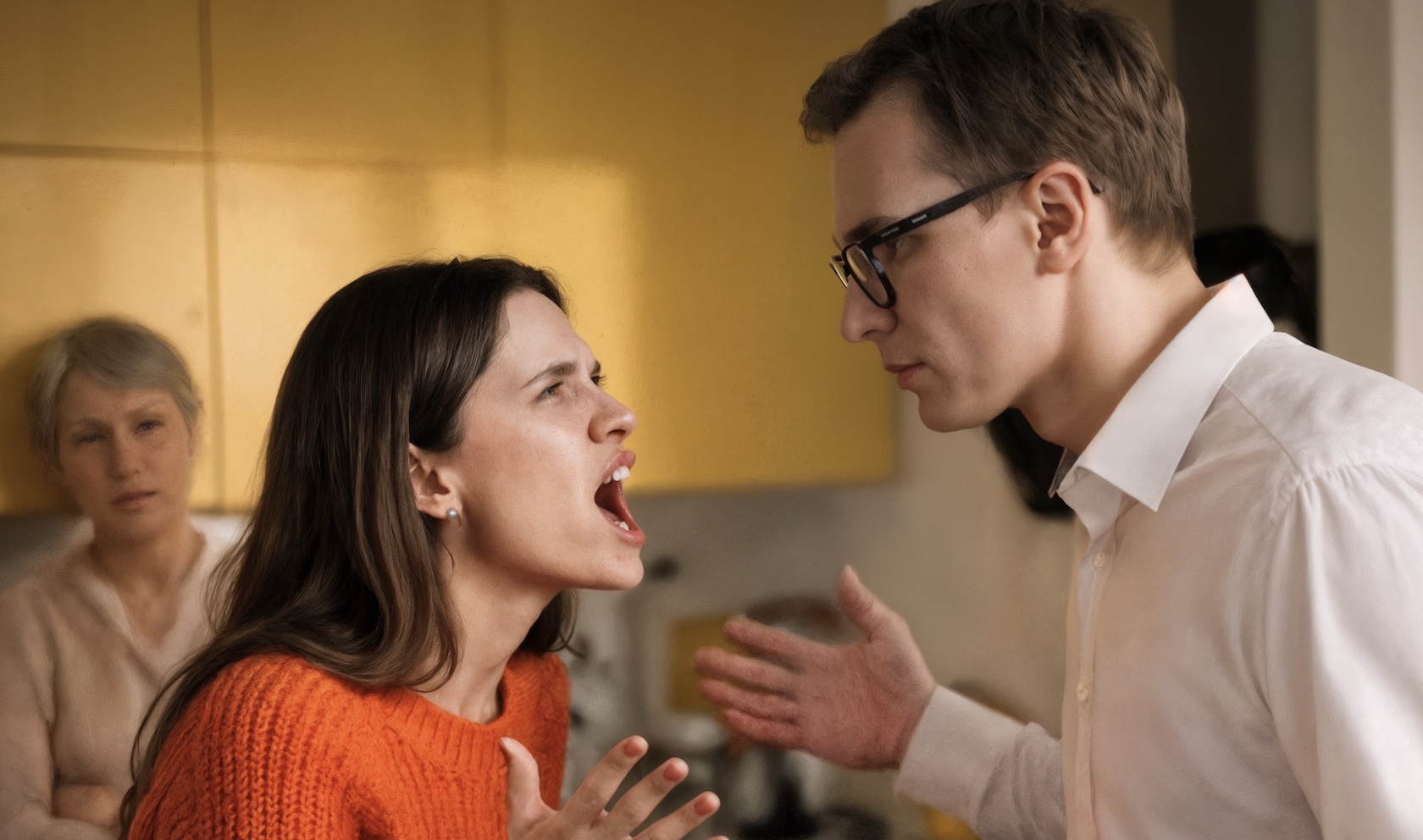
Lena stood by the window, staring out at the December courtyard where the streetlights were already glowing. Snow drifted down in heavy flakes, settling on the bare branches of the trees. Inside, the apartment smelled of mandarins and pine—she’d just carried home groceries for the New Year’s table. Her plan was simple: put everything away, brew some tea, curl up with a blanket in front of the TV. Rest, finally. She’d been dreaming about this break all year—no rushing anywhere, no pleasing anyone, just being home.
“Len, where are you?” Andrey called from the hallway.
She turned. Her husband stood in the kitchen doorway, shaking snow from his jacket and wearing that guilty smile that usually meant something unpleasant was coming.
“What happened?” Lena asked, tension tightening in her chest.
“Nothing major. Mom called, and… I invited her to stay for the holidays. She’s alone, you know? And the kids will be happy—they haven’t seen Grandma in a long time.”
Lena froze with a bag of oranges in her hand.
“For which holidays?”
“New Year’s. From December thirtieth to January eighth. Ten days, that’s all.” Andrey spoke as casually as if he were announcing a pizza delivery.
“Ten days,” Lena repeated, feeling something hot and ugly begin to rise inside her. “Andrey… are you serious?”
“What’s the big deal?” He shrugged, walked to the fridge, opened it, and took out a yogurt. “Mom’s an older woman. It’s boring for her to be alone. And the grandkids miss her.”
Lena set the bag down on the table, trying to keep her hands from shaking.
“Andrey, we didn’t agree to this. I planned to rest. I’m exhausted. All year I’ve been running like a hamster in a wheel—work, home, kids, cooking. I wanted to lie on the couch, watch movies, enjoy some silence.”
“Well, nobody’s stopping you,” he said, honestly surprised. “Mom can manage on her own. She doesn’t need anything special.”
Lena let out a short laugh. Doesn’t need anything special.
She remembered her mother-in-law’s last visit—two years ago, over the May holidays. Valentina Petrovna had also arrived “just for a little while,” and those four days had turned into a marathon. First she did a full inspection of the apartment, eyes sharp and judgmental: dust on the bedroom wardrobe, streaks on the bathroom mirror, towels folded “wrong.” Then came the running commentary about Lena’s cooking:
“Lena, you salt the water after it boils? That’s not how it’s done.”
“Soup needs time to sit, and you’re serving it right away.”
“Andryusha, my boy, you’ve lost weight—does she not feed you?”
And Valentina Petrovna woke up at six every morning and started cleaning. Pots clanged, the vacuum roared, floors were scrubbed like she was preparing for an army drill. When Lena tried to explain the place was already clean, her mother-in-law would stare at her with reproach:
“I’m used to order. I can’t just sit with my hands in my lap.”
“Andrey, your mother doesn’t know how to simply relax,” Lena said. “She’ll be checking how I cook, how I clean. She’ll be up at six making noise. She’ll be teaching me how to live. I won’t be able to rest.”
Andrey finished his yogurt and tossed the bottle into the trash.
“Lena, enough with the drama,” he said. “Mom just wants to help. Yes, she has her habits, but she doesn’t mean harm. It’s the older generation—you know how they are.”
“I’m not being dramatic,” Lena felt her voice tremble. “I’m saying I’m tired. I need a break. I don’t want to spend ten days catering to your mother and listening to how I’m a bad housewife.”
“She doesn’t think you’re a bad housewife!” Andrey waved a hand. “That’s all in your head. She’s just sharing her experience.”
Lena inhaled slowly. They’d done this before—so many times. She’d tried again and again to explain that his mother wasn’t “sharing experience,” she was systematically tearing Lena down. But Andrey never saw it. For him, his mother was practically sacred: a little picky, sure, but loving. He didn’t notice how every one of her remarks made Lena feel incompetent and worthless.
“Andrey, listen to me carefully,” she said, stepping closer and looking him straight in the eyes. “If your mother stays, I’m leaving.”
He froze—and then laughed.
“You’re kidding.”
“No.”
“Come on, Lena. Where would you even go?” His tone was condescending, like she was a child throwing a tantrum. “This is ridiculous. Starting a scene because of my mom.”
“I’m not starting a scene,” Lena said evenly. “I’m warning you.”
Andrey shook his head and walked out of the kitchen. Lena heard the TV click on in the living room, heard him sink onto the couch. She stood in the middle of the kitchen, staring at the grocery bags: mandarins, champagne, red caviar—everything for a cozy family celebration that now felt like it would turn into kitchen duty and constant tension.
She pulled out her phone and texted her mother: “Mom, can I come to you for the holidays?”
The reply came almost immediately: “Of course, sweetheart! What happened?”
“Later. I’ll come on the thirtieth in the morning.”
That evening Lena packed a suitcase. Misha and Polina, their children, were already asleep. Andrey sat in the living room pretending to watch the news, but she could see him glancing toward the bedroom.
Finally he couldn’t take it and came in.
“You’re really going to leave?”
“Yes.”
“Lena, this is absurd.” He sat on the edge of the bed. “We’re a family. New Year’s is a family holiday. The kids will be upset.”
Lena folded a sweater neatly into the suitcase.
“The kids will be with Grandma. She loves them, doesn’t she? She’ll bake pies, tell them stories. And I’ll go to my mom’s.”
“But do you understand how this looks?” Andrey rubbed his face anxiously. “What will people think? A wife ran away from her family on New Year’s.”
“I don’t care what people think,” Lena answered calmly. “I care that I can’t live in constant tension anymore. I warned you. You didn’t listen. That was your choice.”
“Len, I just didn’t think you were that…” He stopped.
“That what?” Lena turned to him. “That tired? That desperate for my husband to respect my opinion? That in need of rest?”
Andrey said nothing. He stood up and left the room. Lena zipped the suitcase, locked it, and lay down. In the morning she would go.
The village greeted her with biting frost and snow that squeaked under her boots. Her mother waited on the porch, wrapped in a warm shawl.
“My daughter!” she hugged Lena so tightly Lena could barely breathe. “Come in, come in—I baked pies!”
Inside, the house smelled of wood, apples, and something cozy and safe. Lena took off her boots, walked into the room where the stove was burning, and for the first time in months she felt her shoulders unclench.
“Tell me what happened,” her mother said, pouring tea into big mugs and setting a plate of pies on the table.
Lena told her everything: the mother-in-law, the exhaustion, the way her husband hadn’t heard her. Her mother listened quietly, nodding from time to time.
“You know, Lenochka,” she said at last, “sometimes people need to be shown that words matter. You did the right thing. Rest. It’s peaceful here—no one will yank you around.”
And Lena rested. She slept until ten, read the books she’d been putting off, walked across snowy fields. In the evenings she and her mother baked cookies, watched old Soviet movies, drank tea with jam. Lena felt herself returning—her real self, not worn down, not cornered, but alive.
On December thirty-first, Oksana—Lena’s school friend, whom she hadn’t seen for fifteen years—stopped by.
“Lena, is it really you?” Oksana kissed her on both cheeks. “I heard from your mom you came! I’m so glad!”
They talked until morning. Oksana told her about her life—her husband, a forest ranger, and their three children. Lena talked about the city, work, her kids. She didn’t want to talk about her husband, and Oksana politely didn’t ask. At midnight they went out onto the porch, lit sparklers, and made wishes.
“You know,” Oksana said, “the Stepanovs are selling their house. The one on the edge—remember? With the apple orchard. Solid house, strong. They’re moving into the city to live near their daughter. Maybe it could be useful for you—for the kids in the summer.”
Lena looked in that direction. The house stood a little away from the others, with tall windows and an old but sturdy roof.
“How much do they want?”
“Not much. You can go see it tomorrow if you want.”
The next day Lena actually went. The house was spacious and bright, with a real Russian stove and a big plot of land. The apple trees, though old, looked well cared for. She imagined bringing Misha and Polina here in the summer—how they’d run through the garden, pick apples, swim in the river.
“I’ll take it,” she told the owner.
Her phone kept buzzing. Andrey texted, called, sent voice messages. At first angry: “Lena, this is childish, come back right now.” Then confused: “The kids miss you, they keep asking where Mom is.” Then simply exhausted: “I feel awful without you.”
Lena answered briefly: “I’ll be back on the eighth.”
The days flew by. She met a few more school friends, went to the next station over to sort out documents for the house. The process moved quickly—the Stepanovs really were in a hurry. Her mother was happy Lena would come more often.
“I’ll help with the grandkids,” she said, delighted. “It’ll be good for them here—just look at this air!”
On January eighth Lena returned home. The first to meet her was Misha. He ran up shouting “Mom!” and hugged her so hard she nearly dropped her bag. Polina came right after him.
“Mommy, we missed you so much! Grandma baked pies, but they weren’t as tasty as yours.”
Andrey stood in the kitchen doorway. He looked tired and thinner, shadows under his eyes.
“Hi,” he said quietly.
“Hi.”
The kids clung to Lena, talking over each other about the holidays. Grandma really had baked pies, played with them, read them stories. But they’d missed their mom—so much.
When they finally let her go and ran off to their room, Andrey stepped closer.
“It was bad without you,” he said. “Truly. Mom tried, the kids were happy, but… you were right. I didn’t hear you. I didn’t understand how hard it was for you. I’m sorry.”
Lena stayed silent, looking at him. She could tell he meant it. That it had truly been hard. That maybe, for the first time in a long while, he understood that family isn’t only about responsibilities—it’s also about listening.
“Mom left on January third,” Andrey went on. “She said she didn’t want to be in the way. That she understood… She asked me to tell you she’s sorry if she ever hurt you.”
Lena sat down on the couch.
“I bought a house,” she said.
“What?” Andrey stared at her.
“In the village. Near my mom. I’ll take the kids there in the summer. It’ll be good for them. And I need a place where I can be myself. Where no one evaluates whether I’m doing everything ‘right.’ Where I can simply breathe.”
Andrey nodded slowly.
“I get it. Can I come with you sometimes?”
Lena looked at him—at her tired, unsettled husband who, it seemed, was finally seeing her clearly.
“We’ll see,” she said. “If you learn to hear me.”
He sat beside her and took her hand.
“I will,” he said. “I promise.”
Lena didn’t know whether he would keep that promise. She didn’t know what their future would look like. But she knew one thing: she had found herself again. Her words carried weight now. She wasn’t required to sacrifice herself for someone else’s comfort.
And she also knew that in the summer she would take the children to the village—to their new house with the apple orchard. She would show them where she’d grown up, where you could run barefoot in the grass and think of nothing but sun and wind.
“Mom,” Polina suddenly said, poking her head into the room, “Grandma said you got offended. Is that true?”
Lena smiled at her daughter.
“No, sweetheart. I just rested. Grown-ups need rest too, you know.”
“I know,” Polina nodded solemnly. “Daddy was tired too. He sat sad every night.”
Andrey smiled guiltily.
“Yeah,” he admitted. “I missed you. We all did.”
That evening, after the kids finally went to bed, Lena and Andrey sat in the kitchen with tea. Snow drifted outside, and inside the air smelled of mandarins and warmth.
“You know,” Andrey said, “Mom admitted it isn’t easy for her to come here either. She’s afraid of seeming unnecessary, so she tries to be useful—and goes too far.”
“All of us go too far sometimes,” Lena replied. “The important thing is stopping in time.”
He nodded.
“Next time I’ll ask you first. Before I invite anyone. Actually—before I make decisions that affect both of us.”
“Deal.”
They finished their tea in silence—not awkward silence, but calm. For the first time in a long while, Lena felt she was exactly where she wanted to be: home. Only now it was a home where she was heard.
And she had another home, too—out in the village, with an apple orchard and open rooms. A place she could always return to if she ever felt herself slipping away again. Just knowing that gave her strength.
“Thank you,” Andrey said quietly.
“For what?”
“For not leaving for good. For coming back.”
Lena looked at him and smiled.
“I came back to myself first,” she said. “Then to you. In that order.”
He nodded, understanding. And in that nod was more than all the words they’d traded before—an acknowledgement that love isn’t just living under the same roof. It’s also space. Respect. The willingness to treat someone else’s boundaries and voice as real.
The new year didn’t begin with fireworks and champagne—it began with quiet and understanding. And that was the best gift Lena could have imagined.