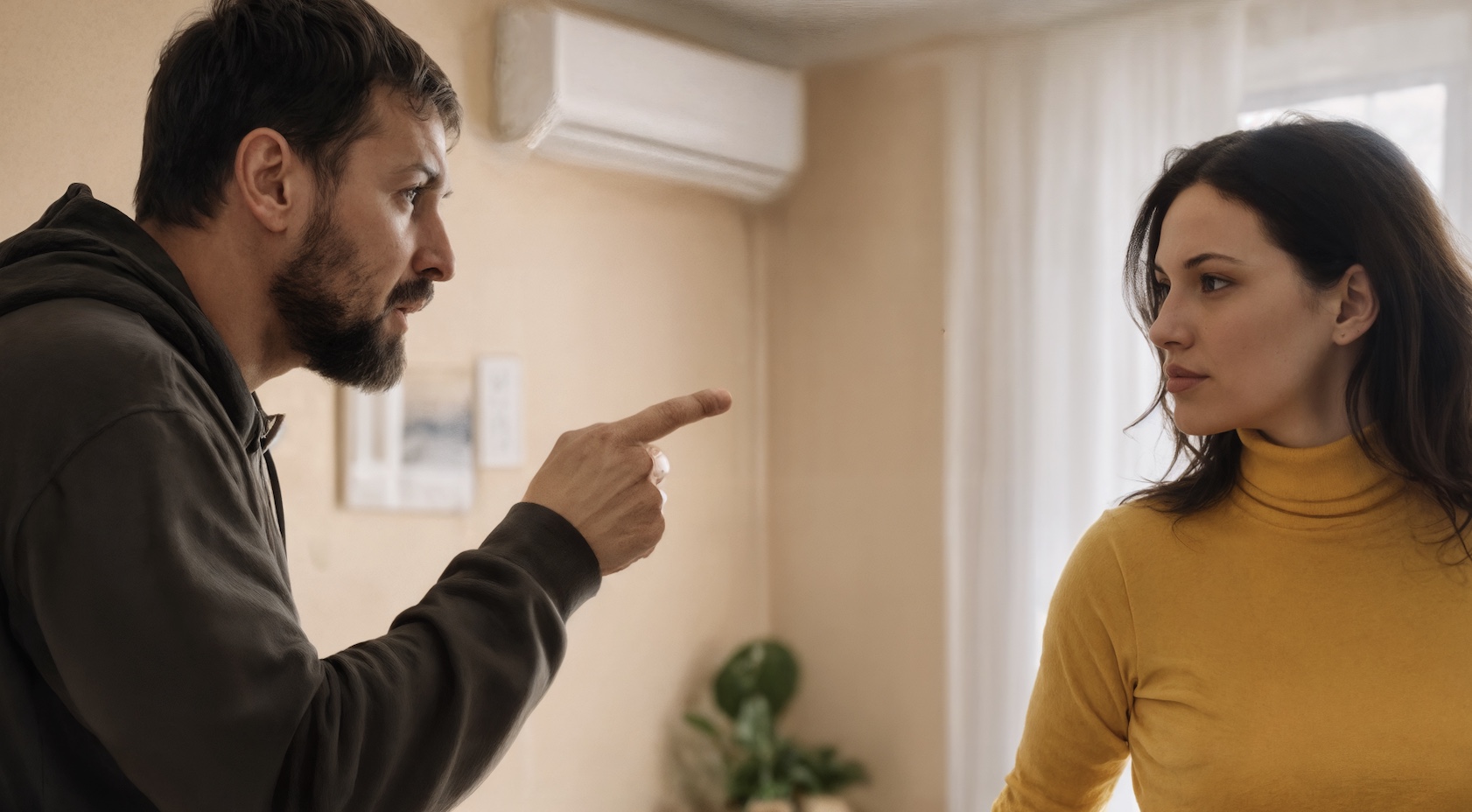
“If you’re going to give me ultimatums, then I’m leaving,” she said—Marina was done being submissive.
Marina stood at the window, staring down into a drab February courtyard. The snow had already turned black, beaten into dirty slush that the janitors kept scraping off the asphalt with no real success. From the kitchen she could hear Dima clattering around, pouring himself tea after work. A normal Monday evening. A normal apartment in a normal building on the edge of town.
“Marish, you remember I told you Mom and Seryoga are planning to renovate?” her husband asked, far too casually—so casually it instantly put her on alert.
Marina turned around. Dima was standing in the living-room doorway with a mug in his hand, his face wearing that familiar mix of guilt and stubbornness she’d learned to read in seven years of marriage.
“You did,” she said shortly, then turned back to the window.
“You have to understand, it’s a disaster over there. Seryoga lost his job, he can’t afford rent anymore, so he moved back in with Mom. And that little two-bedroom… you saw it last time. Wallpaper peeling, cracked bathroom tiles, the kitchen linoleum worn through. How’s anyone supposed to live like that?”
Marina stayed quiet. She already knew where this was headed.
“So they decided to get it in shape. Not anything fancy—just the basics so it’s decent. Seryoga’s thirty-two, he should be starting a family, but how’s he supposed to bring a woman home when the place looks like that?”
“Dima,” Marina turned and looked straight at him. “How much?”
He averted his gaze.
“Well… about two hundred and fifty thousand should cover it. They already made an estimate, talked to workers. Nothing complicated—just what’s necessary.”
“Two hundred and fifty thousand,” she repeated. Her tone held no surprise, no question—only exhaustion. “The money we were saving for our bathroom. The same money I spent a year and a half earning—extra shifts, no new clothes, no extras at all.”
“Marinka, please—try to understand! It’s my mother. My brother. They’re in a situation, and we—”
“And we what?” she felt something heavy and dark beginning to boil up inside her. “We’re doing great, right? Our bathtub isn’t leaking? The tiles aren’t crumbling? The grout isn’t so black no chemicals can fix it?”
“We can wait another year—it’s not the end of the world!”
Marina closed her eyes and drew a slow breath. Don’t explode. Don’t shout. Be calm. Be grown-up.
“Dima, let me remind you. In September your mother lived with us for two weeks because they were replacing a pipe in her apartment. I cooked for three, cleaned, washed her laundry. In October your brother took our car for a month because he ‘needed it for work’—the job he later got fired from for drinking, by the way. In November your mother asked to ‘borrow’ thirty thousand for medicine. She never paid it back. For New Year’s we spent twenty-five thousand on gifts for them because you said we couldn’t give them something cheap—they’re family.”
“What does any of that have to do with this?”
“Everything—because your family has been living at our expense for years!” Marina’s voice rose despite her promise not to yell. “And every time I even try to object, you start shaming me. You tell me I’m cold, that they’re your blood, how can I not help.”
Dmitry slammed his mug onto the coffee table so hard tea splashed.
“Yes, I do! And I’ll keep saying it because it’s true! You only think about yourself—your comfort—some stupid bathroom—while my mother is sixty, and she deserves a peaceful old age!”
“And I don’t deserve anything?” Marina’s voice shook. “I work six days a week, then come home and cook, clean, wash laundry. On weekends I take extra shifts so we can save even a little. Two years ago I gave up professional courses because your mother’s tooth hurt and she needed an expensive crown. I—”
“Marina, enough!” he snapped, waving a hand like he was swatting a fly. “You’re piling everything into one mess just to make me feel guilty. My family has always helped. Remember when your dad ended up in the hospital—who was the first to give money?”
“Dima, my father died four years ago. Your mother gave us fifty thousand, and we paid it back three months later. That’s the only time in all these years.”
“Well, there you go—so they helped!”
Marina walked to the couch and dropped onto it. Suddenly she had no strength left.
“You don’t want to hear me,” she said quietly. “You never do. For you there’s only your mother and your brother. And me… I’m supposed to be convenient. Agree, smile, and hand over everything we have.”
Dima sat beside her, softening his voice.
“Marinka, come on. I love you. Just understand—those are my people. I can’t say no to them. Especially now, when Seryoga’s going through a bad streak. He’s a grown man, he’s ashamed to live with Mom. We need to help him get back on his feet.”
“Seryoga is thirty-two,” Marina repeated, drained. “This is the third time in five years he’s been fired. Every time for the same reason—he shows up drunk. He doesn’t want to change because he knows Mom will always take him in, and you will always give him money. Why would he try?”
“You have no right to talk about my brother like that!”
“I have every right to speak the truth—especially when it affects our money and our life.”
Dima stood and paced the room. Marina watched his jaw tighten—he was angry, trying to keep it under control.
“Fine,” he said at last, his voice turning icy with resolve. “Then here’s the deal. Either you agree to help my family, or I stop all our attempts to have a child.”
Marina froze. For a few seconds she simply stared at him, not believing what she’d heard.
“What did you just say?”
“You heard me. We’ve been trying for two years and nothing works. You want a baby—I know you do. I want one too. But if you can’t even put yourself in my family’s position, then maybe we shouldn’t have children. A child needs a mother who can think about more than just herself.”
Something inside Marina clicked into place with a quiet snap—like she’d been stumbling through a dark hallway for years, feeling along the walls, and suddenly stepped into the light and saw everything as it truly was.
“If you’re going to give me an ultimatum, I’m leaving,” she said. Her voice was steady and calm, and the calm surprised even her. She was simply tired of being obedient.
Dmitry turned to her with a baffled half-smile.
“What are you talking about—leaving?”
“I mean exactly what I said. I’m leaving you. I’m filing for divorce.”
“Marish, stop fooling around. Are you trying to scare me? Fine, fine—I lost my temper. No ultimatums.”
“Dima, I’m not fooling around,” she said, standing and meeting his eyes. “I finally understand what’s happening. We’ve been trying for two years. I’ve done every test. Everything is fine on my end—the doctors say the problem isn’t me. But you refuse to get checked. Why?”
“We already talked about this. In my family, all the men are healthy. Everyone has kids. Grandpa had five, my dad had two. The problem isn’t me.”
“Not you,” she repeated. “Even though you won’t take the simplest test. Because if it turns out it is you, your whole fantasy about ‘healthy men in the family’ collapses. And you’d have to admit you’re not as perfect as you want to believe.”
“Marina, that’s ridiculous!”
“It’s the truth. And so is this: you’ve been using me for years. I work, I earn, I invest money into this home and our life—and you keep giving it away to your mother and brother. I wanted a child. I dreamed of a family of my own. Instead I’m living in some parallel reality where I’m expected to serve grown men who can’t even fix their own bathroom or keep a job.”
“Okay, stop!” Dmitry finally realized how serious she was. “Marina, let’s talk calmly. I get it—you’re tired. Maybe you should take a day off, rest? We all say things in the heat of the moment…”
“This isn’t the heat of the moment, Dima. I’ve been thinking about it for a long time. I just didn’t have the courage to admit our marriage isn’t really a marriage. It’s a system that works for you—where I play nanny and ATM for your family. And my wishes, my dreams, my life—none of it matters.”
She went into the bedroom and pulled an old sports bag from the top shelf.
“What are you doing?” Dmitry stood in the doorway, and for the first time all evening uncertainty crept into his voice.
“Packing. I’ll stay at Lena’s tonight, and tomorrow I’ll start looking for a rental.”
“Marish, wait! We can talk about this!”
“It’s too late to talk. I tried to talk for two years. Every time your mother or brother wanted something, I tried to explain that we have plans too, that we need to think about ourselves. And every time you told me I was selfish. That ‘family is sacred.’ Only when you say ‘family,’ you somehow mean only your mother and brother. And in that family, it’s like I don’t even exist.”
Marina began folding clothes into the bag. Dmitry stepped into the room.
“Fine! Fine, I won’t give them money! We’ll do the bathroom, okay? Just don’t go.”
She stopped and turned to him.
“Dima, you still don’t understand. This isn’t about bathroom money. It’s about what you just did—you tried to blackmail me with a baby. You said you’d stop trying for a child unless I handed over everything we saved to your family. You used the biggest dream of my life as a weapon. And that… that wipes everything out.”
“I wasn’t blackmailing you!” he protested. “I just wanted you to understand that—”
“That my desire to have a child matters less than your brother’s desire to renovate? I understood. I understood perfectly.”
Dmitry sank onto the edge of the bed.
“I didn’t mean it like that,” he muttered. “It’s just… Mom called crying. Said Seryoga was really bad, depressed. That if we don’t help now, he’ll sink even lower.”
“Seryoga sank a long time ago,” Marina said harshly. “And he’ll keep sinking because you and your mother keep cushioning every fall. He doesn’t want to work—you feed him. He drinks his paycheck—you give him money. He can’t rent a place at thirty-two—and you’re planning renovations with someone else’s savings. With my savings, to be precise.”
“Marina… they’re my family…”
“And what am I?” Marina asked. “I’ve been your wife for seven years. Am I not family?”
He said nothing. And in that silence was the answer to every question she’d ever asked herself.
Marina zipped up the bag.
“I’ll call a lawyer. The apartment is in your name—I won’t fight you for anything. Just the divorce.”
“Wait—what about the baby? You wanted one so badly…”
She looked at him for a long moment.
“I wanted a baby with a man who loves me. With a man for whom I matter. But you… you love your mother and brother. That’s your choice, and I respect it. But I can’t live inside this triangle anymore.”
Marina left the apartment without looking back. Outside it was bitter cold, and wet snow started falling in heavy, clumsy flakes. She called a taxi and sat on a bench by the entrance.
Her phone buzzed—Dmitry was texting. First angry accusations. Then begging. Then angry again. She didn’t answer.
A strange feeling washed over her, like a huge weight had fallen off her shoulders. For the first time in a long while, Marina felt she could breathe.
She didn’t know what was ahead—renting a place, maybe a period of financial struggle, a divorce. But she also knew what was ahead: freedom. A chance to live for herself. A chance to meet someone who would value her not as a source of money and free labor, but as a partner.
The taxi arrived ten minutes later.
A year and a half passed.
Marina sat in a café across from her office, sipping cappuccino and scrolling through the news on her phone. Without thinking, her hand rested on her rounded belly—six months pregnant now; soon it would be hard to bend down.
“Hi, Marishka,” a familiar voice made her lift her head.
Dmitry stood by her table with an awkward smile. He’d changed—aged, grown thinner, deep lines carved around his mouth.
“Hi, Dima,” she nodded. “Sit down if you want.”
He lowered himself into the chair across from her, uncertain.
“I heard you got married.”
“Yes. Eight months ago.”
“And right away…” he glanced at her belly.
“Yes—right away,” she smiled. “We found out two months after the wedding.”
Dmitry stared at his hands gripping the edge of the table.
“So the problem really was me,” he said hoarsely.
“Looks like it,” Marina didn’t lie or soften it.
“I got checked… after we divorced. The doctor said… anyway, it could’ve been treated. I just needed to come in earlier.”
They sat in silence for a moment.
“How’s your mother? Seryoga?” Marina asked, mostly out of courtesy.
“Fine. They did the renovation, actually. Seryoga found a new job—seems like he’s holding on for now. Mom’s healthy. She asked me to say hello if I ran into you.”
“Tell her hello from me too.”
Another pause—thick and uncomfortable.
“Marina… I wanted to say something,” Dmitry finally said. “You were right. About everything. I used you. I didn’t appreciate you. I only thought about Mom and my brother, and I didn’t care about you at all. I’m sorry.”
Marina looked at him—this man she once loved, the man she’d spent seven years with—and felt no anger, no hurt. Only calm.
“I forgive you, Dim. I forgave you a long time ago.”
“Thank you,” he stood. “Well… I’ll go. I wish you happiness. You and the baby.”
“Thank you.”
Marina watched him walk away—hunched, older, eyes empty. Then her gaze dropped to her phone, where her lock screen showed a photo: her and Anton at a health resort, hugging and laughing.
Anton. Her husband. The man who, from the very first day, treated her as an equal. The man who—right after they started dating—went and got his health checked the moment she told him about her previous marriage. The man who said “our money,” not “mine” and “yours.” The man who asked her opinion about everything. The man who was just as happy about the pregnancy as she was.
Marina finished her coffee, left a tip, and stepped outside. It was early September—warm, sunny. Ahead was a normal workday, then home, dinner with her husband, conversations about the future—what color stroller to buy, what to name the baby.
An ordinary life. But so deeply happy.
She smiled to herself and walked toward the bus stop. Somewhere back in the past was the obedient Marina—afraid to argue, afraid to demand respect, afraid to leave. And here, in the present, walked a different woman: free, loved, and happy.
All because one day she found the strength to say, “If you’re giving me an ultimatum, I’m leaving you.”