Hanna Pavlivna was sure that no one would notice the patch on her shoe. The cobbler did a good job, but the patch was just really big.
Natalia noticed it on Thursday.
She arrived at her mother-in-law’s place, just like every week, carrying two heavy bags: chicken, buckwheat, milk, a kilo of bananas, a pack of butter, and other groceries. While she was unzipping her jacket in the cramped hallway, her eyes caught the radiator—old wool socks were drying on it. And under the coat rack were the shoes. Natalia bent down, picked up the left one, and turned it over in her hands.
“Mom, what’s this?”
“Oh, it’s nothing,” Hanna Pavlivna called out from the kitchen, wiping her hands on her tiny blue-checkered apron. “I’ll wear them through the winter, and we’ll see after that.”
“Mom, winter’s already here—look out the window.”
Outside, a cold November rain had been falling for three days, and nobody bothered to go around the puddles by the entrance anymore— people just jumped over them.
Natalia didn’t say anything else. She headed to the kitchen to unpack the groceries—and opened the fridge. On the middle shelf, there was a small pot of soup: noodles with a few potatoes. Next to it was half a jar of pickled cabbage. The butter dish was empty. On the fridge door, there was just a single egg lying alone.
“Mom, what happened to all the food?” Natalia tried to joke. “Did the mice eat it?”
“I don’t need much for myself,” her mother-in-law looked away. “I made a little soup—it’s enough for three days.”
The mail carrier brought Hanna Pavlivna’s pension on the tenth. Today was the nineteenth. Natalia set the groceries on the table and noticed her hands were shaking a little.
* * *
Natalia was lucky with her mother-in-law right from the start—from the very first evening Viktor brought her over to meet her. Back then, twenty-two years ago, Hanna Pavlivna made so many cherry dumplings, you’d think she expected the whole building, and then stayed up showing photo albums and telling stories about how picky little Vitya used to be. When Natalia went home, she carried a full container of dumplings and had a strange, warm feeling that she was really wanted here.
“Listen,” she said to Viktor on the bus that day, “your mom said more kind words to me in one evening than my own mother has in twenty years.”
Since then, that became a family joke. Natalia retold it at birthdays, on New Year’s, at every gathering: she’d say she was luckier with her mother-in-law than her own mother. Hanna Pavlivna would always wave her hand and blush like a girl.
She was always like that—soft, gentle, and only inconvenient for herself. She worked at the post office for thirty years, knew exactly how much money she had, but never managed to save it: there was always someone who needed it more.
When Stepan Ivanovych passed away six years ago, she was left alone in a two-room apartment on the fourth floor. Viktor and Natalia visited her every week: they brought groceries, re-papered the bedroom walls, replaced the stove in the kitchen, and insulated the windows every autumn.
But Lyudmila rarely visited. And never just because.
First, the car’s transmission broke down—’and Vadym simply can’t get to work without a car.’ Then, out of nowhere, the fridge started leaking. Then, Vadym and she ‘hadn’t seen the sea in three years,’ and didn’t her mother want her daughter to finally get a little rest? Every time, Hanna Pavlivna would say there was no money. Then she would silently go to the wardrobe in her bedroom.
continued in the comments
* * *
‘Luda again,’ Viktor said in the evening. He didn’t even ask, just rubbed his face with both hands. ‘I talked to her in the spring. Do you know what she said? That Mom is her mom too, and I have no right to tell her what to do.’
‘Vitya, your mom wears patched-up shoes. There’s only one egg in her fridge. I have a feeling she even gives her groceries to Luda. And Luda just takes them.’
He was silent for a long time, gazing out the dark window.
The next day, Natalia called her mother-in-law and didn’t beat around the bush. At first, Hanna Pavlivna stayed silent, then sighed into the receiver:
‘Luda borrowed it, Nataliya. They’re in trouble: the bathroom pipe burst, flooded the downstairs neighbors, and they made such a fuss—they demanded to be paid for repairs right away. Eight thousand. How could I say no? She was in tears.’
But on Saturday night, scrolling through social media before bed, Natalia came across a photo that Luda had posted the previous weekend. Her sister-in-law, dressed in a white terry bathrobe, was sitting by a blue pool with mountains dusted in first snow behind her, Vadym next to her with a cup of coffee. The caption: ‘Finally! We earned this.’
Natalia stared at the screen for a long time. Then she turned off her phone and placed it face down.
‘It’s okay,’ she told herself. ‘You’ll earn your turn too.’
* * *
For Sunday lunch, Natalia invited everyone over. She made salads, meat, baked two bowls of pies—one with cabbage, one with poppy seeds—brewed linden tea, and took out a festive tablecloth embroidered with little flowers. As usual, Vadym ‘couldn’t make it, work.’ Luda came with Sasha.
Thirteen-year-old Sasha had grown so much over the summer, he was now taller than his grandmother. But he was still the same—quiet, attentive, with perpetually messy hair and restless hands always looking for something to tinker with. He kissed Hanna Pavlivna on the cheek, grabbed a pie, and immediately asked Uncle Viktor if he hadn’t thrown away the broken radio.
‘Sasha,’ Natalia said gently, ‘the radio’s on top of the wardrobe in the room, and the screwdriver’s there too. Go ahead, while we talk about boring stuff here.’
He didn’t need to be asked twice.
Luda chatted about Vadym’s job, prices at the market, and a neighbor who’d gotten a third cat. Hanna Pavlivna nodded, handed everyone more pies, and hardly ate herself. Natalia poured more tea for the guests, sat across from her sister-in-law, and calmly, almost casually, asked:
‘Luda, how are your downstairs neighbors? Did they repaint the ceiling? Have you settled up with them?’
‘What neighbors?’ Luda raised her eyebrows in surprise. She stopped mid-bite, pie still in hand.
And at that moment, Hanna Pavlivna turned pale.
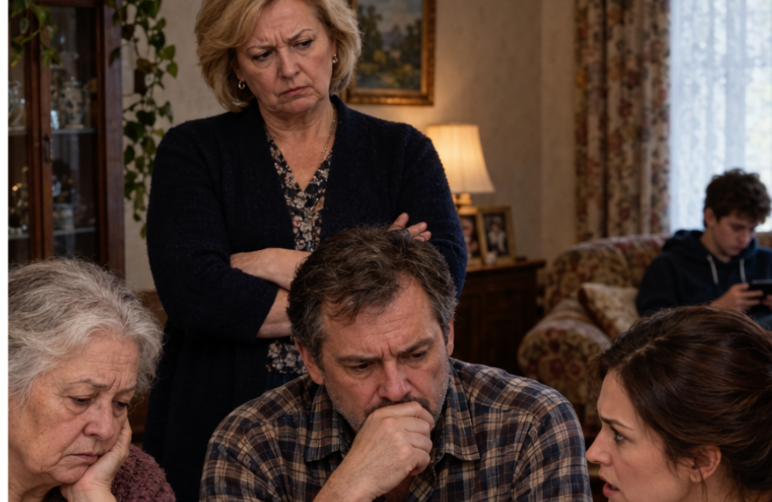
You could see it from across the table: her face went as gray as the November sky outside, her fingers squeezed her teacup so tightly the tea nearly spilled onto the tablecloth. Luda glanced from her mother to Natalia, then to her brother—and something clicked in her.
‘Ahhh,’ she drawled. ‘Mom… Did you tell them?’
“Mom didn’t say anything,” Viktor said quietly. “You showed everything yourself. By the pool.”
Lyuda blushed, and her embarrassment quickly turned to resentment.
“So what? I didn’t force her! Mom gave it herself! Can’t I get a proper vacation once in a few years? You and Vitya spend every summer at the garden outside the city, you have your own joys, and we…”
“You told Mom you flooded the neighbors,” Viktor’s voice was calm, which somehow made it even harder.
“What was I supposed to say? ‘Mom, give me money for a hotel’? She wouldn’t have given it!”
“She would have,” Hanna Pavlivna whispered almost inaudibly.
The living room became so quiet you could hear Sasha unscrewing something with a screwdriver behind the wall.
And that’s when Natalia couldn’t take it anymore.
“Mom, stop giving them your pension!” she said louder than she intended, even startling herself with her own voice. “You’re walking around in shoes with holes in them! There’s only one egg in your fridge! How much longer can this go on?”
Hanna Pavlivna looked at her. Her lips trembled, she tried to say something—but couldn’t. She covered her face with her hands, and her shoulders began to shake with small sobs.
Viktor stood up, walked around the table, sat next to his mother and hugged her. Later, he would admit to Natalia he had never, not once in his life, seen his mom cry. Not once.
“Forty years without tears,” Hanna Pavlivna whispered through her fingers. “After I had Lyudochka, I told myself: that’s it, Hanna, you’re a mother now. You can’t.”
Lyuda abruptly stood up and grabbed her purse.
“Of course. Now I’m the worst one here. Sasha! Get ready, we’re leaving.”
Sasha came out of the room with a screwdriver in his hand, stared bewildered at his crying grandmother, his mother, his uncle. He didn’t say a word. Only at the door did he turn back one last time—and Natalia remembered that look for a long time.
* * *
Natalia drove her mother-in-law home. They rode in silence, the only sound was the windshield wipers squeaking against the glass. At the entrance, Hanna Pavlivna spent a long time searching for her keys in her purse, then said:
“Come in, Natalochka. I want to show you something.”
In the bedroom, she opened the wardrobe, moved aside a stack of bed linens, and took out a round box—the kind grandmothers keep thread and buttons in. But Hanna Pavlivna’s box didn’t have any thread. Inside were a postal envelope and a worn notebook.
Natalia opened the notebook. Neat handwriting, columns, dates:
“For Sasha. September — 1000. October — 1000. November — 800. December — 1000…”
Page after page. Almost four years. And in between, other entries, just as neat, but outlined in a frame:
“Lyuda — transmission — 6000.” “Lyuda — refrigerator — 9000.” “Lyuda — for the sea — 12,000.” “Lyuda — neighbors — 8000.”
Natalia looked up.
“Mom… what is this?”
“That’s for Sasha’s education,” Hanna Pavlivna sat at the edge of the bed and folded her hands on her knees. “He spent all summers with me while they traveled with Vadym. Did you ever see what’s on my shelf?”
Natalia had seen it. A bridge made from ice cream sticks—long, thin supports, railings, even tiny lanterns crafted from beads. She had always thought it was just some school project.
“He worked on it all summer. Drew the blueprints himself, did all the calculations. And then he put a pot of water on it to show me it would hold the weight. And it did!” For the first time that evening, my mother-in-law’s voice held a smile. “He said, ‘Grandma, I’m going to build bridges. Real ones. I’ll be an engineer.’ But you have to study to become an engineer, you know.”
Math tutors cost four hundred hryvnias a lesson these days. And if he gets in — there’s the dorm, books, food… You know Lyuda and Vadim live day to day. I just wanted the boy to have something of his own.
“Why didn’t you tell anyone?”
Hanna Pavlivna gave a bitter smile.
“Because Lyuda would get upset that I’m saving for her son but not giving to her. And maybe she’d take that too. When she asks, Nataliia… She looks at me like that — and all I see is my little girl, ribbons in her hair, reaching her arms out to me. And I just can’t. I can’t say ‘no’ to her.”
Nataliia flipped through the notebook again and did the math in her head. Over the years, there should have been more than forty thousand. But the envelope only held a little more than six.
“So,” she said slowly, “you were giving Lyuda the money you’d saved for her own son.”
Hanna Pavlivna didn’t answer. She just nodded.
* * *
That night, Nataliia could hardly sleep. In the morning, while Viktor drank his coffee, she laid out everything she’d thought about.
“I don’t want to fight with Lyuda. No matter how much we shout, Mom will always take her side because she’s her child. So we need to make sure there’s nothing to fight about.”
Viktor set his cup aside.
“I’m listening.”
“First. The money needs to be someplace neither Lyuda’s tears nor Mom’s soft heart can get to it. We’ll open a deposit in Mom’s name. With top-ups allowed, but no early withdrawal — until that summer when Sashko graduates. Begging, pleading, crying — the bank won’t give it back early.”
“And second?”
“Second — no secrets. As long as Lyuda doesn’t know what the money’s for, she asks Mom for it. But if she knows, she’ll have to ask her own son. — Nataliia paused. — She won’t do it. For all her faults, she loves Sashko.”
“And the third?”
“The third is the hardest. Mom has to learn to say ‘no.’”
Viktor gave a sad little laugh:
“You know she hasn’t said that word once in sixty-seven years.”
“Well, let’s start now.”
* * *
At the bank, Hanna Pavlivna asked the young employee three times just to be sure — she really couldn’t take the money out early?
“That’s right,” the girl replied patiently with a smile. “Only after the term is up.”
Suddenly, my mother-in-law exhaled with relief, as if a heavy weight had been lifted off her shoulders.
“Good,” she said. “Then there’s no point in asking.”
All the money left in the envelope was put into the deposit that very same day. Viktor added two thousand of his own and promised to add more every month.
And on Thursday, lessons began in Hanna Pavlivna’s kitchen.
“Here’s how it goes,” Nataliia set down some cups and sat across from her. “I’m Lyuda. You’re yourself. Ready?” She put on a pitiful face and crooned, “Mommy, we’re in such trouble, the washing machine is broken and Vadym’s paycheck is late…”
“Oh, my dear,” Hanna Pavlivna immediately fussed, “how much do you need? Let me check…”
“Mom!”
“I just want to check…”
“Again. Mommy, we’re in such trouble…”
“Well… Lyudochka… maybe just a little…”
They laughed until they cried—even the mother-in-law had to wipe her eyes with a handkerchief. Then they tried again. And again. On the fifth attempt, Hanna Pavlivna straightened up, took a deep breath, and said quietly but firmly:
“No, Lyuda.”
She was so startled by her own words that she covered her mouth with her hand.
“Yes!” Natalia nearly clapped her hands. “Now for the second part, so it doesn’t sound too harsh: ‘No, dear. But come over on Sunday—I’ll bake a pie.’”
She wrote those words with a marker on a piece of paper and stuck it to the fridge with a magnet.
* * *
Natalia went to see Lyuda alone, without telling anyone beforehand.
Her sister-in-law opened the door and looked at her coldly, but let her into the kitchen. She didn’t bother to put the kettle on. Natalia hadn’t expected her to.
“I’m not here to argue,” she said, sitting down. “I came to tell you something you don’t know.”
And she told her: about the box, about the notebook, about the neat little columns labeled ‘for Sashko’ and the frames with Lyuda’s name. About what Hanna Pavlivna had been saving for nearly four years—and why she had said nothing.
Lyuda listened, staring at the table. When Natalia finished, she didn’t lift her head for a long time.
“She never told me,” she finally said.
“Would you have listened?”
On the other side of the wall, the rasp of sandpaper sounded—Sashko was making something again. Lyuda glanced at the closed door to his room, and her eyes shone.
“I thought she had it,” she said softly. “She always gave. I just thought she was… thrifty.”
“Now she’ll tell you ‘no’,” Natalia said gently. “It will be very hard for her. Just don’t make it any harder.”
Lyuda didn’t make any promises. But she didn’t argue, either.
* * *
The test came three weeks later, in early December.
Hanna Pavlivna was chopping cabbage for dumplings when the phone rang.
“Hi, Mom,” Lyuda spoke quickly, as she always did when asking for something. “Listen, here’s the thing. Our winter tires are completely bald, and Vadym…”
Hanna Pavlivna looked at the fridge. The paper under the sunflower magnet was curling a little at the edge, but the words were still clear. Her heart was pounding as if she were standing by the blackboard, back in fifth grade.
“No, Ludochka,” she said.
There was silence on the line. Hanna Pavlivna opened her mouth to add, “but maybe…”—then closed it again.
“No, dear,” she repeated. “But come over on Sunday. I’ll make something for you.”
The pause lasted so long she thought: That’s it, she’ll get offended, hang up, and it’ll be months of silence again…
“I know, Mom,” Lyuda suddenly said quietly. “I get it. I just had to ask.” After a pause: “We’ll come. Sashko says the balcony door is crooked—he wants to take a look.”
On Sunday, everyone gathered at Hanna Pavlivna’s table—Viktor and Natalia, Lyuda with Sashko, and even Vadym. While the men and Sashko tinkered with the balcony door, Lyuda helped her mother make dumplings—for the first time in maybe ten years. And when they were about to leave, she took a folded envelope out of her bag and placed it on the table, under the sugar bowl.
“This is for Sashko’s savings, Mom. It’s not much. I’ll give what I can every month.”
Hanna Pavlivna didn’t open the envelope. She just hugged her daughter—long and tight—and for the second time in forty years, she cried. Only this time, it felt so completely different.
* * *
There were now new winter boots in the hallway—lined with fur and with soft soles. This month, for the first time in years, Hanna Pavlivna’s pension lasted all the way to the next tenth of the month, and she bought them herself. Tried them on, picked them out, spent a long time walking up and down the rows at the market and didn’t ask anyone for advice.
Sashko was the first to notice them as he put on his shoes.
“Grandma, are those new?”
“They’re new.”
“They’re nice,” he said seriously. Then he nodded toward the shelf, where his bridge made out of popsicle sticks stood. “You know, Grandma, a properly built bridge can hold much more than you’d think at first glance. The most important thing is that the supports are strong.”
Hanna Pavlivna looked at Nataliya, who was fastened her jacket by the door. And she smiled.