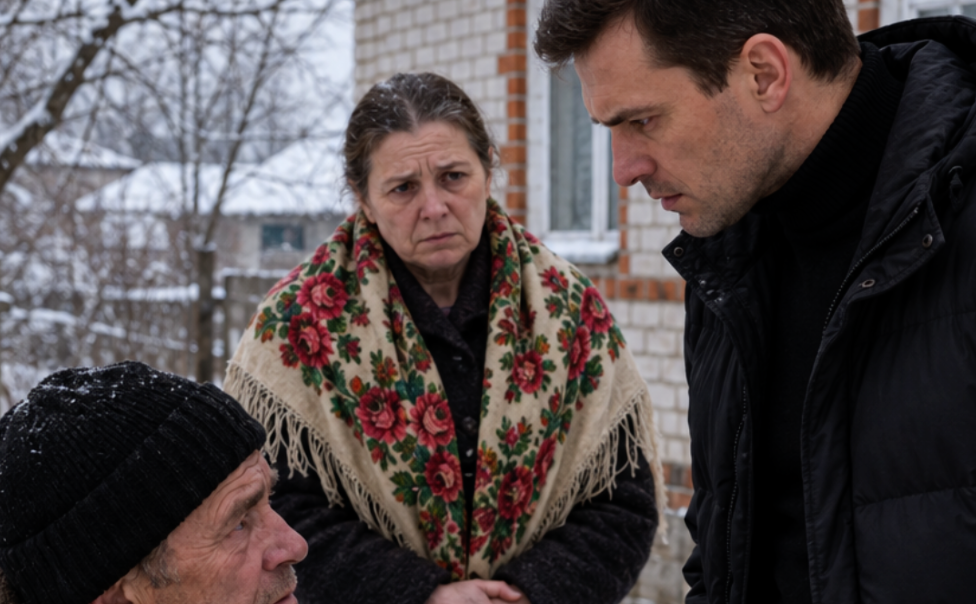
“So, Uncle Vasyl, what do you do around here? Are you still a hired hand, or do you feel like the master of the house now?” Oleg stood in the middle of the snowy yard, his hands shoved deep into the pockets of his expensive jacket.
Sixty-three-year-old Vasyl Andriyovych slowly lowered his axe. He had been splitting birch logs outside the old brick house where Hanna Semenivna lived.
“A hired hand? No way, Oleg. I’m just helping your mother out. See, she’s running short on firewood.”
“Did I ask you to help?” Oleg smirked. “Or do you just run things here without permission now?”
Vasyl didn’t answer. He simply removed his glove and wiped his sweaty forehead.
At that moment, Hanna Semenivna stepped out onto the porch with a bucket in hand, not knowing that in a few minutes her own son would say something that would make her, for the first time in years, not want to invite him to her table.
The village of Kalynivka was small. There used to be a farm, a school, and a store here, but now there were only twenty-seven inhabited houses. Come winter, there were even fewer—some people moved in with their children, others joined relatives in the city.
Most of the houses were small brick homes, with wooden verandas, old fences, and gardens that in spring would burst with white blossoms.
Hanna Semenivna had just turned sixty. She lived alone in her parents’ red brick house, which she and her husband once decorated with light tiles. Her husband had passed away four years ago. Since then, she had learned how to do many things on her own.
She carried water from the well, dug up the garden, shoveled snow. She even tried propping up the old fence with a board until the neighbor noticed.
That neighbor was Vasyl Andriyovych. His house was three doors down, a bit closer to the forest. Vasyl had lived alone for six years. His wife had moved in with her sister in another city, and eventually, they went their separate ways. The couple never had children. He used to work as a tractor driver, then a mechanic at the district center, and now he was retired.
His hands were large and work-worn, with thick fingers. But those hands could fix just about anything.
The first time Vasyl came over to Hanna was in spring, when he saw her trying to repair the gate.
“Hanna, you’re screwing that on the wrong way!” he called over the fence.
“Don’t watch me!” she shot back. “Better tell me what to press the hinge with.”
Vasyl laughed, went home for his tools, and within half an hour had fixed everything. Hanna brought him tea and a plate of pancakes with apples and walnuts.
“Have some, it’s my signature dish. My late husband used to say you could build another house for pancakes like these.”
“Well, I could paint the gate too,” Vasyl joked.
After that, he started stopping by her place more often.
He’d clean the drainpipe, adjust the veranda doors that always stuck in winter. In summer, he fixed the old bench under the apple tree. In autumn, he helped carry potatoes to the cellar and replaced two rotten boards on the steps.
Hanna never asked him to do these things for free. She always tried to offer him money, but Vasyl just waved her off.
“Just bake me some of your pancakes. That’ll be my payment.”
And she did. Sometimes she brought him borscht in a jar, pierogi, or homemade rolls with beans. And Vasyl would pretend to be annoyed:
— Hanna, I only fixed one curtain for you, but you’ve been feeding me all week!
She laughed. That’s how almost two years passed.
Over this time, they got used to each other. Vasyl would stop by in the evenings for tea, and sometimes they watched TV together. Hanna would share stories about her youth, her job at the village library, and her son Oleg, whom she once felt so proud of.
Oleg was thirty-seven. He lived in a city forty kilometers away, worked as a department manager at a trading company, had a wife and a ten-year-old daughter. He visited his mother rarely.
He called more often, but the conversations were brief.
— Mom, is everything okay?
— Everything’s fine, son. How are you?
— Lots of work. Okay, I’ll call you later.
And that was it. Hanna never complained. On the contrary, she always made excuses for her son.
— He has a lot of responsibility at work, Vasyl. A family, a child. He can’t come here every week.
Vasyl would just nod. One time, when they were cleaning up fallen leaves together, Hanna said:
— You know, Vasyl, Oleg used to be so different. As a child, he was always by my side. If I went to the garden, he’d follow. If I was hanging laundry, he’d hand me the clothespins. Now I don’t even know what to talk to him about. He’s always in a hurry.
— All grown children are always rushing somewhere, — Vasyl replied.
— But you don’t have any kids.
— No, I don’t. But I watch people. I see how things go.
Hanna didn’t say anything else. That February morning, the temperature was around fifteen below zero. Snow covered the roofs, birches, and old fences with a thick layer.
Vasyl came to Hanna’s at nine o’clock.
— So, hostess, where’s your firewood? Yesterday you said you used the last logs in the stove.
— I was about to chop some myself.
— Yeah, I know your ‘I’ll do it myself.’ Then you’ll be treating your back for three days.
He brought his own axe, set a log on the big stump, and got to work. Meanwhile, Hanna lit the stove, put the kettle on, and then went outside to gather some firewood.
— Vasyl, why don’t you take a break?
— Just a bit more.
Just then, a dark gray car stopped by the gate. Oleg got out.
His mother lit up with joy.
— Son! Why didn’t you tell me you were coming? I would have made lunch!
— I was running errands nearby. Thought I’d stop by.
He hugged his mother with one arm, then noticed Vasyl.
— Who’s this worker you’ve got here?
— What worker! This is Vasyl Andriyovych, our neighbor. I’ve told you about him.
— Ah, that one…
Oleg gave the man, the axe, the stacked wood, and the open door to the utility shed a careful look.
— So do you come here often?
— Whenever help’s needed, I stop by, — Vasyl replied calmly.
— And how long has this been going on?
Hanna frowned.
— Oleg, what’s with the interrogation? Vasyl has fixed so much for me. You should’ve seen our gate before, and now…
— Mom, I’m not talking to you.
Vasyl straightened up.
— It’s okay, Hanna. Let him ask.
— Good, — Oleg took a step closer. — Tell me, Vasyl Andriyovych, don’t you think you’re getting a bit too carried away helping my mother?
— I don’t understand what you mean.
— What’s not to understand? A single woman, a house, a farm. You fix things, split firewood. Maybe you’re even here for dinner every night now?
Hanna blushed.
— Oleg!
— Mom, wait. I want to understand what’s going on here.
Vasyl slowly placed the axe on the tree stump.
“There’s nothing for you to be ashamed of, son. It’s tough for your mother to handle everything on her own, so I’m just helping out.”
“Son?” Oleg gave a short laugh. “I’m thirty-seven, you know. And I know perfectly well that nobody does anything for free these days.”
“Sometimes they do.”
“Yeah, sure. Especially when a single woman owns the house in her name.”
A hush fell over the yard. Even Hanna was momentarily lost for words. Vasyl looked Oleg straight in the eye.
“What exactly are you getting at?”
“I mean I’m not going to just stand by and watch some stranger worm his way into my mother’s good graces. First it’s firewood, then fixes around the house—what’s next? Planning to move in? Or should we just change the will straight away?”
“Oleh, that’s enough!” Hanna burst out.
But her son was just getting started.
“No, Mom, you need to listen to me. I’m your only son. I won’t let some crafty guy take advantage of your loneliness!”
Vasyl slowly took off his gloves. His face stayed calm, but Hanna noticed his jaw tighten.
“Here’s the truth, Oleh. I’ve never done anything bad to your mother. I haven’t taken any money from her. I’ve never touched her documents. As for the house… I’ve got one of my own. And I’m perfectly happy with it.”
“Then go live in your own house,” Oleg shot back. “No need to come around here anymore. My mother has a son. If she needs something, she’ll call me.”
“Alright,” Vasyl said quietly.
“Good, we have an understanding.”
Vasyl picked up the axe, wiped the blade with an old rag, and put it in a canvas sheath.
“Vasyl, don’t go,” Hanna pleaded.
He looked at her.
“Don’t, Hanna. Your son’s here. Spend some time together.”
“But you…”
“I’ve nearly finished splitting the wood. I’ll get the rest done tomorrow…” He paused, glanced at Oleg, and corrected himself: “Actually, no. Now your son will help you.”
And he headed for the gate. Hanna was about to go after him, but Vasyl gave a barely noticeable shake of his head.
No need. Oleg watched him leave with a satisfied look. When the gate shut, he even smiled.
“See, Mom? That’s that. And you were worried. You have to nip these people in the bud or they’ll take advantage.”
He brushed snow off his shoes and went inside.
“So, what’s for lunch? I barely ate this morning. Also, make some strong tea—not your usual herbal stuff.”
Hanna stood in the middle of the yard, motionless.
“Oleh,” she finally said. “Come back here.”
“What is it now?”
“You’re going to go and apologize to Vasyl Andriyovych right now.”
Her son raised his eyebrows in surprise.
“Seriously, Mom? I just protected you from that random guy, and now you want me to apologize?”
“And just who did you protect me from?”
“From your precious Vasyl, of course!”
“And what exactly did he do to you?”
“Mom, are you being naïve? Can’t you see why a man visits a single woman every day?”
Hanna took a few steps toward her son.
“And do you, Oleh, actually know why he comes here?”
“I already explained it to you!”
“No. Now you’re going to listen to me!”
She raised her voice so suddenly that her son actually took a step back.
“Two years, Oleg! Two years this man has helped me! When the veranda was buried under snow in December, who cleared it? Vasyl! When the well’s pump broke down in the summer, who fixed it? Vasyl! And in the fall, when I almost fell off the ladder trying to clean the gutter, who took the ladder away and did it all himself? Again, Vasyl!”
“Mom, but that’s…”
“I’m not finished yet!”
Oleg went quiet.
“Do you know how many times I called you and asked you to come for at least a day? Do you remember what you answered?”
“I have work…”
“Work! Always work! I understand, son, that you’re busy. I never demanded you drop everything and rush over to me. But is it so hard to at least ask sometimes if I have enough firewood? If the roof isn’t leaking? If I get scared by myself when there’s a blizzard at night and the power goes out?”
Oleg looked away.
“You could have said something…”
“I did say! And you replied, ‘Mom, hire someone, I’ll send you money.’ But you never sent the money, and I never reminded you. Because you’re my son!”
Hanna wiped her eyes with the edge of her headscarf.
“Vasyl has never asked me for anything. Not even a coin. I’ll bring him lunch, and he even argues with me that I made too much. But you—you come here for the first time in three months and don’t even ask how I’m doing. Instead, you immediately start belittling the one who’s helped me!”
“I’m just worried about the house,” Oleg muttered.
Hanna smiled bitterly.
“About the house?”
“Well, yes. Dad built it, I grew up here. This is our family home.”
“Now I finally understand.”
“Understand what?”
“That you care more about the bricks than about your mother who lives inside these walls.”
Oleg wanted to say something, but Hanna wouldn’t let him.
“And one more thing—remember this. Vasyl Andriyovych is a decent man. He’s my friend. I will decide for myself who to invite into my house and whom I want to talk to. I’m sixty years old, Oleg. I’m not a child for you to come and tell me who I can have tea with!”
“Do whatever you want!” her son snapped. “Just don’t come running to me later when he tricks you!”
“I won’t. Now go home.”
Oleg stared at her.
“Are you kicking me out?”
“No. I’m telling you to leave because we’re both angry right now and might say things we’ll regret. Come back when you can talk to me like a human being.”
“Not even a cup of tea?”
Hanna looked at her son for a long, sad moment.
“I would have given you lunch, son. Even baked some pastries. You know I would. But today, I need to be alone.”
Oleg turned angrily, slammed the car door, and drove away. Hanna stood by the gate for a long time, watching the tire tracks stretched along the snowy road toward the edge of the village.
It was warm inside the house. There was a pot of borscht Hanna had cooked the day before sitting on the stove. Two slices of bread lay on the table, covered with a towel.
She sat down, folded her hands in her lap, and suddenly felt a wave of exhaustion, as if she had carried heavy buckets all day. What hurt most wasn’t that Oleg had been rude to her.
It hurt most that he had insulted Vasyl so deeply. Vasyl, who always came with his tools, never boasted about his work, and even got embarrassed when she tried to thank him.
Just a week ago, he fixed the old cabinet door in the kitchen. Hanna had joked:
“Vasyl, you’ve done so much for me, I don’t know how to ever thank you enough.”
And he replied:
“Oh, don’t be silly. Honestly, I feel better when I’ve got someone to visit. Sometimes my house is so quiet that even the ticking clock starts to bother me.”
Back then, Hanna just smiled. Now those words came back to her and her heart ached. She stood up, walked over to the window, and looked toward Vasyl’s house.
A thin curl of smoke rose above the chimney.
“He’s sitting there all alone now,” the woman said. “He probably thinks I’m just like my son.”
Hanna tied her apron with determination. She grabbed milk, eggs, and butter from the fridge. Then she sifted flour into her old enameled mixing bowl with the blue rim.
Next she brought apples from the pantry, which she’d saved since fall, along with a bag of shelled walnuts. These pancakes were a recipe she’d learned from her mother.
The apples had to be grated on a coarse grater, softened a bit in butter, then a pinch of cinnamon and chopped walnuts added. The filling was tucked into thin pancakes, arranged in a baking dish, and popped in the oven for a bit until the edges turned golden.
When Oleg was little, he could eat five in a row. Vasyl loved the ones with extra walnuts. Hanna remembered how he’d tried her pancakes for the first time and said, quite seriously:
“Hanna Semenivna, if you serve pancakes like these to everyone, you’ll have a line from the whole district at your door.”
She laughed so much back then that tears came to her eyes. And now she smiled again. When the pancakes were ready, Hanna carefully placed them in a small pot, wrapped it in a towel, and put on her warm coat, boots, and a woolen scarf.
It was already getting dark outside. Vasyl sat in the kitchen by the window. In front of him was a cup of tea that had long since gone cold. Potatoes were warming on the stove, but he didn’t feel like eating.
He wasn’t angry with Hanna. He understood she wasn’t to blame for her son’s words. Still, it hurt. Vasyl had heard plenty over the years—at work, people yelled, neighbors gossiped, even his own wife had said too much during arguments.
But for a sixty-three-year-old man like him, who’d never taken anything that wasn’t his, to be publicly called almost a hunter for someone else’s house…
That stung. Vasyl looked down at his hands. On his right palm was a fresh blister from the axe.
“What a fool,” he muttered to himself. “I meant well and look how it turned out…”
Someone knocked at the door. He was surprised—almost nobody visited him in the evening. He opened it.
Standing on the doorstep was Hanna, bundled in her woolen scarf, her cheeks red from the cold, holding a small pot wrapped in a towel.
“Good evening, Vasyl Andriyovych.”
Vasyl was caught off guard.
“Hanna? What are you doing out in this cold?”
“I’m here to visit you.”
“Well, come on in, of course…”
He stepped aside and helped her take off her coat. Hanna walked into the kitchen and set the pot on the table.
“I brought you dinner.”
“You really didn’t have to…”
“Pancakes with apples and walnuts. They’re still warm.”
Vasyl looked at the pot, then at Hanna.
“Has your son left?”
“He has.”
“Did you two argue?”
“We talked.”
He nodded.
“Hanna, don’t be mad at me. I didn’t want any trouble between you and your son because of me…”
“Vasyl,” she interrupted, “it’s me who should apologize.”
“For what?”
“For the way my son insulted you. I’m ashamed.”
Vasyl waved his hand dismissively.
“Come on now. He’s still young. Full of fire.”
“Not that young. He’s thirty-seven. At that age, a person should know what they’re saying.”
She sat down at the table.
“I told him everything, Vasyl. Everything I should have said long ago.”
“So what now?”
“I don’t know. Maybe he’ll be upset. Maybe he’ll understand. But I don’t want to stay silent anymore just because I’m afraid of losing my son’s affection.”
Vasyl put the kettle on.
“You did the right thing coming here,” he said quietly. “I was starting to think you wouldn’t even say hello to me anymore.”
Hanna looked at him with such surprise, as if he had just said the most ridiculous thing in the world.
“Vasyl Andriyovych! What are you talking about?”
“Well, your son…”
“Let my son deal with his own attitude. I’m not about to turn away from a good person just because of his nonsense!”
Vasyl smiled. For the first time all day. Hanna unfolded a towel, opened the pot, and placed three pancakes on a plate.
“Eat while they’re warm. I added extra walnuts just for you.”
“And you?”
“I’ll have some too.”
They sat across from each other. Outside, snow was falling slowly. The kitchen smelled of apples, cinnamon, and freshly brewed tea.
Vasyl picked up his fork, cut off a piece of pancake, and suddenly said:
“You know, Hanna, I was upset today. I won’t hide it.”
“I know.”
“Not because he threw me out of the yard. It isn’t even my yard. What hurt was that I never even thought about your house. I have my own, you know that.”
“I know, Vasyl.”
He was quiet for a moment.
“I didn’t come to see you because of your house. Or even for the pancakes, though yours are truly the best.”
Hanna looked up at him.
“Then why?”
Vasyl awkwardly scratched the back of his head.
“Because I feel good when I’m with you, Hanna. That’s all.”
She didn’t answer right away. She looked at him for a long time, at his large, hardworking hands, at the old sweater carefully mended at the elbow.
“I feel good with you too, Vasyl,” she finally said.
He lowered his gaze to his plate.
“I just don’t want you to get in trouble with your son because of me again.”
“Don’t take that on yourself. I’ll handle my son on my own.”
Hanna smiled.
“And anyway, who says I can only come to you for help? Maybe I just want to visit sometimes.”
“Then come by.”
“Will you invite me?”
Vasyl looked at her and smiled too.
“I’ll invite you every single evening if you want.”
Oleh called his mother the next day, close to lunchtime. Hanna was washing the breakfast dishes.
“Hi, Mom.”
“Hi, son.”
“How are you doing?”
“I’m fine.”
“Are you still mad at me?”
“I’m not mad, Oleh. I’m just really upset about what happened yesterday.”
There was silence on the other end of the line.
“Mom, do you really think I acted wrong?”
“Yes, son.”
“I just wanted to do the right thing.”
“Maybe you did. But good intentions can’t justify hurtful words.”
Oleh sighed heavily.
“Alright. Maybe I did go too far.”
“You didn’t just go too far. You hurt someone who helps me more than anyone else.”
“Oh Mom, please don’t start again…”
“I’m not starting. You asked yourself.”
Her son was silent again.
“So what’s he doing now? Not coming around anymore?”
Hanna glanced out the window. Vasyl was standing by the gate with a small wooden toolbox, fixing the latch that had gotten stuck after the frost.
— Why not? He still comes.
— Even after everything I said to him?
— Yes.
— Strange man.
— No, Oleg. He’s just kind.
Oleg fell silent again.
— Mom… I think I’ll come this Saturday. Is that okay?
— Of course, it is. You’re my son.
— And I’ll bring my daughter. She’s been wanting to visit grandma for a while.
— Bring her. I’ll make pancakes.
— The ones with apples?
— The very same.
— Great, Mom. See you Saturday.
Hannah was about to hang up when her son suddenly added:
— Listen… That Vasyl Andriyovych… Will he be home Saturday?
— I think so. Why?
— Oh, nothing. Just wanted to talk.
— About what?
Oleg grew embarrassed, even though his mother couldn’t see him.
— Well… Maybe to apologize. I really did say too much.
Hannah smiled.
— Now, son, that’s a different story.
On Saturday, Oleg arrived with his daughter as promised. In the trunk, he’d brought two sacks of chicken feed, a new snow shovel, and a big bag of groceries.
Hannah met them on the porch. The granddaughter immediately leaped up and hugged her grandma around the neck.
— Grandma, did you make pancakes?
— I did, sweetheart. With apples and with cheese.
Oleg carried the bags into the house and then asked a bit hesitantly:
— Mom, where does Vasyl Andriyovych live?
Hannah pointed with her hand.
— Over there, three houses down. The brick house with white windows and a pear tree by the gate.
— I’ll go over.
Vasyl was chopping wood in his yard. When he saw Oleg, he straightened up and set the axe aside.
— Good day.
— Good day, Vasyl Andriyovych.
Oleg shifted from foot to foot.
— I, uh… wanted to apologize for last Sunday.
Vasyl was silent.
— I really had no right to speak to you like that. Mom explained a few things to me. And I thought about it myself too…
He rubbed his face with his hand.
— I’m ashamed. You help her, and I came and said a bunch of nonsense.
Vasyl put his hand on the axe handle.
— Good thing you realized.
— You’re not angry, are you?
— I was hurt then, Oleg. No use denying it. But when someone comes to apologize, what’s the point in holding onto that hurt?
Oleg exhaled with relief.
— Thank you.
He looked at the piles of logs by the woodshed.
— Let me help you out. You’re on your own here.
Vasyl squinted.
— Know how to handle an axe?
— Honestly, I haven’t tried in ages. In the city, you don’t really get a chance.
— Then grab the other one, it’s under the shed. But let me show you the right way to do it first.
Half an hour later, the two of them were working side by side. Oleg struck a log awkwardly, and the axe got stuck in the wood. Vasyl laughed.
— It’s not about strength, son! You have to know where to hit!
— Looks like I’ve got a lot to learn.
— You’ll get it. Don’t worry.
And when they finished, Oleg suddenly asked:
— Vasyl Andriyovych, do you often visit my mom for no reason? Not for work?
Vasyl looked at him.
— Sometimes.
— And what do you do there?
— We drink tea. We talk. Sometimes we watch TV.
Oleg nodded.
— She’s a good woman, isn’t she?
Vasyl smiled.
— She is, Oleg.
— Just a bit stubborn.
— Aren’t we all set in our ways?
They both laughed. After lunch, Hannah was seeing her son and granddaughter off to the car. Oleg hugged his mother tighter than usual.
— Mom, I’ll visit more often now. Really.
— I’ll be glad, son.
— And call me if you need anything. Don’t be shy.
— I will.
He sat behind the wheel, but before closing the door, he said suddenly:
You know, Mom… Just so you know, I’m not against you being friends with Vasyl Andriyovych.
Hanna looked at him in surprise.
“I didn’t think I needed your permission,” she replied.
Oleh laughed.
“Yeah, I get it now. It’s just… You deserve not to be alone, too.”
Hanna didn’t answer, just fixed the collar of her son’s jacket, just like she used to when he went to school.
“Drive safe. The roads are slippery.”
When the car disappeared around the bend, Hanna returned to the house. Vasyl was waiting on the porch, ready to help clean up after lunch. He was holding an empty plate in his hands.
“So, they left?” he asked.
“Yes, they did.”
“You have a good son, Hanna. Sometimes his mouth acts faster than his head, though.”
Hanna sighed.
“He is good. He’s grown up now, but I still have to explain that people matter more than stuff.”
Vasyl nodded.
“What matters is that he heard you.”
She stepped closer.
“Vasyl, will you come over tonight?”
“Why, what’s up?”
“Oh, nothing. I just made a whole bowl of pancakes. And I opened some cherry jam.”
“You know I don’t eat much sweet.”
“I know. I’ll save two for you.”
“Well, two is fine.”
Hanna laughed, and Vasyl smiled too.
Then, after a moment of silence, he said:
“You know, Hanna, I was thinking… Maybe you could come over for lunch tomorrow? I’ll bake some potatoes and cook some meat. It’s not fair for you to be stuck in the kitchen all the time.”
“You can cook?”
“Oh yes! Maybe not as tasty as yours, but I can.”
“Then I’ll come.”
“It’s a plan.”
Hanna looked out at the snowy street, the small brick houses with smoke rising above them, and suddenly realized that this winter didn’t seem so long anymore.
She didn’t know what the future would bring. Maybe she and Vasyl would remain just good friends, or maybe life had something more in store. But she wasn’t in any rush to decide.
The important thing was that now she had a man nearby who never expected money, gratitude, or promises from her. He just came when he saw she needed help, and stayed when she wanted to talk.
And that evening, as Vasyl walked back to his house, for the first time in a long while he realized he was hurrying home not to rest.
But to tidy up the kitchen, lay out a clean tablecloth, and think about what to make for Hanna tomorrow.
Because on Sunday, he was expecting guests. Well, just one guest. And for some reason, that made his heart feel especially warm.
Sometimes, a stranger can do more for us than someone close. But the best thing is when our own family understands this in time—and finds the courage not only to say sorry, but to change their attitude.