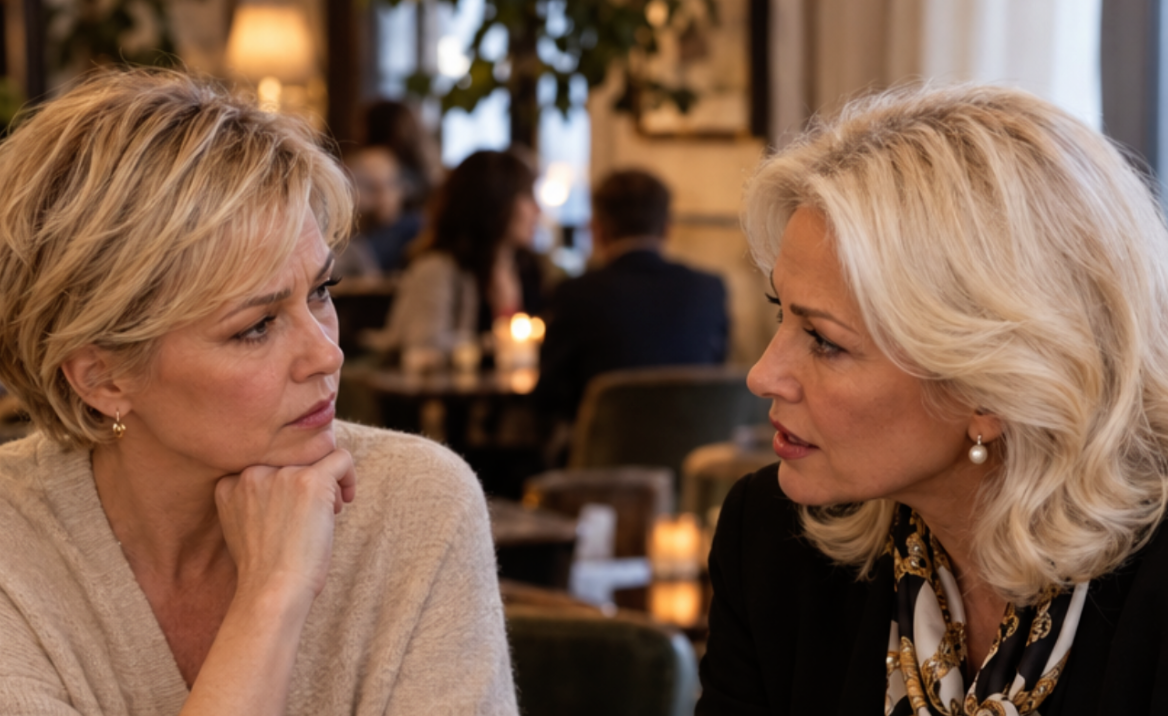
“Did you really say that I gave you some cheap scarf?” Nadya set her cup down on the saucer and looked her friend directly in the eyes.
Margarita, who was just about to call the waiter, slowly lowered her hand.
“Nadya, why are you starting this? We came here to have a normal conversation.”
“That’s exactly what I want. But first, answer me: did you say it or not?”
“I did say it. But you don’t know the context of that conversation.”
“And in what kind of conversation could anyone say something like that about a gift from a friend?”
Margarita leaned back in her chair. Her perfectly styled blonde hair, dark blazer, and silk scarf around her neck – everything about her looked flawless as always. Nadya sat across from her in a beige sweater she had been wearing for the third season in a row.
They had known each other for thirty-four years. And in all that time, they had never spoken to each other like strangers before.
“Alright,” Margarita finally said. “If you want honesty, let’s be honest. But then you need to hear me out, too.”
Nadya nodded. She had no idea just how much her friend was about to bring up.
* * *
They met when they were young, both working at the same department store. Margarita sold women’s clothes, while Nadya was in charge of fabrics and bedding.
Back then, there wasn’t much difference between them. Both lived paycheck to paycheck, brought homemade lunches in jars, rushed to sales together, and swapped sewing patterns.
Margarita was always the bolder one. She could go straight to the manager and ask for a day off, return an unwanted purchase without a fuss, or even say right in the middle of a shift:
“Nadya, let’s go grab a coffee after work. Life’s too short to spend all your time at home!”
Nadya was different. Calm, cautious, always thinking things through before acting.
Margarita often laughed:
“If you were more like me, we’d have opened our own store by now!”
“Then go ahead and open it,” Nadya would smile. “I’ll bring you customers.”
Later, Margarita married a man who was in the retail business. Together they first rented a small kiosk, then opened a store, and after a few years, they had a thriving enterprise of their own that brought in good money.
Nadya got married, too, raised a daughter. Her husband was a driver, and she continued working in retail. When the department store closed, she got a job as a saleswoman at a home textiles shop.
She loved her job. She could tell just by touch in a second which cotton was good and which fabric only looked nice on the shelf. Regular customers came to her to ask which towels absorbed best, how to match curtains with wallpaper, and whether the duvet cover would shrink after washing.
But the salary was small.
Nadya’s husband eventually moved to work in another city, where he stayed. Her daughter grew up, started her own family, and lived separately.
Nadya lived alone in a two-room apartment they’d once received from work. She never complained. In the summer, she grew flowers on the balcony, baked pies for her grandkids on weekends, and took the trolleybus to work.
Meanwhile, Margarita moved into a spacious house outside the city. She had a beautiful car, went on vacation twice a year, and could buy herself a dress without even checking the price tag.
But the friendship between them remained strong.
At least, that’s what both of them believed.
* * *
Margarita gave Nadia her first expensive present for her fiftieth birthday.
She brought over a big box with a coffee machine inside.
“Rita, what are you doing!” Nadia was actually flustered. “How much did this cost?”
“Why does it matter to you? You love coffee, don’t you? Well, that’s all you should worry about.”
“But I could never give you a gift like this.”
“Nadia, stop it. Are we strangers to each other or what?”
Nadia hugged her friend. She used the coffee machine every day and always thought of Margarita with gratitude.
There were more gifts after that. Once, Margarita brought a beautiful handbag from one of her trips.
“I saw it and immediately thought of you. It’s your color!”
Another time, she bought two tickets to a concert.
“I’ve already paid for everything. Don’t even try to argue.”
Whenever they went to a restaurant, Margarita usually paid for both of them. At first, Nadia tried to split the check, but her friend would get offended.
“You might as well offer to pay for my water! I invited you, so I’m treating you.”
Eventually, Nadia stopped arguing. Instead, whenever Margarita came over, she would set a beautiful table.
She cooked her friend’s favorite dishes, baked cheesecake with raisins, and bought the same nut chocolates Margarita had loved since they were young.
“Nadia, why did you make so much food?” her guest would ask.
“Because I know what you like. Eat before it gets cold.”
Margarita always praised her cooking and asked to take something home with her.
And Nadia was happy. She felt that everything between them was just as it used to be: one could afford expensive gifts, the other could offer homemade pie. And they both did it wholeheartedly.
But it turned out that Margarita saw their friendship a little differently.
* * *
Margarita started preparing for her sixtieth birthday in advance. She rented a hall in an expensive restaurant, invited musicians, ordered flowers and a big festive cake.
There were going to be almost forty guests. She called Nadia three weeks ahead of the party.
“You know there’s no party without you, right? I’ll seat you at the main table!”
“Rita, of course I’ll be there. How could I possibly miss your sixtieth birthday?”
“Just make sure you dress up. It’s going to be a fancy event.”
Nadia hung up the phone and started thinking. She had a dark brown dress she bought last year for a colleague’s anniversary. It was perfectly fine, with a neat collar. She decided to wear it.
But finding a present was harder.
Margarita had everything she could want. She bought her own expensive perfume, ordered her cosmetics from abroad, and picked out her own jewelry. Even giving something for the house didn’t make sense—her home had towels color-coordinated to perfection.
Nadia spent a long time browsing shops until she finally saw a silk scarf. It was dark blue, with cream and golden patterns along the edges.
She could immediately picture how stunning it would look with Margarita’s black coat. The price was 1,200 hryvnias.
Nadiya stood by the shop window for a few more minutes. It was a lot of money for her. This month, she had to pay the utility bills, plus she had promised to buy her grandson a construction set for his birthday.
But in the end, she bought the scarf.
When she got home, she carefully opened the box and took another look at the fabric. She knew textiles well and could tell this was a quality item.
She added a small card, writing by hand:
“Ritusya, I wish for you to always stay as bright, bold, and full of life as you are. Thank you for all these years we’ve spent together.”
That evening, she spent a long time deciding which wrapping paper to use for the box. She wanted the gift to be perfect.
* * *
The celebration was truly splendid.
Nadiya hadn’t attended such a grand event in ages. The tables were decorated with tall vases of flowers, waiters served dishes on large white plates, and musicians played familiar tunes.
Margarita met her friend at the entrance.
“Nadyusya! Finally! I’ve been looking out for you.”
She hugged her, kissed her on the cheek, and led her to the table. Nadiya handed her the box.
“This is for you. From the bottom of my heart.”
Margarita quickly unwrapped the present.
“Oh, a scarf! How lovely. Thank you, Nadiya.”
She set the box aside on a separate table and turned to greet the next guests. Nadiya didn’t mind. Margarita had a lot on her plate—she had to welcome everyone, get them seated, and make sure all felt included.
She sat with old friends, listened to music, and reminisced about the past. Later, when guests started dancing, Margarita approached her.
“So, how do you like the party?”
“It’s wonderful, Rita. You did such a great job with everything.”
“I wanted everyone to remember this day.”
“They will, no doubt about it.”
They even danced together to a song they had loved in their youth. Nadiya went home happy, sure that her friend had liked the gift.
Four days later, their mutual friend Larisa called Nadiya. At first, they chatted about everyday things—the weather, their children, how lovely the anniversary was.
Then Larisa suddenly asked:
“Nadya, what did you give Rita as a present?”
“A silk scarf. Why?”
“Oh, nothing. She was just talking about the presents yesterday.”
“And what did she say?”
Larisa hesitated.
“Maybe I shouldn’t have brought it up…”
“Larisa, just tell me already.”
“She said that after all these years of helping you, you brought her just a scarf for her sixtieth birthday. That you could have made more of an effort, at least this once.”
Nadiya was silent for a long time.
“Did she say it exactly like that?”
“Well, something close to that. Maybe she was just in a bad mood. Don’t take it to heart.”
Nadiya thanked her and ended the call. Then she went to her closet, took out the shopping bag with the receipt she had accidentally kept after her purchase.
1,200 hryvnias. She looked at the amount and remembered standing at the shop window, choosing between two scarves. And the joy she felt when she found the one that would suit Margarita perfectly.
That evening, for the first time in many years, Nadiya didn’t feel like calling her friend.
* * *
Margarita didn’t notice her silence right away. The first week, she was busy herself—unpacking gifts after the party, meeting up with relatives, running errands.
Then she called Nadiya.
“Hi! How are you? It’s been a while since we saw each other.”
“I’m fine, Rita. Work’s busy lately with lots of customers.”
Want to have lunch together this Saturday?
I can’t. I’m planning to visit my daughter.
The following week, Margarita suggested meeting up again. Nadia said she had things to do. A few days later, Margarita couldn’t take it anymore.
Nadia, what’s going on? Are you avoiding me?
We need to talk, Rita.
Then let’s talk. Tomorrow at three, at our usual café?
Nadia agreed.
Before the meeting, she thought for a long time about whether she should bring up the issue at all. Maybe Larisa misunderstood something? Maybe Margarita phrased things badly?
She even considered calling and canceling their meeting. But then she remembered those words about at least trying, just once.
Still, she went.
* * *
Did you really say that about my gift? Nadia asked, when Margarita confirmed what Larisa had told her.
Nadia, I never said your scarf was bad. It’s lovely. But it’s not just about the scarf.
Then what is it about?
It’s about the thought behind it.
Nadia even sat up straighter.
The thought behind it?
Yes. I’ve been helping you for so many years. We’ve been through so much together! I’ve always done everything for you without hesitation. And on my sixtieth birthday, I just wanted to feel like you were ready to do something special for me too.
And the scarf wasn’t special?
Nadia, don’t pretend you don’t understand. All the guests made an effort. But you brought an ordinary scarf.
Not ordinary. Silk. I spent a long time picking it out.
I’m not talking about the quality of the material!
But I am. Because I know about that kind of thing. I wanted to get you something nice, something you’d actually wear.
Margarita sighed.
Nadia, it’s not about the price. You could have come up with something more creative. Organize a surprise for me, make an album with our pictures, just do something from the heart. But you just bought a scarf.
For a moment, Nadia fell silent. She admitted to herself that she could have made a photo album. She could have found their old photos, written kind words, collected some memories.
But Margarita never asked for that. And Nadia honestly believed that a beautiful thing, chosen with love, could also be a special gift.
Rita, am I getting this right? You’re upset because I didn’t come up with something unusual?
I was disappointed because, from my closest friend, I hoped for a little more attention.
So why did you go around telling everyone how many years you’ve been helping me?
Margarita frowned.
Because it’s true.
It’s true. You’ve done a lot of good for me. And I’ve always been grateful.
But you’ve gotten used to it, Nadia! Used to me paying, me buying, me inviting. You don’t even try to offer your share of the bill anymore!
Nadia looked at her friend.
You never let me.
Because I knew it was tough for you.
So why bring it up now?
Because sometimes I want someone to take care of me too!
Margarita said those last words louder than she planned. A few people at neighboring tables turned to look.
She picked up her cup, took a sip, and added more quietly:
Everyone thinks that because I have money, I don’t need anything. That I can buy everything myself, organize everything myself, treat everyone myself. But I want to feel important to someone, too.
Nadia listened in silence.
For the first time during this conversation, she saw something different behind Margarita’s anger.
She still couldn’t shake the fact that her friend had discussed her gift with other people.
“Rita, you could’ve just told me. You could’ve asked for help with the party. I would have come, set the tables, decorated the hall, greeted the guests—anything at all. But you organized everything yourself, and now it feels like I was supposed to just guess what you were missing.”
“Isn’t a close friend supposed to think of that on her own?”
“She is. But she can’t read minds.”
Margarita turned away toward the window.
* * *
They sat in silence for a while. Then, suddenly, Margarita spoke in a completely different tone.
“You know, the last time we traveled somewhere together, you didn’t even ask how much the hotel room cost.”
Nadiya looked surprised.
“You told me you’d invited me for the weekend. That it was your gift.”
“Yes. But you could’ve at least shown some interest.”
“I was afraid you’d get upset. You always got annoyed when I asked about the price.”
“Because it made me uncomfortable when you started counting every single hryvnia.”
“So how was I supposed to act, Rita?”
Margarita didn’t answer.
Nadiya opened her purse, took out a napkin, then put it back.
“I’m going to tell you something now. Maybe you won’t like it either.”
“Go ahead.”
“Remember when you bought me that coat?”
“Of course. Why?”
“We just walked into the store. You saw the coat, said it suited me, and bought it. I asked you not to. Remember?”
“I remember.”
“Then we went back to your place, and in front of your husband, you said, ‘See what coat I bought for Nadia? She’d never be able to buy something like this for herself.'”
Margarita raised her eyebrows in surprise.
“What’s wrong with that? I was just stating the truth.”
“The truth. But it made me feel awkward.”
“Why didn’t you say anything then?”
“Because you gave me a gift. I didn’t want to seem ungrateful.”
Margarita became thoughtful.
“Nadia, I never meant to hurt you.”
“I know. That’s why I kept quiet. But, Rita, I don’t need an expensive coat if later it’s brought up in front of others that I couldn’t buy it myself.”
Margarita lowered her gaze to her cup.
“So maybe you didn’t want my gifts at all?”
“I did. I liked them. I just never expected you’d bring up how much you’d spent on me one day.”
“I’m not keeping track of anything!”
“You just mentioned the hotel, the coat, the restaurants. I hadn’t even remembered all that.”
Margarita fell silent again.
She didn’t like where the conversation was going. She’d come to explain her own feelings, but now she had to listen as her friend recalled her careless words.
But what surprised her most was this: Nadia, whom Margarita had always thought quiet and easygoing, was calm today, but not backing down.
* * *
“Do you remember when I used to help you with the shop?” Nadiya asked.
Margarita became wary.
“What shop?”
“The first one. When you and your husband had just opened. You didn’t have enough time for the stock, and I’d come over after my shifts to help out.”
“I remember. You really helped a lot.”
“I spent three weeks sorting your merchandise, writing out price tags, unpacking boxes. And then I sewed your curtains at home because you never had the time.”
“Nadia, I haven’t forgotten!”
“I’m not saying I forgot. I just want to remind you: back then, I didn’t have much free time either. My daughter was still little, and I was working. But I still came when you asked me to.”
“And I’m grateful to you.”
“In thirty years, I never once said to you, ‘Rita, do you remember how many hours I spent helping you?'”
Margarita blushed.
“Are you really comparing a few weeks of helping out to what I’ve done for you over the years?”
“No, I’m not comparing. I’m just saying that back then, we were friends. You needed help, so I helped. Later, when you could afford to give me gifts, you did. I thought that was normal.”
“It is normal,” Margarita agreed. “But for some reason, I always felt like I had to give more.”
“More of what?”
“Everything!”
Nadiya shook her head.
“Rita, I can’t invite you on a vacation at a fancy hotel. I can’t buy you a ten-thousand-dollar coat. But I can come to see you when you’re feeling down. I can listen—even if you talk about the same problems for three hours. I can cook your favorite dinner. Doesn’t that mean anything?”
Margarita wanted to reply, but suddenly remembered last autumn.
Back then, she couldn’t get through to her grown son for weeks. Her husband was always busy, her son hardly called, and Margarita felt lonely in her big house.
Nadiya would come over after work. She’d bring homemade food, make tea, and sit with her until late in the evening.
She never asked when Margarita would finally stop worrying about her son’s indifference. She just listened.
Margarita even told her then:
“It’s good that I have you. At least I can really talk to you.”
And now she was sitting across from this woman, trying to argue that she had done more for her.
“You’re right,” she said quietly. “You’ve done a lot for me too.”
For the first time during the whole meeting, Nadiya relaxed a little. But Margarita’s next words shifted the conversation again.
“But Nadiya, there’s one thing I don’t understand. Why did you never tell me if something bothered you? Why did you accept my gifts, smile, say thank you, and now it turns out you didn’t really like it all this time?”
Nadiya paused to think. It was a fair question.
The truth was, she often stayed silent. She didn’t want to spoil their friendship, was afraid of seeming ungrateful, kept telling herself Margarita meant well.
And gradually, things built up between them that neither had noticed before.
“I guess I was wrong too,” Nadiya said. “I should have spoken up right away.”
“You should have,” Margarita agreed.
“But you could have told me what you expected from me, too. Instead of discussing my gift with Larysa.”
Margarita nodded.
“You’re right, I really shouldn’t have told her anything. That wasn’t fair.”
* * *
The waiter brought the bill. Without thinking, Margarita reached for her purse.
“I’ll pay.”
“No,” Nadiya stopped her. “Today, we each pay for ourselves.”
Margarita froze.
“Nadiya, why? It’s just coffee and dessert.”
“That’s exactly why. I can absolutely pay for my own coffee and dessert.”
“So you want us to split everything from now on?”
“I want you to stop feeling obligated to pay for me all the time.”
“But I don’t feel obligated!”
“Then why did you bring up every restaurant we’ve ever been to together today?”
Margarita didn’t answer. Nadia placed her share of the bill on the table, then closed her purse, straightened her sweater, and stood up.
“Rita, I don’t want us to stop being friends. But I need some time.”
“Are you really ready to throw away thirty-four years over a scarf?”
“It’s not about the scarf. It’s about what I found out today.”
Margarita stood up too.
“And I learned a lot of new things about you today too. Apparently, you’ve been holding grudges and not saying a word for years.”
“Yes,” Nadia agreed. “It looks like there are things we both haven’t understood.”
They said goodbye without their usual hugs. Nadia left the cafe and headed for the bus stop. Margarita stayed at the table, looking at two empty cups.
She wanted to run after her friend. But she didn’t know what to say.
* * *
They didn’t talk to each other for the next two weeks.
Nadia went to work, arranged new bedding sets on the shelves, and helped customers pick out fabric for curtains. In the evenings, she came home, had dinner, and watched TV.
And every now and then, she wanted to pick up her phone.
After so many years, she was used to telling Margarita everything. About her grandchildren, about the funny customer who wanted curtains to match her cat’s color exactly, about a new pie recipe.
Now the phone stayed silent. One evening, Nadia took down the coffee maker her friend had given her ten years ago.
She ran her hand over its shiny lid.
She had never thought about the price of that item. To her, it was a gift from Rita—the same Rita with whom she used to share one bun during their lunch break years ago.
Nadia turned on the coffee maker and thought to herself. Margarita wasn’t completely wrong either.
How many times had Nadia wanted to do something nice for her, but put it off? How many times did she think, ‘Margarita can buy herself anything, so why bother?’
Maybe her friend really did need a kind of attention that wasn’t tied to money. But how could anyone know if Margarita always brushed off any attempts at help?
Nadia never found an answer.
That same evening, Margarita sat in her walk-in closet. She was sorting through scarves, looking for a light one to go with her new jacket, when she suddenly came across Nadia’s gift.
The box was on the top shelf. Margarita opened it and unwrapped the fabric. The scarf really was beautiful. Soft, pleasant to the touch, with an elegant pattern.
At the bottom of the box was a card. Margarita read it again: “Thank you for being by my side all these years.”
She stared at those words for a long time. And, for the first time, she wondered if Nadia had chosen this present as carefully as Margarita had once picked out the coffee maker for her.
Their circumstances were just different.
* * *
On Saturday, Margarita called Nadia.
“Hi. Are you home?”
“I’m home.”
“Can I come over?”
Nadia was silent for a moment.
“Come by.”
An hour later, Margarita was at her door. No flowers, no fancy shopping bags, no usual boxes of gifts. Just a small packet of cookies—the kind they used to buy together in their youth.
“I was thinking, maybe we could have some tea,” she said.
Nadiya smiled.
“Come in. I just baked a pie.”
In the kitchen, they started off talking about everyday things. Margarita asked about her daughter and grandchildren. Nadiya wondered how Margarita’s son was doing.
Then Margarita set her cup on the table.
“Nadiya, there’s something I wanted to tell you.”
“Go ahead.”
“I reread your card. The one that came with the scarf.”
Nadiya looked at her intently.
“And?”
“And I realized I was unfair. You didn’t just pick up any random thing.”
“Of course not.”
“I’m sorry for the way I spoke about it.”
Nadiya nodded slowly.
“It really hurt me, Rita.”
“I know.”
“Not because you didn’t like the gift. That happens. But because you told others that I didn’t make any effort.”
“I won’t do that again.”
Nadiya poured her another cup of tea.
Margarita took a piece of pie and suddenly smiled.
“Do you know what I actually wanted for my sixtieth birthday?”
“What?”
“For you to give a toast. Remember at my fiftieth, you told that story about our first trip to the sea? Everybody laughed so much. I thought you’d come up with something again this time.”
Nadiya looked surprised.
“Why didn’t you ask me?”
“I didn’t want to ask. I hoped you’d want to do it yourself.”
Nadiya shook her head.
“Rita, you know I don’t like speaking in front of people. At your fiftieth, you talked me into it.”
Margarita laughed.
“That’s right. I almost forgot.”
They both fell silent.
Then, Nadiya softly said:
“You know, I have something to apologize for too. So many times I stayed quiet when I should’ve told you right then that something hurt me. And then I brought it all up in one evening.”
“So, maybe we could agree not to do that anymore?”
“Let’s agree.”
Margarita reached her hand across the table. Nadiya placed hers on top.
“And one more thing, Rita. If you invite me to a restaurant next time, I want the chance to pay for myself.”
“Fine. And what if I want to treat you?”
“Then ask me first. And I’ll tell you if I agree.”
Margarita smiled.
“Deal. But you’ll still let me take some pie home, right?”
“Of course. Just don’t tell everyone how many pieces I gave you.”
Margarita looked at her friend in surprise at first, then both of them burst out laughing.
* * *
A few days later, Margarita showed up for a meeting with Nadiya, wearing that very same silk scarf.
“Oh, you’re wearing it!” Nadiya exclaimed happily.
“Yeah. And you know what? It goes perfectly with my coat.”
“I told you so!”
Margarita adjusted the knot at her neck.
“Two women have already complimented me on it today.”
“Then tell them that a saleswoman with thirty years’ experience picked out that scarf!”
They went to a little coffee shop where they used to love meeting after work. When the bill came, Margarita put down her share.
Nadiya put down hers as well. Then, unexpectedly, she took a small package out of her purse.
“This is for you.”
“What now?” Margarita asked, surprised.
Inside was a photograph in a simple wooden frame. In the picture, it was the two of them—young, smiling, standing by the entrance to the department store where they once worked.
“I found it while going through my albums,” Nadiya explained. “I thought it would make you happy.”
Margarita studied the photograph for a long time.
— Just look at us in this picture! Do you remember that day when you lost the locker key and we spent half an hour searching for it?
— And then you found it in your own pocket!
Margarita burst out laughing. Then she carefully placed the frame on the table.
— Nadia, this really is a special gift.
— It’s not expensive, Rita.
— I can see that. So what?
Nadia smiled. They didn’t talk about the price anymore. Later, the photo found its place on the shelf in Margarita’s living room—right next to family photos and keepsakes.
Sometimes, guests would ask who those two young women by the department store were.
Margarita would pick up the frame and answer:
— That’s me and my Nadia. Back then, we hardly had anything. But at least we had each other.