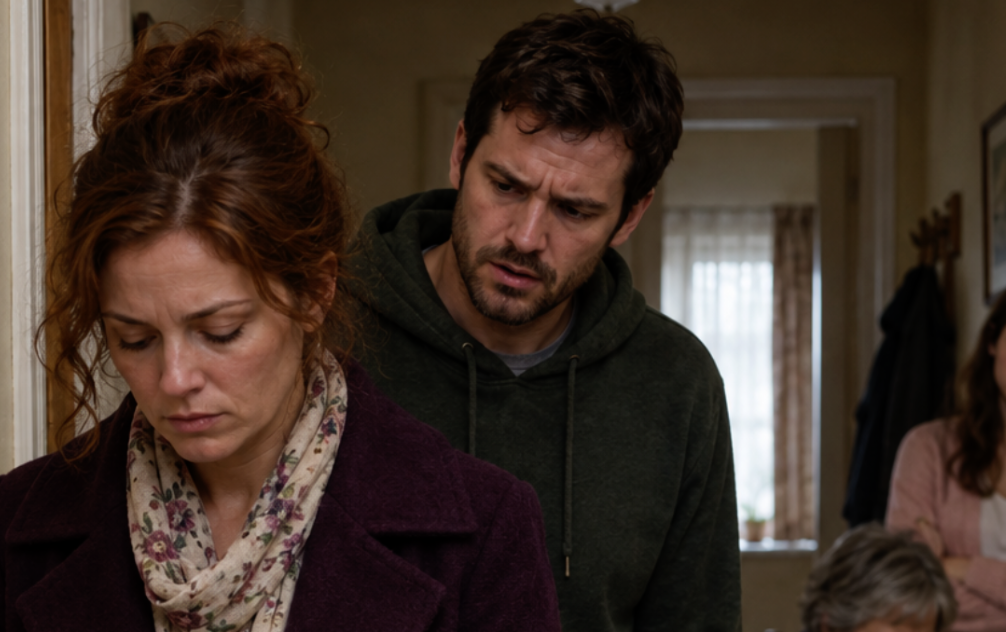
“Larisa, please don’t be upset, but I’ve given the apartment to Stasik. On the seventeenth, actually. I just didn’t want you to hear it from someone else.”
She said this without taking her eyes off her plate of buckwheat. She held the spoon in her left hand. Her right, still weak after the cast, lay on the tablecloth, looking almost foreign.
I was just pouring water into the kettle and turned around, still holding it.
“Your cast was taken off on the seventeenth. Stas took you to the trauma clinic.”
“Yes, the trauma clinic. Then we went to the notary on Sovetskaya. That didn’t take long.”
Gena sat across from his mom, carefully peeling a mandarin, picking off every single white string.
“Did you know?” I asked.
“I found out yesterday, Lar.”
“And you kept it from me?”
“Mom wanted to tell you herself.”
Mom wanted to tell me herself. Of course.
Zinaida Fyodorovna had been living with us since August sixth. That day, she slipped on wet tiles near the pharmacy and broke her wrist. She had a cast for six weeks, and on her own in her two-room place on Severnaya Pravda, she couldn’t bathe or even lift a pot. Dasha’s room here was empty; our daughter has lived in Yaroslavl for a long time. So we brought Mom to stay with us.
I’m a pastry chef, working in the bakery workshop. My shift starts at five a.m., so I’m home by two. That meant my mother-in-law was my responsibility all through August and September. Pills, checking her blood pressure twice a day, washing her hair over the sink since she was afraid to get in the tub. Stas visited twice in all that time. Once, he brought bananas.
“Okay,” I said, putting the kettle on the stove. “And where will you live?”
“What do you mean, where? At my place. Once my arm heals, I’ll go back. Stasik won’t throw me out, he’s my son.”
“And until your arm heals?”
“Am I in the way?” She finally looked up. Her pale, watery eyes were already filled with tears. She was always good at that.
“You’re not in the way. I’m just asking, who’s going to take care of you now that the apartment is Stas’s? Stas?”
“Lara,” Gena said.
“What about Lara? I asked a simple question.”
My mother-in-law pushed her plate away.
“I gave you two hundred thousand for this kitchen,” she tapped the table with her left hand, “back in 2004. From my father. For the garage and the Moskvich, what was left of it. You didn’t have enough for the down payment, remember? I do. And what did I give Stas? Nothing. He’s got two kids, Timokha is already in the third grade, and the landlords keep raising the price or putting the place up for sale. You’re all set. Three rooms, a summer house. He’s living out of other people’s corners.”
“We would’ve given you the two hundred thousand back if you’d asked,” I said.
“I’m not asking. I’m being fair about this.”
She tried to stand up, leaned on her right arm, but immediately gasped and sat back down. She sat quietly, staring at the table. Then she spoke softly, in a completely different voice:
“I’m not doing this for myself, Lara. What would I need it for? I don’t need anything anymore.”
I did feel sorry for her—for about a minute. Then I remembered: she kept quiet about the notary for eleven days. In that time, I washed her hair eleven times.
***
I called Stas the next day, during lunch, right from the bakery. Went out the back door, hands still covered in flour.
“Hey, Lar,” he answered right away, already sounding guilty. So he knew why I was calling.
“Congrats on the apartment.”
“Oh come on, Lar. I didn’t ask for it, honestly. She wanted it. She said: either now or I’ll change my mind.”
“And so you took her to the notary the same day they took her cast off.”
“When else was I supposed to? She’s been with you guys, never goes out on her own.”
He fell silent. I could hear the TV blaring in the background, and a little kid demanding juice.
“The landlady’s raising the rent in January,” Stas said quietly. “By five thousand. If we can’t pay, we’ll have to move again, Timokha’ll have to change schools again. He just made friends, Lar.”
His voice had gone hoarse. I couldn’t even remember it sounding like that. Stas is forty-one, but in my mind he’s still fourteen—scrawny like he was at our wedding: he ate half a cake and spent the whole evening sitting on the bench outside, looking green.
“Stas, I’m happy for you,” I said. “Really. But now Mom is your responsibility. By the end of October her arm will be healed. You need to figure out how to bring her over or visit her every day. Pills, blood pressure, groceries.”
“I can’t do every day. The salon’s open till eight.”
“So I can do it, but you can’t?”
“Well, you’re free after two, aren’t you?”
That’s when I hung up. Rude, I know. But honestly, it felt awful to be lectured about my free time by someone who’d only brought bananas over in a month and a half.
That evening, he called Gena. They talked on the balcony for a long time. Gena smoked, even though he quit back in spring. I wasn’t eavesdropping. Well, almost.
“They’ll come on Saturday,” Gena said when he came back. “Both of them, with Kristina. We’ll sit down and talk things over like adults.”
Saturday morning I started dough for a cabbage pie. At noon Stas texted Gena: ‘Can’t make it, sorry.’ Then, at half past one, Galina, my mother-in-law’s neighbor, called me.
“Larisa, there’s someone walking around in Zina’s apartment. Some girl with a tape measure. I saw her through the peephole. Are they with you?”
Five thousand and a store-bought cake
Turns out the girl with the measuring tape was Kristina. I found out three days later when I went to their rented apartment myself. I told Gena I was going to the pharmacy.
They lived on Davydovsky, in a panel building, on the seventh floor. The elevator wasn’t working. As I climbed the stairs, I decided: I’m not going to shout. I’ll come in, sit down, and talk calmly.
Kristina opened the door. She was in a home outfit, her nails freshly done, each painted with a tiny cherry and a leaf. For some reason, I kept staring at those cherries during our whole conversation.
“Oh, Larisa! Stas, it’s for you!”
Their kitchen was tiny, the fridge humming, and Alisa’s uncapped markers were scattered on the windowsill. Stas came out of the room wearing a stretched-out t-shirt, sat down on a stool, and immediately slouched over.
“I really couldn’t make it on Saturday,” he began.
“I’m not here about Saturday. I’m here about something else.” I put a sheet of paper on the table, where I’d written everything out last night. “Look. The surgeon will check on mom at the end of October. If her arm is fine, she’ll go home. You’ll visit her every other day, Gena will too. I’ll buy groceries for the week and bring them, it’s no trouble for me. Medicines we’ll split fifty-fifty. If you want, we’ll hire her a helper for two hours a day, also split the cost.”
Stas looked at the sheet as if it was written in Chinese.
“Did you go there to measure?” I asked Kristina. “Galina saw you.”
“Yes, I measured,” she replied easily. “Getting ready for renovations. The wallpaper is from Soviet times, and the wiring is aluminum. We’ll move in spring, not before.”
“That’s good then. When you move, mom will be with you, and the problem will sort itself out. Until spring, like this,” I said, pointing at the sheet.
Kristina and Stas exchanged glances.
“Larisa, is it hard for you?” she asked, not angrily but even with some sympathy—which actually surprised me. “Your mom is living like she’s in a spa. She even tells Stas herself, ‘Lara takes better care of me than my own daughter would.’ Why move her around? She’s an old woman.”
“She is old,” I agreed. “And she has two sons. One of them now has an apartment.”
Stas lifted his head.
“I’ll come, Lar. On weekends. Really. And I’ll send some money.”
“Every other day, Stas.”
“Okay, at least on weekends. To start with.”
Kristina didn’t say anything. She got up, poured me some tea—although I didn’t ask for it—and set a dish of dried bagels in front of me. The bagels were rock hard. I couldn’t even finish one; I put it back in the dish, and I’m still embarrassed about that.
I left the sheet of paper on their table. Stas folded it four times and shoved it in his pocket. I never saw that sheet again.
***
In the next two weeks Stas came only once. On a Sunday, around lunchtime, for forty minutes. He brought a cake from the supermarket—‘Prague’ in a plastic box.
A supermarket cake, for me—a pastry chef. But whatever, let it be.
When my mother-in-law saw her younger son, she lit up. She sat next to him, stroked his sleeve, and put more of my pie on his plate. Stas told a story about how some guy in his dealership bought two cars at once for his wife and mother-in-law—identical ones. She laughed harder than she had in all these past months with me. Then he kissed her on the top of her head, transferred five thousand to Gena ‘for medicine,’ and left.
Five thousand. Just my blood pressure pills and eye drops alone for that month cost me more than seven thousand. I didn’t even mean to keep track—it’s just that I collect receipts in my wallet and can’t seem to throw them away. Habit.
“Stasik says I can stay with you until spring,” my mother-in-law told me in the evening while I was checking her blood pressure. “While they’re doing renovations. No point in sitting alone.”
“Did Stasik ask me?”
“Are you against it?” She looked at me, honestly surprised, like a child. “I don’t bother you. I’m quiet.”
One forty over ninety. I wrote it down in the notebook and didn’t reply.
I couldn’t sleep that night. Gena was snoring, my mother-in-law was tossing and turning on Dasha’s squeaky sofa in the next room. I went out to the balcony wearing Gena’s jacket and sat out there for probably an hour.
I kept thinking: maybe I’m just being petty? So she gave the apartment to her youngest. It’s hers, her right. She’s seventy-eight. How much time does she have left, five years, ten? And here I am collecting receipts for medicine. This old woman once gave us her late husband’s last money. My own mother—God rest her soul—would have said: Lara, don’t be greedy. She said that to everyone—even to the cat when it wouldn’t let another cat near the radiator.
By morning, I’d almost made up my mind. Let her stay until spring. I’ll tell Gena I changed my mind and put this all to rest.
At lunch, as I was leaving the workshop, Galina called me.
“Larisa, are you sitting down?” she asked. “My granddaughter showed me something on her phone. Zina’s apartment is up for rent. There are photos of her kitchen, with her curtains, the ones with the roosters. Thirty-two thousand a month.”
Landlord doesn’t bother you
I found the listing myself, on the bus. Curtains with roosters, mother-in-law’s buffet, the carpet on the wall. Thirty-two thousand, furnished. And at the very bottom it said: “Landlord doesn’t bother you.”
Landlord doesn’t bother you. The landlord is sitting on Dasha’s sofa at my place, watching soap operas.
That evening I told my mother-in-law I’d go get her winter boots—the keys had been with me since August. She nodded and asked me to bring back her gray cardigan too, the one with buttons.
In the hallway by the radiator, as always, stood the kids’ scooter chained up. It’s been there for about three years now, and I’ve never seen anyone actually ride it.
The apartment door wasn’t locked. In the entryway, there were about six empty banana boxes. Lying on top in one of them were her crystal salad bowls, wrapped in newspaper.
Kristina was in the kitchen, taking down the curtains. The same ones with the roosters.
“Oh,” she said, climbing down from the stool.
“Should the curtains go in the box too?” I asked. “They look nice in the photos.”
“Larisa, what are you doing here?”
“I’m here for the boots. Mom asked me.”
Right then the door slammed, and Stas walked in with a bag from the hardware store. He saw me and stopped in the kitchen doorway.
“Why are you packing up Mom’s things?” I asked him—not Kristina.
“Lar, we aren’t throwing anything out. We’ll just put it all in the storage room,” he said, setting the bag on the floor. “Hear me out. We’ll rent it out for a year. Thirty-two a month is nearly four hundred for the year. With what we’ve saved up for the down payment, it’s enough. We’ll get a mortgage, buy our own two-bedroom, and take Mom to live with us. To our own place. I’ve thought it all through.”
“But you were going to move in this spring. Renovation.”
“We changed our minds,” Kristina said. “This way is more profitable.”
“And where will Mom go for a year?”
“Well, she’s fine with you, isn’t she? She says so herself.”
– Does she know that you’re renting out her apartment?
Stas looked away. He stared at the wall where his father-in-law’s photo used to hang. Now, just a single nail remained.
– She knows. I told her. She said, ‘Do whatever’s best.’
– Best for whom?
He didn’t answer. Kristina climbed up on the stool again to reach for the curtains. I took my boots and sweater from the closet and left. I closed the door quietly. I was surprised at myself.
At home, my mother-in-law was sitting in the kitchen with a cup of tea.
– Did you bring the sweater?
– I did. Zinaida Fyodorovna, did you know that Stas is renting out your apartment?
She put down her cup.
– I knew. So what? It’s his apartment. Let him save up for the kids.
– So that means you’ll be with us for a year?
– Well, where else would I go? I can’t live on the street.
– Did anyone think to ask me?
She went to her room and came back with her brown bag, the one she takes to the clinic. She pulled out some folded papers and tossed them on the table.
– Here, read. Since you’re so smart. Everything’s legal, the notary read it a hundred times.
I read through them. Not a hundred times, just once, but carefully. It was a gift deed, with signatures and a seal. In clause seven, it stated that the donor had the right to live in the apartment and use it for life.
It seemed my mother-in-law didn’t really remember that clause. I folded the papers and handed them back to her.
– Thank you, Zinaida Fyodorovna. It’s a very good agreement.
***
Oksana, a lawyer, works in an office above the shoe repair shop near the Central Market. We used to rent one room together back in the nineties. She had a cactus in a mayonnaise jar on her windowsill—huge, the size of a fist.
– Challenge the gift? Don’t even think about it, she said right away. The mother was of sound mind, and she saw a notary. She could give it to whoever she wanted.
– I’m not talking about challenging it. I’m asking about the seventh clause.
– Oh, that’s different. She’s got the right to live there till the end of her days, and Stas can’t evict her. Besides, who would want to rent a place where the owner’s mother lives next door? By law, the children need to take care of their mother. Both sons. The daughter-in-law doesn’t owe anything—not meds, not baths. Legally, Larka, you’re nothing to her.
While she searched her computer, for some reason I remembered my first job in the factory canteen. There was a cook, Valya, a huge woman who wore two aprons—one over the other. She taught me how to whisk egg whites with a fork because their mixer burned out back in the Brezhnev days. I could never get the whites to thicken, Valya would scold me and then do it herself in a minute. I never did figure out how she managed it. But that’s beside the point.
– Just keep this in mind, Oksana said as I was leaving. She’s old. If you take her somewhere and something happens to her, neither Gena nor you will forgive yourself.
On Friday, I took my mother-in-law to the surgeon myself. He turned her wrist, asked her to make a fist, and looked at the X-ray.
– It’s healed. Start exercising it, grandma. Don’t lift anything heavy yet, but otherwise, you can manage on your own.
– On my own, my mother-in-law repeated, looking at me. I don’t know what she was thinking at that moment.
That evening, I called Stas.
– Be at mom’s apartment tomorrow by ten. With Kristina. We need to talk.
– Lar, we have a showing on Sunday, people are coming to see the place.
– That’s why I said tomorrow, I replied.
Three bags in the hallway
I had my bags packed the night before. Three big checkered ones—the same we used to take to the dacha.
One bag was filled with clothes, with a gray buttoned sweater on top. Another held all the medicine, a blood pressure monitor, and a thick notebook where I’d written daily pressure readings for the last two and a half months. In the third bag were jars: soup, buckwheat with cutlets, and compote. I fried the cutlets at six in the morning on my day off, convinced myself to stop complaining and just do it.
My mother-in-law came into the kitchen, saw the bags, and immediately understood everything.
“You’re sending me away,” she said. It wasn’t a question.
“I’m taking you home. To your house. The surgeon said you’ll be okay. And by your agreement, you have the right to stay there as long as you want—nobody’s going to make you leave.”
“I’m better off with you.”
“I know.”
“Gena!” she called out. “Gena, do you hear what she’s doing?”
Gena was standing in the kitchen doorway, wearing his jacket, jingling the car keys. We’d talked for half the night. Actually, I talked—he just smoked on the balcony and stayed silent until dawn, when he finally said he’d drive her, but warned me not to complain about it later.
“I hear you, Mom,” he said. “Let’s go. I’ll stop by tomorrow. And the day after.”
She quietly cried in the car during the whole drive, dabbing her tears with a handkerchief. I sat next to her, holding her brown purse with the contract inside. Not once did she look at me the whole way.
Stas and Kristina were waiting on the landing. Stas was smoking by the stairwell window—when he saw us, he stubbed his cigarette out on the windowsill. The scooter was still in its spot by the radiator.
“What’s all this?” Stas asked, eyeing the bags.
“Mom’s home.”
“Lara, are you out of your mind? The viewing is tomorrow! People are ready to leave a deposit!”
“Cancel it.”
“But we agreed!” Kristina said, stepping towards me. “Mom was the one who agreed!”
“You made an agreement with her. You didn’t make one with me.”
I unlocked the door with my own keys. The boxes in the hallway were already gone. My mother-in-law walked in, looked around, saw the nail on the wall where her husband’s portrait used to hang, and sat down silently on a stool, still wearing her coat.
I put the bags down by the coat rack, lining them up neatly.
“Here’s the clothes. Here are the medicines and the notebook—everything is recorded by day, Stas, you’ll need to read it. In the morning, she takes a white pill for blood pressure, in the evening two more. Take her pressure every day. Here’s food for three days. The rest is up to you.”
Then I put her keys, with the little fish keychain, on the shoe shelf.
“And these are for you. To the owner. I won’t be needing them anymore.”
Stas just stared at the keys, saying nothing. His face looked exactly like Timokha’s did the time he broke the dacha window with a ball—confused and angry all at once. Kristina was still talking about the deposit and about having to stay in someone else’s place. I tuned her out.
Gena kissed his mother on the top of her head and promised to visit that evening.
“Goodbye, Zinaida Fyodorovna,” I said.
She didn’t reply.
***
Right before New Year’s, I baked a honey cake. Eight layers, with sour cream frosting—just the way my mother-in-law likes it. I’ve baked it every December 30th for over twenty years, and every year Gena takes half to his mom.
This year, he brought it over too. He actually visited her nearly every evening now. He’d even eat dinner there. He came home around nine, ate whatever I’d left for him, and watched TV. We didn’t argue. Not once in those two months. The house just became quiet in a way it never was before.
At the beginning of December, Stas, Kristina, and the kids moved in with his mother-in-law. They couldn’t rent out their apartment after all, and didn’t want to pay their landlord an extra five thousand starting January. Now, five of them are living in a two-room place. Timokha eventually got a transfer to the school across the street, the same one where Gena and Stas went as kids. Galina says the mother-in-law walks her grandson to the crosswalk every morning, still in that same gray sweater, and she actually looks better now than she did in the summer.
Maybe she really is better off. I don’t know. I haven’t seen her since that Saturday.
She stopped calling me. In November, on her birthday, I was the one to pick up the phone. She thanked me—briefly—and said she was busy because Stasik had arrived.
Dasha came over for the weekend in mid-December. She sat with me in the kitchen, turning her cup in her hands.
“Mom, Grandma called me. She was crying. She said you kicked her out.”
“I just took her home.”
“I get it.” Dasha paused. “It was just harsh, Mom. Sitting on a stool in her coat. Stas sent me a photo.”
I never did ask to see that photo.
On the thirtieth, Gena came home late and set an empty cake dish—the one I use for honey cake—on the table. It was spotless, cleaned and washed.
“So, how was it?” I asked.
“She said the cake layers were a little dry this year.”
He stood for a moment, clearly wanting to say more. But he didn’t. He just went to the bathroom.
And the key to our apartment—the one I’d given her back in August—she still hasn’t returned. I’m not asking. Neither is Gena. Maybe she lost it. Maybe it’s just sitting in that brown bag next to the contract.