There were twenty-six name cards for the guests. Maryana was arranging them for the third time, because Aunt Larysa simply could not be seated next to Godmother Raisa—those two hadn’t spoken since that summer when they’d had a falling out over tomato seedlings.
She placed her mom’s name card right in the center of the long table, across from the window with a view of the Dnipro. She wrote it out by hand: “Valentyna Hryhoriyivna.” She paused, then added a small “60” below the name.
A waiter, a slender young man with a neat ponytail, came by carrying another vase with chrysanthemums.
“Where should I put this?”
“Closer to my mom. She loves yellow ones.”
“Are you her daughter?”
“Yes, I am.”
“She’s lucky to have you,” he said, and then walked off to fetch the candles.
Maryana smiled, but only half-heartedly. In twenty-five years, she had never once heard that “lucky” from her own mother.
* * *
In first grade, she brought home her first top grade in math. She ran from school, hugging her report card to her chest so it wouldn’t get wet in the soggy snow. Her mom opened it, glanced through the pages.
“Why only ten in writing?”
That’s how it always went. A certificate for second place in the regional olympiad—“So, who came in first, then?” A gold medal—“Petrenko’s Olya also got a medal, nothing special.” Maryana quickly learned not to rush home with her news. She would simply put her report card on the table and go wash her hands.
But her brother Andriy, six years older, could bring home a C from trade school, and Mom would tell the neighbors on the bench outside that her son ‘thinks like a real technician, but the teachers just don’t get him.’ He dropped out of two schools, lasted a month at a car wash, then decided ‘it’s not his level,’ and since then had been living in their mother’s apartment in Cherkasy, sleeping in till noon, still searching for his path. By now, those searches had gone on eight years.
“It’s tough for a young man,” Valentyna Hryhoriyivna would say. “A man needs to find his calling. But you, my girl, you’re strong—you make everything look so easy.”
Nothing was ever easy for Maryana. She had just learned not to show it.
At fourteen, she baked her first honey cake all by herself, following a recipe from grandma’s old checkered notebook, rolling out the layers with a bottle since they didn’t have a rolling pin. She brought it to her mom for her birthday. Her mom cut a slice, chewed thoughtfully.
“The layers are overbaked. And you were stingy with the cream.”
The next day, the honey cake ended up at the neighbor’s on the third floor. Maryana saw the empty plate when it was returned. After school, she timidly told her mom she wanted to study to become a pastry chef. Her mom put down her spoon.
“Dough on your hands isn’t a real profession. That’s for people who didn’t get into college. You’ll study economics—there, it’s steady work, good money.”
So Maryana went into economics. She graduated with honors, got an internship, then landed a good job at an auditing firm in the city center—air-conditioned office, quarterly bonuses. When her mom heard about her first paycheck, she just nodded:
“Well, an accountant. But Zinchyshyna Tanya is working at a bank in Kyiv—now that’s a real job.”
Maryana would save her bonuses. Then spend them—on her mom’s dentist when the dental bridge hurt, on repairs for Andriy’s car because ‘he needs it for interviews’ (though he never went to any), on medicine, on a new fridge. Meanwhile, on the bench by the entrance, her mom always told the neighbors that her son was her rock.
* * *
Mariyana started planning the big birthday months in advance, back in April. She booked a riverside restaurant with a hall for twenty-six guests, hired a saxophonist (her mom had once said she loves the saxophone), and ordered a custom, three-tier cake. At first, Mariyana wanted to bake it herself, but her mom insisted, “Don’t embarrass me with something homemade, just order a proper one—people are coming.”
The search for a present took her three weeks. She visited every jewelry store along Shevchenko Boulevard until she found it: a golden swallow-shaped pendant, tiny, with a small blue gemstone as its eye. Long ago, when Mariyana was little, her mom told stories of how swallows would nest every spring under her grandmother’s eaves in Smila, and how her mom, Valya, sat on the porch counting the baby birds.
At that moment, her mother’s voice carried a warmth Mariyana rarely heard again. She never forgot.
The saleslady wrapped the box in creamy-colored paper and tied it with a delicate ribbon.
“Is it for your mom?” she asked.
“Yes. For her sixtieth.”
“She’ll cry for sure, just wait and see.”
* * *
Valentyna Hryhorivna arrived right at six, straight from the beauty salon—new hairstyle, wearing the burgundy dress Mariyana had bought her back in August. Guests stood up, kissed her, and handed over bouquets. Andrii showed up at seven, in jeans and a sweater, carrying a supermarket bag.
“Traffic jams,” he explained, though he lived only three stops away.
Their mom lit up like he’d just arrived from overseas.
“Son! I was starting to worry.”
Andrii gave the first toast. He raised his glass, paused, searched for words.
“Well… Mom, you’re the best. Yup.”
Valentyna Hryhorivna dabbed her eyes with a napkin. Aunt Larysa sighed, “Oh, how lovely,” and someone started to clap.
Mariyana had been working on her toast for a week. She’d saved it in her phone, then memorized it: about the swallows in Smila, about how her mom taught her to braid hair, about how everything she’s done in life has been to make her mom proud. She made it halfway through.
“Mariyana, make it shorter,” her mom interrupted. “The food’s getting cold.”
The guests laughed. Mariyana smiled, too, said, “To you, Mom,” and sat down.
Presents were given after the hot course. Andrii pulled out a set of linen napkins in plastic wrap from his bag. He hadn’t removed the price sticker, and everyone sitting nearby saw it.
“Oh, son, how lovely!” their mom pressed the napkins to her chest. “I’ve been wanting something like this for the New Year table. See? You read my mind!”
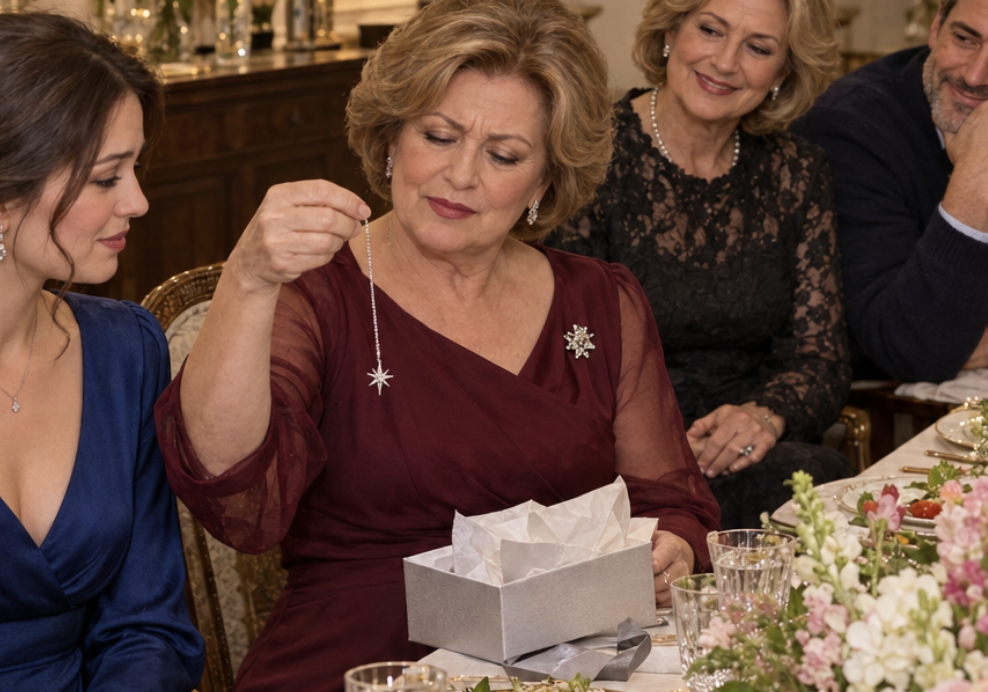
Then Mariyana handed over her little box. Valentyna Hryhorivna untied the ribbon, unwrapped the paper, opened the lid. She lifted the chain and the swallow spun in the chandelier light, its blue eye sparkling.
The table fell silent for a second.
“A swallow…” her mother drawled. “Mariyana, who wears this sort of thing these days? This is so old-fashioned—the kind of design we wore back when I was in trade school. Outdated. You could’ve just asked me—I’d have told you what I wanted.”
“But it is pretty,” Aunt Larysa quietly protested.
“Yes, yes, it is. I’ll put it in the cabinet.”
She closed the lid, set the box next to the napkins, and turned to the waiter:
“Young man, could you bring us some more wine, please?”
Maryana didn’t cry. She was surprised herself at how calm she suddenly felt. It was as though there had been a taut string humming inside her for ages, and now it just… went silent. It didn’t snap or break. It just stopped.
She got up, pretending she was leaving for just a moment, and grabbed her coat and umbrella from the cloakroom. The ponytailed waiter caught up with her near the door.
“You’re leaving already? The cake hasn’t even been brought out yet.”
“Go ahead without me. The candles—there’s a six and a zero—don’t mix them up.”
Outside, a drizzling October rain was falling, and chestnut leaves stuck to her shoes. Maryana walked across town for nearly an hour. Her phone only buzzed once—it was from Andriy: “Where are you? Mom’s asking. And you still need to pay extra for something.”
She turned off her phone.
* * *
Her mother arrived at nine in the morning. She rang the bell for a long time, not letting go—like only family members do.
“You embarrassed me!” her mother began right at the door. “In front of everyone! You just got up and left like a stranger. Larisa’s already called half the city about it. Do you even realize how I must’ve looked?”
“Mom, sit down.”
“I will not sit! I came here to tell you…”
“No. This time, let me speak. And please, listen until I’m finished.”
There must have been something in her voice, because Valentyna Hryhorivna fell silent. She didn’t sit down, but she stopped talking.
“In first grade, I brought home a twelve and you asked why I got a ten in writing. At the school competition, I came in second and you asked who was first. I baked you a honey cake, and you gave it to our neighbor. Did you think I didn’t notice the plate? I wanted to bake cakes, mom. I always wanted to. You said that baking was for people who didn’t get into college. I got into the place you chose. Graduated with honors. Landed a good job. And you talked to me about Zinchyshyna Tanya instead.”
“Don’t make things up…”
“I pay for your dentist. I paid for Andriy’s car—for the repairs, for the tires, for the gas. Yesterday I paid for the restaurant, for the saxophonist, for the cake, for the dress you wore. I spent three weeks looking for that swallow for you. Because you once told me a story about Smila. You probably don’t even remember. And Andriy brought napkins with the price tag still on, and you nearly cried with happiness.”
Valentyna Hryhorivna pressed her lips together.
“Are you actually counting how much you’ve spent on your own mother? You should be ashamed! It’s your duty. I raised you.”
“It’s not about the money, Mom. I just needed to hear that I did well. Just once.”
“I never praised you because I always knew you could do more. I didn’t want you to get lazy. But Andriy needed support—he’s sensitive, fragile. You’re strong. You didn’t need it.”
“I did need it,” Maryana said quietly. “Very much.”
Her mother turned to the window. Then she took a familiar cream-colored box out of her bag and set it on the table.
“I’ve never done anything bad to you. I’m a decent mother—others would be grateful. But take your swallow back. I don’t want gifts like that.”
The door slammed so hard that an umbrella fell from the hook in the hallway.
Maryana sat in the kitchen for a long time. The kettle boiled and switched off, then boiled again. She waited for that wave of guilt to hit her, like it always did when her mother got upset. But this time, the guilt didn’t come. Instead, there was silence—and in that silence, Maryana suddenly saw the truth: No matter how many diplomas she brought home, no matter how many restaurant bills she paid, her mother would never say the words Maryana longed to hear. Not because Maryana wasn’t trying hard enough, but because her mom simply didn’t know how. Or maybe she just didn’t want to. It didn’t matter anymore.
That same evening, she called Ulyana, her friend from university who had moved to Lviv three years ago.
“Ulya, did you say you have a room available?”
“It’s available. What happened?”
“Nothing. I just think I’ve finally grown up.”
* * *
Her manager signed her resignation in silence, only asking if Maryana was sure about her decision. She closed out her apartment rental in Cherkasy within two weeks, gave away some of her things, and packed the rest into two suitcases and a box of books. No one came to the station to see her off. Andriy messaged her: “Mom says you’ve lost your mind.” Maryana replied, “Maybe,” and for the first time in a long while, she laughed out loud, right there on the platform.
In Lviv, December brings a mix of snow and rain, the cobblestones shine, and at six in the morning, the old city center smells of coffee and fresh pastries. Maryana knew that scent by heart now, because every day by five she was already at the oven of a small bakery on Lychakivska Street. They hired her as an assistant, at a salary three times lower than at the audit firm. In the evenings, she took pastry classes, and at Ulyana’s place in Sykhiv, she would roll out layers of dough on the windowsill late into the night—living, for the first time in twenty-five years, without having to ask anyone for permission on how to live her life.
The bakery owner, Mrs. Stefania, a strict woman with a white braid under her headscarf, tasted everything that came out of the oven. One morning, Maryana brought her a honey cake made from her grandmother’s recipe, from that same old notebook covered in graph paper. Mrs. Stefania cut a slice, chewed for a long time, staring out the window.
“The cake layer is just right,” she finally said. “And you didn’t skimp on the cream. Let’s put it in the display.”
Maryana turned to the oven so no one would see her chin trembling. So little. Just one sentence. Turns out, it could mean more than a red diploma ever did.
Right before New Year’s, a message arrived from her mother—the first in two months. No greeting, no “how are you”: “Andriy caught a cold, he’s in bed. You could come help, since you have so much free time now.”
Maryana read the message, set her phone on the table, and stared at it for a long time. Once, she would have started looking for tickets. Now, she simply replied: “Let’s hope he gets well soon. I’m working until eight. Happy New Year, Mom.” Then she went back to taking new cakes out of the oven.
Under her apron, on a thin chain, swung a little golden swallow with a blue eye. Maybe the style really was outdated. But for Maryana, it suited her just fine.