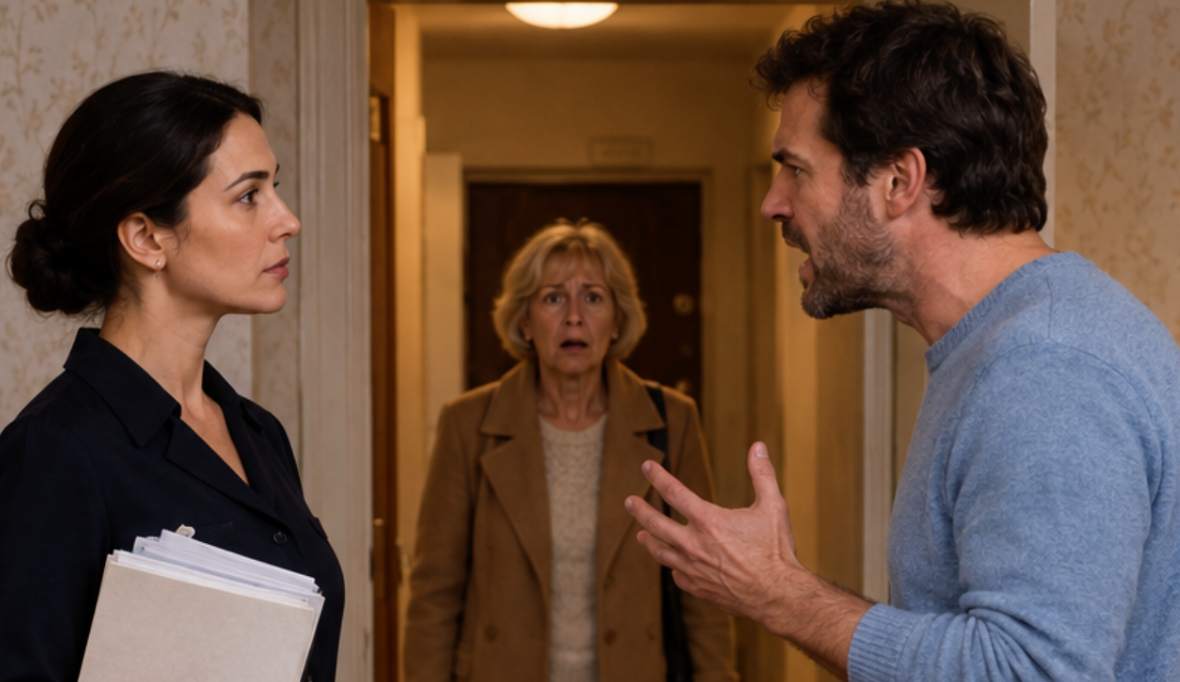
The words echoed in the hallway, right by the doorway, as deep blue November dusk settled outside. Vadim stood with his back pressed against the front door, hands buried deep in the pockets of his jacket, looking at Nadezhda with a patronizing confidence—the kind you reserve for someone cornered with no way out. He was absolutely sure he couldn’t miss his mark. Twenty-three years of marriage, a shared three-bedroom apartment in a quiet neighborhood, a grown daughter who had left for a job assignment in the north six months ago, and their comfortable routine—Vadim believed all this made Nadezhda defenseless.
“Repeat that,” Nadezhda said calmly.
She was holding her coat, just taken off after her shift at the pool reception, and didn’t make a single unnecessary movement. Her voice was steady.
“Why repeat?” Vadim smirked, savoring the moment. “You heard everything perfectly. My mother won’t be living alone in the village anymore. It’s too hard for her there. The house needs maintenance, there’s the garden, wood stove heating, snow in the yard. We have to bring her here. Into the big room. For good. If you don’t like it, go file for divorce. Go write your application tomorrow. I won’t stop you.”
He expected tears. Expected her to go quiet, to argue, to insist his mother had two other kids who never spent a day caring for her, to plead for another solution. But instead, Nadezhda met his eyes directly.
“Agreed,” she said.
Vadim was stunned. His smug smile froze on his round, clean-shaven face like a pasted-on mask.
“Agreed to what?”
“We’ll file for divorce. Tomorrow morning at nine, we meet at the district registry office. Don’t forget your passport.”
Nadezhda carefully hung her coat on a hanger, turned, and walked down the long corridor into the living room.
Vadim stayed standing by the front door. In the silence of the apartment, you could hear nothing but the steady, prickly rain tapping against the metal windowsill outside.
Nadezhda sat on the sofa and smoothed the folds of her wool skirt. There was no panic or confusion inside. Only a resonant, crystal-clear awareness: the abscess that had been festering for the last six months had finally burst.
It all started back in the spring, when her mother-in-law, Tamara Petrovna, first brought up moving in. She was already seventy-one, but any foreman would envy this woman’s energy. In her suburban village, she ruled the whole street with an iron fist, regularly called neighborhood meetings, scolded the local administration for bad street lights, and bossed around the electricians so thoroughly they didn’t dare step out of line. But as soon as Vadim appeared on the horizon, Tamara Petrovna would instantly transform: her voice would grow weak, her shoulders would droop, and her eyes would fill with the endless cosmic sorrow of an abandoned mother.
Vadim was her eldest son. The middle child was Marina, her daughter, and the youngest was Kostik, the 40-year-old family favorite who never stayed at one job for long, lived on odd jobs, and was always complaining about how unfair life was. Marina had married well, to the head of the local trucking company, moved to the regional center, and only called her mother twice a year—on New Year’s and her birthday. Kostik still lived with their mother in the village, didn’t pay for anything, rode around on their father’s old motorcycle, and insisted on having fresh meals served to him three times a day.
Then suddenly, Tamara Petrovna announced that she couldn’t stand living in the village any longer.
“I just don’t have the strength anymore, son,” she sighed into the phone every Saturday, knowing that Vadim had put her on speaker. “There’s no one to clear the snow. No one to chop firewood. Kosti isn’t up to it—he gets tired, he’s always looking for work, he doesn’t have time for all this heavy lifting. Take me to your place. You have so much room, a three-bedroom. I’ll just sit quietly in a corner, I won’t bother anyone.”
Nadezhda stayed silent at the time. The apartment they were living in once belonged to her parents. Her father, a dedicated worker, received the three-bedroom from the factory during Soviet times. Before privatization, Nadezhda’s parents made sure everything was done legally: half the apartment belonged to her, and when it came time to split and inherit, the other half was divided equally between Nadezhda and Vadim, since her husband had been registered there for many years. Vadim considered himself the rightful owner of every square meter.
“Try to understand, Nadya,” he repeated all summer. “This is my mother. We can’t just leave her there alone.”
“She’s not alone—Kostya, her grown and healthy son, lives with her,” Nadezhda replied. “Why can’t Kostya pick up a shovel and clear the paths? Why doesn’t Marina offer to move her mother into her two-story cottage?”
“Marina is a very busy person!” Vadim raised his voice. “And Kostik is just different—he’s not made for household chores! Only we can give my mother the care and peace she deserves!”
Nadezhda saw right through this family dynamic. After twenty-three years, she had every detail of her mother-in-law’s clan figured out. Tamara Petrovna’s entire life was based on a simple doctrine: the eldest son, Vadim, should provide and rescue, the youngest, Kostik, should enjoy life, and the daughter-in-law, Nadezhda, was supposed to keep it all running—quietly nodding along.
But behind Tamara Petrovna’s latest demand was more than just a whim. Nadezhda sensed it three weeks back, when she happened to overhear her husband talking on the balcony.
Usually, Vadim spoke to his mother in front of everyone, sighing dramatically and repeating, “Yes, of course, Mom.” But that evening, he locked himself out on the balcony, closed the sliding door tight, and spoke in a hushed voice, almost a whisper:
“Don’t rush things, Mom. I’ll take care of everything. First, we need to break her spirit. If she puts up a fight right away, we’ll have to go straight ahead. The main thing is for you to have already moved your stuff. Once you settle into the big room, there’ll be no turning back. And we’ll give away the village house immediately, just as we planned.”
Back then, Nadezhda didn’t open the balcony door or make a scene. She knew how to wait. Patience was a skill she’d mastered over years of dealing with hundreds of visitors at the pool—people always coming for certificates, passes, and always finding something to complain about. Nadezhda understood: the first person to start yelling always loses the game.
And now Vadim was just standing in the hallway, blinking in confusion.
“What do you mean, to the registry office?” he repeated, finally stepping forward and pulling off his heavy boots. “Are you even in your right mind? You’re ready to throw away twenty-three years just because my own mother is moving in with us?”
“I’m not the one throwing it away,” Nadezhda replied calmly, not even turning her head. “You were the one who gave the ultimatum: either your mother moves in permanently or we get divorced. I chose divorce. You’re a grown man, you’re forty-eight years old. Or are you just used to tossing out words like they’re empty shells?”
Vadim blushed. The skin above his sweater collar turned a deep, dark red.
“I thought you’d come to your senses! I tried to reach your conscience! You’re a cold, heartless woman, that’s what you are! My mother worked her whole life at the plant, raised three kids! And it’s too much for you to pour a bowl of soup for an elderly woman?”
“Pouring a bowl of soup isn’t hard, Vadim. What’s hard is living with people who treat you like a servant and act like you don’t matter. I endured your relatives for twenty-three years. When your sister Marina was renovating, her two kids lived with us for half a year. I did their laundry, ironed their clothes, picked them up from school, while you and your sister talked about how tough life is for young people these days. When your Kostik got into trouble over debts for his trailer, who paid out of our family savings? You. And I stayed silent. But moving your mother, who can’t stand me and openly says I’m not good enough for you, into the apartment where I grew up—that won’t happen.”
“It’s my apartment too!” Vadim snapped. “I legally own a share! I have every right to register my mother here!”
“Go ahead and try,” Nadezhda said quietly. “Without the consent of all adult owners, you can’t even register a hamster here. Open the law and read it. And if you decide to sell your share, you have to offer it to me first at the official price. So tomorrow at nine in the morning, I expect to see you at the registry office.”
Vadim angrily yanked down the zipper of his jacket, tossed it onto the cabinet, and went into the kitchen. He clattered around for a long time—banging cabinet doors, filling the kettle, dramatically dropping spoons. Nadezhda sat in her room, staring out the window. The rain was getting heavier. Murky streams slipped down the glass, blurring the glow of the streetlights.
At half past eight in the evening, Vadim’s phone rang in the kitchen. The ringtone was old and harsh—the kind he only used for calls from the village.
Nadezhda stood up, silently approached the slightly open kitchen door, and paused in the dim hallway.
“Yeah, Mom,” Vadim said in a muffled voice. “No, I haven’t talked to her properly yet. She’s being stubborn. Can you imagine, she said she’s fine with a divorce. She actually told me: we’re going to the registry office tomorrow.”
On the other end of the line, Nadya heard her mother-in-law’s high, rattling voice. The call was on speaker, and Nadya could make out every single word.
“What did I tell you?” Tamara Petrovna announced triumphantly. “She’s just trying to scare you, Vadim! Putting on a show! Where will she go at her age? Who wants her now that she’s nearly fifty? It’s just women’s tricks! Stand your ground! Tell her: if she wants a divorce, then go ahead. We’ll split the apartment in court and you’ll get half! She’ll be left with a tiny place on the outskirts, and we’ll see how she likes that! And tomorrow, we’re transferring the title of the house in the village to Kostya. The buyers agreed to an advance, Kostya will get the deposit, buy himself a decent car, and move to the city with his fiancée.”
Nadya felt a chill inside. Not from fear, no. From disgust.
The whole picture came together like pieces of a kaleidoscope. The house in the village wasn’t run down or abandoned at all. It was a sturdy brick home with four rooms and a large plot by a pine forest. Just last year, central gas had been connected to the village, and property prices had nearly doubled. City folks were eagerly buying up houses for summer cottages.
Tamara Petrovna and Kostik had simply decided to sell the village house, hand the money over to Kostya for his new life and a car, and dump Tamara Petrovna on Vadim and Nadya as a permanent responsibility! Vadim was in on this whole scheme, too. He knew they were selling the family nest just to benefit his freeloading little brother, while Nadya was expected to just accept it: living with her mother-in-law forever, taking care of her, cleaning, cooking porridge, while Kostik cruised around the city in his brand-new car.
“Mom, she’s serious about this,” Vadim said uncertainly. “You don’t really know Nadya. If she’s made up her mind, there’s no moving her.”
“Oh, stop it!” his mother waved off through the phone. “Tomorrow morning, just pretend you’re going through with it. We’ll see how nervous she gets when you’re actually at the door. Women are weak; they fear being alone more than anything! The main thing is to show her who’s boss in the house!”
Vadim sighed.
“Alright. We’ll sort it out in the morning.”
Nadya quietly stepped away from the kitchen door, went back to the bedroom, and lay down on her side of the bed over the bedspread. Her eyes were wide open. Any pity she’d felt for her husband was completely gone. In twenty-three years together, there had been good times and hard times, but to betray someone’s trust just to spoil the relatives and dump their problems on your wife as a ‘son’s duty’—that can’t be forgiven.
In the morning, the alarm rang at seven.
Nadya got up, washed her face with cool water, put on a dark, formal dress, and neatly packed her documents in her bag. Her passport, marriage certificate, and apartment papers had all been ready since the night before.
Vadim came out of the kitchen looking haggard. He’d barely slept, as shown by the dark circles under his eyes. He was hoping Nadya would be the first to start talking that morning, maybe offer a compromise. But Nadya silently zipped up her boots, threw on her coat, and reached for the door handle.
“Where are you going?” he asked hoarsely.
“To the registry office. It’s quarter to nine. Don’t be late.”
She stepped out onto the stairwell and gently closed the door behind her, not waiting for a response.
The morning air was damp and fresh. The rain had stopped, and wet, brown leaves rustled under her feet. Nadezhda walked down the street with a quick, confident stride. Inside, she felt a strange, long-forgotten lightness, as if a huge, dusty bundle she’d silently carried for more than twenty years had finally fallen from her shoulders.
She arrived at the steps of the government building exactly ten minutes before opening. Vadim was already there, shifting from foot to foot at the granite stairs, tucking his chin into his collar and glancing nervously around. When he saw Nadezhda, he straightened up, trying to recover the self-assured look he’d had the day before.
“So you came after all,” he muttered. “Changed your mind yet?”
“No,” Nadezhda replied. “The doors are opening. Let’s go.”
Inside it was warm, with the smell of official paperwork and freshly polished furniture. There were only two couples in the hallway—young people with shining eyes, clearly here to file for marriage, and an elderly man in glasses.
A middle-aged woman with a strict face and attentive eyes, sitting at the front desk, took their documents.
“Is it by mutual agreement? Do you have any underage children?”
“Our daughter is twenty-two and lives on her own,” Nadezhda said clearly. “It’s a mutual agreement. There are no disputes over the divorce.”
The woman shifted her gaze to Vadim:
“Do you confirm this?”
Vadim hesitated. He cast a quick glance at Nadezhda, as if expecting her to signal him, to stop the process or say she was joking. But Nadezhda simply stared straight ahead at the bulletin board with application samples.
“I confirm,” he squeezed out in a strained voice.
“Sign here and here. There’s a one-month period for reconciliation. Come back in a month for your divorce certificates. If you change your mind—come in and withdraw the application.”
When they walked out onto the steps, Vadim suddenly stopped and grabbed Nadezhda by the sleeve of her coat.
“So, what did you achieve? Satisfied your pride? Think I’m scared? A month from now I’ll get the papers and immediately file a lawsuit to split the property! We’ll sell the apartment and split the money! I’ll buy myself a one-bedroom and move my mother in, and you can sit in your ruins!”
Nadezhda pulled her arm free and looked at him with deep, almost disgusted sympathy.
“Vadim, do you really not understand anything? Or are you just pretending?”
“What don’t I understand?”
“You’re selling your father’s house in the village. The house your grandfather and father built with their own hands. Kostik is taking the money to buy himself a car so he can drive his girlfriends around. And you want to dump your own mother on me, in my late parents’ apartment, so I’ll mop the floors and endure her nagging for the rest of her days. And you still talk about your duty as a son?”
Vadim’s face fell. He stepped back half a step.
“How… how did you find out about the sale of the house?”
“The walls are thin in our apartment, Vadim. And your mother yells into the phone loud enough for the whole village to hear. You betrayed your father’s memory, betrayed me, and now you’re pretending to fight for justice. Go to your mother. Help Kostik count the down payment. And don’t worry about me.”
She turned and walked toward the bus stop without looking back.
The next three weeks felt like a silent standoff, a drawn-out siege.
Vadim made a show of it, acting cold and distant. He stopped talking to Nadezhda and openly bought his own food—a stick of smoked sausage, a loaf of bread, store-bought dumplings—then neatly stored everything on his own shelf in the fridge. Nadezhda paid absolutely no attention to his behavior. She simply went about her usual routines: working her shifts, handling documents at the pool, tidying up her things in the evenings, arranging her books and clothes.
Meanwhile, things in the village were moving quickly.
Nadezhda got a call from Aunt Klava, Tamara Petrovna’s neighbor, who had always stayed in touch since the wedding. Klava was a straightforward woman, toughened by village life, with no patience for nonsense.
“Hello, Nadya, dear,” Klava rattled off, lowering her voice. “Hang in there. Things are getting wild here! Tamarka has lost her mind. Some city folks came by yesterday, inspecting the house and measuring the land. Kostik was trailing after them like a puppy, grinning from ear to ear. They say a deposit has already been paid! Tamarka’s strutting down the street, nose in the air, boasting, ‘I’m moving to the city to live with my eldest son! I’ll have a palace, want for nothing, and Nadya will have to tiptoe around me—she’ll have no choice!'”
“Let her say what she wants, Aunt Klava,” Nadezhda replied calmly. “Paper will take anything, and tongues have no bones.”
“How can this be, Nadya? It’s your father’s house! Poor Peter, God rest his soul, built it with his own hands, log by log! How can they just hand everything over to Kostik? He’ll blow it all in six months!”
“It’s their family affair, Aunt Klava. They made their own decision.”
“Oh Nadyushka, I feel it in my bones—they’ll come crawling back to you, mark my words!”
A week after this conversation, Vadim came home—but this time, he wasn’t alone.
It was Saturday, around two in the afternoon. Nadezhda was dusting the bookshelf in the bedroom when the front door burst open with a bang. A noisy crowd spilled into the hallway, and her mother-in-law’s loud, commanding voice immediately filled every corner of the apartment.
“Bring it in, bring it over here! Put it by the wall! Careful—that’s the china wrapped in a blanket; break it and you’ll pay for it for the rest of your life! Vadik, open the other door, the trunk won’t fit!”
Nadezhda stepped into the hallway.
Near the front door stood three huge checkered bags, an old plywood suitcase tied with a laundry rope, and a massive wooden trunk, its corners reinforced with metal. Amid this chaos stood Tamara Petrovna, dressed up in a formal wool coat with a karakul collar and a knitted beret. Next to her, Kostik was puffing and panting in his open puffer jacket, his face red and shameless. Bringing up the rear was Vadim, holding a TV box.
Tamara Petrovna gave Nadezhda a triumphant look, like a general entering a conquered fortress.
“Well, hello there, daughter-in-law,” she announced loudly, making no attempt to take off her shoes. “Get ready for a guest! As you can see, I didn’t waste any time. Vadim said the room was available. Kostik helped bring my things on the trailer. Where’s your kettle? We all got soaked on the way here.”
Kostik smirked, tossed the heavy bundle right onto the light-colored entryway rug, and said:
“Hey, Nadya. Looks like it’s a housewarming for all of us.”
Vadim stood behind his mother, avoiding Nadya’s gaze, but his posture radiated tense triumph: finally, it’s done—let’s see you do something about it.
Nadezhda didn’t move. She leaned her hand against the bedroom doorway and sized up the whole trio.
“Take your things back out,” she said calmly and clearly.
A heavy silence filled the hallway. Only dark, melting snow dripped from Kostik’s wet boots onto the parquet.
Tamara Petrovna frowned, her cheeks trembling:
“What? Who do you think you’re talking to? I’m the mother of your legal husband! I came to live with my son! In his legal apartment!”
“This apartment isn’t just his, it’s ours,” Nadya replied just as evenly. “And I never gave permission for you to live here. In fact, in ten days, our divorce will be finalized. Mr. Vadim is free to go wherever he wants—move to the village, rent a place, whatever. But there will be no strangers living in this house. Take your bags and clear the landing.”
Kostik exchanged a nervous glance with his mother:
“Vadik, why are you staying quiet? Say something! We’ve already sold the house—the new owners are moving in tomorrow and changed the locks! Where is Mom supposed to go?”
Vadim stepped forward, dropping a box onto the floor.
“Nadezhda, stop this drama! You’re out of line! My mother is staying here! If you don’t like it, pack your rags and leave! I’m registered here, and I have the right to bring in whoever I want!”
“No, you don’t,” came a calm male voice from the stairwell.
A tall, fit man in a dark jacket stepped in through the slightly open door. It was Andrey Sergeevich, the head of the local housing cooperative and a longtime friend of Nadezhda’s late father. Behind him stood the local police officer—a young captain with a tablet under his arm.
Vadim immediately dropped his tone, his face stretching with surprise.
“Andrey Sergeevich? What are you doing here?”
“I’m here on official business, Vadim Petrovich,” the chairman said sternly as he entered the hallway and nodded to Nadezhda. “Nadezhda Pavlovna applied to the cooperative and the police yesterday with a formal complaint about an illegal move-in attempt without a co-owner’s consent. Captain, please confirm.”
The officer stepped forward, took a form out from his tablet, and looked closely at Tamara Petrovna and Kostik.
“Ladies and gentlemen, may I see your IDs, please? On what grounds are you staying in this apartment?”
Tamara Petrovna clutched her chest, her face going red:
“Are you all out of your minds? What protocol? I’m the mother! This is my son! He owns this place!”
“The owner here isn’t alone, ma’am,” the captain replied calmly. “According to the Rosreestr records, this property is jointly owned. In order for any third parties who aren’t the owners to move in, all co-owners must give written, notarized consent. There is no such consent. In fact, there’s a written objection from the second owner. So I must insist that you gather your things and leave the premises. Otherwise, I’ll have to draw up an administrative offense report for unlawful action.”
Kostik backed towards the exit, blinking in fear:
“Mom… Do you hear me, Mom? Let’s just get out of here, forget it… I’ve got the deposit in the car, I’ll rent you a hotel for a couple of days, we’ll figure things out…”
“What hotel?!” Tamara Petrovna shrieked, losing the last of her composure. “Where do you think you’re spending that money, you fool?! You need to pay it for the car! Vadik, do something! Are you a man or not?! Kick that stray girl out of the apartment!”
“Mom, please stop!” Vadim burst out, his face turning crimson down to his roots. He felt unbearable shame in front of the chairperson, the police officer, and the neighbors who were starting to peek out onto the landing because of the commotion. “Please, just stop!”
“Would you look at him!” the old woman ranted, jabbing her finger at Nadezhda. “She’s been playing innocent for twenty years, and all along she’s been growing her fangs! Curse you! May you rot alone within these four walls!”
“Ma’am, stop with the insults,” the officer raised his voice. “Out. Now. Grab your things. Young man, grab the bags and don’t block the stairs.”
Kostik, pale and terrified of dealing with the police, snatched up the checkered bags and dragged them out to the landing. Tamara Petrovna, breathing heavily and wailing loudly enough for the whole building to hear, shuffled after him, gripping the railing for support. Vadim seized a wooden trunk and struggled to drag it to the door, but at the threshold, he stopped and turned to face Nadezhda.
There was no remorse in his eyes. Only blind, powerless rage—rage of a man whose comfortable, easy life, built at someone else’s expense, had collapsed in seconds.
“You’ll regret this,” he hissed through clenched teeth. “I’ll sell my share to the first person I meet. I’ll sell it to gypsies! I’ll give it away for nothing, but I won’t let you live in peace here!”
Nadezhda looked at him calmly, without a trace of fear.
“No, you won’t, Vadim. If you want to sell your share, you’ll have to first send me a notarized notice with the real price. If you try to lowball it, I’ll buy it for next to nothing the very next day. Andrey Sergeevich has already helped me draft a preliminary agreement with the bank for a consumer loan. And if you try anything shady, like a fake donation, we’ll challenge it in court in a single session—with most of the building as witnesses to your threats. So pick up your box and close the door behind you.”
Vadim flinched, wanting to shout something back, but met the fierce, unblinking gaze of the co-op chairperson. Grinding his teeth so hard it could be heard, he grabbed the box, stormed onto the landing, and slammed the door behind him.
The lock clicked.
A deep and peaceful silence settled over the apartment—one that hadn’t been felt here in many months.
“Thank you, Andrey Sergeyevich,” Nadya said quietly, turning to her elderly neighbor. “And thank you too, Comrade Captain. I’m sorry for all that drama.”
“Don’t worry about it, Pavlovna,” the chairman waved his hand dismissively. “Everyone in the district remembers and respects your father. We won’t let these troublemakers bully you. You did the right thing. If anything happens, call me or the guys on duty right away. But honestly, I don’t think they’ll be back. They’ve been put in their place.”
Once the guests had left, Nadya fetched a bucket, poured in warm water, added some soap, and carefully scrubbed the hallway floor. She washed every strip methodically, polishing the wooden boards until they gleamed, erasing every muddy footprint left by strangers.
Ten days later, Nadya received her official divorce certificate at the registry office.
Vadim never showed up for his copy—he sent his application by mail, asking for the document to be forwarded to the local branch at his temporary registration address with his sister Marina. As tireless Aunt Klava later reported, Marina refused to let her mother live permanently in her cottage. Instead, she gave Tamara Petrovna a small, unheated outbuilding in the yard, saying she had her own family, a certain status, and no room for extra people in her house.
Kostik, after getting the deposit for the sale of his father’s house, did buy a used foreign car. But two weeks later, he lost control on a slippery road, crashed into a road sign, and totaled the car. There was no money left for repairs, the buyers of the house demanded penalties for the delay in moving out, and that set off a massive fight in the family over the scraps of money—full of mutual accusations and scandals that became the talk of the entire suburb.
Vadim tried to file a lawsuit over the property division, but after seeing attorney fees and learning Nadya was ready to officially buy out his share at fair market value through a bank loan, he quickly gave up. He had no choice but to sign a contract to sell his share to Nadya. With the money, he could only afford a modest room in a communal apartment on the edge of the industrial zone, where he shared the kitchen and bathroom with four other tenants.
In December, Nadya took a week off work.
She painted the walls of the living room a light, warm pistachio color, got rid of the old, heavy furniture that came from her mother-in-law’s hand-me-downs, and put a comfy armchair and a soft floor lamp by the window.
On a weekend evening, her daughter Olya arrived—she’d taken a fast train to spend three days supporting her mother. They sat together at a round dining table covered with a white linen tablecloth. Olya held her mother’s hand and studied her face intently.
“Mom, how are you? Really, tell me. Do you have any regrets?”
Nadezhda glanced over at the window. Outside, in the quiet frosty air, big fluffy snowflakes slowly twirled down onto the windowsill. The room was warm, filled with the scent of freshness, clean cotton, and peace. For the first time in many years, her home wasn’t burdened by the anxious wait for someone else’s malice, or the fear of saying the wrong thing, or the need to play along with another person’s greedy schemes.
“Not for a single second do I regret it, my dear,” Nadezhda replied.