Sergey Pryakhin spent ten years building his house. Ten whole years—from age twenty-seven to thirty-seven. Every vacation, every weekend, every evening after work was devoted to it. He started with the foundation, mixing concrete by hand in a trough until his hands bled. Then came the pine log walls, laid the old-fashioned way with moss. He covered the roof with metal tiles and installed plastic windows to keep the warmth in. Sergey even built the brick stove himself, complete with a sleeping platform and cooktop. In the parlor, a fireplace stood—his pride and joy.
The house turned out solid. Big, bright, perched on the high riverbank. From the terrace, Sergey enjoyed a view of the water and the forest on the far shore. He would go there in the evenings, sit on the bench, and look out. His heart would soar—because this was his house. His fortress. His nest.
Lena—his wife—didn’t appreciate the new house. Or she did, but in her own way. Once it was finished, she said:
“Sergey, maybe we should sell it? Move to the city? Why should we waste away here in the middle of nowhere?”
“Sell it?” Sergey was bewildered. “I spent ten years building it. Are you serious?”
“You built it—good for you,” Lena shrugged. “But why live here? There are no people, no fun, no decent shops. I want to move to the city. We’ll buy an apartment, get a good job.”
Sergey shook his head:
“Lena, this is our home. I built it for us. For you. For our family. It’s not for sale.”
Lena pursed her lips, but didn’t argue.
But a month later, the house was sold.
Sergey went away on a two-week job assignment—he worked as an equipment technician at the local timber mill, and they sent him to another region to set up a new line. When he came back, his house was gone. A new lock was on the door. A strange car sat in the yard. And on the terrace, where he loved to relax in the evenings, there sat a man he didn’t know, in shorts and a T-shirt, drinking beer.
At first, Sergey didn’t understand. He thought he had the wrong address—the village was tiny, the houses looked alike. But then he saw his stove’s chimney—the one he built himself. Then the fireplace—his design, his stonework.
“Who are you?” he asked the stranger.
“I’m the new owner,” the man replied lazily. “Bought the house a month ago. From the owner, Elena. And you are…?”
Sergey’s vision blurred. He rushed to the city—to the notary, to the registry office. Sure enough: the house was sold. The power of attorney had been signed a month before, while he was away on another business trip. Perhaps his wife forged his signature—or convinced him to sign something without looking, who knows now. The large sum of money had been wired to her account.
And Lena had disappeared. She didn’t answer her phone. Her parents, who lived in the capital, answered evasively: “She’s gone, didn’t say where. Don’t call again.”
Sergey was left with nothing. The house he’d spent ten years building was gone. His wife of fifteen years had betrayed him. There was zero money in their joint account.
He went back to the village—not to his house, that was already someone else’s—but to his neighbor, Grandpa Pyotr. The old man let him stay. Sergey sat in the kitchen, staring into space.
“Have a drink,” Grandpa Pyotr said, sliding a glass toward him.
“I don’t want to.”
“Go on, drink it. You’ll feel better.”
Sergey drank. It didn’t help.
“They took your house from you,” said Grandpa. “That’s not something you forgive. But you’re a man. You have to hold on.”
“Ten years I…” Sergey started, then fell silent.
“I know,” Grandpa Pyotr nodded. “I saw you building that house. I understand.”
Sergey didn’t cry. He’d forgotten how to cry entirely. Inside, there was just emptiness—so vast it felt like it could fill the sea. Deep in that emptiness, a slow-burning anger smoldered. Not at Lena, but at himself. For not seeing through things. For believing. For building a home for a woman who never wanted it.
He moved to another district and started working at a new lumber mill—luckily, his experience made that easy. He rented a small room from a lonely old lady. His life became quiet and withdrawn. He hardly spoke to anyone, least of all to women.
A year went by. Then another.
Gradually, Sergey began to heal. He managed to save up a little money—just enough. He bought an old house in a remote village, almost for nothing. He decided to start over.
His new house was smaller than the last, but just as sturdy. Again, he built it with his own hands. At first, the village folks thought he was crazy: “He’s building without a wife, but for who?” Sergey didn’t care. This time, he built for himself. It was the first time in his life he was doing something only for himself—and it felt good.
He lived in the unfinished house: one room was warm, while the wind still whistled through the others. Gradually, he laid brick by brick, log by log. He fixed up the ceiling by himself, hauling the timbers on his own shoulders. He built a workbench, shelves for tools. He raised chickens, got a goat, dug a pond. He fished, foraged for mushrooms, picked berries. He simply lived—just lived.
Sometimes in the evenings, sitting on the porch of his unfinished home, he’d remember his old life. Lena. The house on the high bank. The terrace where he’d look out over the water. And he was surprised: it didn’t hurt anymore. The pain was gone. It had died away.
Even the anger had faded. All that was left was a faint bitterness—somewhere deep inside. But he’d learned to live with it.
A third year passed. Sergey turned forty.
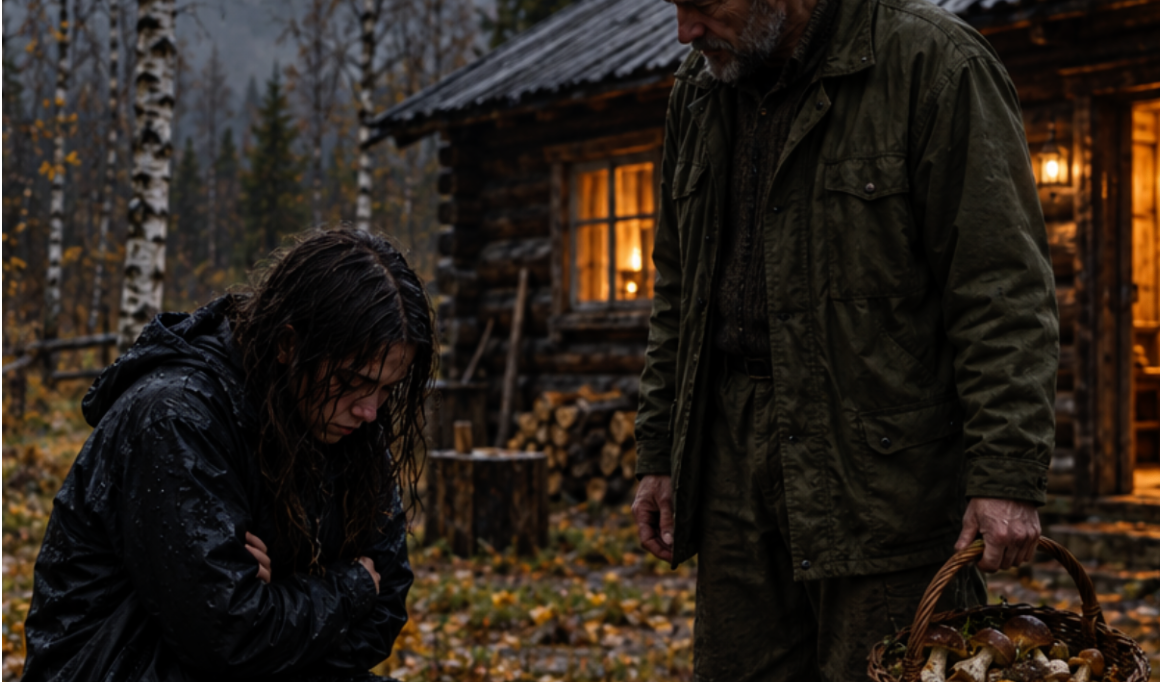
One September evening—as dusk fell and drizzle misted the air—he was coming back from the woods with a basket of honey mushrooms. As he approached the house, he saw someone sitting on the porch. A woman. She was huddled up, soaked, wearing only a thin jacket. When she heard his footsteps, she looked up.
It was Lena.
Sergey stopped in his tracks. The basket nearly slipped from his hands. He hadn’t seen her for almost three years—and hadn’t wanted to.
“Why did you come?” he asked, his voice flat.
“Sergey…” Her voice trembled. “Can I… warm up a bit? I’m freezing.”
He looked at her for a long time. Then, without a word, he set down the basket, opened the door, and let her inside.
The house was warm—the stove was burning. Lena sat on a bench by the stove and stretched her red hands toward the fire. Sergey poured tea, put bread, milk, and honey on the table.
“Eat,” he said shortly.
She ate hungrily, quickly. Clearly, she hadn’t eaten in a while. When she was warmed up and calmer, he asked again:
“Why did you come?”
And then she told her story.
A month after selling the house, she moved to the city to be with the very man she did all of this for. His name was Andrey—a businessman from a big city, good-looking, wealthy, driving an expensive car. He promised her the world. At first, everything seemed perfect: a rented apartment, fancy restaurants, lovely gifts. Lena felt like a real woman—beautiful, wanted. But gradually, Andrey started disappearing. First for a day, then for a week at a time. The money ran out, and it turned out the apartment wasn’t a real rental but simply borrowed from friends for a couple of months. In the end, he vanished for good. Lena was left alone in a strange city—with no money, no job, and nowhere to live.
She tried to go back to her parents—but they greeted her coldly: ‘You made this mess, now deal with it yourself.’ She sold whatever belongings she had left. Hopped from place to place, working as a cleaner. Then an old friend told her, ‘Listen, silly, go to your husband. Apologize. Maybe he’ll forgive you.’
And so here she is.
Sergey stayed silent. He stayed silent for a long time. The fire crackled and popped. Rain drummed against the roof. Lena cried—quietly, shakily. He looked at her and thought, ‘I loved this woman. I loved her for fifteen years. I built a home for her. And she sold it off like an old couch. Left me for another man.’
‘Lena,’ he finally said. ‘Do you understand what you’ve done?’
‘I understand,’ she whispered.
‘You sold the house. My house. The one I built with my own hands. You sold it behind my back and left for a man you were with while I was away on business trips. Do you have any idea what it’s like to spend three years with no home? No family? Nothing?’
‘I do… Sergey, I know I was wrong. Terribly wrong. But I have nowhere to go. Nowhere at all.’
Sergey stood up and walked over to the window. It was dark outside.
‘I’m building a new house now,’ he said. ‘It’s smaller, but it’s mine. I’m forty years old. I live alone. I’ve learned to be fine on my own over the past three years. And I don’t want to lose everything all over again because of you.’
Lena lowered her head. Her shoulders trembled.
‘I understand,’ she said. ‘I’ll leave. I’m sorry I came.’
He didn’t turn around. But he heard her get up, walk to the door, and place her hand on the handle.
And then he said:
‘Wait.’
She froze in place.
‘I can’t let you go out in the rain,’ Sergey said, still staring out at the darkness beyond the window. ‘Stay until morning. We’ll figure things out then.’
In the morning, he went into the forest to check his traps. He came back around noon. Lena was sitting on the porch peeling potatoes.
‘What’s that?’ he asked gruffly.
‘Lunch. You do eat potatoes, right?’
He ate the potatoes. And he ate the soup, too. And the patties. She had made a three-course lunch from the humble supplies she found in his cellar.
For three days, he didn’t say a word. She stayed silent too—cooking, cleaning, tending the chickens. On the fourth day, he sat across from her at the table and said:
‘Let’s talk.’
She looked up at him. Her eyes weren’t the same as three years ago. Back then, they were cold, calculating. Now, they were tired and regretful. She looked thinner, her face worn. But something deeper had shifted—gone was that easy way she used to destroy his life. Now, there was something else. Something that looked a lot like understanding.
‘I don’t trust you,’ Sergey said. ‘You betrayed me once. You could do it again. Why should I believe you?’
“There’s nothing more to say,” she replied. “You’re right. I have nothing left. All I can say is this: I finally understand. It’s too late—but I get it now. You were the only person who ever truly loved me. And I never appreciated that. I thought money, the city, the good life… those were what mattered. But in the end, it was all meaningless.”
“I built this house for you,” he said. “I hammered in every nail with my own hands. I thought we’d grow old here together. Maybe have kids, if God gave us any. Watch our grandkids play one day. And you…”
“I know. I know everything.”
He fell silent. She began to cry—quietly, without a sound. Tears ran down her cheeks, and she didn’t wipe them away. Something about that sight made Sergey’s heart suddenly ache.
“Stay for now,” he said. “We’ll see.”
She stayed. First for a month, then for two, then half a year.
Sergey didn’t rush things. He watched. He paid attention to how she managed the house—wondering if she was just putting on an act. He noticed how she treated his things, his tools, his home. He watched for any signs that she wanted to return to city life.
But she didn’t crave city life anymore. She changed. Became quieter, calmer, less talkative. She stopped talking about the city, or about fancy living, or complaining that “it’s boring here.” She simply lived. Cooked, cleaned, spent time in the garden, went mushroom hunting. It was as if something had burned out inside her—and now, in place of that fire, there was a gentle, steady light.
At first, the neighbors whispered: “Look, she’s back. She sold their house—and now comes back like nothing happened. And he, the fool, took her in.” But Sergey paid them no mind. He’d long since stopped caring about what people said.
One evening, as they sat on the porch, he asked:
“Lena, do you really understand now? Or are you just pretending?”
She was silent for a long time. Then she said:
“You know, Sergey, when Andrey left me, at first I seriously thought about ending it all. I stood on a bridge, looking down at the water. But then I thought: ‘No. I can’t do that. I have to come back.’ Not because I had nowhere else to go. But because I have to give everything back to you. Not with money—I could never do that. But with my life. Through my work. My care.”
He sat in silence.
“Did you love him?”
“Andrey?” she gave a bitter little laugh. “No. I loved the image—the fancy car, the restaurants, the money he splurged. I thought that was life. Turns out it was a soap bubble. It burst—and there was nothing.”
“And me?” he asked softly.
She turned to him. In the dusk, her face looked so young—just like it had fifteen years ago when they first got married.
“You—yes. I always loved you. Even when I was selling the house, I convinced myself I loved money. But truly, it was you. I just realized it too late.”
He didn’t answer. But that night he couldn’t sleep. He tossed and turned, deep in thought. The next morning he got up and went to the workshop. He spent the whole day carving and sawing. That evening, he brought Lena a hand-carved wooden box and set it down in front of her.
“Here,” he said.
“What’s this?” she asked, surprised.
“Open it.”
She opened it. Inside, on a velvet cloth, lay two keys. To a new house.
“These are for you,” he said. “I can’t promise everything will be the same as before. I can’t promise I’ll be able to fully forgive. But—I’m going to try.”
She picked up the jewelry box and hugged it tightly to her chest. Suddenly, she burst into tears, sobbing like a child. Sergey stood there, just watching her. Deep inside, in a place that had felt empty and dark for three years, he felt something stir. Maybe it was hope. Maybe love was coming back to life. Who can say what to call it.
Another year passed.
Sergey finished building the house. This time, it was made for two. Lena was there to help: plastering the walls, painting the window frames, making the place feel like home. She was so handy with her work—it surprised him. Or maybe he’d always known, but just forgot.
At their housewarming, the neighbors came by—the very same ones who had shaken their heads in disbelief a year ago. Now, they sat at the table, sipped tea, and said, “Well, Sergey, you’re a real man. Anyone else would have kicked her out, but you forgave.”
Sergey listened quietly. He didn’t think of himself as a hero. He had just followed his heart. Not because he was weak, but because he was strong. It takes more strength to forgive than to push someone away. That’s what he had learned over the years.
Lena sat beside him—calm, quiet. She looked at him with such gratitude that sometimes it made him feel embarrassed. He just wasn’t used to being looked at like that.
“Sergey,” she asked one evening, “do you regret it?”
“Regret what?”
“Everything. That you forgave me. That you took me back.”
He thought for a moment.
“No,” he said. “I don’t regret it. You know, there’s a saying: ‘If someone betrays you, that’s on them. If you refuse to forgive, that’s on you.’ For a long time, I couldn’t let go. But when I did—it surprised me. I felt lighter inside.”
She took his hand. It was warm, alive.
“I won’t let you down again,” she promised. “I swear to you.”
“I believe you,” he replied. And it was true.
In autumn, they went to the empty lot where the first house—sold to Andrey—used to be. The new owner had never moved in; rumor had it he failed in some business venture and left for the south. The house was abandoned: the fence had fallen, the yard was choked with weeds taller than a person, the windows were boarded up with plywood.
Sergey and Lena stood at the crooked old gate and looked at it.
“There it is,” Sergey said. “My first house. I spent ten years building it.”
“I’m sorry,” Lena whispered. “Forgive me, Sergey. If only I could turn things back…”
“Don’t,” he interrupted. “Don’t try to go back. That house was built on sand. It was big, beautiful—but it was still on sand. Now we have a different one. Smaller. But real.”
He fell silent for a moment, then added:
“You know, I sometimes think: if it weren’t for that whole story, I never would’ve truly gotten to know you. The woman who sold the house—I didn’t know her. But the woman who came back—I do. And they’re two different people.”
Lena didn’t say anything. She simply held on to his arm. So there they stood, on the edge of the village—two people no longer young, who had survived betrayal, separation, and the difficult, painful act of forgiveness. Over the abandoned house, crows circled. Grasshoppers chirped in the tall weeds. Cool air drifted from the river, carrying the scent of algae.
“Let’s go home,” Lena said.
“Let’s go,” he agreed.
And off they walked down the dusty road—toward the other end of the village, where their new house waited for them. It was small, but warm. Built from scratch. Just like their life together.
The keys to their new home hung on a nail in the hallway. Two keys on one ring—one was Sergey’s, the other Lena’s. Every evening, after work, Sergey would take his key and unlock the door. Every evening, Lena would greet him at the threshold—calm, homely, with evening tea and a warm dinner.
And Sergey would think: “God, we humans are so complicated. We can destroy—and we can build. We can betray—and we can forgive. And how grateful I am that I didn’t kick her out back then. How glad I am that I gave her a second chance. And gave myself one, too.”
He watched Lena bustling around the stove, the warm glow of the lamp above the kitchen table, the swallows’ nests flickering past the window. And he realized: this is life. Not the one we plan. But the one that happens to us. Sometimes it’s scary, sometimes it hurts. But if you endure, if you don’t break, if you find the strength to forgive—there will always be light at the end.
Always.