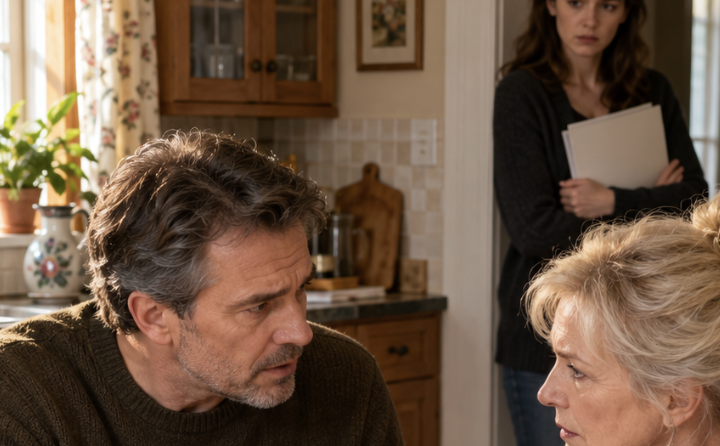
Sveta, you understand that Mom has a hard time living on her own. So we’ll sell your country house, and that’s it—the problem is solved.”
Andrei stood by the kitchen window with a cup of tea and said it so calmly, as though he were suggesting they take out the trash. Not, “Let’s discuss it,” not, “What do you think?” but immediately, “We’ll sell it.” A plural pronoun hiding a singular decision. His.
Svetlana was washing the last plate. The water was hot, her hands had turned red, and she stared at them as though they belonged to someone else. The plate slipped from her fingers but didn’t break—it landed neatly in the drying rack, just as a proper thing should in a proper home.
“We’ll sell it,” she repeated without turning around. “And where exactly are we putting the comma? Before ‘Mom’ or after?”
Andrei frowned. He didn’t like it when she spoke like that—with sarcasm, in that teacherly tone of hers. Twenty-two years of teaching had taught her one thing: whenever someone began a sentence with, “You understand, don’t you?” it usually meant they had no intention of letting you understand anything at all.
And, of course, it had all started with his mother.
Tamara Nikolaevna was an imposing woman—in both size and personality. She had spent her entire working life as a deputy principal at a technical college and had become accustomed to treating her word not as an opinion, but as an instruction. After retiring, she discovered she no longer had anyone to command, so she unleashed all her administrative talent on her only son.
Svetlana had tolerated her mother-in-law for twelve years. From the very day she entered their family, she had learned the rules of the game: Tamara Nikolaevna was always right, Andrei always agreed with his mother, and Svetlana was always expected to “be understanding.” Understanding of whom, exactly, was never specified.
The country house had come to Svetlana from her grandmother. It wasn’t luxurious—six hundred square meters of land in a gardening cooperative outside the city, with a two-story little house her grandfather had built with his own hands back in Soviet times. Apple trees forty years old. Currant bushes along the fence. An old gazebo where her grandmother used to clean berries in summer and tell her granddaughter about the war, about hunger, and about how important it was to have a place of your own where no one could come and tell you, “Get out.”
Her grandmother had left the property to Svetlana in her will. Everything had been arranged properly through a notary six months before she passed away.
“This is yours, Sveta,” she had said. “Yours alone. Don’t give it to your husband, and especially not to your mother-in-law. Let there always be somewhere you are the mistress.”
At the time, Svetlana hadn’t understood those words.
Now she understood them all too well.
The conversations about selling the country house had begun in spring. First came the hints. During family dinners, Tamara Nikolaevna would sigh about how difficult it was to live in her apartment—the second floor, no elevator, aching knees. Then she would dream aloud about how wonderful it would be to move closer to her son, into a building with an elevator. Then came the observation that it would only require “a little money.”
Svetlana listened to these performances for about two months and said nothing. She had long ago noticed that if you stayed silent long enough, people eventually said aloud what they had been afraid to say directly.
And now they had finally reached it.
“We’ll sell your country house.”
“Sveta, why are you just standing there?” Andrei put his cup into the sink, directly on top of the freshly washed dishes. “I’m serious. Mom needs a better apartment, and your country house just sits there unused. You go there twice all summer.”
“Three times,” Svetlana said, drying her hands on a towel. “And it isn’t sitting unused, Andrei. It’s resting. There’s a difference.”
“Don’t nitpick over words.”
“I’m a Russian-language teacher. Nitpicking over words is my profession and my retirement plan.”
Andrei rolled his eyes. He had picked up that gesture from his mother. Tamara Nikolaevna reacted exactly the same way to anything that didn’t fit her plans.
“Sveta, stop acting like a child. We’re a family. Everything in a family is shared. Mom is struggling, so we help her. That’s normal.”
“Shared,” Svetlana repeated, hanging the towel neatly on its hook. “You know, Andrei, that word ‘shared’ seems to work rather selectively in our family. Your car loan is shared—we pay that out of my salary. Our utility bills are shared—I pay those too. But somehow your bonus isn’t shared. And now my country house suddenly becomes shared at precisely the moment you want to sell it.”
Andrei’s face turned red. He always flushed when the truth came too close.
“Are you throwing money in my face now?”
“I’m explaining grammar to you,” Svetlana replied calmly. “The word ‘shared’ seems to have two meanings. The first is something that belongs to everyone. The second is something one person wants to take from another while giving it a pretty name. I think we’re using the second definition.”
The conversation died there. Andrei went into the other room and turned up the television—his favorite way of putting a period at the end of an argument.
Svetlana remained alone in the kitchen.
She sat at the table and poured herself some cold tea. It was getting dark outside. Lights came on in the building across the way—ordinary people living ordinary lives, probably trying to prove things to each other too.
Svetlana suddenly realized that during twelve years of marriage she had forgotten how to be the mistress of her own life.
Always the same phrases:
“Try to understand.”
“Give in.”
“You’re smarter than that.”
Smarter.
That was the word they used every time they wanted her to surrender.
“You’re smarter than that, Sveta. Just give in to Mom.”
“You’re smarter than that. Why argue?”
As though intelligence meant having a lifelong obligation to lose.
A week later, Tamara Nikolaevna arrived at their apartment in person, carrying a cake and a plan.
She swept into the hallway, dropped her coat into Svetlana’s arms with the practiced motion of someone handing clothes to a cloakroom attendant, and walked into the kitchen, where the table had already been set.
Andrei fussed around his mother, pulling out her chair and pouring tea.
Svetlana watched the performance from the side, like a theatergoer who had accidentally bought a ticket to the wrong play.
“Well then, children,” Tamara Nikolaevna began, cutting herself a slice of cake, “I’ve been thinking about our matter.”
Our matter.
Svetlana mentally wrote the phrase into an imaginary notebook.
“So here’s what we’ll do. We’ll sell the country house. I’ve already found an apartment—a two-bedroom in a new building, with an elevator, everything as it should be. It isn’t expensive. If we add the money from the country house, it will be just enough. Sveta, you don’t mind, do you? That wreck is only a burden for you anyway.”
Svetlana slowly stirred her tea. The quiet clinking of the spoon against the porcelain was the only sound at the table.
“Tamara Nikolaevna,” she finally said, “are you aware that the country house is registered solely in my name? I inherited it from my grandmother. It had nothing to do with Andrei before our marriage, and it still has nothing to do with him.”
For a second, her mother-in-law faltered, but quickly regrouped. Decades as a deputy principal had trained her well.
“So what? You’re husband and wife. Everything is shared in a family.”
That word again.
Svetlana even smiled.
“You see? You’re doing it too. Andrei said exactly the same thing today. It must be a family proverb. But you know what’s interesting? Legally, property received through inheritance is personal property. It isn’t divided and doesn’t become jointly owned. Article 36 of the Family Code. I checked.”
Tamara Nikolaevna put down her fork. Her eyes sharpened.
“So now you’re trying to frighten me with laws? I spent thirty years as a deputy principal. I know all about your articles…”
“Then you must know perfectly well that you can’t sell someone else’s property,” Svetlana interrupted gently. “Even if you’re relatives. Even if you really, really want to.”
Andrei shifted uncomfortably in his chair.
“Sveta, why are you talking to Mom like that? We’re trying to do this nicely.”
“Nicely?” Svetlana turned toward her husband. “What does that mean? Nicely is when I’m informed that my country house has already been sold in someone else’s imagination, an apartment has already been chosen, the money has been calculated, and I’m asked only at the very end, just for appearances?”
“You’re not being asked at the end!” Andrei snapped. “We’re discussing it with you!”
“Andrei, a discussion is when there are options. I have exactly one option: agree. That isn’t a discussion. It’s an ultimatum served with cake.”
Tamara Nikolaevna pursed her lips. She wasn’t accustomed to being contradicted—especially not calmly, without shouting, and with those irritating arguments.
“I see you’ve completely spoiled your wife, Andryusha,” she hissed. “In our time, wives listened to their husbands. But this one… far too educated for her own good.”
“Mom, come on…”
“Don’t ‘Mom, come on’ me!” Tamara Nikolaevna raised her voice. “I want what’s best for my son, and she sits here quoting laws at me! Svetlana, I’ll tell you plainly: if you refuse to help the family, what kind of relative are you to us? Blood is thicker than water. Andrei would do anything for you, and you’re stingy over some little country house!”
Svetlana rose from the table.
Calmly. Without sudden movements.
“Tamara Nikolaevna, I’ve been part of this family for twelve years. For twelve years I have ‘been understanding.’ I gave in. I stayed quiet. I paid loans, utilities, groceries. I drove you to doctors when Andrei was ‘busy.’ I sat with you when you were sick. And not once—not once—did anyone ask how I was doing. What I needed. What I felt. And now, when we’re talking about the only thing I have left from my grandmother, you tell me, ‘What kind of relative are you to us?’ So now I’m suddenly not family.”
Silence settled over the kitchen.
Even the refrigerator seemed to grow quiet.
“If you won’t do this the easy way,” her mother-in-law said softly, “we’ll do it the hard way. Andrei, pack your things. You’re coming home with me. Let her sit here alone and think. Maybe she’ll come to her senses.”
There it was again.
Come to her senses.
As though intelligence could be measured by one’s willingness to give away what belonged to them.
Andrei looked helplessly between his wife and his mother. He looked at Svetlana—standing straight and calm. Then he looked at his mother—staring at him with a demanding expression.
And he chose.
Without a word, he went into the bedroom to pack a bag.
Svetlana watched him walk away and understood: this was it. The moment of truth. The moment her grandmother had predicted.
Let there be somewhere you are the mistress.
Not only the country house.
Her whole life.
Half an hour later, they left.
The door slammed.
Svetlana remained alone in the quiet apartment and suddenly felt not pain, but something else.
Relief.
As though someone had removed a backpack from her shoulders that she had carried for so long she had forgotten how heavy it was.
She thought that would be the end of it.
But the story was only beginning.
The next several days turned into a siege.
Tamara Nikolaevna deployed every weapon she had.
First came Andrei’s phone calls—apologetic and pleading.
“Sveta, you’re smart. Let’s discuss everything.”
Then the relatives started calling. Andrei’s sister phoned—someone Svetlana barely saw once a year.
“Sveta, how can you do this? You have to help an elderly mother. What do you need that country house for?”
Then her mother-in-law’s neighbor, some Aunt Lyuba who had absolutely nothing to do with the matter, decided it was her duty to call and inform Svetlana that “respectable families don’t behave this way.”
Svetlana listened politely to everyone.
She didn’t shout at anyone.
She simply asked the same question every time:
“Why does no one suggest selling Tamara Nikolaevna’s apartment and using that money to move her into a two-bedroom apartment with an elevator? Wouldn’t that be easier?”
The answer was either a disconnected call or indignant huffing.
No one wanted to touch her mother-in-law’s property.
Her apartment was sacred.
Only someone else’s country house was available for sacrifice.
Then Svetlana accidentally learned the truth.
She stopped by to see an old acquaintance named Irina, with whom she had once worked. Over tea, they began talking, and Irina hesitated before saying:
“Sveta, don’t be upset with me. But yesterday I saw your mother-in-law at a real estate agency. The one near the market. She was sitting with some man, looking at documents. I was just passing by and overheard bits and pieces. They were talking about the country house. Something about ‘registering it in the son’s name first, then selling it quickly.’”
Svetlana carefully set her cup on the saucer.
“In the son’s name,” she repeated. “So they want me to transfer the country house to Andrei first, and then sell it.”
“Yes. That’s how I understood it. Your mother-in-law also said something like, ‘His wife is stubborn, but we’ll do it through a gift agreement. She won’t even notice.’ Sveta, forgive me for interfering, but I thought you should know.”
Svetlana thanked her friend.
She left the café, sat in her car, and spent about five minutes simply staring through the windshield.
She didn’t cry.
She didn’t boil with anger.
Inside, everything felt cold and clear, like a winter morning.
So that was their plan.
While she politely fought off phone calls, they were already planning everything behind her back.
Transfer it using a gift agreement.
So that she “wouldn’t notice.”
As though she were furniture that could be moved while the owner was sleeping.
What hurt most wasn’t what her mother-in-law had planned.
Tamara Nikolaevna was consistent. She had spent her whole life treating other people’s property as though it belonged to her.
What hurt was that Andrei was participating.
Her husband.
The man she had lived with for twelve years. The man who had made vows to her. The man who ate the dinners she cooked every evening.
He was prepared to deceive her into transferring her inheritance into his name and then sell it.
Quietly.
Behind her back.
Trust is a strange thing.
It doesn’t collapse gradually.
It disappears instantly.
One moment it exists.
The next it doesn’t.
Like someone switching off the light.
Svetlana started the car and drove home.
On the way, she stopped at one place—a notary she knew from dealing with her grandmother’s estate.
She asked several questions.
She received several answers.
She nodded.
And only then did she truly calm down.
She returned home and waited.
She knew the final act would come soon.
She was right.
Andrei arrived on Saturday.
Alone, without his mother, but carrying a folder of documents under his arm.
He looked determined—the way a person looks after receiving thorough instructions.
“Sveta, hi. We need to talk.”
“Come in,” she said, nodding toward the kitchen. “Tea?”
“Sure.”
He sat down at the table and placed the folder in front of him.
Svetlana put on the kettle and took out two cups.
Everything looked the same as always.
Except nothing was the same anymore.
“Sveta, I’ve been thinking,” Andrei began, stroking the folder almost as if it were a cat. “I was wrong to leave. I lost my temper. Mom is upset too. Let’s make peace. I want everything to be good between us.”
“So do I,” Svetlana said while pouring the tea.
Andrei visibly relaxed.
“Great. Listen, I brought some documents. Just so everything is fair and proper. Let’s transfer the country house into my name—just for convenience, so Mom stops worrying. She thinks you don’t consider us family. We’ll transfer it, and that will settle everything. Everyone will calm down. It’s purely a formality.”
He opened the folder.
Inside was a prepared gift agreement.
Everything had already been filled in.
All that remained was her signature.
Svetlana picked up the document.
She read it carefully from beginning to end.
A gift agreement.
From her—to Andrei.
The country house.
Free of charge.
“A formality,” she repeated thoughtfully. “So I give you my country house, and in return ‘everyone calms down.’ Interesting formality.”
“Come on, Sveta. It’s only so Mom will stop worrying! No one is going to sell it!”
Svetlana looked directly into her husband’s eyes.
“Andrei, tell me something. Why did your mother go to the real estate agency near the market last week? Why was she sitting there with a realtor discussing how to sell the country house quickly after it was first transferred to you as a gift? So that I ‘wouldn’t notice.’”
Andrei froze.
The cup stopped halfway to his mouth.
Color slowly climbed from his neck to his ears.
“Who… who told you?”
“Acoustics,” Svetlana said with a slight smile, remembering one of her grandmother’s favorite expressions. “It’s a small city, Andrei. People walk around. They see things. They hear things. And they talk. So let’s forget the ‘formalities.’ You came here to transfer my country house into your name so you and your mother could sell it. Have I understood your plan correctly?”
Andrei put down the cup.
His face shifted from confusion to irritation.
“So what?!” he suddenly raised his voice, apparently deciding that since the truth had come out, pressure was the only strategy left. “Yes, we wanted you to transfer it! Because you don’t understand when people try to talk nicely to you! We tell you about my mother and all you talk about are laws and articles! What do you even need that country house for? It’s an old shack! Mom is suffering! I’m your husband, for God’s sake, and I have the right…”
“What exactly do you have the right to, Andrei?” Svetlana asked quietly.
He stopped.
“To… well… we’re a family…”
“Family again.” Svetlana shook her head. “You know, I’ve spent a long time thinking about what family actually means. And here’s what I’ve concluded. Family is when people protect one another. Not when one person secretly transfers the other person’s property into his own name so he can sell it. What you and your mother planned isn’t called ‘family.’ It has other names, but I won’t say them. I’m still a teacher. My vocabulary is extensive, but even it has limits.”
She stood, walked to the cabinet, and took out her own folder.
She placed it on the table beside his.
“I prepared too. Look.”
She laid out the first sheet.
“This is an extract from the Unified State Register of Real Estate. The country house is registered in my name. I am the sole owner. The basis of ownership is inheritance through a will. Personal property. You have no rights to it. None whatsoever.”
She placed down a second sheet.
“This is information from the notary. Yesterday I confirmed that a gift agreement signed under pressure or deception can be challenged in court. And if you tried to sell the country house after having it transferred to you, while I stated that the transfer had been fraudulent… Do you know what kind of trouble that could lead to? I won’t frighten you, but the relevant legal provisions are serious. And they’re not from the Family Code.”
Then came the third sheet.
“And this, Andrei, is the most interesting one. This is an application for divorce. I’ve already filled it out. All I need to do is submit it. We don’t have children, and there’s almost nothing to divide because the only thing we truly own together is your car loan. You and your mother can divide that between yourselves if you like. But the country house—my grandmother’s property, the place where I grew up—is mine. And it will remain mine.”
Andrei stared at the three sheets of paper, and Svetlana could almost see the gears turning in his head—a rare sight.
The plan had collapsed.
That wonderfully reliable plan: pressure her, make her feel guilty, quietly transfer the property.
It crumbled like old plaster from the gazebo.
“Sveta, wait,” he said, his tone instantly changing from arrogant to pleading. The transformation took less than a second. “I lost my temper. Let’s forget all of this. I’ll tell Mom it won’t work. She can deal with her apartment herself. I love you. You know that.”
“Andrei,” Svetlana said as she collected her papers back into the folder, “you don’t love me. You love a comfortable life where someone pays the bills, cooks dinner, and doesn’t ask unnecessary questions. For twelve years, I was that someone. I’m tired of it.”
“But I’ll change!”
“People don’t change because they’ve been caught. They change because they themselves want to. You don’t want to change. You’re simply frightened because your plan failed.”
She stood and opened the kitchen drawer.
She took out his spare apartment keys and placed them beside the gift agreement.
“Take your documents and your keys. I’m changing the locks today. Go live with your mother—you two will be comfortable together. You can ‘be understanding’ of her, and she can ‘be understanding’ of you. A perfect family. Everything shared.”
Andrei kept talking—saying she would regret it, that she would never manage on her own, that no one would want a woman like her at her age.
Svetlana barely listened.
The words slid past her like raindrops down glass.
She was already somewhere else.
He collected his folder, grabbed the keys that were about to become useless, and left.
The door slammed.
And once again, there was that same silence.
Clean.
Ringing.
Liberating.
That evening, Svetlana called a locksmith.
He changed the lock cylinder in twenty minutes.
“Good lock,” he said while packing his tools. “How many turns are you going to lock it?”
“All of them,” Svetlana replied. “Every single one.”
And on Sunday, she drove to the country house.
It was a warm September day.
The apple trees bent under the weight of the harvest—large red apples from her grandmother’s old variety.
The currants were already finished for the season, but their leaves remained green.
The gazebo leaned slightly to one side, its wooden boards dried and cracked, but it still stood.
Strong.
Hers.
Svetlana sat on the old bench where her grandmother had once cleaned berries.
She took out a thermos of tea and poured some into the lid.
Everything around her was quiet—only birds and the wind rustling through the apple branches.
She thought of her grandmother.
Of her words:
“Let there always be somewhere you are the mistress.”
Years ago, Svetlana had thought those words were simply about property.
Now she understood.
Her grandmother hadn’t been talking about the country house.
She had been talking about life.
About the fact that a person must have something of their own.
Not shared.
Not divided.
Not surrendered under pressure.
Something truly theirs.
A place where no one can come and say:
“Get out.”
She took a sip of tea.
For the first time in many years, she didn’t need to hurry anywhere, adjust herself to anyone, or “be understanding” of someone else’s situation.
She was alone.
But it wasn’t loneliness.
It was freedom.
Boundaries.
A strange thing.
All her life she had been taught that protecting what was hers was selfish.
That a good woman gave everything away.
But it turned out that personal boundaries weren’t walls built against other people.
They were the foundation on which a person stood.
Remove the foundation—and everything collapses.
Svetlana finished her tea and screwed the lid back onto the thermos.
She walked around the property, touched the trunk of an apple tree—rough and warm from the sun.
She picked an apple and took a bite.
Sweet, with a hint of tartness.
The taste of childhood.
She regretted nothing.
Twelve years were gone—so be it.
What mattered most remained:
her home,
her country house,
her name on the documents,
and her right to say no.
A right she had been afraid to use for far too long.
The sun was sinking toward the horizon, turning the apple trees golden.
Svetlana locked the gate and got into her car.
On the drive home, she turned on the music she liked—not the music that “didn’t annoy her husband.”
She drove and smiled.
Sometimes, in order to find yourself, you first have to lose what had been weighing you down.
And then you realize you didn’t really lose anything at all.
You found yourself.
And what do you think? Was Svetlana right not to try to save the marriage and pretend nothing had happened? Or should she have given her husband a second chance, considering they had spent twelve years together?
Write in the comments. It would be interesting to know what you would have done in her place