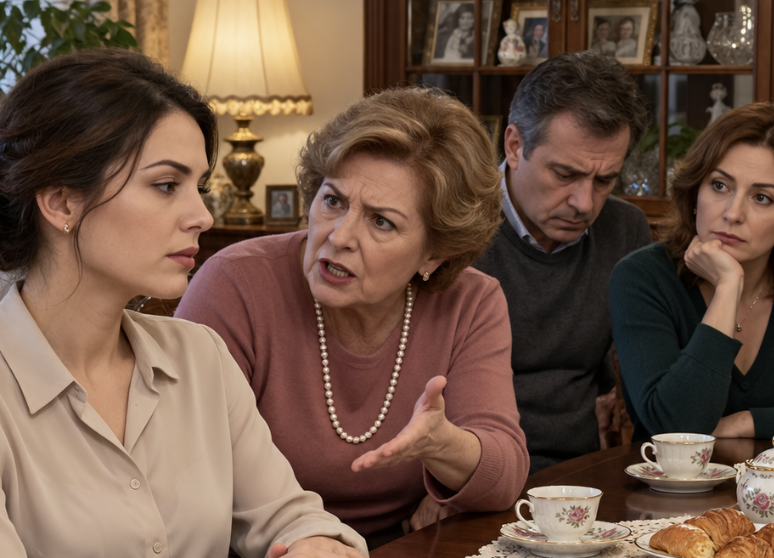
My husband had already told his sister the amount she was counting on, even though I had never promised anything. On Sunday, they sat me down at the table so we could “decide as a family” how much of my father’s money I should be allowed to keep for myself.
“You’re going to account to us for your father’s inheritance,” Tamara Petrovna said, placing her handbag on the empty chair. “So there won’t be any misunderstandings later.”
She said this in my kitchen at half past seven in the evening. I had just been putting away the folder I had taken to the notary earlier that day.
Four months had passed since my father’s death. Papers, requests, certificates, the bank, the apartment. I had already grown accustomed to the fact that the word “inheritance” did not mean money. It meant an endless queue of documents.
My mother-in-law, however, clearly attached a different meaning to it.
“Account to whom?” I asked.
Igor, sitting across from his mother, rubbed the bridge of his nose.
He always did that when he already knew I wasn’t going to like the conversation.
“Lena, Mom doesn’t mean it like that,” he began. “We just want to understand the overall picture.”
“That’s exactly what I mean,” Tamara Petrovna interrupted him. “The apartment is still there?”
“Yes.”
“There was a bank deposit?”
I looked at my husband.
Tamara Petrovna noticed and pursed her lips slightly.
“Why are you looking at Igor? We’re not strangers.”
“I’m trying to understand how you know about the deposit.”
“Oh, Elena, what do you mean, ‘how do I know’?” She took off her glasses, wiped the lenses with the edge of her sweater, and put them back on. “My son said your father had savings. Is that some kind of state secret?”
Igor stared down at the table.
Now I had even more questions.
My father had been seventy-six. During his final years, he lived alone in his two-bedroom apartment. My mother had died long ago. I was his only daughter.
We rarely discussed money.
Dad generally disliked talking about amounts. Even when he bought a new refrigerator, he would first install it in the kitchen and only afterward tell me that the old one had “gone into a well-earned retirement.”
After the funeral, I found the apartment documents and some bank papers in his folder.
I told Igor.
My husband.
Not the family council.
“What exactly did you tell your mother?” I asked.
“Nothing special,” he replied, no longer looking at me. “That there’s an apartment. That there’s some money.”
“Some money?”
Tamara Petrovna smirked.
“Don’t interrogate your own husband. You’d better tell us when you’re getting the apartment appraised.”
“Why do you need the appraisal?”
“Elena, stop picking at every word. We need to understand what resources the family has.”
I closed the cupboard door.
“Your family does not have my father’s apartment at its disposal.”
My mother-in-law turned toward Igor.
Not toward me.
Toward him.
“See? I told you from the beginning she’d start dividing everything into mine and yours.”
Igor sighed heavily.
“Lena, no one is taking anything away from you.”
“Then why do you need a report?”
“So we can talk normally,” he said. “Without secrets.”
Tamara Petrovna immediately continued:
“Come to my place on Sunday. Oksana will be there too. We’ll all sit down together and decide everything calmly.”
“Decide what?”
“How to use the money sensibly. Oksana has an important housing issue right now. You already have an apartment. She doesn’t have a decent place of her own. I’m not saying you have to give her everything. But that’s what family is for—to help each other.”
I stared at her for several seconds.
Four months earlier, I had stood in my father’s hallway packing his shirts into large bags. Now, at that same kitchen table, I was being told what family was for.
“And why should I bring the documents?” I asked.
“So we can discuss things properly,” Tamara Petrovna replied. “The bank statement, the apartment documents, the appraisal if you already have one. No one is counting your money. But without actual figures, it’s impossible to make a fair decision.”
I almost admired her choice of words.
“Make.”
Not ask.
Not suggest.
Make a decision.
For me.
“All right,” I said. “We’ll talk on Sunday.”
Igor finally looked up.
Tamara Petrovna nodded with satisfaction.
But I was no longer thinking about Sunday.
I was thinking about exactly how much my husband had already told his mother, and what they had discussed before deciding to invite me to the division of my own property.
The next day, I went back to the notary.
Marina Alexeyevna sat behind a wide desk with my folder in front of her. She was checking another document while explaining which request still had to come through.
When we had finished with the inheritance matter, I stayed behind.
“Can I ask you a question that isn’t exactly about the inheritance?”
“If I can answer it, go ahead.”
“Does my husband have any right to demand documents concerning property I’m inheriting from my father?”
She looked at me over the top of her glasses.
“Anyone can demand family documents from you in everyday life. The more important question is whether you are obligated to provide them.”
I smiled despite myself.
“That’s exactly what I want to know.”
“As a general rule, inherited property received by one spouse is that spouse’s separate property,” Marina Alexeyevna said. “For the inheritance proceedings, you provide the necessary information to the notary. If you have a family dispute over how to dispose of the property, that is a separate issue. But your husband does not become your father’s heir merely because he is married to you.”
I needed nothing more.
I had already known something along those lines. But “more or less” and “for certain” are two very different things when four relatives are preparing to explain to you that fairness matters more than documents.
That evening, Igor came home later than usual.
He placed a grocery bag on the kitchen table and began putting everything away.
That was how he usually demonstrated that the day was perfectly normal.
“Did you tell your mother how much was in the account?” I asked.
His hand froze around a package of grain.
“I gave her a rough figure.”
“Why?”
“Lena, why are you starting again? We were talking.”
“You were talking about my money.”
“About the family situation.”
“What situation exactly?”
He put the grain into the cupboard and shut the door harder than necessary.
“Oksana found a good apartment. She doesn’t have enough for the down payment. Mom is worried. I said maybe we could help.”
“We?”
“Don’t start picking at pronouns now.”
“That’s exactly what I want to pick at. Because somehow the word ‘we’ appeared in a situation where the money belongs to me.”
Igor leaned against the counter.
“You didn’t get that money because you worked fifteen years without taking a day off. It’s an inheritance. The money came unexpectedly.”
“After my father died.”
He looked away.
“That’s not what I meant.”
“Then explain what you did mean.”
“I mean we’re not going to be left without resources. We have an apartment. We have jobs. A car. A normal life. Oksana genuinely needs help.”
“And you’ve already promised her something?”
He did not answer immediately.
The pause was enough.
“Igor.”
“I told Mom that two million could probably be set aside.”
I stared at him.
“Two million of my money?”
“Don’t talk as if I’ve already withdrawn it from the account.”
“You did something worse. You promised someone money that wasn’t even yours.”
“I didn’t promise anything definitively.”
“Does Oksana know about the two million?”
He rubbed the bridge of his nose again.
“Mom may have told her.”
“So she knows.”
“Lena, why turn this into a catastrophe? You never said before that you were categorically against helping.”
And there it was.
Everything suddenly fell into place.
I hadn’t said I was against it.
Therefore, I had agreed.
I hadn’t stopped him when he used the word “help.”
Therefore, he could choose the amount.
I hadn’t made a scene after the funeral.
Therefore, they could make plans for what remained of my father’s estate.
“I also never said I wanted to sell Dad’s apartment,” I said. “But somehow that didn’t stop anyone from making calculations.”
“Mom just wants clarity.”
“She’ll get it.”
Igor immediately became wary.
“Just don’t make some kind of performance out of it on Sunday.”
“The performance has already been organized without me. There’s an amount, a cast of participants, and an agenda.”
“I asked you normally.”
“I heard you.”
He looked toward the folder lying on the dresser in the hallway.
“Are you taking the documents?”
“I’ll take whatever I consider necessary.”
This time, I didn’t elaborate.
On Sunday, Tamara Petrovna set the table as if we were celebrating an anniversary.
There wasn’t enough room for everyone in the kitchen, so we sat in the large room. There were plates of salad, sliced meats, and pie on the table. Oksana sat beside her mother.
Igor sat next to me.
They left me a place directly opposite Tamara Petrovna.
I appreciated the seating arrangement.
Very convenient for negotiations.
“Well, finally everyone is here,” my mother-in-law said. “Let’s discuss everything calmly first, and then we’ll eat.”
She looked at my hands.
Then at the chair beside me.
“Where’s the folder?”
“At home.”
Tamara Petrovna blinked.
“What do you mean, the folder is at home?”
“The one you asked me to bring.”
“Elena, we agreed.”
“We agreed to talk.”
“How can we talk without the documents?”
“We’ll find out.”
Oksana glanced at her brother.
Igor gave a barely noticeable shake of his head, as if asking everyone not to start too soon.
Tamara Petrovna picked up a sheet of paper.
I nearly laughed.
She had actually prepared notes.
“All right. Then let’s start with what we know. Your father’s apartment is a two-bedroom.”
“Was.”
“What difference does that make? It’s yours now.”
“The paperwork is still being processed.”
“Exactly. It will become yours anyway. And there is money in the bank.”
I said nothing.
She placed her palm on the sheet.
“Oksana is two million short for the down payment. Igor said that level of assistance is affordable for you.”
Oksana immediately cut in:
“Lena, I don’t want this to look like I’m demanding anything. I was told you and Igor were prepared to help. That’s why I started seriously considering this apartment.”
I turned to her.
“Who told you?”
Oksana hesitated.
“Mom. And Igor said it was something that could be worked out.”
I looked at my husband.
His jaw tightened.
“I said we’d discuss it.”
“You said something different,” Tamara Petrovna said. “Don’t try to wriggle out of it now. You said Elena had the money and two million wouldn’t ruin the family.”
Oksana lowered her eyes.
I even felt a little sorry for her.
Not sorry enough to give her two million.
But enough to understand that she, too, had been brought to the table with a prearranged version of events.
“Oksana,” I said, “I never promised you two million.”
She quickly looked up.
“I thought you two had already decided it between yourselves.”
“No. We decided nothing of the sort.”
Igor turned toward me.
“Lena, why phrase it like that? We discussed helping.”
“We never discussed an amount.”
“Because you never said you were against it.”
“Igor, if someone never says they’re against selling their car, that doesn’t mean you can promise it to the neighbor.”
Tamara Petrovna slapped her palm on the table. Not hard, but enough to make the plate beside her shift.
“Why take everything to the point of absurdity? No one is selling your car. We’re talking about helping your husband’s sister. About family.”
“Then ask me for help.”
“I am asking!”
“No. A request sounds like: ‘Elena, can you help Oksana?’ You started by demanding a report on my inheritance, arranging a meeting, and deciding the amount in advance.”
Tamara Petrovna leaned back in her chair.
“Because there’s no other way to deal with you. You immediately shut yourself off.”
“From what?”
“From the family.”
I looked at the sheet in front of her.
“What’s written there?”
She covered it with her hand.
“Those are my notes.”
“Then let’s keep your notes with you, and my documents with me.”
Igor leaned toward me.
“Lena, let’s not turn this conversation into a competition over clever phrases.”
“I’m not competing. I’m trying to understand why your decisions always seem to begin before I give my consent.”
Oksana said quietly:
“Mom, if Lena never promised anything, then you shouldn’t have told me the two million was already settled.”
Tamara Petrovna turned sharply toward her daughter.
“And don’t start pretending to be noble now. We’re talking about a normal family distribution of resources.”
“Exactly,” I said. “Distribution.”
My mother-in-law looked directly at me.
“Fine. No more word games. How much money is there?”
“I’m not telling you.”
“Why?”
“Because it has nothing to do with your decision.”
“What decision of ours?”
“The one you’ve already made. You decided part of my inheritance should go to Oksana. Now you’re trying to fit the numbers around that.”
“So what, you’re going to keep everything for yourself?” Tamara Petrovna asked. “Every last kopeck?”
“I will decide for myself what I do with what I received from my father.”
“While you still have a living husband?”
I turned toward Igor.
“That’s a good question. Igor, do you also think that while I have a living husband, I can’t decide for myself what to do with my inheritance?”
He clearly hadn’t expected to have to answer that question here.
In front of his mother.
In front of his sister.
“I think that in a marriage, things like this are discussed.”
“Discussed. Not promised on someone else’s behalf.”
“I wanted to help my sister.”
“Then promise her your own money.”
Tamara Petrovna smirked.
“How convenient. When you need a family, Igor is your husband. But the moment money appears, suddenly everything is yours.”
“That money is mine.”
“According to a piece of paper?”
I took my phone out of my bag and placed it in front of me.
No statements.
No inheritance certificate.
No appraisal.
“According to the law and according to where the property came from. But even if no such law existed, you still wouldn’t have the right to assign me an amount at this table.”
“So you show the documents to the notary?” my mother-in-law asked.
“Of course. Because the notary is handling the inheritance.”
“But your husband isn’t allowed to see them?”
“I told my husband what I wanted to share with him. He passed that information along and promised part of the money on my behalf. From now on, the amount of information he receives will be different.”
Igor moved his chair away from the table.
“So this is how you decided to punish me?”
“No. I decided not to keep giving you information that you then use without me.”
“You’re making me sound like some kind of thief.”
“I never used that word.”
“But that’s exactly what you mean.”
“What I mean is that you took my trust and turned it into preliminary consent for two million.”
Oksana stood and began gathering her bag.
“Mom, I’m not taking part in this.”
“Sit down,” Tamara Petrovna snapped. “You came here, so stay until the end.”
“I came because I thought Lena had already agreed. I’m not going to sit here listening to you divide her money right in front of her.”
My mother-in-law sharply turned toward her son.
“What exactly did you tell her?”
And at that moment, the foundation of the entire family council became completely clear to me.
Igor’s “probably.”
His “she won’t mind.”
His mother’s talent for turning assumptions into decisions.
Oksana’s certainty that everything had already been agreed.
Aside from me, there wasn’t a single person at the table who had actually received a promise from me.
“I didn’t tell her anything,” Igor said. “I said the possibility existed.”
“You had one possibility,” I replied. “To ask me first.”
Tamara Petrovna took off her glasses.
“So that’s your final answer?”
“To what exactly?”
“To helping Oksana.”
“If Oksana wants to ask me for help, she can ask me herself. Without reports, without your sheet of paper, and without an amount chosen in advance. Then I will decide for myself whether I can and want to help.”
My mother-in-law put her glasses back on.
“And the two million?”
“You invented the two million without me.”
“And you won’t show us the documents?”
“I show inheritance documents to the people who need them to process the inheritance.”
“So, the notary.”
“Exactly.”
She removed the sheet from the table.
Folded it carefully in half.
Then in half again.
The family council did not end with shouting.
It simply turned out there was nothing to vote on.
Igor and I went home separately.
He followed me outside, but I told him I wanted to walk. He got into the car and drove away.
When I returned, he was in the kitchen.
The grocery bag he had bought on Thursday was still standing by the wall. For some reason, Igor was rearranging jars on the shelf.
I took off my jacket and walked past him.
“Are you satisfied?” he asked.
“With what exactly?”
“Mom was humiliated. Oksana left. And you made me look like a man who disposes of someone else’s money.”
“But you did dispose of it.”
He slammed the cupboard shut.
“I was trying to help.”
“At my expense.”
“There you go again with those words.”
“Because there are no other words for it.”
Igor sat down at the table.
He no longer looked angry.
Just tired.
“We’ve been together for twenty-three years, Lena.”
“That’s exactly why I told you about Dad’s money.”
“I’m your husband. Am I not allowed to discuss anything with my mother anymore?”
“You can discuss your job, football, gasoline prices, and even our plans—if they are actually our plans. What you cannot do is declare a sum from my inheritance to be a free family resource.”
He rubbed his hand over his face.
“So what happens now?”
It was a simple question.
The answer no longer was.
A week earlier, I would have started explaining that I didn’t want us to fight, that I loved him, that I needed time. I would have tried to keep every possible door open.
There was less of that habit left in me now.
“From now on, the inheritance stays separate,” I said. “The accounts, the documents, decisions about the apartment. Everything.”
“Separate from me?”
“Separate from the joint household finances.”
“Wonderful.”
“It’s not wonderful. It’s just that after today, things can’t go back to the way they were.”
He looked at me.
“And if I say I can’t accept that?”
“Then we’ll decide what to do about our marriage. But two million will not become the price I pay to avoid that conversation.”
Igor looked away.
“You’ve already decided everything.”
“No. I haven’t decided anything for the two of us. Unlike you.”
He said nothing.
A few days later, Oksana messaged me herself.
Without her mother.
Without her brother.
She apologized for the conversation that Sunday and said she had found another apartment option with a smaller down payment.
She did not ask me for money.
I replied briefly, but without anger.
Things with Igor were more complicated.
He did not apologize that evening.
Nor the next day.
Several times he tried to return to the conversation in his usual way: Mom is upset, Oksana is hurt, I had “made too big a deal of it.”
I stopped arguing in circles.
Two weeks later, he finally said:
“I shouldn’t have named an amount without asking you. I genuinely thought you would agree.”
“You were free to think anything you wanted. You just weren’t free to speak on my behalf.”
“I understand that now.”
It wasn’t enough to restore the old trust in a single conversation.
But it was enough for us to stop pretending nothing had happened.
The inheritance proceedings continued in their own time.
On the appointed day, I sat once again across from Marina Alexeyevna. She checked the documents, explained the next steps, and handed me what I needed for the final paperwork.
I put the papers back into that same folder.
My father had once kept receipts, contracts, and statements in it. On the inside cover, in his handwriting, were the words:
“Apartment documents.”
No family decisions.
No fair shares.
Just documents.
This time, they came home with me again.
And I never took them to another family council.