You know, my father repeated one phrase all his life. It was simple:
“Trust people, but keep the documents in your own name.”
When I was twenty-five, I thought it was just an old man’s paranoia. At thirty-four, I realized my dad was a genius.
My name is Marina. I was married to Kostya Zavyalov for eight years. He seemed like a decent enough man. Good with his hands, went to work regularly, never caused much trouble.
But he had a soft character.
So soft, in fact, that every decision in our family was actually made by his mother, Galina Petrovna.
What curtains should we hang in the bedroom? Galina Petrovna knew best.
Where should we go on vacation? Galina Petrovna had already decided.
Which school should we choose for our daughter Dasha?
Well, you get the idea.
I put up with it. I smiled. Sometimes I ground my teeth, but I endured it.
And then Kostya left me.
Not for his mother.
For Oksana from accounting.
Thirty years old, long legs, and absolutely no children with their endless runny noses and parent-teacher meetings.
Kostya packed a sports bag and told me he needed to “find himself.”
Apparently, he had lost himself somewhere between Oksana’s eyelashes.
I didn’t cry. I didn’t make a scene.
I closed the door behind him and went to make cocoa for Dasha. My daughter was seven years old. Stability mattered more to her than her mother’s emotional breakdown.
Galina Petrovna, however, took the divorce as a signal to launch an attack.
She called on the third day.
Her voice sounded so solemn you would have thought she was reading out a court sentence.
“Marina, you understand that the house stays with Kostya. You’re getting divorced, so you need to find somewhere else to live. I can give you two weeks. I’m not some kind of monster.”
I nearly spilled my cocoa.
Not from fear.
From astonishment.
The house where we lived was in the village of Rakitnoye, about forty minutes from the city.
It was a two-story house with a quarter-acre plot, cozy and lived-in, with swings in the yard and garden beds where I grew strawberries every year.
Galina Petrovna was absolutely convinced that the house belonged to her son.
“Galina Petrovna, let’s not rush to conclusions,” I said.
“What conclusions, Marina? Kostya bought this house. Kostya paid for it. You arrived here with one suitcase.”
That part was true.
I really had arrived with one suitcase.
But something else had come with me too.
I’ll get to that later.
For the first week, I simply ignored my mother-in-law’s calls.
She called in the morning, afternoon, and evening.
Like an alarm clock, only more irritating.
Then she started showing up in person.
One day I came home from school with Dasha and found a brand-new lock on the front gate.
I stood there tugging at it.
It wouldn’t open.
Then Galina Petrovna’s face appeared above the fence, looking triumphant.
“I changed the lock on the gate. My son, my house, my gate.”
I didn’t even argue.
I walked around the property to the other side, where there was a narrow gap between our fence and the neighbor’s fence that Galina Petrovna didn’t know about.
Dasha and I squeezed through like partisans.
My daughter actually enjoyed it. She thought it was an adventure.
That evening, I called my father.
“Dad, she changed the lock on the gate.”
He was silent for a second.
“Let her. We can change locks too. The important thing, sweetheart, is not to get nervous. Everything is going according to plan.”
What plan, you ask?
I’ll tell you.
Eight years earlier, when Kostya and I decided to live together, the question of housing came up.
Renting an apartment in the city swallowed half our salaries.
Then my parents offered to buy a house.
My father had recently sold my grandfather’s apartment in Samara, and it brought in a decent amount of money.
Mom and Dad found the house in Rakitnoye.
The price was good. The neighborhood was quiet.
Dad said, “We’re buying it.”
Then he added that same phrase:
“But we’re putting it in our names.”
At the time, I waved my hands and protested.
Why, Dad? Kostya and I are a family. We trust each other.
My father looked at me and calmly replied:
“Daughter, I served in the army for thirty years. I trust people, but I always make sure I have backup. The house will be registered to your mother and me. You two can live peacefully. But if anything ever goes wrong, you won’t end up on the street.”
Did Kostya know?
That was the interesting part.
Kostya knew my parents had helped buy the house.
But he had no interest in the paperwork.
He had never dealt with documents in his life.
In eight years, he never once asked whose name was on the official property record.
It was enough for him that he lived in the house, mowed the lawn, and grilled meat on weekends.
Galina Petrovna knew even less.
She had simply decided that because her son lived in the house, the house belonged to her son.
Ironclad logic, right?
Meanwhile, my mother-in-law was launching a full-scale operation.
Two weeks after changing the lock, she brought some man to the property.
I saw them through the kitchen window.
The man walked around the yard, photographed the house, and peered through the windows.
“Who is that?” I asked, stepping onto the porch.
“A buyer, Marina. I’m putting the house up for sale. The money will go to Kostya.”
I stood on the porch holding a mug of tea and watched this man tap the walls and make thoughtful noises.
I could have stopped everything right then.
With one phone call.
With one document.
But Dad had said:
“Wait. Let her back herself into a corner.”
So I waited.
Galina Petrovna brought the buyer back once more.
Then she brought another.
She showed off the house as if it were her personal palace.
She talked about the foundation, the boiler, and how “she and her son had personally chosen every tile.”
For the record, I had chosen the tiles.
And my father had installed them himself, on his knees, for three straight days.
Eventually one of the buyers turned out to be serious.
A middle-aged businessman looking for a house for his parents.
Galina Petrovna was glowing.
She was already discussing with Kostya how they would spend the money.
To his credit, Kostya called me.
“Marin, Mom says we’re selling the house. Half for you, half for me. That’s fair, right?”
“Kostya, do you even know whose name the house is registered under?”
There was a pause.
A long pause.
“Well… mine, probably? Or ours?”
“Ask your mother,” I said, and hung up.
Of course, Kostya never asked.
He hated uncomfortable conversations.
And Galina Petrovna had already scheduled the transaction.
She called me on Friday evening.
“Marina, the notary and the buyer are coming on Monday. I’m asking you not to make a circus out of this. Pack your things and clear out of the house by the weekend.”
“Galina Petrovna, come on Monday. I’ll be home.”
She was actually surprised that I didn’t argue.
She probably thought I had surrendered.
On Monday, three cars pulled up outside the house.
Galina Petrovna got out of the first one wearing a brand-new coat and a salon-styled haircut.
The buyer and his wife got out of the second.
A man carrying a briefcase stepped out of the third.
Apparently, he was the notary.
Galina Petrovna opened the gate with her new key.
The entire procession walked into the yard.
I was sitting on the porch drinking tea.
Dasha was at school.
“There you are, have a look around,” Galina Petrovna said, sweeping one hand proudly across the yard.
The buyer nodded.
His wife took pictures of the flowerbeds.
The notary opened his briefcase.
“Let’s begin with the documents, Galina Petrovna. I’ll need an extract from the Unified State Register of Real Estate and the documents establishing ownership of the property.”
Galina Petrovna froze.
“My son has the documents. He’ll be here shortly.”
“No, he won’t,” I said, rising from the porch. “Kostya isn’t coming because Kostya has no documents for this house. He never has.”
Galina Petrovna turned toward me.
Her face looked like someone had just informed her that the Earth was actually square.
“What nonsense are you talking about?”
I took an envelope from my bag.
Inside was a fresh extract from the property register that my father had ordered the previous week.
I handed it to the notary.
He looked at it.
Then he looked at Galina Petrovna.
Then back at the paper.
“Galina Petrovna, the registered owners of this property are Viktor Sergeyevich Kravtsov and Lyudmila Andreyevna Kravtsova. Your son is not an owner. You have no legal right to dispose of this property.”
The silence was so complete that I could hear the neighbor’s cat scratching its claws against the fence.
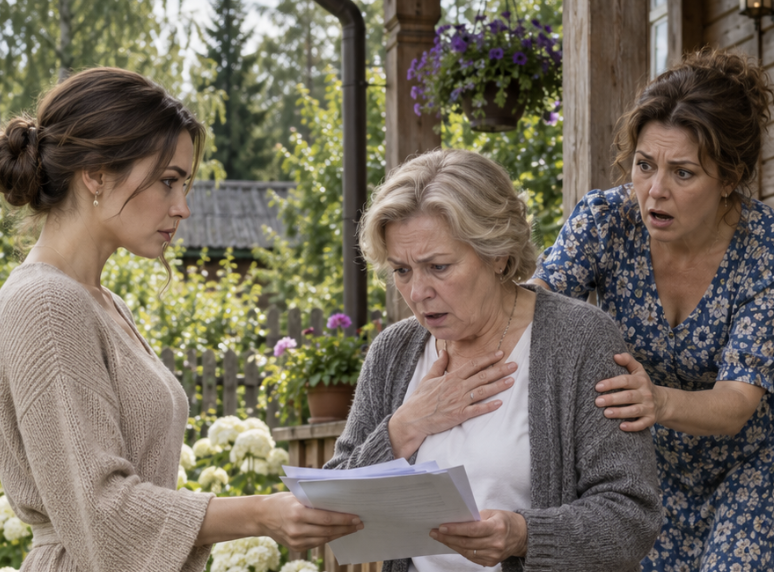
Galina Petrovna clutched her chest.
Not theatrically.
For real.
Her face turned gray, and she started breathing heavily.
The buyer and his wife exchanged glances and quietly began backing toward their car.
The notary closed his briefcase.
I walked over to my mother-in-law and took her by the arm.
“Sit down. I’ll bring you some water.”
“You… you did this on purpose… you kept quiet for eight years…” she wheezed.
“I didn’t keep quiet, Galina Petrovna. Nobody ever asked.”
I helped her sit on the bench by the porch, brought her some water, and called an ambulance.
Whatever I thought of her, she was still an elderly woman.
The paramedics arrived twenty minutes later.
They checked her blood pressure and gave her an injection.
They said there was nothing critical, but that she absolutely needed to avoid stress.
The buyer had left before the ambulance arrived.
The notary left his business card “just in case” and drove away too.
Galina Petrovna sat on the bench staring blankly into the distance.
Kostya came rushing over an hour later.
Apparently, his mother had finally called him.
“Marin, is it true? The house isn’t mine?”
“Kostya, it was never yours. My parents bought it. With their own money. Six months before our wedding. You just never bothered to look at the paperwork in eight years.”
He stood in the middle of the yard he had always considered his own, blinking in disbelief.
Then he looked at his mother.
Then at me.
Then back at his mother.
“Mom, you said…”
“I thought so!” Galina Petrovna snapped. “I thought that was how it was!”
And that was how it came to light that in eight years, nobody in the Zavyalov family had ever bothered to look at the ownership documents for the house they lived in.
Not once.
The feeling of ownership had been enough for them.
After that day, Galina Petrovna never came back.
Not once.
I changed the lock on the gate again that same evening.
Dad came over, installed a new, reliable one, and repaired the gate while he was at it.
A month later, Kostya asked if he could come back.
It turned out Oksana from accounting also liked making decisions for him, except she didn’t cook his dinners or wash his shirts.
I said no.
Calmly.
Without anger.
Just no.
We were officially divorced by autumn.
There turned out to be nothing to divide.
The car was already registered in Kostya’s name, and the house had never belonged to him in the first place.
Dasha stayed with me.
Sometimes in the evening, I sit on the porch drinking tea and look at the swing my father welded together for Dasha.
And I think about how my father, who spent thirty years wearing army boots from one garrison to another, turned out to be wiser than all the lawyers and notaries put together.
Trust people, but keep the documents in your own name.
A simple rule.
But what a difference it makes.